Questions

[3 marks Question Answer]

🎯

Test yourself on this topic

11 questions · timed · auto-graded

Question 13 Marks
Differentiation between:
Stomatal transpiration and lenticular transpiration.
Answer
 Stomatal transpiration Lenticular transpiration
 It is the loss of water from the leaves. It is the loss of water from the minute openings on
 the old stem.
 It occurs through stomata present on leaf. It occurs through lenticels present on old stem.
 Stomatal transpiration occurs with higher rate. Lenticular transpiration is much less as compared   to stomatal transpiration.
 Stomata open and close during day time and   night time. Lenticels remain open all the time.
View full question & answer
Question 23 Marks
Differentiation between:
Transpiration and guttation
Answer
TranspirationGuttation
 The loss of water as water vapour from the aerial
 parts of plants.
 The loss of water as water droplets from the   hydathodes of plants.
 Water vapour is lost through stomata, lenticels and   cuticle. Water is lost through pores (hydathodes) found   at  the end of veins.
 It occurs in the presence of sunlight. It occurs at night or in the early morning.
View full question & answer
Question 33 Marks
Differentiation between:
Transpiration and evaporation
Answer
TranspirationEvaporation
 It is loss of water from aerial parts of the plants. It is loss of water from any free surface.
 It is a physiological process. It is a physical process.
 It is controlled by osmosis and other physiological   processes. It is not controlled by osmosis and any such         processes.
View full question & answer
Question 43 Marks
Differentiation between:
Guttation and bleeding
Answer
GuttationBleeding
 It is defined as loss of water as water droplets. It is the exudation of sap from the injured   parts of the plants.
 Water is lost through pores (hydathodes) found at end of   veins. It usually occurs in the stem of the plant.
 It can be seen in grasses, tomato, potato and colocasia   plants. It is common in mulberry, Euphorbia and   Calotropis plants.
View full question & answer
Question 53 Marks
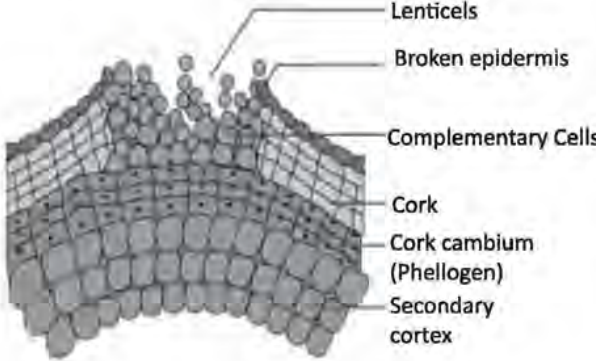
Given below is the diagram showing lenticels. Read the information and fill in the blanks:

Image
Lenticels are specialised structures found in the ____________ (i) ____________ of woody ____________ (ii) ____________ and roots of certain plants. These small, raised patches serve as pores, allow direct ____________ (iii) ____________ exchange between the internal tissues and the atmosphere. Unlike the impermeable bark, lenticels facilitate the movement oxygen, ____________ (iv) ____________ , and water vapour. They are essential for the survival and growth of ____________ (v) ____________ plants.
Answer
(i) bark
(ii) stems
(iii) gaseous
(iv) carbon dioxide
(v) woody
View full question & answer
Question 63 Marks
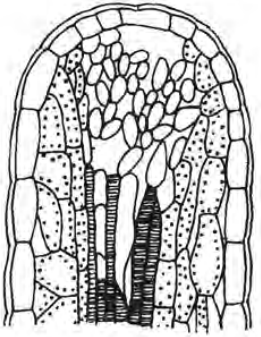
The figure given alongside represents the vertical section of a leaf.
(i) Name the given structure.
(ii) Give an example of two plants where this structure is present.
(iii) Which physiological process takes place through this structure?

Image
Answer
(i) Hydathode
(ii) Garden nasturtium, grasses
(iii) Guttation
View full question & answer
Question 73 Marks
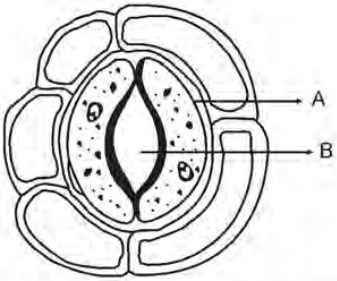
The diagram given below represents a structure found in a leaf.
Study the same and answer the questions that follow:
(i) Name the parts labelled as $A$ and $B$.
(ii) What is the biological term for the above structure?
(iii) What is the function of the part labelled A?
Answer
(i) A. Guard Cell, B. Stoma
(ii) The above structure is known as stomatal apparatus.
(iii) The part A is known as guard cell which helps in the opening and closing of stomata.

Image
View full question & answer
Question 83 Marks
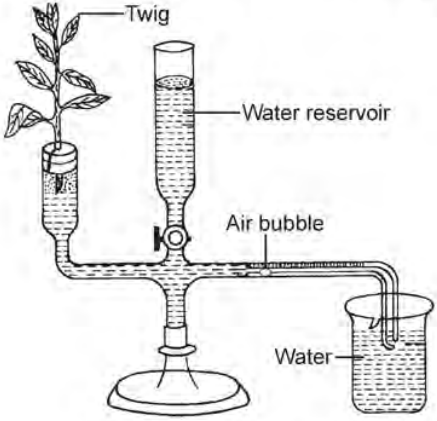
Given below is an apparatus used to study a particular process in plants.
Study the same and answer the questions that follow :
(i) Name the apparatus.
(ii) Mention one limitation of this apparatus.
(iii) Which phenomenon is studied with the help of this apparatus?

Image
Answer
(i) The given apparatus is Ganong's potometer.
(ii) The experiment takes long time and the twig may not remain alive for this much duration.
(iii) Transpiration is measured with the help of given apparatus.
View full question & answer
Question 93 Marks
Mention four disadvantages of transpiration to the plant.
Answer
Four disadvantages of transpiration to the plant are:
(i) Stunted growth- Transpiration reduces the amount of water available to the plant. Plant with water deficit decreases in growth and thus, the plant remain stunted. Hence, excessive transpiration may result in the stunted growth of the plant.
(ii) Wilting-Wilting is the loss of turgidity. It occurs mostly during afternoon when transpiration rate is higher than the rate of water absorption through roots. The leaf cells become flaccid causing wilting of plant. Sometimes, it may be due to diseases also.
(iii) Energy expenditure-As most of the water absorbed is lost through transpiration, and energy is utilised in transpiration and conduction of water goes waste.
(iv) Abscission- When very little water is available to plant, transpiration results in the closing of stomata following the production of abscissic acid. It causes premature leaf fall and delayed flower production.
View full question & answer
Question 103 Marks
How does the rate of transpiration get affected by?
(i) Wind velocity
(ii) Intensity of light
(iii) Humidity
Answer
The rate of transpiration get affected by various internal and external factors. Some of the factors that affect it majorly are:
(i) Wind velocity-Wind will affect the rate of transpiration. Wind blow away the small pockets of humid air that develops when air is still. With the removal of these, wind will increase the movement of water from leaf surface, and thus more transpiration will occur. The higher the wind speed the higher the rate of transpiration.
(ii) Intensity of light- The higher the light intensity, the higher the rate of evaporation. Light intensity stimulates stomatal openings which in turn brings about an increase in transpiration.
(iii) Humidity-Humidity is defined as the water vapour present in the air. For water to evaporate, there must be a water potential gradient between the air in the leaf and the atmosphere. As the humidity increases in the surrounding, the rate of transpiration decreases. Water evaporates easily in drier air than that in more saturated air.
View full question & answer
Question 113 Marks
List some adaptations found in desert plants to reduce transpiration.
Answer
(i) Leaves with thick cuticle - Some desert plants develop a thick waxy cuticle over the epidermis to reduce the loss of water by transpiration.
(ii) Reduced number of stomata - These plants have few stomata and concentrated on the underside of leaves to avoid direct sunlight.
(iii) Presence of epidermal hair - In some plants like cucurbits, leaf surface may be covered by thick coating of epidermal hairs to reduce transpiration.
(iv) Presence of sunken stomata - The stomata of leaves in dry environment sink into the leaf to reduce the surface area of the pores which further reduces rate of transpiration.
(v) Leaves modified into spines - In cactus, leaves are modified into spines to reduce surface area for transpiration, while their stem performs photosynthetic functions.
View full question & answer