Question types

Metallurgy question types

69 questions across 8 question groups — pick any mix to generate a Chemistry paper with step-by-step answer keys.

69
Questions
8
Question groups
5
Question types
Sample Questions

Metallurgy questions

One sample from each question group in this chapter. Select any group above to see the full set with answer keys.

Q 1MCQ1 Mark
Assertion (A): Froth floatation process is employed for the concentration of sulphide Ores.
Reason (R): Sulphide ores are heavy weight ores.
  • A
    Both A and R are true and R is the correct explanation of A
  • B
    Both A and R are true but R is not the correct explanation of A
  • A is true but R is false
  • D
    A is false but R is true

Answer: C.

View full solution
Q 2MCQ1 Mark
Assertion (A): Highly reactive metals can be used as reducing agent.
Reason (R): Highly reactive metals can displace metals of lower reactivity from their compounds.
  • Both A and R are true and R is the correct explanation of A
  • B
    Both A and R are true but R is not the correct explanation of A
  • C
    A is true but R is false
  • D
    A is false but R is true

Answer: A.

View full solution
Q 3MCQ1 Mark
Assertion (A): Carbon can easily reduce the oxides of highly reactive metals.
Reason (R): Highly reactive metals have more affinity for oxygen than carbon.
  • A
    Both A and R are true and R is the correct explanation of A
  • B
    Both A and R are true but R is not the correct explanation of A
  • C
    A is true but R is false
  • A is false but R is true

Answer: D.

View full solution
Q 4MCQ1 Mark
The principal metal in an alloy known as type metal Is :
  • lead
  • B
    tin
  • C
    antimony
  • D
    copper

Answer: A.

View full solution
Q 5MCQ1 Mark
The conversion of the concentrated ore into oxide takes place through the calcination and roasting processes.
Which of the following pairs of involved process and the concerning ore are correct?
P. Calcination: Metallic carbonates; Roasting: Hydrated metallic oxides
Q. Calcination: Metallic carbonates, Roasting: Metallic sulphides
R. Calcination: Metallic sulphides; Roasting: Metallic carbonates
  • A
    P only
  • Q only
  • C
    R only
  • D
    Both P and Q

Answer: B.

View full solution
Name the following :
(i) The property possessed by metals by which they can be beaten into sheets.
(ii) A compound added to lower the fusion temperature of electrolytic bath in the extraction of aluminium.
View full solution
Metal X is found in nature as its sulphides XS. It is used in the galvanization of iron articles. Identify the metal X. How will you convert this sulphide ore into the metal? Explain with equations.
View full solution
(a) What do you understand by the term concentration of ore?
(b) Name three processes used for the concentration of ore and name one specific ore which can be concentrated by the named process.
View full solution
Name an alloy of
(i) iron used in manufacturing of surgical instruments.
(ii) lead used in joining metals for electric welding.
(iii) copper used in making household vessels.
(iv) aluminium used in making aircraft parts.
Write one property of each associated with the use.
View full solution
From the list of concentrated oxide ores mentioned here, identify their reduction processes. Write the chemical equations involved.
(i) ZnO, (ii) HgO, (iii) Cr2O3, (iv) CuO
View full solution
Bauxite is the chief ore of aluminium. The ore is first purified and then aluminium metal is extracted by electrolyic reduction.
(i) Write three balanced equations for the purification of ore by Hall's process.
(ii) Name the chemical used for dissolving pure aluminium oxide. In which state the chemical is used?
(iii) Write equations for the reactions taking place at the anode in a electrolytic tank.
View full solution
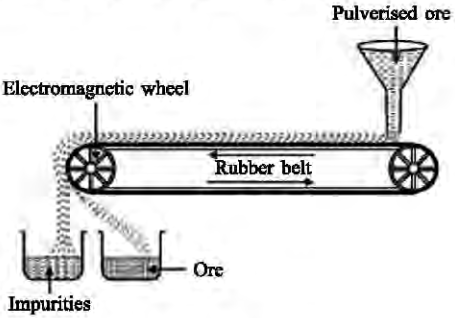
Look at the given picture carefully and answer the related questions:
Image
(i) Which step of metallurgy is performed by this method?
(ii) Give two examples of ores related to this method.
(iii) Write the property of ore and the principle of this process.
(iv) Name two other processes that come under the step of metallurgy in (i).
View full solution
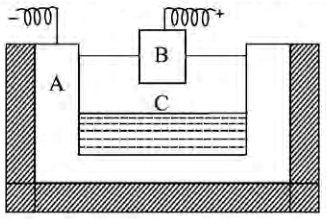
The following is a sketch of an electrolytic cell used in the extraction of aluminium:
Image
(i) What is the substance of which the electrodes A and B are made?
(ii) At which electrode (A or B) is aluminium formed?
(iii) What are the two aluminium compounds in the electrolyte C?
(iv) Why is it necessary for electrode B to be continuously replaced?
View full solution

Generate a Metallurgy paper free

Pick question groups from the list above, set marks and difficulty, and export a branded PDF with step-by-step answer keys. First 3 chapters free — no signup.

Download App