Question types

Metallurgy question types

212 questions across 7 question groups — pick any mix to generate a Chemistry paper with step-by-step answer keys.

212
Questions
7
Question groups
5
Question types
Sample Questions

Metallurgy questions

One sample from each question group in this chapter. Select any group above to see the full set with answer keys.

Q 3MCQ1 Mark
Heating of the ore in the absence of air to high temperature
  • Calcination
  • B
    roasting
  • C
    pulverization
  • D
    smelting

Answer: A.

View full solution
Q 4MCQ1 Mark
Crushing of the ore into a fine powder
  • A
    Calcination
  • B
    roasting
  • pulverization
  • D
    smelting

Answer: C.

View full solution
Q 5MCQ1 Mark
The diavalent metal whose oxide is reduced to metal by electrolysis of its fused salt is ________
  • Al
  • B
    Na
  • C
    Mg
  • D
    K

Answer: A.

View full solution
Calcium, copper, lead, aluminium, zinc, chromium, magnesium, iron.
Choose the major metals from the list given above to make the following alloys:
(a) Stainless steel
(b) brass
View full solution
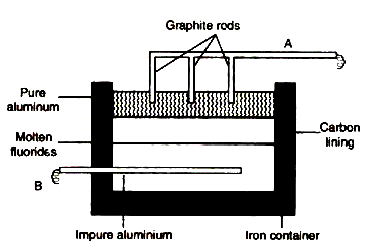
The sketch below illustrates the refin ing of aluminium by Hoopes process

(a) Which of A and B is th e cathode and which one is the anode?
(b) What is the electroly te in the tank?
( c) What material is used for th e cathode?
View full solution
Aluminium is extracted from its chief ore bauxite. The ore is first purified and then the metal is extracted from it by electrolytic reduction.
Name a chemicals used for dissolving aluminium oxide. In which state of sub-division is the chemical used?
View full solution
Aluminium is extracted from its chief ore bauxite. The ore is first purified and then the metal is extracted from it by electrolytic reduction.
Write three balanced equations for the purification of bauxite by Halls process.
View full solution
From the metals copper, iron, magnesium, sodium and zinc, select a different metal in each case which:
(a) Does not react with dilute hydrochloric acid
(b) Can form $2^+$​​​​​​​ and $3^+$ ions
(c) Has a hydroxide that reacts with both acid and alkalis.
(d) Does not react with cold water, but reacts with steam when heated.
View full solution
XY
Normal Electronic Configuration 2,8,72,8,2
Nature of OxideDissolves in water  and truns blue litmus red.Very low solublity in water. Dissolves in hydrochloric acid
Tendency for Oxidising and reducing reactionsTends to oxidise elements and compoundTends to act as a reducing agent
Electrical and Thermal ConductivityVery poor electrical conductor Poor thermal conductivityGood electrical conductor Good thermal conductor
Tendency to form Alloys and AmalgamsNo tendency to form alloysForms alloys
Using the information above, complete the following :
(i) _________ is the metallic element.
(ii) Metal atoms tend to have a maximum of ________ electrons in the outermost energy level.
(iii) Non-metallic elements tend to form _________ oxides while metals tend to form _______oxides.
(iv) Non-metallic elements tend to be ______ conductors of heat and electricity.
(v) Metals tend to _______ electrons and act as ________ agents in their reactions with elements and compounds.
View full solution
The following is an extract from Metals in the service of Man, Alexander and street /Pelican 1976:
Alumina (aluminium oxide) has a very high melting point of over $2000^oC $so that it cannot readily be liquefied. However, conversion of alumina to aluminium and oxygen, by electrolysis, can occur when it is dissolved in some other substance.
(a) Which solution is used to react with bauxite as a first step in obtaining pure aluminium oxide?
(b) The aluminium oxide for the electrolytic extraction of aluminium is obtained by heating aluminium hydroxide. Write the balanced chemical equation for this reaction.
(c) Name the element which serves both as the anode and the cathode in the extraction of aluminium.
(d) Write the balanced chemical equation for the reaction that occurs at the cathode during the extraction of aluminium by electrolysis.
(e) Give the balanced chemical equation for the reaction which occurs at the anode when aluminium is purified by electrolysis.
View full solution
Compare the properties of a typical metal and a non- metal on the basis of the following:
(a) electronic configuration
(b) nature of oxides
(c) oxidizing or reducing action
(d) conductivity of heat and electricity
View full solution
In order to obtain one tone of aluminium, the following inputs are required:
4 tones of bauxite, $150 Kg $ of sodium hydroxide and $600 \ Kg$ of graphite.
The aluminium compound in bauxite is aluminium oxide and the main impurity is iron (II) oxide. Aluminium is obtained by the electrolysis of aluminium oxide dissolved in cryolite.
(i) Write the formula of cryolite.
(ii) Write down the word which correctly completes the following sentence.
"By dissolving aluminium oxide in cryolite, a ______ (conducting / non- conducting) solution is produced.
(iii) Why so much graphite required for this electrolytic process.
(iv) Write the equation for the reaction which takes place at cathode.
View full solution

Generate a Metallurgy paper free

Pick question groups from the list above, set marks and difficulty, and export a branded PDF with step-by-step answer keys. First 3 chapters free — no signup.

Download App