Questions · Page 1 of 2

[3 marks sum]

🎯

Test yourself on this topic

50 questions · timed · auto-graded

Question 13 Marks
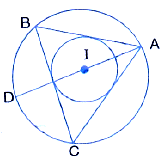
If I is the incentre of triangle ABC and AI when produced meets the circumcircle of triangle ABC in point D. If ∠BAC = 66° and ∠ABC = 80°. Calculate : ∠DBC
Answer
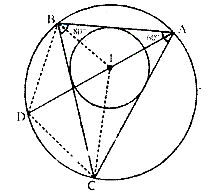
Join DB and DC, IB and IC
∠BAC 66°, ∠ABC 80°, I is the incentre of the ΔABC,
since ∠DBC and ∠DACare in the same segment
∠DBC =∠DAC
$\text { But, } \angle D A C=\frac{1}{2} \angle B A C=\frac{1}{2} \times 66^{\circ}=33^{\circ}=$
$\therefore \angle DBC =33^{\circ}$
View full question & answer
Question 23 Marks
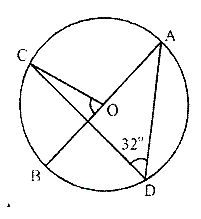
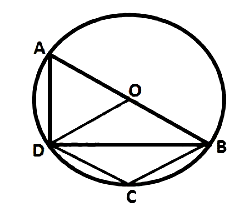
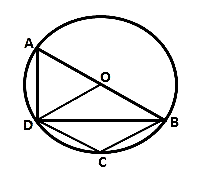
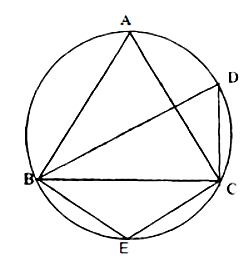
In the figure, ∠DBC = 58°. BD is a diameter of the circle. Calculate : ∠BDC
Answer
Given that BD is a diameter of the circle.
The angle in a semicircle is a right angle.
∴ ∠ BCD = 90°
Also given that ∠ DBC = 58°
In Δ BDC ,
∠ BCD + ∠ BCD + ∠ BDC = 180°
⇒ 58° + 90° + ∠ BDC = 180°
⇒ 148° + ∠ BDC = 180°
⇒ ∠ BDC = 180° - 148°
⇒ ∠ BDC = 32°
View full question & answer
Question 33 Marks
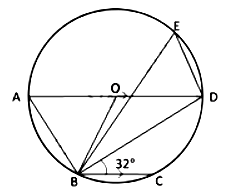
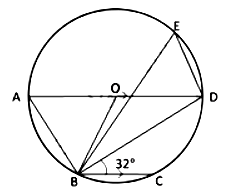
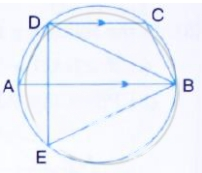
In the given figure, AD is a diameter. O is the centre of the circle. AD is parallel to BC and ∠CBD = 32°.

Find: ∠BED
Answer
In Δ OAB ,
OA = OB ...(Radii of the same circle° )
⇒ ∠ OAB = ∠ OBA = x (say)
⇒ ∠ OAB + ∠ OBA + ∠ AOB = 180°
⇒ x + x + 64° = 180°
⇒ 2x = 180 ° - 64 °
⇒ 2x = 116°
⇒ x = 58°
⇒ ∠ OAB = 58°
i.e. ∠ DAB = 58°
⇒ ∠ DAB = ∠BED = 58° ....(Angles inscribed in the same arc are equal)
View full question & answer
Question 43 Marks
In the given figure, AD is a diameter. O is the centre of the circle. AD is parallel to BC and ∠CBD = 32°.

Find: ∠AOB
Answer
AD is parallel to BC, i.e., AO is parallel to BC and OB is transversal.
⇒ ∠ AOB = ∠ OBC ......(Alternate angles)
⇒ ∠ OBC = ∠ OBD + ∠ DBC
⇒ ∠OBC = 32° + 32°
⇒ ∠OBC = 64°
⇒ ∠ AOB = 64°
View full question & answer
Question 53 Marks
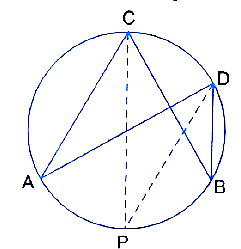
In the figure, given alongside, CP bisects angle ACB. Show that DP bisects angle ADB.
Answer
Given – In the figure, CP is the bisector of ∠ABC
To prove – DP is the bisector of ∠ADB
Proof – Since CP is the bisector of ∠ACB
∴ ∠ACP = ∠BCP
But ∠ACP = ∠ADP [Angle in the same segment
And ∠BCP = ∠BDP
But ∠ACP = ∠BCP
∴ ∠ADP = ∠BDP
∴ DP is the bisector of ∠ADB
View full question & answer
Question 63 Marks
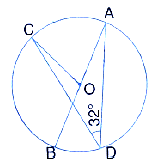
In the given figure, AB is the diameter of the circle with centre O.

If ∠ADC = 32°, find angle BOC
Answer

Arc AC subtends ∠AOC at the centre and ∠ADC at the remaining part Of the circle
∴ ∠AOC = 2 ∠ADC
⇒∠AOC = 2× 32° = 64°
Since ∠AOC and ∠BOC are linear pair, we have
∠AOC + ∠BOC = 180°
⇒ 64° + BOC = 180°
⇒ ∠BOC = 180°
⇒ ∠BOC = 180° - 64°
⇒∠BOC = 116°
View full question & answer
Question 73 Marks
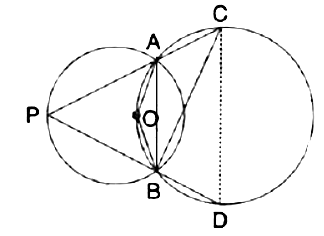
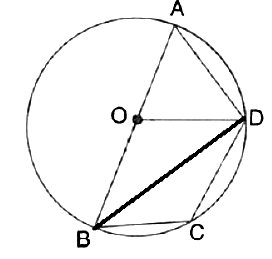
In the figure, $O$ is the centre of the circle and the length of arc $AB$ is twice the length of arc $BC.$ If angle $AOB = 108^\circ$ find $: \angle ADB.$
Answer

Again, Arc $AB$ subtends $\angle AOB$ at the centre and
$\angle ACB$ at the remaining part of the circle.
$\angle ACB =\frac{1}{2} \angle AOB$
$=\frac{1}{2} \times 108^{\circ}$
$=54$
In cyclic quadrilateral $ADBC$
$\angle ADB + \angle ACB =180^\circ$ (sum of opposite angles)
$\Rightarrow \angle ADB + 54^\circ = 180^\circ$
$\Rightarrow \angle ADB = 180^\circ - 54^\circ$
$\Rightarrow \angle ADB = 126^\circ$
View full question & answer
Question 83 Marks
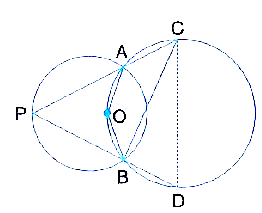
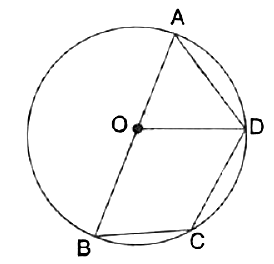
In the figure, $O$ is the centre of the circle and the length of arc $AB$ is twice the length of arc $BC.$ If angle $AOB = 108^\circ,$ find $: \angle CAB$
​​​​​​​
Answer

Join $AD$ and $DB$
Arc $B = 2$ arc $BC$ and $\angle AOB = 180^\circ$
$\therefore \angle BOC = 1 \angle AOB$
$=\frac{1}{2} \times 108^{\circ}$
$=54^{\circ}$
Now, Arc $BC$ subtends $\angle BOC$ at the centre and
$\angle CAB$ at the remaining part of the circle.
$\therefore \angle C A B=\frac{1}{2} \angle B O C$
$=\frac{1}{2} \times 54^{\circ}$
$=27^{\circ}$
View full question & answer
Question 93 Marks
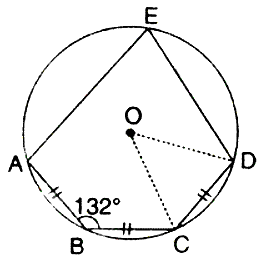
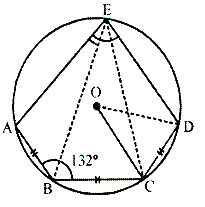
In the given figure, AB = BC = CD and ∠ABC = 132° . Calcualte: ∠ COD.
Answer

In the figure, O is the centre of circle, with AB = BC = CD.
Also, ∠ABC = 132°
Arc CD subtends ∠COD at the centre and
∠CED at the remaining part of the circle.
∴ COD = 2∠CED
= 2 × 24°
= 48°
View full question & answer
Question 103 Marks
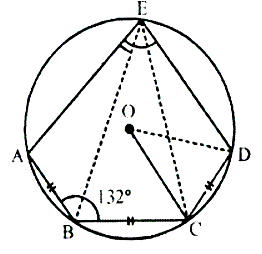
In the given figure, AB = BC = CD and ∠ABC = 132° . Calcualte: ∠AEB
Answer

In the figure, O is the centre of circle, with AB = BC = CD.
Also, ∠ABC = 132°
In cyclic quadrilateral ABCE
∠ABC + ∠AEC = 180° (sum of opposite angles)
→ ∠132 + ∠AEC = 180°
→ ∠AEC = 180° -132°
→ ∠AEC = 48°
Since, AB = BC,∠AEB = ∠BEC (equal chords subtends equal angles)
$\therefore \angle AEB =\frac{1}{2} \angle AEC$
$=\frac{1}{2} \times 48^{\circ}$
$=24^{\circ}$
View full question & answer
Question 113 Marks
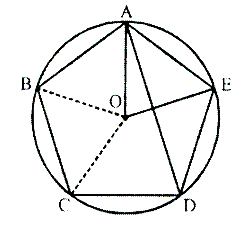
In a regular pentagon ABCDE, Inscribed in a circle; find ratio between angle EDA and angle ADC.
Answer

Arc AE subtends ∠AOE at the centre and
∠ADE at the remaining part of the circle.
$\therefore \angle ADE =\frac{1}{2} \times 72^{\circ}$
= 36 (central angle is a regular pentagon at O)
∠ADC = ∠ADB + ∠BDC
= 36° + 36° + 72°
∴ ∠ADE : ∠ADC = 36° : 72° = 1: 2
View full question & answer
Question 123 Marks
In the given figure, AB is a side of a regular six-sided polygon and AC is a side of a regular eight sided polygon inscribed in the circle with centre O. Calculate the sizes of:
(i) ∠AOB, (ii) ∠ACB (iii) ∠ABC
Answer
(i) Arc AB subtends ∠AOB at the centre and
∠ACB at the remaining part of the circle.
$\therefore \angle A C B=\frac{1}{2} \angle A O B$
Since AB is the side of a regular hexagon,
∠AOB = 60°
(ii) $\angle A O B=60^{\circ} \Rightarrow \angle A C B=\frac{1}{2} \times 60^{\circ}=30^{\circ}$
(iii) Since AC is the side of a regulare octagon,
$\angle A O C=\frac{360^{\circ}}{8}=45^{\circ}$
Again, Arc AC subtends ∠AOC at the center and
∠ABC at the remaining part of the circle.
$\Rightarrow \angle A B C=\frac{1}{2} \angle A O C$
$\Rightarrow \angle A B C=\frac{45^{\circ}}{2}=22.5^{\circ}$
View full question & answer
Question 133 Marks
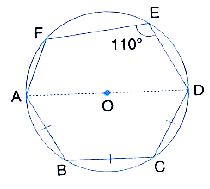
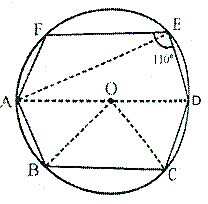
In the following figure, AD is the diameter of the circle with centre O. chords AB, BC and CD are equal. If ∠DEF = 110°, Calculate: ∠AEF
Answer

Join AE, OB and OC
∵ AOD is the diameter,
∴ ∠AED = 90° (Angle in a semi-circle)
But ∠DEF = 110° (given)
∴ ∠AEF = ∠DEF - ∠AED
= 110° - 90° = 20°
View full question & answer
Question 143 Marks
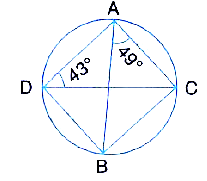
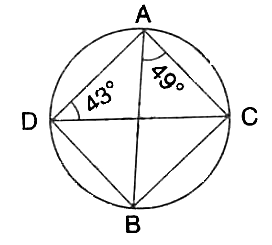
Calculate:
(i) ∠CDB, (ii) ∠ABC, (iii) ∠ACB
Answer

Here,
∠CDB = ∠BAC = 49°
∠ABC =∠ADC = 43°
(Angle subtend by the same chord on the circle are equal)
By angle – sum property of a triangle,
∠ACB = 180°- 49° -43°= 88°
View full question & answer
Question 153 Marks
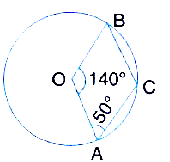
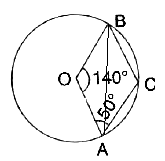
In the given figure, O is the centre of the circle. If ∠AOB = 140° and ∠OAC = 50°; Find:
(i) ∠ACB, (ii) ∠OBC, (iii) ∠OAB, (iv) ∠CBA.
Answer

Here, $\angle A C B=\frac{1}{2} \operatorname{Reflex}(\angle AOB )=\frac{1}{2}\left(360^{\circ}-140^{\circ}\right)=110^{\circ}$
(Angle at the centre is double the angle at the circumference subtended by the same chord)
Now, OA = OB (Radii of same circle)
$\therefore \angle OBA =\angle OAB =\frac{180^{\circ}-140^{\circ}}{2}=20^{\circ}$
∴ ∠CAB = 50° - 20°= 30°
ΔCAB,
∠CBA - 180° -110°- 30° = 40°
∴ ∠OBC = ∠CBA + ∠OBA = 40° + 20° = 60°
View full question & answer
Question 163 Marks
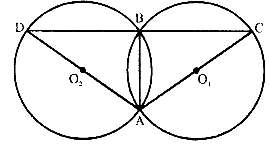
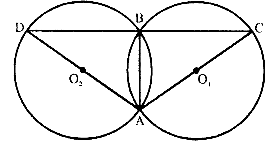
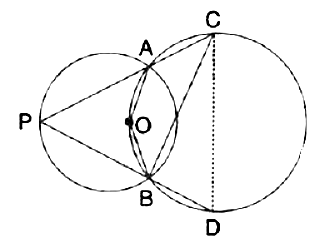
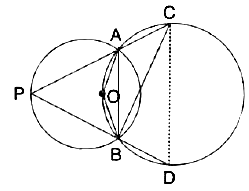
In the figure, AB is a common chord of the two circles. If AC and AD are diameters; prove that D, B, and C are in a straight line. $O_1$ and $O_2$ are the centers of two circles.
Answer

Given: Two circles with centre $O_1$ and $O_2$ intersect each other at A and B. AC and AD are the diameters of the circles.
To Prove: D, B, C are in the same straight line.
Construction: Join AB.
Proof:
$AO_1C$ is diameter.
∠ABC = 90°. .......(Angle in a semi-circle)
Similarly, ∠ABD = 90°,
Adding, we get:
∠ABC + ∠ABD = 90° + 90° = 180°
DBC is a straight line. or D, B, C are in the same line.
View full question & answer
Question 173 Marks
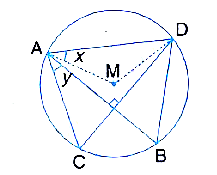
In the given figure, M is the centre of the circle. Chords AB and CD are perpendicular to each other.
If ∠MAD = x and ∠BAC = y : express ∠AMD in terms of x.
Answer
In the figure, M is the centre of the circle.
Chords AB and CD are perpendicular to each other at L.
∠MAD = x and ∠BAC = y
In ∆AMD,
MA = MD
∴ ∠MAD = ∠MDA = x
But in ∆AMD,
∠MAD + ∠MDA + ∠AMD = 180°
⇒ x + x + ∠AMD = 180°
⇒ 2x + ∠AMD = 180°
⇒ ∠AMD =180° - 2x
View full question & answer
Question 183 Marks
The given figure shows a circle with centre O and ∠ABP = 42°

Calculate the measure of:
(i) ∠PQB
(ii) ∠QPB + ∠PBQ
Answer

Join AP.
(i) ∠APB = 90°
(Angle in a semicircle)
∴ ∠BAP = 90° - ∠ABP = 90° - 42° = 48°
Now, ∠PQB = ∠BAP = 48°
(Angle in the same segment)
(ii) By angle sum property of ∆BPQ,
∠QPB + ∠PBQ = 180° - ∠PQB = 180° - 48° = 132°
View full question & answer
Question 193 Marks
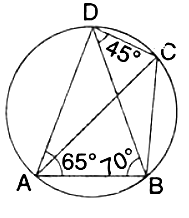
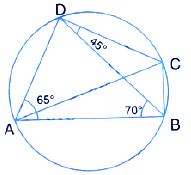
In the given figure, ∠BAD = 65°, ∠ABD = 70° and ∠BDC = 45°. Find: ∠ ACB.
Hence, show that AC is a diameter.
Answer

By angle sum property of ∆ABD,
ADB = 180° - 65° - 70° = 45°
Again, ∠ACB = ∠ADB = 45°
(Angle in the same segment)
∴ ∠ADC = ∠ADB + ∠BDC = 45° + 45° = 90°
Hence, AC is a semicircle.
(since angle in a semicircle is a right angle)
View full question & answer
Question 203 Marks
In the given figure, the centre O of the small circle lies on the circumference of the bigger circle. If ∠APB = 75° and ∠BCD = 40°, find : ∠ADB
Answer

Join AB and AD
In cyclic quadrilateral AOBD,
∠ADB = 180° - ∠AOB = 180° -150° = 30°
(pair of opposite angles in a cyclic quadrilateral are supplementary)
View full question & answer
Question 213 Marks
In the given figure, the centre O of the small circle lies on the circumference of the bigger circle. If ∠APB = 75° and ∠BCD = 40°, find : ∠AOB
Answer

Join AB and AD
∠AOB = 2 ∠APB = 2 ×75° =150°
(Angle at the centre is double the angle at the circumference subtended by the same chord).
View full question & answer
Question 223 Marks
AB is the diameter of the circle with centre O. OD is parallel to BC and ∠ AOD = 60° ; calculate the numerical values of: ∠ DBC
Answer

∠BDA = 90° (Angle in a semicircle)
Also, ∠OAD is equilateral (∴ ∠OAD = 60° )
∴ ∠ODB = 90° - ∠ODA = 90° - 60° = 30°
Also, OD || BC
∴ ∠DBC = ∠ODB = 30° (Alternate angles)
View full question & answer
Question 233 Marks
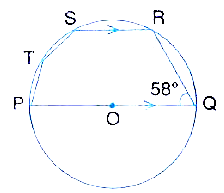
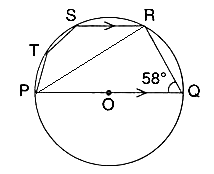
In the given figure, PQ is a diameter. Chord SR is parallel to PQ. Given that ∠PQR = 58°,
Calculate:
(i) ∠RPQ, (ii) ∠STP
Answer

Join PR.
(i) ∠PRQ = 90°
(Angle in a semicircle)
∴ In right triangle PQR,
∠RPQ = 90° - ∠PQR = 90° - 58° = 32°
(ii) Also, SR || PQ
∠PRS = ∠RPQ = 32 (Alternate angles) In cyclic quadrilateral PRST,
∠STP =180° - ∠PRS = 180° - 32° = 148°
(pair of opposite angles in a cyclic quadrilateral are supplementary)
View full question & answer
Question 243 Marks
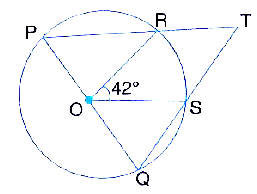
In the given figure, PQ is the diameter of the circle whose centre is O. Given ∠ROS = 42°, Calculate ∠RTS.
Answer

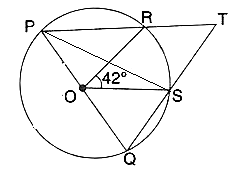
Join PS.
∠PSQ = 90°
(Angle in a semicircle)
Also, $\angle S P R=\frac{1}{2} \angle R O S$
(Angle ate the centre is double the angle at the circumference subtended by the same chord)
$\Rightarrow S P T=\frac{1}{2} \times 42^{\circ}=21^{\circ}$
∴ In right triangle PST,
∠PTS = 90° -∠SPT
⇒ ∠RTS = 90°- 21° = 69°
View full question & answer
Question 253 Marks
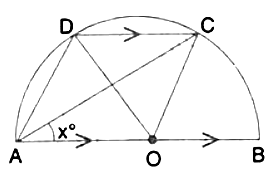
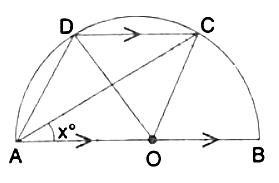
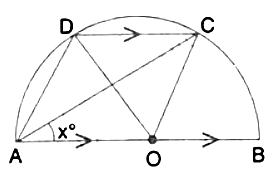
In the given figure, $A O B$ is a diameter and $D C$ is parallel to $A B$. If $\angle C A B=x^0$; find (in terms of $x$ ) the values of: $\angle$ ADC.
Answer

$\mathrm{DC} \| \mathrm{AO}$
$\therefore \angle \mathrm{ACD}=\angle \mathrm{OAC}=\mathrm{x} \text { (Alternate angles) }$
By angle sum property,
$\angle A D C=180^{\circ}-\angle D A C-\angle A C D$
$=180^{\circ}-\left(90^{\circ}-2 x\right)-x$
$=90^{\circ}+x$
View full question & answer
Question 263 Marks
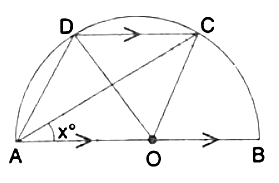
In the given figure, $A O B$ is a diameter and $D C$ is parallel to $A B$. If $\angle C A B=x^{\circ}$; find (in terms of $x$ ) the values of: $\angle$ DOC.
Answer

$\angle O C D=\angle C O B=2 x$ (Alternate angles)
$\text { In } \angle O C D, O C=O D$
$\therefore \angle O D C=\angle O C D=2 x$
By angle sum property of $\triangle O C D$,
$\angle D O C=180^{\circ}-2 x-2 x=180^{\circ}-4 x$
View full question & answer
Question 273 Marks
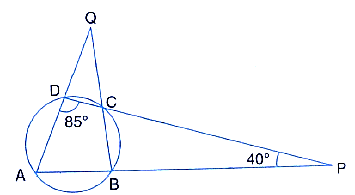
Use the given figure to find:
(i) ∠BAD,
(ii) ∠DQB
Answer

(i) By angle sum property of ∆ADP,
∠BAD = 180° - 85° - 40° = 55°
(ii) ∠ABC = 180° - ∠ADC = 180° - 85° = 95°
(pair of opposite angles in a cyclic quadrilateral are supplementary)
By angle sum property,
∠AQB = 180° - 95° - 55°
⇒ ∠DQB = 30°
View full question & answer
Question 283 Marks
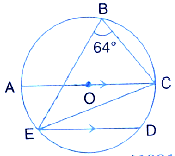
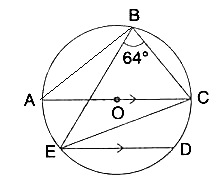
In the given figure, AOC is a diameter and AC is parallel to ED. If ∠CBE = 64°, Calculate ∠DEC .
Answer

Join AB,
∠ABC = 90°
(Angle in a semi circle)
∴ ∠ABE = 90° - 64° = 26°
Now, ∠ABE = ∠ACE = 26°
(Angle in the same segment)
Also, AC || ED
∴ ∠DEC = ∠ACE = 26° (Alternate angles)
View full question & answer
Question 293 Marks
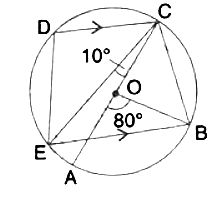
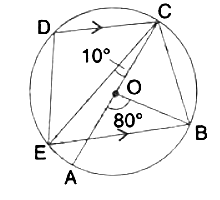
In the given figure, AC is the diameter of circle, centre $\mathrm{O} . \mathrm{CD}$ and BE are parallel. Angle $\mathrm{AOB}=80^{\circ}$ and angle $\mathrm{ACE}=$ $10^{\circ}$. Calculate : Angle BCD
Answer

DC || EB
∴ DCE = ∠BEC = 50° (Alternate angles)
∴ ∠ AOB = 80°
$\Rightarrow \angle ACB =\frac{1}{2} \angle AOB =40^{\circ}$
(Angle at the center is double the angle at the circumference subtended by the same chord) We have,
∠BCD = ∠ACB + ∠ACE + ∠DCE = 40° +10°+ 50° = 100°
View full question & answer
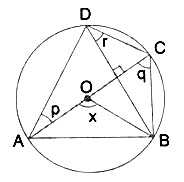
Question 303 Marks
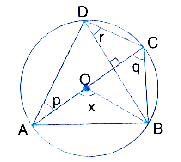
In the given figure, AC is a diameter of circle, centre O. Chord BD is perpendicular to AC. Write down the angles p, q and r in terms of x .
Answer

∠AOB = 2∠ACB = 2ADB
(Angle at the centre is double the angle at the circumference subtended by the same chord)
$\Rightarrow x=2 q$ and $\angle A D B=\frac{x}{2} \therefore=q=\frac{x}{2}$
Also, ∠ADC = 90°
(Angle in a semicircle)
$\Rightarrow r+\frac{x}{2}=90^{\circ}$
$\Rightarrow r=90^{\circ}-\frac{x}{2}$
Again, ∠DAC = ∠DBC
(Angle in the same segment)
$\Rightarrow p=90^{\circ}-q$
$\Rightarrow p=90^{\circ}-\frac{x}{2}$
View full question & answer
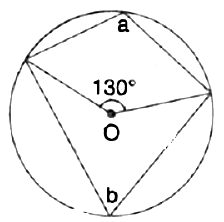
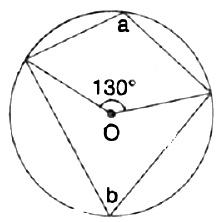
Question 313 Marks
In the following figures, O is the centre of the circle. Find the values of a, b and c.
Answer

Here, $b=\frac{1}{2} \times 130^{\circ}$
(Angle ate he centre is double the angle at the circumference subtended by the same chord)
⇒ b = 65°
Now, a + b 180°
(Opposite angles of a cyclic quadrilateral are supplementary)
⇒ a = 180°- 65°= 115°
View full question & answer
Question 323 Marks
In the given figure, AB is a diameter of the circle with centre O. DO is parallel to CB and ∠DCB = 120°.
Calculate : ∠DAB
Also show that the ΔAOD is an equilateral triangle .
Answer

ABCD is a cyclic quadrilateral
∴ ∠DCB + ∠DAB = 180°
(pair of opposite angles in a cyclic quadrilateral are supplementary)
⇒ ∠DAB =180° -120° = 60°
View full question & answer
Question 333 Marks
In the given figure, AB is a diameter of the circle. Chord ED is parallel to AB and ∠EAB = 63°. Calculate : ∠ BCD.
Answer

AB || ED
Therefore ∠DEB = EBA = 27° (Alternate angles)
Therefore BCDE is a cyclic quadrilateral
Therefore ∠DEB + ∠BCD = 180°
(pair of opposite angles in a cyclic quadrilateral are supplementary)
Therefore ∠BCD =180° - 27° =153°
View full question & answer
Question 343 Marks
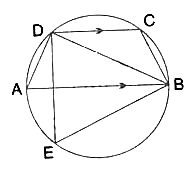
ABCD is a cyclic quadrilateral in which AB is parallel to DC and AB is a diameter of the circle. Given ∠BED = 65°; Calculate:
(i) ∠DAB, (ii) ∠BDC
Image
Answer

(i) ∠DAB = ∠BED = 65°
(Angle subtended by the same chord on the circle are equal)
(ii) ∠ADB = 90°
(Angle in a semicircle is a right angle)
∴ ∠ABD = 90° - ∠DAB = 90° - 65° = 25°
AB || DC
∴ ∠BDC = ∠ABD = 25° (Alternate angles)
View full question & answer
Question 353 Marks
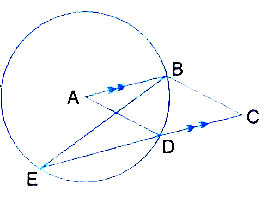
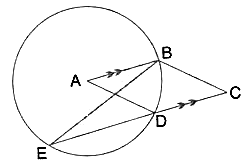
In the given figure, A is the centre of the circle, ABCD is a parallelogram and CDE is a straight line.
Prove that : ∠BCD = 2∠ABE .
Answer

∠BAD = 2∠BED
(Angle at the centre is double the angle at the circumference subtended by the same chord)
And ∠BED = ∠ABE (alternate angles)
∴ ∠BAD = 2∠ABE ……… (i)
ABCD is a parallelogram
∴ ∠BAD = ∠BCD ………. (ii)
(opposite angles in a parallelogram are equal) From (i) and (ii),
∠BCD = 2∠ABE
View full question & answer
Question 363 Marks
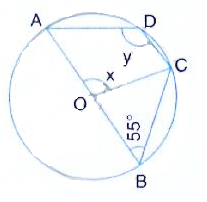
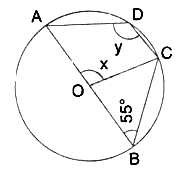
In the given figure, O is the centre of the circle and ∠ABC = 55°. Calculate the values of x and y.
Image
Answer

∠AOC = 2 ∠ABC = 2 × 55°
(Angle at the centre is double the angle at the circumference subtended by the same chord)
∴ x = 110°
ABCD is cyclic quadrilateral
∴ ∠ADC +∠ ABC = 180°
(pair of opposite angles in a cyclic quadrilateral are supplementary
⇒ y = 180° - 55° = 125°
View full question & answer
Question 373 Marks
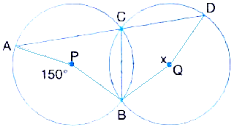
In the figure, given below, P and Q are the centres of two circles intersecting at B and C ACD is a straight line. Calculate the numerical value of x .
Image
Answer
$\angle ACB =\frac{1}{2} \angle A P B=\frac{1}{2} \times 150=75^{\circ}$
(Angle at the centre is double the angle at the circumference subtended by the same chord)
∠ACB + ∠BCD =180°
(Straight line)
⇒ ∠BCD =180° - 75° =105°
Also,$\angle B C D=\frac{1}{2}=$ reflex $\angle BQD =\frac{1}{2}\left(360^{\circ}- x \right)$
(Angle at the center is double the angle at the circumference subtended by the same chord) x
⇒ 105 = 180°
∴ x = 2 (180 ° -° ) = 2×75 = 150°
View full question & answer
Question 383 Marks
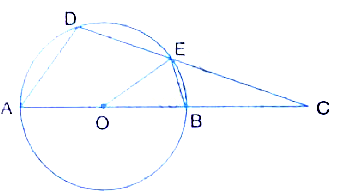
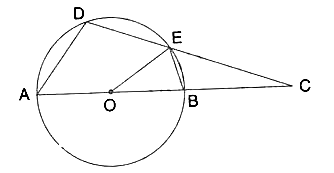
In the figure, O is the centre of the circle, ∠AOE = 150°, ∠DAO = 51°. Calculate the sizes of the angles CEB and OCE.
Answer

∠ADE =$\frac{1}{2} \operatorname{Re}$ flex $(\angle AOE )=\frac{1}{2}\left(360^{\circ}-150^{\circ}\right)=105^{\circ}$
(Angle at the center is double the angle at the circumference subtended by the same chord)
∠DAB + ∠BED = 180°
(pair of opposite angles in a cyclic quadrilateral are supplementary)
⇒ ∠BED =180° - 51° = 129°
∴ ∠CEB = 180° - =180° -129° = 51°
Also, by angle sum property of ∆ADC,
∠OCE =180° - 51° -105° = 24°
View full question & answer
Question 393 Marks
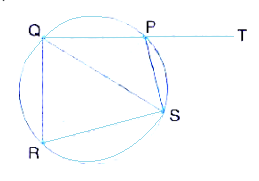
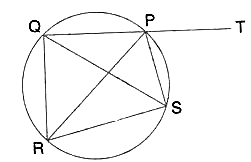
In the given figure, SP is bisector of ∠RPT and PQRS is a cyclic quadrilateral. Prove that SQ = SR .
Image
Answer

PQRS is a cyclic quadrilateral
∠QRS +∠QPS = 180° …………(i)
(pair of opposite angles in a cyclic quadrilateral are supplementary)
Also, QPS +∠SPT = 180° ……(ii)
(Straight line QPT)
From (i) and (ii)
∠QRS = ∠SPT ………. (iii)
Also, ∠RQS = ∠RPS ……(iv)
(Angle subtended by the same chord on the circle are equal)
And ∠RPS = ∠SPT (PS bisects ∠RPT ) …… (v)
From (iii), (iv) and (v)
∠QRS = ∠RQS
⇒ SQ = SR
View full question & answer
Question 403 Marks
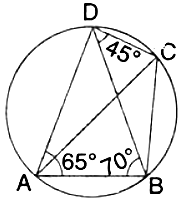
In the figure, ∠BAD = 65° , ∠ABD = 70° , ∠BDC = 45°
(i) Prove that AC is a diameter of the circle
(ii) Find ∠ACB
Answer
(i)
In Δ ABD ,
∠ DAB + ∠ ABD + ∠ ADB = 180°
⇒ 65° + 70° + ∠ ADB = 180°
⇒ 135° + ∠ ADB = 180°
⇒ ∠ ADB = 180° - 135° = 45°
Now , ∠ ADC = ∠ ADB + ∠ BDC = 45° + 45° = 90°
Since ∠ ADC is the angle of semicircle , so AC is a diameter of the circle.
(ii)
∠ ACB = ∠ ADB .....(angles in the same segment of a circle)
⇒ ∠ ACB = 45°
View full question & answer
Question 413 Marks
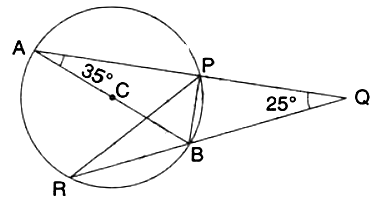
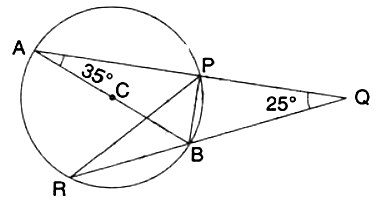
AB is a diameter of the circle APBR as shown in the figure. APQ and RBQ are straight lines. Find: ∠ BPR
Answer

ABP = 90°- ∠BAP = 90° - 35° = 55°
∴ ∠ABR = ∠PBR = ∠ABP = 115° - 55° = 60°
∴ ∠APR = ABR = 60°
(Angles subtended by the same chord on the circle are equal)
∴ ∠BPR = 90° - ∠APR = 90° - 60° = 30°
View full question & answer
Question 423 Marks
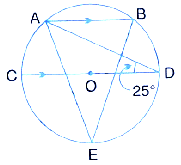
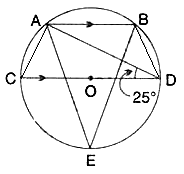
In the figure, given alongside, AB ∥ CD and O is the centre of the circle. If ∠ADC = 25°; find
the angle AEB give reasons in support of your answer.
Answer

Join AC and BD
∴ ∠CAD = 90° and ∠CBD = 90°
(Angle in a semicircle is a right angle) Also, AB || CD
∴ ∠BAD = ∠ADC = 25° (alternate angles)
∠BAC = ∠BAD + ∠CAD = 25°+ 90° = 115°
∴ ∠ADB = 180°- 25° - BAC = 180° - 25° -115° = 40°
(pair of opposite angles in a cyclic quadrilateral are supplementary) Also, ∠AEB = ∠ADB = 40°
(Angle subtended by the same chord on the circle are equal)
View full question & answer
Question 433 Marks
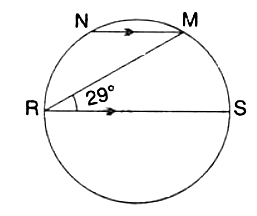
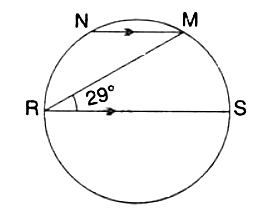
In the given figure, RS is a diameter of the circle. NM is parallel to RS and ∠MRS = 29°.
Calculate : ∠ NRM
Answer

Also, RS || NM
∴ ∠NMR = ∠MRS = 29° (Alternate angles)
∴ ∠NMS = 90° + 29° = 119°
Also, ∠NRS + ∠MS = 180°
(pair of opposite angles in a cyclic quadrilateral are supplementary)
⇒ ∠NMR + 29° +119° = 180°
⇒ ∠NRM = 180° -148°
∴ ∠NRM = 32°
View full question & answer
Question 443 Marks
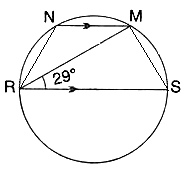
In the given figure, RS is a diameter of the circle. NM is parallel to RS and ∠MRS = 29°.
Calculate: ∠RNM,
Answer

Join RN and MS.
∴ ∠RMS = 90°
(Angle in a semicircle is a right angle)
∴ ∠RSM = 90° - 29° = 61°
(By angle sum property of triangle RMS)
∴ ∠RNM =180° ∠RSM =180° - 61° = 119°
(pair of opposite angles in a cyclic quadrilateral are supplementary)
View full question & answer
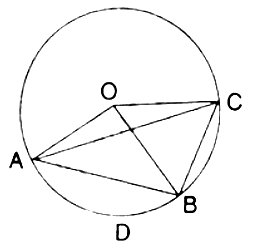
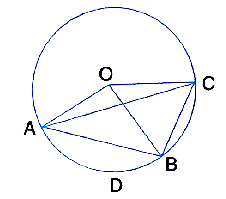
Question 453 Marks
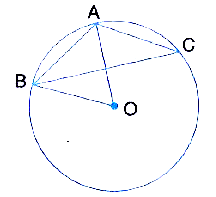
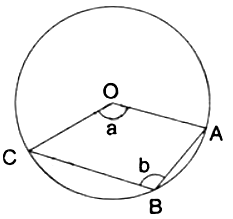
The figure given below, shows a circle with centre O. Given: ∠ AOC = a and ∠ ABC = b.
1. Find the relationship between a and b.
2. Find the measure of angle OAB, if OABC is a parallelogram.
Answer
(i) $\angle ABC =\frac{1}{2}$ Reflex $( COA )$
(Angle at the centre is double the angle at the circumference subtended by the same chord)
$\Rightarrow b=\frac{1}{2}(360-a)$
⇒ a + 2b = 360°
(ii) Since OABC is a parallelogram, so opposite angles are equal.
2b + b = 360°
3b = 360°
b = 120°
∴ 120° + 120° + x + x = 360°
2x = 360° - 240°
2x = 120°
$x=\frac{120^{\circ}}{2}$
$x=60^{\circ}$
$\Rightarrow \angle O A B=60^{\circ}$
View full question & answer
Question 463 Marks
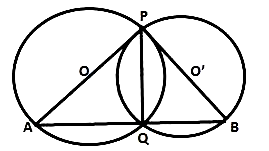
Two circles intersect at P and Q. through P diameter PA and PB of the two circles are drawn.
Show that the points A, Q and B are collinear.
Answer

Let O and O' be the centres of two intersecting circle, where
Points of intersection are P and Q and PA and PB are their diameter respectively.
Join PQ, AQ and QB.
∴ ∠AQP = 90° and ∠BQP = 90°
(Angle in a semicircle is a right angle)
Adding both these angles,
∠AQP + ∠BQP = 180° ⇒ ∠AQB = 180°
Hence, the points A, Q and B are collinear.
View full question & answer
Question 473 Marks
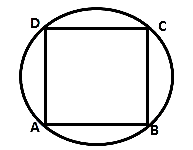
Prove that:
the rhombus, inscribed in a circle, is a square.
Answer

Let ABCD be a rhombus, inscribed in a circle
Now, ∠BAD = ∠BCD
(Opposite angles of a parallelogram are equal)
And ∠BAD = ∠BCD =180°
(pair of opposite angles in a cyclic quadrilateral are supplementary)
$\therefore \angle BAD =\angle BCD \frac{180^{\circ}}{2}=90^{\circ}$
∥y, the other two angles are 90° and all the sides
are equal.
∴ ABCD is a square.
View full question & answer
Question 483 Marks
Prove that:
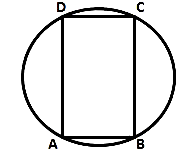
the parallelogram, inscribed in a circle, is a rectangle.
Answer

Let ABCD be a parallelogram, inscribe in a circle,
Now, ∠BAD = ∠BCD
(Opposite angles of a parallelogram are equal)
And ∠BAD = ∠BCD = 180°
(pair of opposite angles in a cyclic quadrilateral are supplementary)
$\angle BAD =\angle BCD =\frac{180^{\circ}}{2}=90^{\circ}$
∥y, the other two angles are 90 and opposite pair of sides
Are equal.
∴ ABCD is a rectangle.
View full question & answer
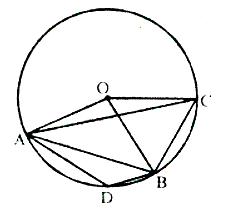
Question 493 Marks
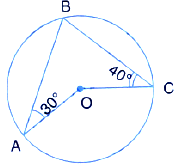
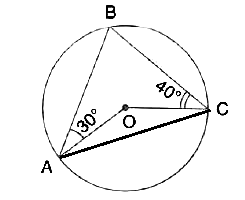
In the given figure, O is the centre of the circle. ∠OABand ∠OCB are 30° and 40°
respectively. Find ∠AOC . Show your steps of working.
Answer

Join AC,
Let ∠OAC = ∠OCA = x (say)
∴ ∠AOC =180° -2x
Also, ∠BAC = 30°+ x
In ΔABC,
∠ABC =180°- ∠BAC -∠BCA
=180° - (30°+x) - (40°+ x ) = 110°- 2x
Now, ∠AOC = ∠2 ABC
(Angle at the centre is double the angle at the circumference subtended by the same chord)
⇒ 180°- 2x = 2(110° - 2x)
⇒ 2x = 40
∴ x = 20
∴ ∠AOC = 180° - 2×20° = 140°
View full question & answer
Question 503 Marks
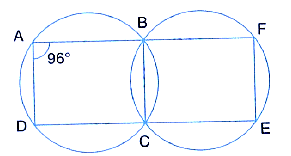
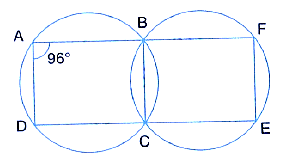
In the following figure,
If $\angle BAD = 96^\circ,$ find $\angle BCD$ and $\angle BFE.$
​​​​​​​
Answer

$ABCD$ is a cyclic quadrilateral
$ \therefore \angle BAD +\angle BCD =180^{\circ} $
(pair of opposite angles in a cyclic quadrilateral are supplementary)
$ \Rightarrow \angle BCD =180^{\circ}-96^{\circ}=84^{\circ}$
$\therefore \angle BCE =180^{\circ}-84^{\circ}=96^{\circ} $
Similarly, $BCEF$ is a cyclic quadrilateral
$ \therefore \angle B C E+\angle B F E=180^{\circ} $
(pair of opposite angles in a cyclic quadrilateral are supplementary)
$ \therefore \angle B F E=180^{\circ}-96^{\circ}=84^{\circ} $
View full question & answer