Question 14 Marks
The cross-section of a tunnel is a square of side 7m surmounted by a semi circle as shown in theadjoining figure. The tunnel is 80 m long.
(1) its volume
(2) the surface area of the tunnel (excluding the floor) and
(3) its floor area.
AnswerSide of square $= 7\ m$
Radius of semicircle $=\frac{7}{2} m$
Length of the tunnel $= 80\ m$
Area of cross section of the front part $=a^2+\frac{1}{2} \pi r^2$
$=7 \times 7+\frac{1}{2} \times \frac{22}{7} \times \frac{7}{2} \times \frac{7}{2}$
$=49+\frac{77}{4} m^2$
$=\frac{196+77}{4}$
$=\frac{273}{4} m^2$
(1) therefore, volume of tunnel $=$ area $\times$ length
$=\frac{273}{4} \times 80$
$=5460 m ^3$
(2) Circumference of the front of tunnel
$=2 \times 7+\frac{1}{2} \times 2 \pi r$
$=14+\frac{22}{7} \times \frac{7}{2}$
$=14+11$
$=25 m $
Therefore, surface area of the inner part of the tunnel
$=25 \times 80$
$=2000 m^2$
(iii) Area of floor $=1 \times b=7 \times 80=560 m ^3$
View full question & answer→Question 24 Marks
A right circular cylinder having diameter $12$ cm and height $15$ cm is full ice-cream. The ice-cream is to be filled in cones of height $12$ cm and diameter $6$ cm having a hemispherical shape on the top. Find the number of such cones which can be filled with ice-cream.
AnswerWe have
Radius of the cylincler = 12/2 = 6cm
Height of the cylinder = 15cm
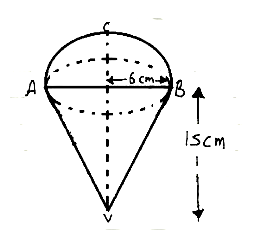
$\therefore$ volume of the cy linder $= \pi r^2h$
$=\pi x 6^2 x 15$
$= 540\pi cm^3$
Radius of the ice-cream cone = 3cm
Height of the ice-cream cone = 12cm
∴ volume of the conical part of ice-cream
cone $=\frac{1}{3} \pi r^2 h$
volume of the conical part of ice-cream
cone $=\frac{1}{3} \times \pi \times 3^2 \times 12 cm ^3$
valume of the conical part of ice-cream
cone = $36\pi cm^3$
volume of the hemispherical top of the ice-cream $\left.=\frac{2}{3} \pi r^3=\frac{2}{3} \times \pi \times 3^3\right)$
$= 18\pi cm^3$
Total volume of the ice-cream
cone $= (36\pi +18\pi )cm^3 = 54\pi cm^3$
$\therefore \text { Number of ice-cream cone }=\frac{\text { volume of the cylinder }}{\text { Total volume of ice-cream }}$
$=\frac{540 \pi}{54 \pi}=10$ View full question & answer→Question 34 Marks
An exhibition tent is in the form of a cylinder surmounted by a cone. The height of the tent above the ground is $85\ m$ and height of the cylindrical part of $50\ m.$ If the diameter of the base is $168\ m,$ find the quantity of canvas required to make the tent. Allow $20\%$ extra for fold and for stitching. Give your answer to the nearest $m^2.$
Answer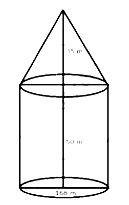
Total height of the tent $= 85 m$
Diameter of the base $= 168 m$
Therefore, radius $(r) = 84 m$
Height of the cylindrical part $= 50 m$
Then height of the conical part $= (85 - 50) = 35 m$
Slant height (1)=
$\sqrt{r^2+h^2}=\sqrt{84^2+35^2}=\sqrt{7056+1225}=\sqrt{8281}=91 cm$
$\text { Total surface area of the tent }=2 \pi r h+\pi r l=\pi(2 h+l)$
$=\frac{22}{7} \times 84(250+91)$
$=264(100+91)$
$=264 \times 191$
$=50424 m ^2$
Since $20\%$ extra is needed for folds and stitching,
total area of canvas needed
$=50424 \times \frac{120}{100}$
$=60508.8$
$=60509 m ^2$ View full question & answer→Question 44 Marks
A cylindrical water tank of diameter $2.8 m$ and height $4.2 m$ is being fed by a pipe of diameter $7 cm$ through which water flows at the rater of $4\ ms^{-1}.$ Calculate, in minutes, the time it takes to fill the tank.
AnswerDiameter of cylindrical tank $= 2.8 m$
Therefore, radius $= 1.4 m$
Height $= 4.2 m$
Volume of water filled in it $=\pi r^2 h$
$=\frac{22}{7} \times 1.4 \times 1.4 \times 4.2 m ^3$
$=\frac{181.104}{7} m ^3$
$=25.872 m ^3........(1)$
Diameter of pipe $= 7 cm$
Therefore, radius $(r)=\frac{7}{2}$
Let length of water in the pipe $=h_1$
$\therefore$ Volume $=\pi r^2 h_1$
$\therefore \text { Volume }=\pi r^2 h_1$
$=\frac{22}{7} \times \frac{7}{2} \times \frac{7}{2} \times h_1$
$=\frac{77}{2} h_1 cm ^3.......(2)$
From (1) and (2)
$\frac{77}{2} h_1 cm ^3=25.872 \times 100^3 cm ^3$
$\Rightarrow h_1=25.872 \times 100^3 cm ^3$
$\Rightarrow h_1=\frac{25.872 \times 100^3 \times 2}{77}$
$\Rightarrow h_1=0.672 \times 100^2 m$
$\Rightarrow h_1=6720 m $
Therefore, time taken at the speed of $4 m$ per second
$\frac{6720}{4 \times 60}$ minutes $=28$ minutes
View full question & answer→Question 54 Marks
A wooden toy is in the shape of a cone mounted on a cylinder as shown alongside.If the height of the cone is $24\ cm,$ the total height of the toy is $60\ cm$ and the radius of the baseof the cone $=$ twice the radius of the base of the cylinder $= 10\ cm;$ find the total surface area ofthe toy.
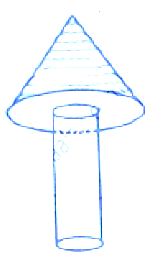
AnswerHeight of the cone $= 24 cm$
Height of the cylinder $= 36 cm$
Radius of the cone $=$ twice the radius of the cylinder $= 10 cm$
Radius of the cylinder $= 5\ cm$
Slant height of the cone $=\sqrt{r^2+h^2}$
$=\sqrt{10^2+24^2}$
$=\sqrt{100+576}$
$=\sqrt{676}$
$=26 cm $
Now, the surface area of the toy $=$ curved area of the conical point $+$ curved area of the cylinder
$=\pi r l+\pi r^2+2 \pi R H$
$=\pi\left(r l+r^2+2 R H\right)$
$=3.14\left(10 \times 26 \times(10)^2+2 \times 5 \times 36\right)$
$=3.14(260+100+360)$
$=3.14(720)$
$=2260.8 cm ^2$
View full question & answer→Question 64 Marks
A vessel is a hollow cylinder fitted with a hemispherical bottom of the same base. The depth ofthe cylindrical part is $4 \frac{2}{3}$ and the diameter of hemisphere is $3.5\ m.$ Calculate the capacity andthe internal surface area of the vessel.
Answer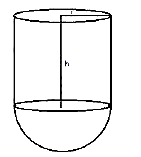
Diameter of the base $= 3.5\ m$
Therefore, radius $=\frac{3.5}{2} m=1.75 m=\frac{7}{4} m$ Height of cylindrical part $=4 \frac{2}{3}=\frac{14}{3} m$
(1) Capacity (volume) of the vessel $=\pi r^2 h+\frac{2}{3} \pi r^3=\pi r^2\left(h+\frac{2}{3} r\right)=$
$=\frac{22}{7} \times \frac{7}{4} \times \frac{7}{4}\left(\frac{14}{3}+\frac{2}{3} \times \frac{7}{4}\right)$
$=\frac{77}{8}\left(\frac{14}{3}+\frac{7}{6}\right)$
$=\frac{77}{8}\left(\frac{28+7}{6}\right)$
$=\frac{77}{8} \times \frac{35}{6}$
$=\frac{2695}{48}$
$=56.15 m ^3$
Internal curved surface area $=$
$2 \pi r h+2 \pi r^2=2 \pi r(h+r)$
$=2 \times \frac{22}{7} \times \frac{7}{4}\left(\frac{14}{3}+\frac{7}{4}\right)$
$=11\left(\frac{56+21}{12}\right)$
$=11 \times \frac{77}{12}$
$=\frac{847}{12}$
$=70.58 m ^2$ View full question & answer→Question 74 Marks
A circus tent is cylindrical to a height of $8m$ surmounted by a conical part. If total height of thetent is $13m$ and the diameter of its base is $24m;$ calculate:
(i) total surface area of the tent,
(ii) area of canvas, required to make this tent allowing $10\%$ of the canvas used for folds and stitching.
Answer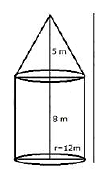
Height of the cylindrical part $= H =8 m$
Height of the conical part $=h=(13-8) m =5 m$
Diameter $=24 m \rightarrow$ radius $= r =12 m$
Slant height of the cone $=1$
$ l=\sqrt{r^2+h^2} $
$ l=\sqrt{12^2+5^2} $
$ l=\sqrt{169}=13 m$
Slant height of cone $=13 m$
(i) Total surface are of the tent $=2 \pi r h+\pi r l=\pi r(2 h+l)$
$=\frac{22}{7} \times 12 \times(2 \times 8+13) $
$=\frac{264}{7}(16+13) $
$ \frac{264}{7} \times 29 $
$ =\frac{7656}{7} m ^2 $
$ =1093.71 m ^2$
$\text { Area of canvas used in stitching }=\text { total area }$
$\text { Total area of canvas }=\frac{7656}{7}+\frac{\text { Total area of canvas }}{10}$
$\Rightarrow \text { Total area of canvas- } \frac{\text { Total area of canvas }}{10}=\frac{7656}{7}$
$ \Rightarrow \text { Total area of canvas }\left(1-\frac{1}{10}\right)=\frac{7656}{7}$
$ \Rightarrow \text { Total area of canvas } \times \frac{9}{10}=\frac{7656}{7} $
$ \Rightarrow \text { Total area of canvas }=\frac{7656}{7} \times \frac{10}{9} $
$ \Rightarrow \text { Total area of canvas }=\frac{76560}{63}=1215.23 m ^2$ View full question & answer→Question 84 Marks
A cylindrical can, whose base is horizontal and of radius $3.5\ cm,$ contains sufficient water sothat when a sphere is placed in the can, the water just covers the sphere. Given that the spherejust fits into the can, calculate:
(i) the total surface area of the can in contact with water when the sphere is in it;
(ii) the depth of water in the can before the sphere was put into the can.
Answer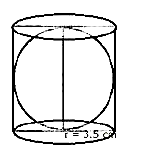
Radius of the base of the cylindrical can $= 3.5\ cm$
$(1)$ When the sphere is in can, then total surface area of the can $=$ Base area $+$ curved surface area
$=\pi r^2+2 \pi r h $
$=\left(\frac{22}{7} \times 3.5 \times 3.5\right)+\left(2 \times \frac{22}{7} \times 3.5 \times 7\right) $
$ =\frac{77}{2}+154$
$ =38.5=154 $
$=192.5\ cm ^2$
$(2)$ Let depth of water $= x\ cm$
When sphere is not in the can, then volume of the can $=$ volume of water $+$ volume of sphere
$\Rightarrow \pi r^2 h+\pi^2 x \times+\frac{4}{3} \pi r^3 $
$ \Rightarrow \pi r^2 h+\pi r^2\left(x+\frac{4}{3} r\right) $
$ \Rightarrow h=x+\frac{4}{3} r $
$\Rightarrow x=h-\frac{4}{3} r $
$\Rightarrow x=7-\frac{4}{3} \times \frac{7}{2} $
$ \Rightarrow x=7-\frac{14}{3}$
$ \Rightarrow x=\frac{21-14}{3} $
$\Rightarrow x=\frac{7}{3} $
$\Rightarrow x=2 \frac{1}{3} cm$ View full question & answer→Question 94 Marks
The horizontal cross-section of a water tank is in the shape of a rectangle with semi-circle at oneend, as shown in the following figure. The water is $2.4$ metres deep in the tank. Calculate thevolume of water in the tank in gallons.
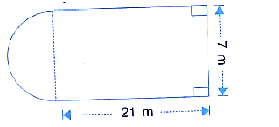
AnswerLength $= 21\ m$
Depth of water $= 2.4\ m$
Breadth $= 7\ m$
Therefore, radius of semicircle $=\frac{7}{2} m$
Area of cross-section $=$ area of rectangle $+$ Area of semicircle
$=1 \times b+\frac{1}{2} \pi r^2$
$=21 \times 7+\frac{1}{2} \times \frac{22}{7} \times \frac{7}{2} \times \frac{7}{2}$
$ =147+\frac{77}{4} $
$ =\frac{588+77}{4}$
$=\frac{665}{4} m^2$
Therefore, volume of water filled in gallons
$=\frac{665}{4} \times 2.4 m ^3$
$=665 \times 0.6 $
$=399 m ^3$
$ =399 \times 100^3 cm ^3$
$=\frac{399 \times 100 \times 100 \times 100}{1000} \text { gallons }$
$=\frac{399 \times 100 \times 100 \times 100}{1000 \times 4.5}$
$=\frac{399 \times 100 \times 100 \times 100 \times 10}{1000 \times 45} \text { gallons }$
$ =\frac{1330000}{15} \text { gallons } $
$=\frac{266000}{3} \text { gallons } $
$ =88666.67 \text { gallons }$
View full question & answer→Question 104 Marks
The cross-section of a railway tunnel is a rectangle $6$ m broad and 8 m high surmounted by asemi-circle as shown in the figure. The tunnel is $35$ m long. Find the cost of plastering theinternal surface of the tunnel (excluding the floor) at the rate of $Rs. 2.25$ per $m^2$
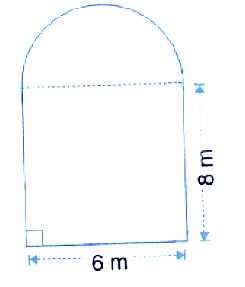
AnswerBreadth of the tunnel $= 6\ m$
Height of the tunnel $= 8\ m$
Length of the tunnel $= 35\ m$
Radius of the semi-circle $= 3\ m$
Circumference of the semi-circle =$\pi r$
$=\frac{22}{7} \times 3$
$ =\frac{66}{7} m $
Internal surface area of the tunnel
$=35\left(8+8+\frac{66}{7}\right) $
$ =35\left(16+\frac{66}{7}\right)$
$=35\left(\frac{112+66}{7}\right) $
$=35 \times \frac{178}{7} $
$ =890 m ^2$
$\text { Rate of plastering the tunnel }=\text { Rs. } 2.25 \text { per } m ^2$
$\text { Therefore, total expenditure }=\text { Rs. } 890 \times \frac{225}{100} $
$ =890 \times \frac{9}{4}$
$ =\frac{8010}{4} $
$=\text { Rs. } 2002.5$
View full question & answer→Question 114 Marks
A vessel is in the form of an inverted cone its height is $8\ cm$ and the radius of its top, which isopen, is $5\ cm.$ If is filled with water up to the rim. When lead shots each of which is a sphere ofradius $0.5\ cm$ are dropped into the vessel, one fourth of the water flows out. Find the number oflead shots sopped in the vessel.
Answer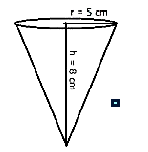
Height of cone $= 8 cm$
Radius $= 5 cm$
Volume $=\frac{1}{3} \pi r^2 h$
$=\frac{1}{3} \times \frac{22}{7} \times 5 \times 5 \times 8 cm ^3$
$=4400 / 21 cm ^{\wedge} 3$
Therefore, volume of water flowed out $=$
$=\frac{1}{4} \times \frac{4400}{21} cm ^3$
$=\frac{1100}{21} cm ^3$
Volume of a ball$=\frac{4}{3} \pi r^3$
$=\frac{4}{3} \times \frac{22}{7} \times \frac{1}{2} \times \frac{1}{2} \times \frac{1}{2} cm ^3$
$=\frac{11}{21} cm ^3$
Therefore, N . of balls $=1100 / 21 \div 11 / 21=100$
Hence, number of lead balls $=100$ View full question & answer→Question 124 Marks
A cubical block of side $7$ cm is surmounted by a hemisphere of the largest size. Find the surfacearea of the resulting solid.
AnswerThe diameter of the largest hemisphere that can be placed on a face of a cube of side $7$ cm willbe $7$ cm.
Therefore, radius $=r=\frac{7}{2} cm$
Its curved surface area $=2 \pi r^2$
$=2 \times \frac{22}{7} \times \frac{7}{2} \times \frac{7}{2}$
$=77 cm ^2 .......(1)$
Surface area of the top of the resulting solid $=$ Surface area of the top face of the cube $−$ Area ofthe base of the hemisphere
$=(7 \times 7)-\left(\frac{22}{7} \times \frac{49}{4}\right)$
$=49-\frac{77}{2}$
$=\frac{98-77}{2}$
$=\frac{21}{2}$
$=10.5 cm ^2 \ldots \ldots . . . . . . . .(2)$
Surface area of the cube $=5 \times(\text { side })^2=5 \times 49=245 cm ^2$
Total area of resulting solid $=245+10.5+77=332.5 cm ^2$
View full question & answer→Question 134 Marks
A hollow sphere of internal and external diameter 4 cm and 8 cm respectively is melted into acone of base diameter 8 cm. Find the height of the cone.
AnswerExternal diameter = 8 cm
Therefore, radius (R) = 4 cm
Internal diameter = 4 cm
Therefore, radius (r) = 2 cm
Volume of metal used in hollow sphere = $\frac{4}{3} \pi\left(R^3-r^3\right)=\frac{4}{3} \times \frac{22}{7} \times\left(4^3-2^3\right)=\frac{88}{21}(64-8)=\frac{88}{21} \times 56 cm ^3 \ldots \ldots..(1)$
Diameter of cone = 8 cm
Therefore, radius = 4 cm
Let height of cone = h
$\therefore$ Volume $=\frac{1}{3} \pi r^2 h=\frac{1}{3} \times \frac{22}{7} \times 4 \times 4 \times h=\frac{352}{21} h \ldots . .(2)$
From (i) and (ii)
$\frac{352}{21} h=\frac{88}{21} \times 56$
$\Rightarrow h=\frac{88 \times 56 \times 21}{21 \times 352}=14$
Height of the cone = 14 cm.
View full question & answer→Question 144 Marks
The surface area of a solid sphere is increased by $21\%$ without changing its shape. Find the percentage increase in its: volume
AnswerLet the volume of the sphere be $V$
Let the new volume of the sphere be $V'.$
$V=\frac{4}{3} \pi r^3 $
$ V^I=\frac{4}{3} \pi r_1^3$
$ \Rightarrow V^I=\frac{4}{3} \pi\left(\frac{11 r}{10^3}\right) $
$ \Rightarrow V^I=\frac{4}{3} \pi \frac{1331}{1000} r^3$
$\Rightarrow v^I=\frac{4}{3} \pi r^3 \frac{1331}{1000}$
$ \Rightarrow V^I=\frac{1331}{1000} V $
$\Rightarrow V^I=v+\frac{1331}{1000} v$
$\Rightarrow V^I-v=\frac{331}{1000} v$
$\therefore$ Change in volume $=\frac{331}{10000} v$
Percentage change in volume $=\frac{\text { Change in volume }}{\text { original volume }} \times 100$
$ =\frac{\frac{331}{1000} V }{V} \times 100 $
$ =\frac{331}{10} \\ =33.1$
Percentage change in volume $=33.1 \%$
View full question & answer→Question 154 Marks
The surface area of a solid sphere is increased by $12\%$ without changing its shape. Find the percentage increase in its: radius .
AnswerLet the radius of the sphere be $'r'.$
Total surface area the sphere, $S=4 \pi r^2$
New surface area of the sphere, $S^{\prime}$
$=4 \pi r^2+\frac{21}{100} \times 4 \pi r^2$
$ =\frac{121}{1004} \pi r^2$
$(1)$ let the new radius be $r^1$
$S^I=4 p r_1^2$
$S^I=\frac{121}{1004} \pi r^2$
$\Rightarrow 4 \pi r_1^2=\frac{121}{100} 4 \pi r^2$
$\Rightarrow r_1^2=\frac{121}{100} r^2 $
$ \Rightarrow r_1=\frac{11}{10} r $
$ \Rightarrow r_1=r+\frac{r}{10} $
$ \Rightarrow r_1-r=\frac{r}{10} $
$ \Rightarrow \text { change in radius }=\frac{r}{10}$
Percentage change in radius $=\frac{\text { change in radius }}{\text { change in radius }} \times 100$
$\Rightarrow \frac{\frac{r}{10}}{r} \times 100$
Percentage change in radius $=10\%$
View full question & answer→Question 164 Marks
A solid sphere and a solid hemi-sphere have the same total surface area. Find the ratio between their volumes.
AnswerLet the radius of the sphere be $I r_1 I$.
Let the radius of the hemisphere be $I r_2 I$
TSA of sphere $=4 \pi r_1^2$
TSA of hemisphere $=3 \pi r_2^2 e$
TSA of sphere = TSA of hemi-sphre
$4 \pi r_1^2=3 \pi r_2^2$
$\Rightarrow r_2^2=\frac{4}{3} r_1^2$
$\Rightarrow r_2=\frac{2}{\sqrt{3}} r_1$
Volume of sphere, $v_1=\frac{4}{3} \pi r_1^3$
Volume of hemisphere, $v_2=\frac{2}{3} \pi r_2^3$
$v_2=\frac{2}{3} \pi r_2^3$
$\Rightarrow v_2=\frac{2}{3} \pi\left(\frac{r_1 2}{3 \sqrt{3}}\right)^3$
$\Rightarrow v_2=\frac{2}{3} \pi \frac{r_2^3 8}{3 \sqrt{3}}$
Dividing $v_1 b y v_2$
$\frac{v_1}{v_2}=\frac{\frac{4}{3} \pi r_1^3}{\frac{2}{3} \pi \frac{8}{3 \sqrt{3}} r_1^3}$
$\Rightarrow \frac{v_1}{v_2}=\frac{\frac{4}{3}}{\frac{2}{3} \frac{8}{3 \sqrt{3}}}$
$\Rightarrow \frac{v_1}{v_2}=\frac{4}{3} \times \frac{9 \sqrt{3}}{16}$
$\Rightarrow \frac{v_1}{v_2}=\frac{3 \sqrt{3}}{4}$
View full question & answer→Question 174 Marks
Two right circular cone x and y are made x having three times the radius of y and y having halfthe volume of x. Calculate the ratio between the heights of x and y.
AnswerLet radius of cone $y = r$
Therefore, radius of cone $x = 3r$
Let volume of cone $y = V$
then volume of cone $x = 2V$
Let $h_1$ be the height of $x$ and $h_2$ be the height of $y.$
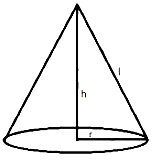
Therefore, Volume of cone$=\frac{1}{3} \pi r^h$
Volume of cone $x=\frac{1}{3} \pi(3 r)^2 h_1=\frac{1}{3} \pi 9 r^2 h_1=3 \pi^2 h_1$
Volume of cone $y=\frac{1}{3} \pi r^2 h_1$
$\therefore 2 \frac{V}{v}=\frac{3 \pi r^2 j_1}{\frac{1}{3} \pi r^2 h_2}$
$\Rightarrow \frac{2}{1}=\frac{3 h_1 \times 3}{h_2}=\frac{9 h_1}{h_2}$
$\Rightarrow \frac{h_1}{h_2}=\frac{2}{1} \times \frac{1}{9}=\frac{2}{9}$ View full question & answer→Question 184 Marks
A vessel, in the form of an inverted cone, is filled with water to brim. Its height is $32 cm$ anddiameter of the base is $25.2 cm.$ Six equal solid cones are dropped in it, so that they are fullysubmerged. As a result one fourth of water is volume of each of the solid cone submerged?
Answer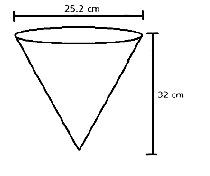
Volume of vessel=volume of water $=\frac{1}{3} \pi r^2 h$
diameter $= 25.2\ cm,$ therefore radius $= 12.6\ cm$
height $= 32\ cm$
Volume of water in the vessel=$\frac{1}{3} \pi r^2 h$
$=\frac{1}{3} \times \frac{22}{7} \times 12.6 \times 12.6 \times 32$
$=5322.24 cm ^3$
On submerging six equal solid cones into it, one-fourth of the water overflows.
Therefore, volume of the equal solid cones submerged
$=$ Volume of water that overflows
$=\frac{1}{4} \times 5322.24$
$=1330.56 cm ^3$
Now, volume of each cone submerged
$=\frac{1330.56}{6}=221.76 cm ^3$ View full question & answer→Question 194 Marks
The area of the base of a conical solid is $38.5 cm^2$ and its volume is $154 cm^3$. Find curved surface area of the solid.
AnswerArea of the base, $\pi r^2=38.5 cm ^2$
Volume of the solid, $V =154 cm ^3$
Curved surface area of the solid $=\pi r^2 h$
$\text { Volume, } V =\frac{1}{3} \pi r^2 h$
$\Rightarrow 154=\frac{1}{3} \pi r^2 h$
$\Rightarrow h =\frac{154 \times 3}{\pi r^2}$
$\Rightarrow h =\frac{154 \times 3}{38.5}$
$=12 cm $
$\text { Area }=38.5$
$\pi r^2=38.5$
$\Rightarrow r^2=\frac{38.5}{3.14}$
$\Rightarrow r=\sqrt{\frac{38.5}{3.14}}$
$=3.5$
$\text { Curved surface area of solid }=\pi r l$
$=\pi r \sqrt{r^2+h^2}$
$=\frac{22}{7} \times 3.5 \times \sqrt{3.5^2+12^2}$
$=\frac{22}{7} \times 3.5 \times 12.5$
$=137.5 cm ^2$
View full question & answer→Question 204 Marks
A metal pipe has a bore (inner diameter) of $5 cm.$ The pipe is $5\ mm$ thick all round. Find the weight, in kilogram, of $2$ metres of the pipe if $1 cm^3$ of the metal weights $7.7 g.$
AnswerInner radius of the pipe $= r = \frac{5}{2} cm = 2.5\ cm$
External radius of the pipe $= R =$ Inner radius of the pipe $+$ Thickness of the pipes
$= 2.5 cm + 0.5 cm = 3 cm$
Length of the pipe $= h = 2 m = 200 cm$
Volume of the pipe $=$ External Volume $-$ Internal volume
$=\pi R ^2 h -\pi r ^2 h$
$=\pi\left( R ^2- r ^2\right) h$
$=\frac{22}{7}\left(3^2-\left(\frac{5}{2}\right)^2\right) \times 200$
$=\frac{22}{7} \times\left(9-\frac{25}{4}\right) \times 200$
$=\frac{22}{7} \times\left(\frac{36-25}{4}\right) \times 200$
$=\frac{22}{7} \times \frac{11}{4} \times 200$
$=\left(\frac{22}{7} \times 550\right)$
$=1728.6 cm ^3$
Since $1\ cm^3$ of the metal weights $7.7 g,$
$\therefore$ Weight of the pipe $= (1728.6 \times 7.7)g$
$=\left(1728 \times \frac{7.7}{1000}\right) kg$
$=13.31 kg $
View full question & answer→Question 214 Marks
What length of solid cylinder $2\ cm$ in diameter must be taken to recast into a hollow cylinder of external diameter $20\ cm, 0.25\ cm$ thickand $15\ cm$ long?
AnswerExternal diameter of hollow cylinder $=20 cm$
Therefore , radius $=10 cm$
Thickness $=0.25 cm$
Hence, Internal radius $=(10-0.25)=9.75 cm$
Length of cylinder $(h)=15 cm$
$\therefore \text { volume }=\pi h\left(R^2-r^2\right)=\pi \times 15\left(10^2-9.75^2\right)$
$=15 \pi(100-95.0625) cm ^3$
$=15 \pi \times 4.9375 cm ^3$
Diameter $=2 cm$
Therefore, radius $(r)=1 cm$
Let $h$ be the lenght
then, volume $=\pi r^2 h=\pi(1 \times 1) h=\pi h$
Now, according to given condition:
$\pi h=15 \pi \times 4.9375$
$\Rightarrow h=15 \times 4.9375$
$\Rightarrow h=74.0625$
Length of cylinder $=74.0625 cm$
View full question & answer→Question 224 Marks
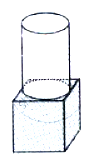
The given figure shows a solid formed of a solid cube of side 40cm and a solid cylinder of radius $20 cm$ and height $50 cm$ attached to the cube as shown.
Find the volume and the total surface area of the whole solid (Take $\pi = 3.14$).AnswerEdge of a cube $= I = 40 cm$
∴ Volume of a cube $= I^3 = (40)^3 = 64000 cm^3$
Radius of a solid cylinder $= r = 20 cm$
Height of a solid cylinder $= h = 50 cm$
∴ Volume of cylinder $= \pi r^2h$
$= 3.14 \times 20 \times 20 \times 50$
$= 62800 cm^3$
∴ Volume of whole solid = Volume of cube + Volume of cylinder
$= (64000 + 62800) cm^3$
$= 126800 cm^3$
Total surface area of the whole solid
= Total surface area of a cube + Curved surface area of a cylinder
$= 6l^2 + 2\pi rh$
$= 6 \times (40)^2 \times 2 \times 3.14 \times 20 \times 50$
$= 9600 + 6280$
$= 15880 cm^2$
View full question & answer→Question 234 Marks
The total surface area of a hollow cylinder, which is open from both sides, is $3575 cm^2$; area of the base ring is 357.5 $cm ^2$ and height is $14\ cm$ . Find the thickness of the cylinder.
AnswerTotal surface area of a hollow cylinder $= 3575\ cm^2$
Area of the base ring $= 357.5\ cm^2$
Height $= 14\ cm$
Let external radius $= R$ and internal radius $= r$
Let thickness of the cylinder $= d = (R-r)$
Therefore, Total surface area $= 2\pi Rh + 2\pi rh + 2\pi (R^2 - r^2)$
$= 2\pi h (R+r)+2\pi (R+r)(R-r)$
$= 2\pi (R + r)(h + R - r)$
$= 2\pi (R + r) (h+d)$
$= 2\pi (R+r)(14+d)$
But
$2\pi (R+r)(14+d) = 3575 ...(i)$
and area of base =
$\pi (R^2 - r^2) = 357.5$
$\Rightarrow \pi (R+r)(R-r) = 357.5$
$\Rightarrow \pi (R+r)d = 357.5 ...(ii)$
Dividing (i) by (ii)
$\frac{2 \pi( R + r )(14+ d )}{\pi( R + r ) d }=\frac{3575}{357.5}$
$\frac{2(14+ d )}{ d }=10$
$28+2 d=10 d$
8d=28
$d =\frac{28}{8}=3.5 cm$
Hence , thickness of the cylinder = 3.5 cm
View full question & answer→Question 244 Marks
Two solid cylinders, one with diameter $60 \ cm$ and height $30 \ cm$ and the other with radius $30 \ cm$ and height $60 \ cm, $aremetledandrecastedinto a third solid cylinder of height $10 \ cm$. Find the diameter of the cylinder formed.
AnswerFor cylinder 1,
Height $= h_1 = 30 cm$
Radius $=r_1=\frac{60}{2}=30 cm$
Volume $= V _1=\pi r _1^2 h _1=\pi \times 30 \times 30 \times 30=27000 \pi cm ^3$
For cylinder 2 ,
Height $= h_2 = 60 cm$
Radius $= r_2 = 30 cm$
Volume $= V _2=\pi r _2^2 h _2=\pi \times 30 \times 30 \times 60=54000 \pi cm ^3$
Let r be the radius of the third cylinder.
Height = h = 10 cm
Volume $= V = \pi r^2h = \pi r^2 \times 10$
Now,
$V = V_1 + V_2$
$\Rightarrow \pi r^2 \times 10 = 27000 \pi + 54000 \pi$
$\Rightarrow \pi r^2 \times 10 = 81000 \pi$
$\Rightarrow r^2 = 8100$
$\Rightarrow r = 90$
$\Rightarrow $ Diameter $= 2r = 180 cm$
View full question & answer→Question 254 Marks
The total surface area of a solid cylinder is $616 cm^2$. If the ratio between its curved surface area and total surface area is $1 :2$; find the volume of the cylinder.
AnswerLet r and h be the radius and height of a solid cylinder. Total surface area of a cylinder = $616 cm^2$
⇒ 2πr (h+r) = 616 ....(i)
Curved surface area of a cylinder = 2πrh
$\text { Now, } \frac{\text { Curved surface area of a cylinder }}{\text { Total surface area of a cylinder }}=\frac{1}{2}$
$\Rightarrow \frac{2 \pi rh }{2 \pi r ( h + r )}=\frac{1}{2}$
$\Rightarrow \frac{ h }{ h + r }=\frac{1}{2}$
$\Rightarrow h =1$
Substituting h = r in (i) , we get
2πr (r+r) = 616
$\Rightarrow 2 \times \frac{22}{7} \times 2 r ^2=616$
$\Rightarrow r ^2=\frac{616 \times 7}{2 \times 22 \times 2}=49$
$\Rightarrow r =7= h$
$\therefore \text { Volume of cylinder }=\pi r ^2 h$
$=\frac{22}{7} \times 7 \times 7 \times 7=1078 cm ^3$
View full question & answer→Question 264 Marks
A circular tank of diameter $2\ m$ is dug and the earth removed is spread uniformly all around the tank to form an embankment $2\ m$ in width and $1.6\ m$ in height. Find the depth of the circular tank.
AnswerLet the depth of the circular tank be $h m$.
Radius of the tank $=\frac{2}{2} m =1 m = r$
$\therefore$ Volume of the tank $=\pi r^2 h=\pi \times 1 \times h=\pi hm ^3$
Now, volume of the embankment
$=$ Volume of hollow cylinder having height $1.6 m$
$=\pi\left(R^2-r^2\right) H $
$=\pi\left[(1+2)^2-(1)^2\right] \times 1.6 \\ =\pi(9-1) \times 1.6$
$=12.8 \pi m ^3$
Now,
Volume of tank = Volume of embankment
$ \Rightarrow \pi h =12.8 \pi$
$ \Rightarrow h =12.8\ m $
View full question & answer→Question 274 Marks
$3080 cm3$ of water is required to fill a cylindrical vessel completely and $2310 cm^3$ of water is required to fill itupto $5$ cm below the top. Find :
(i)radiusof the vessel.
(ii)heightof the vessel.
(iii)wettedsurface area of the vessel when it is half-filled with water.
AnswerLet r be the radius of the cylindrival vessel and h be its height
Now, volume of cylindrical vessel = volume of water filled in it
$\Rightarrow \pi r ^2 h =3080$
$\Rightarrow \frac{22}{7} \times r ^2 \times h =3080$
$\Rightarrow r ^2 \times h =980 \ldots \text {. (i) }$
Volume of cylindrical vessel of height $5 cm = (3080 - 2310) cm^3$
$\Rightarrow \pi r ^2 \times 5=770$
$\Rightarrow \frac{22}{7} \times r ^2 \times 5=770$
$\Rightarrow r ^2=49$
$\Rightarrow r=7 cm $
Substituting $r^2 = 49$ in (i) , we get
49 × h = 980
⇒ h = 20 cm
Wetted surface area of the vessel when it is half - filled with water
$=2 \pi rh +\pi r ^2$
$=\pi r (2 h + r )$
$=\frac{22}{7} \times 7(2 \times 10+7) \ldots . .\left(\text { Half }- \text { fil } \leq d \Rightarrow \text { Height }=\frac{20}{2}=10 cm \right)$
$=22 \times 27$
$=594 cm ^2$
View full question & answer→Question 284 Marks
Find the minimum length in cm and correct to nearest whole number of the thin metal sheet required to make a hollow and closed cylindrical box of diameter $20$ cm and height $35$ cm.
Given that the width of the metal sheet is 1 m. Also, find the cost of the sheet at the rate of Rs. $56$ per m.
Find the area of metal sheet required, if $10\%$ of it is wasted in cutting, overlapping, etc.
AnswerHeight of the cylindrical box = h = 35 cm
Base radius of the cylindrical box = r = 10 cm
Width of metal sheet = 1 m = 100 cm
Area of metal sheet required = Total surface area of the box
⇒ Length × width = 2 πr (r + h)
$\Rightarrow \text { Length } \times 100=2 \times \frac{22}{7} \times 10(10+35)$
$\Rightarrow \text { Length } \times 100=2 \times \frac{22}{7} \times 10 \times 45$
$\Rightarrow \text { Length }=\frac{2 \times 22 \times 10 \times 45}{100 \times 7}=28.28 cm =28 cm $
\therefore Area of metal sheet = $Length \times width = 28 \times 100 = 2800 cm^2 = 0.28 m^2$
\therefore Cost of the sheet at the rate of Rs. $56 ~per ~m^2 = Rs. (56 \times 028) = Rs 15.68$
Let the total sheet required be x.
Then , $x - 10\%$ of $x = 2800 cm^2$
$\Rightarrow x -\frac{10}{100} \times x =2800$
$\Rightarrow \frac{9 x}{10}=2800 $
$\Rightarrow x=\frac{2800 \times 10}{9}$
$\Rightarrow x=3111 cm ^2$
View full question & answer→Question 294 Marks
The radius of a solid right circular cylinder decreases by $20\%$ and its height increases by $10\%$. Find the percentage change in its : curved surface area.
AnswerCurved surface area (Original) of a solid right circular cylinder$=2 \pi rh$
$= 2 \pi \times 100 \times 100$
$= 20000 \pi cm^2$
Curved surface area (New) of a solid right circular cylinder
$= 2\pi r'h'$
$= 2 \pi \times 80 \times 110$
$= 17600 \pi cm^2$
Decrease in curved area
= Original CSA - New $CSA$
$= (20000 \pi - 17600 \pi ) cm^2$
$= 2400 \pi cm^2$
Percentage change in curved surface area =
$\frac{\text { Decrease in curved surface area }}{\text { Original curved surface area }} \times 100 \%$
$=\frac{2400 \pi cm ^2}{20000 \pi cm ^2} \times 100 \%$
$=12 \%$
View full question & answer→Question 304 Marks
The radius of a solid right circular cylinder decreases by 20% and its height increases by 10%. Find the percentage change in its : volume
AnswerLet the radius of a solid right circular cylinder be r = 100 cm
And , let the height of a solid right circular be h = 100 cm
Volume (original) of a solid right circular cylinder =$\pi r ^2 h$
$=\pi \times(100)^2 \times 100$
$=1000000 \pi cm ^3$
New radius = r' = 80 cm
New height = h' = 110 cm
∴ Volume (New) of a solid right circular cylinder = $\pi r \prime^2 h \prime$
$=\pi \times(80)^2 \times 110$
$=704000 \pi cm ^3$
∴ Decrease in volume = Original Volume - New Volume
$=1000000 \pi cm ^3-704000 \pi cm ^3$
$=296000 \pi cm ^3$
Percentage change in volume $=\frac{\text { Decrease in volume }}{\text { Original Volume }} \times 100 \%$
$=\frac{296000 \pi cm ^3}{1000000 \pi cm ^3} \times 100 \%$
$=29.6 \%$
View full question & answer→Question 314 Marks
The radius of a solid right circular cylinder increases by $20\%$ and its height decreases by $20\%$. Find the percentage change in its volume.
AnswerLet the radius of a solid right circular cylinder be r = 100 cm
And let the height of a solid right circular cylinder be $h = 100 cm$
$\therefore $ Volume (original) of a solid right circular cylinder
$=\pi r ^2 h$
$=\pi \times(100)^2 \times 100$
$=1000000 \pi cm ^3$
New radius $= r' = 120 cm$
New height $= h' = 80 cm$
$\therefore $ Volume (New) of a solid right circular cylinder $= \pi '^2 h'$
$= \pi \times (120)^2 \times 80$
$= 1152000 \pi cm^3$
$\therefore $ Increase in volume = New Volume - Original Volume
$= 1152000 \pi cm^3 - 1000000 \pi cm^3$
$= 152000 \pi cm^3$
Thus , Percentage change in volume =$\frac{\text { Increase in volume }}{\text { Original Volume }} \times 100 \%$
$=\frac{152000 \pi cm ^3}{1000000 \pi cm ^3} \times 100 \%$
$=15.2 \%$
View full question & answer→Question 324 Marks
The height and radius of base of a cylinder area in the ratio 3: 1. if it volume is $1029 \pi cm ^3$; find it total surface area.
AnswerRatio between height and radius of a cylinder=3:1
Volume $=1029 \pi cm ^3 \ldots \ldots .(1)$
Let radium of the base=r
then height = 3r
$\therefore$ Volume $=\pi r^2 h=\pi \times r^2 \times 3 r=3 \pi r 63 \ldots(2)$
From (1) and (2)
$3 \pi r 63=1029 \pi$
$r^3=\frac{1029}{3} \pi=343$
$r=7$
Therefore , radius = 7 cm and height =3xx7=21 cm
$\text { Now, total surface area }=2 \pi r(h+r)$
$=2 \times \frac{22}{7} \times 7 \times(21+7)$
$=2 \times \frac{22}{7} \times 7 \times 28$
$=1232 cm ^2$
View full question & answer→Question 334 Marks
In the following diagram a rectangular platform with a semi $-$ circular end on one side is $22$ metreslong from one end to the other end. If the length of the half circumference is $11$ metres. Find thecost of constructing the platform $,1.5$ metres high at the rate of $Rs. 4$ per cubic metres.
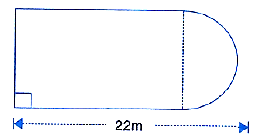
AnswerLength of the platform $= 22 \ m$
Circumference of semicircle $= 11 \ m$
$\therefore$ Radius $=\frac{c \times 2}{2 \times \pi}=\frac{11 \times 7}{22}=\frac{7}{2}\ m$
Therefore, breadth of the rectangular part $=\frac{7}{2} \times 2=7$
And length $=22-\frac{7}{2}=\frac{37}{2}=18.5\ m$
Now area of platform $=1 \times b+\frac{1}{2} \pi r^2$
$=18.5 \times 7+\frac{1}{2} \times \frac{22}{7} \times \frac{7}{2} \times \frac{7}{2} m ^2$
$=129.5+\frac{77}{4} m ^2$
$=148.75 m ^2$
Height of the platform $= 1.5 \ m$
$\therefore$ Volume $=148.75 \times 15=223.125 m ^3$
Rate of construction $=Rs. 4 \text{per} \ {m}^3$
Total expenditure $=Rs. 4 \times 223.125= Rs. 892.50$
View full question & answer→Question 344 Marks
An iron pole consisting of a cylindrical portion $110 \ cm$ high and of base diameter $12 \ cm$ issurmounted by a cone $9 \ cm$ high. Find the mass of the pole, given that $1 \ cm^3$ of iron has $8\ gm$ of mass $($approx$).$
Answer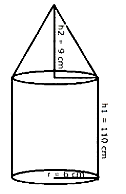
Radius of the base of poles $(r) = 6 \ cm$
Height of the cylindrical part $(h1) = 110 \ cm$
Height of the conical part $(h2) = 9 \ cm$
Total volume of the iron pole $=\pi r^2 h_1+\frac{1}{3} \pi r^2 h_2=\pi r^2\left(h_1+\frac{1}{3} h_2\right)$
$=\frac{355}{113} \times 6 \times 6\left(110+\frac{1}{3} \times 9\right)$
$=-\frac{355}{113} \times 36 \times 113$
$=12780 \ cm ^3$
Weight of $1 \ cm ^3=8 gm$
Therefore, total weight $=12780 \times 8$
$=102240\ gm$
$=102.24 \ kg$ View full question & answer→Question 354 Marks
The diameter of a sphere is $6 \ cm,$ It is melted and drawn into a wire of diameter $0.2 \ cm$. Findthe length of the wire.
AnswerDiameter of a sphere $= 6 \ cm$
Radius $= 3 \ cm$
$\therefore$ Volume $=\frac{4}{3} \pi r^3$
$=\frac{4}{3} \times \frac{22}{7} \times 3 \times 3 \times 3$
$=\frac{792}{7} \ cm ^3......(1)$
Diameter of cylindrical wire $= 0.2 \ cm$
Therefore, radius of wire $=\frac{0.2}{2}=0.1=\frac{1}{10} \ cm$
Let length of wire $= h$
$\therefore$ Volume $=\pi r^2 h$
$=\frac{22}{7} \times \frac{1}{10} \times \frac{1}{10} \times h m^3$
$=\frac{22 h}{700}.......(2)$
From $(i)$ and $(ii)$
$\frac{22 h}{700}=\frac{792}{7}$
$\Rightarrow h=\frac{792}{7} \times \frac{700}{22}$
$\Rightarrow h=3600 \ cm =36 \ m $
Hence, length of the wire $= 36 \ m$
View full question & answer→Question 364 Marks
A conical tent is to accommodate $77$ persons. Each person must have $16m^3$ of air to breathe. Given the radius of the tent as $7m,$ find the height of the tent and also its curved surface area.
AnswerAccording to the condition in the question,
$77 \times 16=\frac{1}{3} \pi r ^2 h$
$\Rightarrow 77 \times 16=\frac{1}{3} \times \frac{22}{7} \times 7 \times 7 \times h$
$\Rightarrow h =\frac{77 \times 16 \times 3 \times 7}{22 \times 7 \times 7}$
$\Rightarrow h =\frac{11 \times 16 \times 3}{22}$
$\Rightarrow h =24 m $
We know that,
$l^2= r^2+ h^2$
$\Rightarrow l^2= (7)^2+ (24)^2$
$\Rightarrow l^2= 49 + 576$
$\Rightarrow l^2= 625$
$\Rightarrow l = 25 m$
$\therefore$ Curved Surface Area $=\pi rl =\frac{22}{7} \times 7 \times 25=550 m ^2$
Thereforethe height of the tent is $24m$ and it curved surface area is $550m^2.$
View full question & answer→Question 374 Marks
A certain number of metallic cones, each of radius $2 \ cm$ and height $3\ cm,$ are melted and recast into a solid sphere of radius $6 \ cm.$ Find the number of cones used.
AnswerLet the number of cones melted be $n.$
Let the radius of sphere ber $s= 6 \ cm$
Radius of cone ber $ c= 2 \ cm$
And, height of the cone be $h = 3 \ cm$
Volume of sphere $= n ($Volume of a metallic cone$)$
$\Rightarrow \frac{4}{3} \pi r _{ s }^3= n \left(\frac{1}{3} \pi r _{ c }^2 h \right)$
$\Rightarrow \frac{4}{3} \pi r _{ s }^3= n \left(\frac{1}{3} \pi r _{ c }^2 h \right)$
$\Rightarrow \frac{4 r _{ s }^3}{ r _{ c }^2 h }= n$
$\Rightarrow n =\frac{4(6)^3}{(2)^2(3)}$
$\Rightarrow n =\frac{4 \times 216}{4 \times 3}$
$\Rightarrow n =72$
Hence , the number of cones is $72.$
View full question & answer→Question 384 Marks
Two solid spheres of radii $2 \ cm$ and $4 \ cm$ are melted and recast into a cone of height $8 \ cm$. Find the radius of the cone so formed.
AnswerRadius of small sphere $= r = 2 \ cm$
Radius of big sphere $= R = 4 \ cm$
Volume of small sphere $=\frac{4}{3} \pi r^3=\frac{4 \pi}{3} \times(2)^3=\frac{32 \pi}{3} \ cm ^3$
Volume of big sphere $=\frac{4}{3} \pi R^3=\frac{4 \pi}{3} \times(4)^3=\frac{256 \pi}{3} \ cm ^3$
Volume of both the spheres $=\frac{32 \pi}{3}+\frac{256 \pi}{3}=\frac{288 \pi}{3} \ cm ^3$
we need to find $R_1 . h=8 \ cm \ ($Given$)$
Volume of the cone $=\frac{1}{3} \pi R_1^2 \times(8)$
Volume of the cone $=$ Volume of both the sphere
$\Rightarrow \frac{1}{3} \pi R_1^2 \times(8)=\frac{288 \pi}{3}$
$\Rightarrow R_1^2 \times(8)=288$
$\Rightarrow R_1^2=\frac{288}{8} $
$\Rightarrow R_1^2=36$
$\Rightarrow R_1=6 \ cm $
View full question & answer→Question 394 Marks
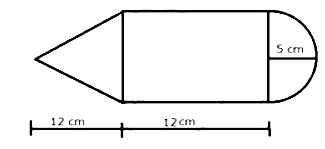
The given figure shows the cross $-$ section of a cone, a cylinder and a hemisphere all with the same diameter $10 \ cm$ and the other dimensions are as shown. Calculate: the total volume of the solid.
Answer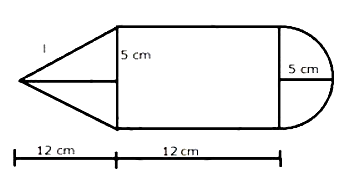
Diameter $= 10 \ cm$
Therefore, radius $(r) = 5 \ cm$
Height of the cone $(h) = 12 \ cm$
Height of the cylinder $= 12 \ cm$
$=\frac{1}{3} \pi r ^2 h +\pi r ^2 h +\frac{2}{3} \pi r ^3$
$=\pi r ^2\left(\frac{1}{3} h + h +\frac{2}{3} r \right)$
$=\frac{22}{7} \times 5 \times 5\left(\frac{1}{3} \times 12+12+\frac{2}{3} \times 5\right)$
$=\frac{550}{7}\left(4+12+\frac{10}{3}\right)$
$=\frac{550}{7}\left(16+\frac{10}{3}\right)$
$=\frac{550}{7} \times \frac{58}{3}$
$=\frac{31900}{21}$
$=1519.0476 \ cm ^3$ View full question & answer→Question 404 Marks
The given figure shows the cross$-$section of a cone, a cylinder and a hemisphere all with the same diameter $10 \ cm$ and the other dimensions are as shown. Calculate :the total surface area .
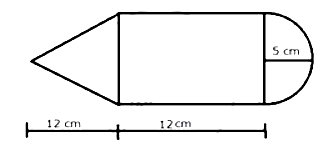
Answer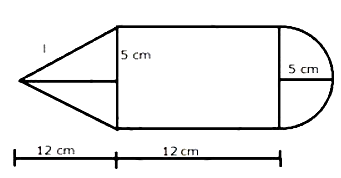
Diameter $= 10 \ cm$
Therefore, radius $(r) = 5 \ cm$
Height of the cone $(h) = 12 \ cm$
Height of the cylinder $= 12 \ cm$
$\therefore l =\sqrt{ h ^2+ r ^2}$
$=\sqrt{12^2+5^2}$
$=\sqrt{144+25}$
$=\sqrt{169}$
$=13 \ cm$
$=\pi rl +2 \pi rh +2 \pi r ^2$
$=\pi r ( l +2 h +2 r )$
$=\frac{22}{7} \times 5(13+(2 \times 12)+(2 \times 5))$
$=\frac{110}{7}(13+24+10)$
$=\frac{110}{7} \times 47$
$=\frac{5170}{7}$
$=738.57 \ cm ^2$ View full question & answer→Question 414 Marks
A wooden toy is in the shape of a cone mounted on a cylinder as shown alongside.If the height of the cone is $24 \ cm,$ the total height of the toy is $60 \ cm$ and the radius of the baseof the cone $=$ twice the radius of the base of the cylinder $= 10 \ cm;$ find the total surface area ofthe toy.
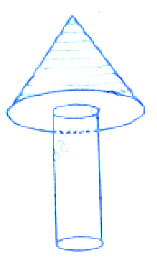
AnswerHeight of the cone $= 24 \ cm$
Height of the cylinder $= 36 \ cm$
Radius of the cone $=$ twice the radius of the cylinder $= 10 \ cm$
Radius of the cylinder $= 5 \ cm$
Slant height of the cone $=\sqrt{r^2+h^2}$
$=\sqrt{10^2+24^2}$
$=\sqrt{100+576}$
$=\sqrt{676}$
$=26 \ cm $
Now, the surface area of the toy $=$ curved area of the conical point $+$ curved area of the cylinder
$=\pi r l+\pi r^2+2 \pi R H$
$=\pi\left(r l+r^2+2 R H\right)$
$=3.14\left(10 \times 26 \times(10)^2+2 \times 5 \times 36\right)$
$=3.14(260+100+360)$
$=3.14(720)$
$=2260.8 \ cm ^2$
View full question & answer→Question 424 Marks
A circus tent is cylindrical to a height of $4 m$ and conical above it. If its diameter is $105 m$ and its slant height is $80 m,$ Calculate the total area of canvas required. Also, find the total cost of canvas used at $\text { Rs. } 15$ per metre if the width is $1.5 m$
Answer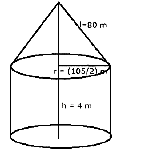
Radius of the cylindrical part of the tent $(r) =\frac{105}{2} m$
Slant height $(l)=80m$
Therefore, total curved surface area of the ten $t= 2 \pi r h+\pi r l$
$=\left(2 \times \frac{22}{7} \times \frac{105}{2} \times 4\right)+\left(\frac{22}{7} \times \frac{105}{2} \times 80\right)$
$=1320+13200$
$=14520 m ^2$
Width of canvas used $=1.5 m$
Total cost of canvas at the rate of $\text { Rs. }15$ per meter
Length of canvas $=\frac{14520}{1.5}$
$=9680 m$
$=9680 \times 15$
$=\text { Rs. }145200$ View full question & answer→Question 434 Marks
A hollow cylinder has solid hemisphere inward at one end and on the other end it is closed witha flat circular plate. The height of water is $10 \ cm$ when flat circular surface is downward. Findthe level of water, when it is inverted upside down, common diameter is $7 \ cm$ and height of the cylinder is $20 \ cm.$
Answer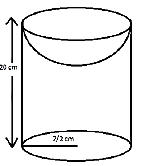
Let the height of the water level be $'h\ ',$ after the solid is turned upside down.
Volume of water in the cylinder $=\pi\left(\frac{7}{2}\right)^2 10$
Volume of the hemisphere $=\frac{2}{3} \pi\left(\frac{7}{2}\right)^3$
Volume of water in the cylinder $=$ Volume of water level $−$ Volume of the hemisphere
$\pi\left(\frac{7}{2}\right)^2 10=\pi\left(\frac{7}{2}\right)^2 h-\frac{2}{3} \pi\left(\frac{7}{2}\right)^2$
$\Rightarrow 10=h-\frac{7}{3}$
$h=10+\frac{7}{3}$
$h=12 \frac{1}{3} \ cm $
The height of water when the hemisphere is facing downwards is $12 \frac{1}{3} \ cm$ View full question & answer→Question 444 Marks
The given figure shows the cross section of a water channel consisting of a rectangle and a semicircle.Assuming that the channel is always full, find the volume of water discharged through itin one minute if water is flowing at the rate of $20 \ cm$ per second. Give your answer in cubicmetres correct to one place of decimal.
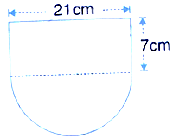
AnswerLength $= 21 \ cm,$ Breadth $= 7 \ cm$
Radius of semicircle $=\frac{21}{2} \ cm$
Area of cross section of the water channel $=1 \times b+\frac{1}{2} \pi r^2$
$=21 \times 7+\frac{1}{2} \times \frac{22}{7} \times \frac{21}{2} \times \frac{21}{2}$
$=147+\frac{693}{4}$
$=\frac{588+693}{4}$
$=\frac{1281}{4} \ cm ^2$
Flow of water in one minute at the rate of $20 \ cm$ per second
$\Rightarrow$ Length of the water column $=20 \times 60=1200 \ cm$
$\therefore$ volume of water $=\frac{1281}{4} \times 1200 \ cm ^2$
$=384300 \ cm ^2$
$=\frac{384300}{100 \times 100 \times 100} m ^3$
$=0.3843 m ^3$
$=0.4 m ^3$
View full question & answer→Question 454 Marks
The cross$-$section of a railway tunnel is a rectangle $6 m$ broad and $8 m$ high surmounted by asemi$-$circle as shown in the figure. The tunnel is $35 m$ long. Find the cost of plastering theinternal surface of the tunnel $($excluding the floor$)$ at the rate of $Rs. 2.25$ per $m^2$
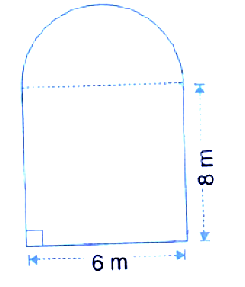
AnswerBreadth of the tunnel $= 6 m$
Height of the tunnel $= 8 m$
Length of the tunnel $= 35 m$
Radius of the semi$-$circle $= 3 m$
Circumference of the semi$-$circle $=\pi r$
$=\frac{22}{7} \times 3$
$=\frac{66}{7} m $
Internal surface area of the tunnel
$=35\left(8+8+\frac{66}{7}\right)$
$=35\left(16+\frac{66}{7}\right)$
$=35\left(\frac{112+66}{7}\right)$
$=35 \times \frac{178}{7}$
$=890 m ^2$
Rate of plastering the tunnel $=\text { Rs. } 2.25 \text { per } m ^2$
Therefore, total expenditure $=\text { Rs. } 890 \times \frac{225}{100}$
$=890 \times \frac{9}{4}$
$=\frac{8010}{4}$
$=\text { Rs. } 2002.5$
View full question & answer→Question 464 Marks
A cubical block of side $7 \ cm$ is surmounted by a hemisphere of the largest size. Find the surfacearea of the resulting solid.
AnswerThe diameter of the largest hemisphere that can be placed on a face of a cube of side $7 \ cm$ will be $7 \ cm.$
Therefore, radius $=r=\frac{7}{2} \ cm$
Its curved surface area $=2 \pi r^2$
$=2 \times \frac{22}{7} \times \frac{7}{2} \times \frac{7}{2}$
$=77 \ cm ^2.......(1)$
Surface area of the top of the resulting solid $=$ Surface area of the top face of the cube $−$ Area ofthe base of the hemisphere
$=(7 \times 7)-\left(\frac{22}{7} \times \frac{49}{4}\right)$
$=49-\frac{77}{2}$
$=\frac{98-77}{2}$
$=\frac{21}{2}$
$=10.5 \ cm ^2 \ldots \ldots . . . . . . . .(2)$
Surface area of the cube $=5 \times(\text { side })^2=5 \times 49=245 \ cm ^2$
Total area of resulting solid $=245+10.5+77=332.5 \ cm ^2$
View full question & answer→Question 474 Marks
From a rectangular solid of metal $42 \ cm$ by $30 \ cm$ by $20 \ cm,$ a conical cavity of diameter $14 \ cm$ and depth $24 \ cm$ is drilled out. Find: the surface area of remaining solid
AnswerTotal surface area of cuboid $= 2 (lb+bh+lh)$
$=2(42 \times 30+30 \times 20+20 \times 42)$
$=2(1260+600+840)$
$=2 \times 2700$
$=5400 \ cm ^2$
Diameter of the cone $= 14 \ cm$
$\Rightarrow$ Radius of the cone $=\frac{14}{2}=7 \ cm$
Area of circular base $=\pi r^2=\frac{22}{7} \times 7 \times 7=154 \ cm ^2$
$\pi r l=\frac{22}{7} \times 7 \times \sqrt{7^2+24^2}=22 \sqrt{49+576}=22 \times 25=550 \ cm ^2$
Area of curved surface area of cone $= \pi r l=\frac{22}{7} \times 7 \times \sqrt{7^2+24^2}$
$=22 \sqrt{49+576}=22 \times 25=550 \ cm ^2$
Surface area of remaining part $=5400+550-154=5796 \ cm ^2$
View full question & answer→Question 484 Marks
A solid cone of radius $5 \ cm$ and height $8 \ cm$ is melted and made into small spheres of radius $0.5\ cm.$ Find the number of sphere formed.
AnswerRadius of a solid cone $(r) = 5 \ cm$
Height of the cone $= 8 \ cm$
$\Rightarrow$ Volume of a cone
$=\frac{1}{3} \pi r^2 h$
$=\frac{1}{3} \times 5 \times 5 \times 8 \ cm ^3$
$=\frac{200 \pi}{3} \ cm ^3$
Radius of each sphere $= 0.5 \ cm$
$\therefore \text { Volume of one sphere }=\frac{4}{3} \pi r^3$
$=\frac{4}{3} \times I I \times \frac{1}{2} \times \frac{1}{2} \times \frac{1}{2} \ cm ^3$
$=I \frac{I}{6}$
$\text { Number of spheres }=\frac{\text { Total volume }}{\text { Volume of one sphere }}$
$=\frac{\frac{200 \pi}{3}}{\frac{\pi}{6}} \times \frac{6}{\pi}$
$=\frac{200 \pi}{3} \times \frac{6}{\pi}$
$=400$
View full question & answer→Question 494 Marks
The radii of the internal and external surface of a metallic spherical. It is melted and recast intoa solid right circular cone of height 32 cm. Find the diameter of the base of the cone.
AnswerInternal radius $=3 cm$
External radius $=5 cm$
Volume of spherical shell
$\begin{aligned}
& =\frac{4}{3} \pi\left(5^3-3^3\right) \\
& =\frac{4}{3} \times \frac{22}{7}(125-27) \\
& =\frac{4}{3} \times \frac{22}{7} \times 98
\end{aligned}$
Volume of solid circular cone
$\begin{aligned}
& \frac{1}{3} \pi r^2 h \\
& \frac{1}{3} \times \frac{22}{7} \times r^2 \times 32
\end{aligned}$
$\begin{aligned} & \text { Vol. of Cone }=\text { Vol. of sphere } \\ & \Rightarrow \frac{1}{3} \times \frac{22}{7} \times r^2 \times 32=\frac{4}{3} \times \frac{22}{7} \times 98 \\ & \Rightarrow r^2=\frac{4 \times 98}{32} \\ & \therefore r=2 \times \frac{7}{2} \\ & \therefore r=7 cm \end{aligned}$
View full question & answer→Question 504 Marks
A hollow sphere of internal and external diameter 4 cm and 8 cm respectively is melted into acone of base diameter 8 cm. Find the height of the cone.
AnswerExternal diameter $=8 cm$
Therefore, radius $(R)=4 cm$
Internal diameter $=4 cm$
Therefore, radius $(r)=2 cm$
Volume of metal used in hollow sphere $=$
$
\frac{4}{3} \pi\left(R^3-r^3\right)=\frac{4}{3} \times \frac{22}{7} \times\left(4^3-2^3\right)=\frac{88}{21}(64-8)=\frac{88}{21} \times 56 cm ^3 .
$Diameter of cone $=8 cm$
Therefore, radius $=4 cm$
Let height of cone $=h$
$
\therefore \text { Volume }=\frac{1}{3} \pi r^2 h=\frac{1}{3} \times \frac{22}{7} \times 4 \times 4 \times h=\frac{352}{21} h \text {. }
$From (i) and (ii)
$\begin{aligned}
& \frac{352}{21} h=\frac{88}{21} \times 56 \\
& \Rightarrow h=\frac{88 \times 56 \times 21}{21 \times 352}=14
\end{aligned}$
Height of the cone $=14 cm$.
View full question & answer→