Question 14 Marks
AB is a diameter of a circle with centre $0.$ If the ooordinates of $A$ and $0$ are $( 1, 4)$ and $(3, 6).$ Find the ooordinates of B and the length of the diameter.
Answer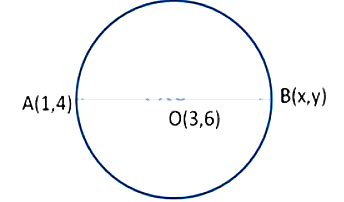
$O$ is the centre of the circle with diameter $A B$.
$\therefore AO : OB =1: 1$
Coordinnates of $O$ are,
$O(3,6)=O\left(\frac{1+x}{2}, \frac{4+y}{2}\right) $
$3=\frac{1+x}{2}, 6=\frac{4+y}{2} $
$6=1+x, 12=4+y $
$x=5, y=8$
Coordinates of B are $(5,8)$
$\text { Length of } A B=\sqrt{(5-1)^2+(8-4)^2} $
$=\sqrt{16+16}=4 \sqrt{2} \text { units }$ View full question & answer→Question 24 Marks
The midpoints of three sides of a triangle are $(1, 2), (2, -3)$ and $(3, 4).$ Find the centroid of the triangle.
Answer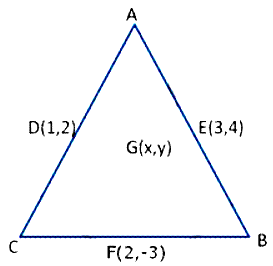
Let $A B C$ be a triangle
The midpoint of whose sides $A C, A B$ and $B C$ are $D, E$ and $F$ respectively.
We know that the centroid of $\triangle D E F$. Let $G(x, y)$ be the centroid of $\triangle A B C$ and $\triangle D E F$
Coordinates of centroid $G$ are ,
$G(x, y)=G\left(\frac{1+3+2}{3}, \frac{2+4-3}{3}\right)$
$=G(2,1)$ View full question & answer→Question 34 Marks
Two vertices of a triangle are $( -1, 4)$ and $(5, 2).$ If the centroid is $(0, 3),$ find the third vertex.
Answer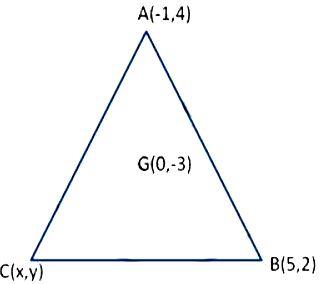
Let $G$ be the centroid of $\triangle A B C$ whose coordinaes are $(0,-3)$ and let $C(x, y)$ be the coordinates of thgird vertex
coordinates of $G$ are ,
$G(0,-3)=G\left(\frac{-1+5+x}{3}, \frac{4+2+y}{3}\right) $
$O=\frac{4+x}{3},-3=\frac{6+4}{3} $
$x=-4, y=-15$
Coordinates of third vertex are $(-4,-15)$ View full question & answer→Question 44 Marks
The coordinates of the centroid I of triangle PQR are $(2, 5).$ If $Q = (-6, 5)$ and $R = (7, 8).$ Calculate the coordinates of vertex $P.$
Answer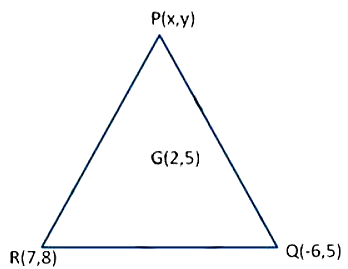
Let $G$ be the centroid of $\triangle P Q R$ whose coordinates are $(2,5)$ and let $(x, y)$ be the coordinates of vertex $P$.
Coordinates of $G$ are,
$G(2,5)=G\left(\frac{x-6+7}{3}, \frac{y+5+8}{3}\right) $
$2=\frac{x+1}{3}, 5=\frac{y+13}{3} $
$6=x+1,15=y+13 $
$x=5, y=2$
coordinates of vertex $P$ are $(5,2)$ View full question & answer→Question 54 Marks
$A( 4, 2), B(-2, -6)$ and $C(l, 1)$ are the vertices of triangle ABC. Find its centroid and the length of the median through C.
Answer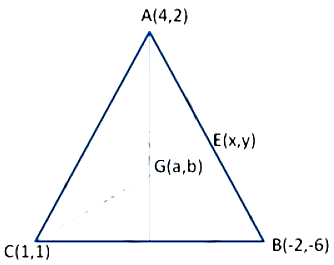
Let $G(a, b)$ be at centroid of $\triangle A B C$,
Coordinates of $G$ are ,
$G(a, b)=G=\left(\frac{4-2+1}{3}, \frac{2-6+1}{3}\right)=G(1,-1)$
Let CE be the median through C
$\therefore AE : EB =1: 1$
Coordinates of $E$ are
$E(x, y)=E\left(\frac{4-2}{2}, \frac{2-6}{2}\right)=E(1,-2)$
Length of median $C E=\sqrt{(1-1)^2+(2-1)^2}$
$=\sqrt{9} $
$=3 \text { units }$ View full question & answer→Question 64 Marks
The line joining P $(-5, 6)$ and Q $(3, 2)$ intersects the y-axis at R. PM and QN are perpendiculars from P and Q on the x-axis. Find the ratio PR: RQ.
Answer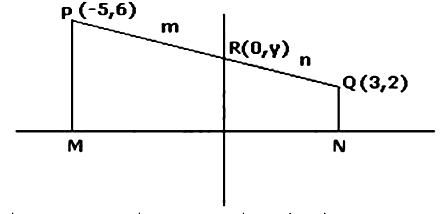
$R(O, y)$ is the point on the $y$-axis that divides $PQ.$
Let the ratio in which $P Q$ is divided by $R$ be m:n.
Now, $R(0, y)_t(x 1, y 1)=(-5,6)$ and $(x 2, y 2)=(3,2)$ and the ratio is $m: n$.
$0=\frac{ mx _2+ nx _1}{ m + n } $
$\Rightarrow 0=\frac{3 m -5 n }{ m + n } $
$\Rightarrow 0=3 m =5 n $
$\Rightarrow 3 m =5 n $
$\Rightarrow \frac{ m }{ n }=\frac{5}{3} $
$\Rightarrow m : n =5: 3 $
$\Rightarrow PR : RQ =5: 3$ View full question & answer→Question 74 Marks
Find the ratio in which the line $y = -1$ divides the line segment joining $(6, 5)$ and $(-2, -11).$ Find the coordinates of the point of intersection.
Answer
Let $R(x,-1)$ be the point on the line $y=-1$ which divides the line segment PQ in the ratio $k: 1$.
Coordinates of $R$ are,
$x=\frac{2 k+6}{k+1}, \quad-1=\frac{-11 k+5}{k+1} $
$x=\frac{-2\left(\frac{3}{5}\right)+6}{\frac{3}{5}+1}, \quad \Rightarrow-k-1=-11 k+5$
$\Rightarrow x=\frac{-6+30}{8} \Rightarrow 10 k=6 $
$x=3 \quad \Rightarrow k=3 / 5 \quad \ldots .(1)$
Hence, the required ratio is $3: 5$ and the point of inter sec tion is $(3,-1)$. View full question & answer→Question 84 Marks
Find the ratio in which the line $x = -2$ divides the line segment joining $(-6, -1)$ and $(1, 6).$ Find the coordinates of the point of intersection.
Answer
Let $P(-2, y)$ be the pcint on line $x$ which divides the line segment $A B$ the ratio $k: 1$.
Coordinates of $P$ are
$-2=\frac{ k -6}{ k +1} $
$\Rightarrow-2 k -2= k -6 $
$\Rightarrow-3 k =-4 $
$\Rightarrow k =\frac{4}{3} \ldots . .(1) $
$\Rightarrow k =\frac{4}{3} $
$y =\frac{6 k -1}{ k +1} $
$\Rightarrow y =\frac{69\left(\frac{4}{3}\right)-1}{\frac{4}{3}+1} \ldots(from(1))$
$\Rightarrow y =\frac{24-3}{7} $
$\Rightarrow y =3$
Hence, the required ratio is $4: 3$ and the point of intersection is $(-2,3)$. View full question & answer→Question 94 Marks
In what ratio does the point $(1, a)$ divided the join of $(-1, 4)$ and $( 4, -1)?$ Also, find the value of a.
Answer
Let the point $P(1, a)$ divides the line segment $A B$ in the ratio $k: 1$.
Coordinates of $P$ are,
$1=\frac{4 k -1}{ k +1} $
$\Rightarrow k +1=4 k -1 $
$\Rightarrow 2=3 k $
$\Rightarrow k =\frac{2}{3} \quad \ldots \ldots(1) $
$\Rightarrow a =\frac{- k +4}{ k +1} $
$\Rightarrow a =\frac{-\frac{2}{3}+4}{\frac{2}{3}+1} \ldots(\text { from (1)) } $
$\Rightarrow a =\frac{10}{5}=2$
Hence, the required ratio is $2: 3$ and the value of $a$ is $2 .$ View full question & answer→Question 104 Marks
Find the ratio in which the line $x = O$ divides the join of $( -4, 7)$ and $(3, 0).$
Also, find the coordinates of the point of intersection.
Answer
Let $S(0, y)$ be the point on line $x=0$ i.e. $y$-axis which divides the line segment $P Q$ in the ratio $k: 1$.
Coordinates of $S$ are,
$0=\frac{3 k -4}{ k +1} Y =\frac{0+7}{ k +1} $
$\Rightarrow 3 k =4$
$k =\frac{4}{3}\ldots(1)$
$Y=\frac{7}{\frac{4}{3}+1}\ldots(from(1))$
$Y=3$
Hence, the required ratio is $4: 3$ and the required point is $S ( O , 3)$. View full question & answer→Question 114 Marks
The points A, B and C divides the line segment MN in four equal parts. The coordinates of Mand N are (-1, 10) and (7, -2) respectively. Find the coordinates of A, B and C.
Answer
Given, $A(x, y), B(a, b)$ and $C(p, q)$ divides the line segment $M N$ ir four equal parts. $B$ in the mid point of $MN$. i.e. $MB : BN =1: 1$ Coordinates of $B$ are,
$
B(a, b)=B\left(\frac{7-1}{2}, \frac{-2+10}{2}\right)=B(3,4)
$
$A$ is the mid point of $M B$ i.e. $M A: A B=1: 1$
coordinates of $A$ are.
$
A ( x , y )= A \left(\frac{3-1}{2}, \frac{4+10}{2}\right)= A (1,7)
$
$C$ is the mid point of $BN$ i.e $BC : CN =1: 1$
$
C(p, q)=C\left(\frac{3+7}{2}, \frac{4-2}{2}\right)=C(5,1)
$
Hence, the coordinates of $A , B$ and $C$ are $(1,7),(3,4)$ and $(5,1)$ respectively View full question & answer→Question 124 Marks
In what ratio is the line joining $(2, -4)$ and $(-3, 6)$ divided by the line $y = O ?$
Answer
Let $P(x, O)$ be tne point on line $y=0$ i.e. $x$-axis which divides the line segment $A B$ in the ratio $k: 1$.
Coordinates of $P$ are
$x=\frac{3 k+2}{k+1}, 0=\frac{6 k-4}{k+1} $
$\Rightarrow 6 k=4 $
$\Rightarrow k=\frac{2}{3}$
Hence tne required ratio is $2: 3$. View full question & answer→Question 134 Marks
Find the coordinates of the points of trisection of the line segment joining the points $(3, -3)$ and $( 6, 9).$
Answer
Let $A(x, y)$ and $B(a, b)$ be the points of trisection of line segment MN MA:AN $=1:2$
$\therefore$ cocrdinates of $A$ are,
$x=\frac{1 \times 6+2 \times 3}{1+2}=4 $
$y=\frac{1 \times 9+2 \times-3}{1+2}=1 $
$A(4,1)$
Also, $MB : BN =2: 1$
coordinates of B are,
$a=\frac{2 \times 6+1 \times 3}{2+1}=5 $
$b=\frac{2 \times 9+1 \times-3}{21}=5 $
$B(5,5)$
points of trisection are $(4,1)$ and $(5,5)$. View full question & answer→Question 144 Marks
$A (30, 20)$ and $B ( 6, -4)$ are two fixed points. Find the coordinates of a point Pin $AB$ such that $2PB = AP.$ Also, find the coordinates of some other point Qin $AB$ such that $AB = 6 AQ.$
Answer
$2 PB = AP$
$\Rightarrow \frac{ AP }{ PB }=\frac{2}{1}$
$\Rightarrow \text { Coordinates of } P \text { are }$
$P ( x , y )= P \left(\frac{2 \times 6+1 \times 30}{2+1}, \frac{2 \times-4+1 \times 20}{2+1}\right)$
$= P (14,4)$

$AB : AQ =6: 1$
$AQ : QB =1: 5$
Coordinates of $Q$ are
$Q(a, b)=Q\left(\frac{1 \times 6+5 \times 30}{1+5}, \frac{1 \times-4+5 \times 20}{2+1}\right)=Q(26,16)$ View full question & answer→Question 154 Marks
P and Q are two points lying on the x - axis and the y-axis respectively . Find the coordinates of P and Q if the difference between the abscissa of P and the ordinates of Q is $1$ and PQ is $5$ units.
Answer$P$ lies on $x$-axis and $Q$ lies on $y$-axis
Let abscissa $P$ be $x$ then ordinate of $Q$ is $x -1$
$\therefore P(x, 0), Q(0, x-1)$
Given $P Q=5$ units
$\sqrt{( x -0)^2+(0-x+1)^2}=5$
squaring both sides
$x^2+x^2+1-2 x=25 $
$2 x^2-2 x-24=0 $
$x^2-x-12=0 $
$x^2-4 x+3 x-12=0 $
$(x-4)(x+3)=0 $
$x=+4 \text { or }-3$
Coordinates of $P$ are $(4,0)$ or $(-3,0)$
Coordinates of $Q$ are $(0,3)$ or $(0,-4)$
View full question & answer→Question 164 Marks
Find the relation between a and b if the point $P(a ,b)$ is equidistant from $A (6,-1)$ and $B (5 , 8).$
Answer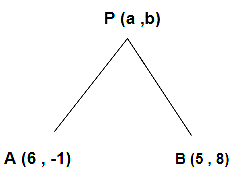
Given , $PA = PB$
$\therefore PA^2 = PB^2$
$\Rightarrow (a - 6)^2 + (b + 1)^2 = (a - 5)^2 + (b - 8)^2$
$\Rightarrow a^2 + 36 - 12a + b^2 + 1 + 2b = a^2 + 25 - 10 a + b^2 + 64 - 16 b$
$\Rightarrow -2a + 18b - 52 = 0$
$\Rightarrow -a + 9b - 26 = 0$
$\Rightarrow a = 9b - 26$ View full question & answer→Question 174 Marks
Prove that the points (0 , -4) , (6 , 2) , (3 , 5) and (-3 , -1) are the vertices of a rectangle.
Answer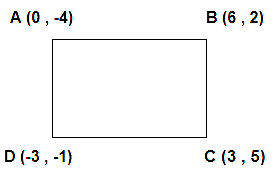
$A B=\sqrt{(6-0)^2+(2+4)^2}=6 \sqrt{2}$ units
$BC =\sqrt{(6-3)^2+(2-5)^2}=3 \sqrt{2}$ units
$CD =\sqrt{(3+3)^2+(5+1)^2}=6 \sqrt{2}$ units
DA $=\sqrt{(-3-0)^2+(-1+4)^2}=3 \sqrt{2}$ units
$A C=\sqrt{(3-0)^2+(5+4)^2}=3 \sqrt{10}$ units
$BD =\sqrt{(6+3)^2+(2+1)^2}=3 \sqrt{10}$ units
$\because A B=C D$ and $B C=D A$,
Also $A C=B D$
$\therefore ABCD$ is a rectangle. View full question & answer→Question 184 Marks
Prove that the points $(a , b) , (a + 3 , b + 4) , (a - 1 , b + 7)$ and $(a - 4 , b + 3)$ are the vertices of a parallelogram.
Answer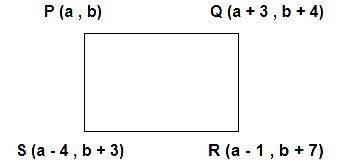
$P Q=\sqrt{(a+3-a)^2+(b+4-b)^2}=\sqrt{9+16}=5 \text { units } $
$Q R=\sqrt{(a+3-a+1)^2+(b-4-b-7)^2}=\sqrt{16+9}=5 \text { units } $
$R S=\sqrt{(a-1-a+4)^2+(b+7-b-3)^2}=\sqrt{9+16}=5 \text { units } $
$S P=Q R=\sqrt{(a-4-a)^2+(b+3-b)^2}=\sqrt{16+9}=5 \text { units }$
Since the opposite sides of quadrilateral PQRS are equal ,therefore it is a parallelogram. View full question & answer→Question 194 Marks
Prove that the points (0 , 0) , (3 , 2) , (7 , 7) and (4 , 5) are the vertices of a parallelogram.
Answer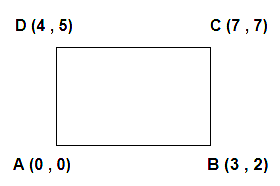
$A B=\sqrt{(3-0)^2+(2-0)^2}=\sqrt{9+4}=\sqrt{13}$ units $B C=\sqrt{(3-7)^2+(2-7)^2}=\sqrt{16+25}=\sqrt{41}$ units $CD =\sqrt{(7-4)^2+(7-5)^2}=\sqrt{9+4}=\sqrt{13}$ units $DA =\sqrt{(4-0)^2+(5-0)^2}=\sqrt{16+25}=\sqrt{41}$ units
$\because A B=C D$ and $B C=D A$
$\therefore ABCD$ is a parallelogram. View full question & answer→Question 204 Marks
Prove that the points $(0,3),(4,3)$ and $(2,3+2 \sqrt{3})$ are the vertices of an equilateral triangle.
Answer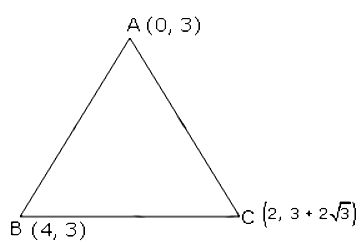
$A B=\sqrt{(0-4)^2+(3-3)^2}=4 \text { units } $
$B C=\sqrt{(4-2)^2+(3-3-2 \sqrt{3})^2}=\sqrt{4+12}=4 \text { units } $
$A C=\sqrt{(2-0)^2+(3+2 \sqrt{3}-3)^2}=\sqrt{4+12}=4 \text { units }$
$\because A B=B C=A C$
$\therefore ABC$ is an equilateral triangle. View full question & answer→Question 214 Marks
Prove that the points $(1,1),(-1,-1)$ and $(-\sqrt{3}, \sqrt{3})$ are the vertices of an equilateral triangle.
Answer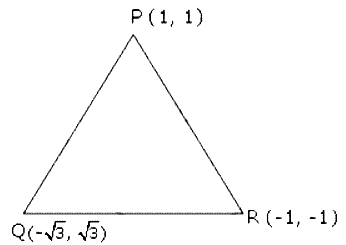
$PQ =\sqrt{(1+\sqrt{3})^2+(1-\sqrt{3})^2}=\sqrt{4+4} \sqrt{8} \text { units }$
$QR =\sqrt{(-\sqrt{3}+1)^2+(\sqrt{3}+1)^2}=\sqrt{4+4}=\sqrt{8} \text { units } $
$PR =\sqrt{(-1+1)^2+(-1+1)^2}=\sqrt{4+4}=\sqrt{8} \text { units }$
$\because PQ = QR = PR$
$\therefore PQR$ is an equilateral triangle. View full question & answer→Question 224 Marks
Prove taht the points $(-2 , 1) , (-1 , 4)$ and $(0 , 3)$ are the vertices of a right - angled triangle.
Answer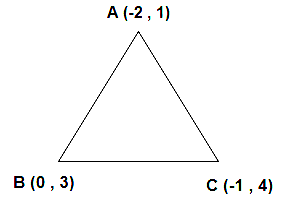
$A B=\sqrt{(-2-0)^2+(1-3)^2}=\sqrt{4+4}=\sqrt{8} \text { units } $
$B C=\sqrt{(10+1)^2+(3-4)^2}=\sqrt{1+1}=\sqrt{2} \text { units } $
$A C=\sqrt{(-2+1)^2+(1-4)^2}=\sqrt{1+9}=\sqrt{10} \text { units } $
$A B^2+B C^2=8+2=10 $
$A C^2=10 $
$\because A B^2+B C^2=A C^2$
$\therefore A, B$ and $C$ are the verices of a right angled triangle. View full question & answer→Question 234 Marks
Prove that the points (1 ,1),(-4 , 4) and (4 , 6) are the certices of an isosceles triangle.
Answer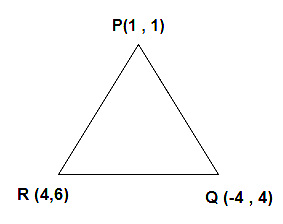
$P Q=\sqrt{(1+4)^2+(1-4)^2}=\sqrt{25+9}=\sqrt{34}$ units $QR =\sqrt{(-4-4)^2+(4-6)^2}=\sqrt{64+4} \sqrt{68}$ units $P R=\sqrt{(4-1)^2+(6-1)^2}=\sqrt{9+25}=\sqrt{34}$ units
$\because P Q=Q R$
$\therefore P, Q$ and $R$ are the vertices of an isosceles triangle. View full question & answer→Question 244 Marks
Prove that the points (6 , -1) , (5 , 8) and (1 , 3) are the vertices of an isosceles triangle.
Answer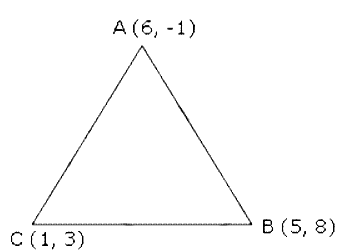
$A B=\sqrt{(6-5)^2+(-1-8)^2}=\sqrt{1+81}=\sqrt{82}$ units
$BC =\sqrt{(5-1)^2+(8-3)^2}=\sqrt{16+25}=\sqrt{41}$ units
$A C=\sqrt{(1-6)^2+(3-1)^2}=\sqrt{25+16}=\sqrt{41}$ units
$\because B C=A C$
$\therefore A, B$ and $C$ are the vertices of an isosceles triangle. View full question & answer→Question 254 Marks
If $(-3, 2), (1, -2) $ and $(5, 6)$ are the midpoints of the sides of a triangle, find the coordinates of the vertices of the triangle.
Answer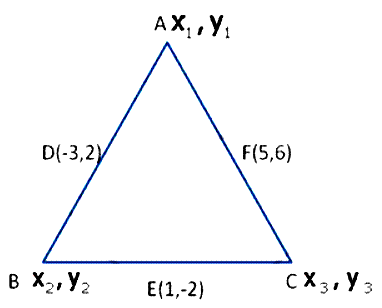
let $A\left(x_1, y_1\right), B\left(x_2, y_2\right)$ and $O\left(x_3, y_3\right)$ be the coordinates of the vertices of $\triangle A B C$.
$D$ is the midpoint of $A B<$
$D (-3,2)= D \left(\frac{ x _1+ x _2}{2}, \frac{ y _1+ y _2}{2}\right)$
$\frac{ x _1+ x _2}{2}=-3, \frac{ y _1+ y _2}{2}$
$x _1+ x _2=-6\ldots(1)$
$Y_1+Y_2=4\ldots(2)$
Similarly
$x_2+x_3=2\ldots(3)$
$Y 2+Y 3=-4\ldots(4)$
$x_1+x_3=10\ldots(5)$
$Y_1+Y_3=12\ldots(6)$
Adding $(1), (3) $ and $(5)$
$2\left(x_1+x_2+x_t\right)=6$
$x_1+x_2+x_3=3$
$-6+x_3=3$
$x_3=9$
From $(3)$
$x_2+9=2$
$x_2=9$
From $(3)$
$x_2+9=2$
$x_2=-7$
From $(5)$
$x_1+9=10$
$x_1=1$
Adding $(2), ( 4)$ and $(6)$
$2\left(y_1+Y_2+y_3\right)=12$
$y_1+Y_2+Y_3=6$
$4+y_3=6$
$Y_3=2$
from $(4)$
$y _2+2=-4$
$Y _2=-6$
from $(6)$
$Y_1+2=12$
$Y_1=10$
The coordinates of the vertices of $\triangle ABC$ are $(9,2),(1,10)$ and $(-7,-6)$. View full question & answer→Question 264 Marks
If the midpoints of the sides ofa triangle are $(-2, 3), (4, -3), (4, 5),$ find its vertices.
Answer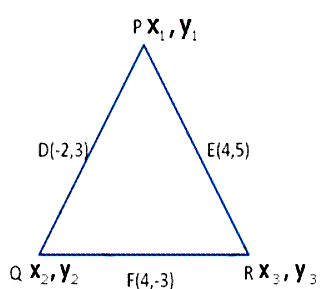
Let $P\left(x_1, y_1\right), Q\left(x_2, y_2\right)$ and $R\left(x_3, y_3\right)$ be the coordinates of the vertices of .
$\triangle P Q R$ Midpoint of $PQ$ is $D$
$D (-2,3)= D \left(\frac{ x _1+ x _2}{2}, \frac{ y _1+ y _2}{2}\right)$
$\frac{ x _1+ x _2}{2}=-2, \frac{ y _1+ y _2}{2}=3$
$X _1+ X _2=-4 \ldots . .(1), Y _1+ y _2=6\ldots(2)$
similarly,
$x_2+x_3=8 \ldots \ldots(3), y_2+y_3=-6\ldots(4)$
$x_1+x_3=8 \ldots .(5), y_1+y_3=10\ldots(6)$
Adding $(1), (3)$ and $(5)$
$2\left(x_1+x_2+x_3\right)=12$
$x_1+x_2+x_3=6$
$-4+x_3=6$
$x_3=10$
Adding $(2), (4)$ and $(6)$
$2\left(Y_1+Y_2+Y_3\right)=10$
$1+Y_2+Y_3=5$
$6+Y_3=5$
$Y_3=-1$ View full question & answer→Question 274 Marks
The points $(2, -1), (-1, 4) $ and $(-2, 2)$ are midpoints of the sides ofa triangle. Find its vertices.
Answer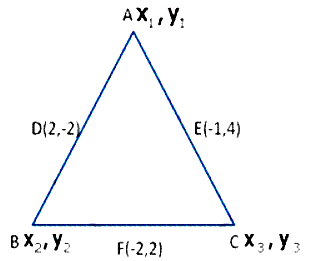
Let $A\left(x_1, y_1\right), B\left(x_2, y_2\right)$ and $C\left(x_3, y_3\right)$ be the coordinates of the vertices of $\triangle A B C$.
Midpoint of $A B$, i.e. $D$
$D(2,1)=D\left(\frac{x_1+x_2}{2}, \frac{y_1+y_2}{2}\right)$
$2=\frac{ x _1+ x _2}{2}, \frac{ y _1+ y _2}{2}=-1$
$x_1+x_2=4\ldots(1)$
$Y_1+Y_2=-2\ldots(2)$
Similarly,
$x_1+x_3=-2\ldots(3)$
$y_1+y_3=8\ldots(4)$
$x_2+x_3=-4\ldots(5)$
$Y_2+Y_3=4\ldots(6)$
Adding $(1), (3)$ and $(5)$
$2\left(x_1+x_2+x_3\right)=-2$
$x_1+x_2+x_3=-1$
$4+x_3=-1 \ldots\ ($from $(1))$
$x_3=-5$
From $(3)$
$x_1-5=-2$
$x_1=3$
From $(5)$
$x_2=-5=-4$
$x_2=1$
Adding $(2),(4)$ and $(6)$
$2\left(Y_1+Y_2+Y_3\right)=10$
$Y_1+Y_2+Y_3=5$
$-2+Y_3=5\ [$from $(2)]$
$y_3=7$
From $(4)$
$y_1+7=8$
$y_1=1$
From $(6)$
$y_2+7=4$
$y_2=-3$
The coordinates of the vertices of $A.\text{ABC}$ are $(3,1),(1,-3)$ and $(-5,7)$ View full question & answer→Question 284 Marks
Let $A(-a, 0), B(0, a)$ and $C(\alpha, \beta)$ be the vertices of the $L_1 \ \ce{ABC}$ and $G$ be its centroid. Prove that $G A^2+G B^2+G C^2=\frac{1}{3}\left(A B^2+B C^2+C A^2\right)$
Answer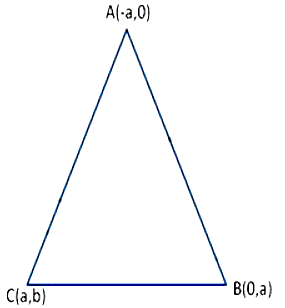
Coordinates of $G$ are,
$G(x, y)=G\left(\frac{-a+0+a}{3}, \frac{0+a+b}{3}\right)=G\left(0, \frac{a+b}{3}\right)$
$G A^2=(0+a)^2+\left(\frac{a+b}{3}-0\right)^2$
$G A^2=\frac{9 a^2+a^2+b^2+2 a b}{9}=\frac{10 a^2+b^2+2 a b}{9}$
$G B^2=(0-0)^2+\left(\frac{a+b}{3}-a\right)^2$
$G B^2=\left(\frac{b-2 a}{3}\right)^2=\frac{b^2+4 a^2-4 a b}{9}$
$G C^2=(0-a)^2+\left(\frac{a+b}{3}-b\right)^2$
$G C^2=a^2+\left(\frac{a-2 b}{3}\right)^2=\frac{9 a^2+a^2+4 b^2-4 a b}{9}$
$G A^2+G B^2+G C^2=\frac{10 a^2+b^2+2 a b+b^2+4 a^2-4 a b+10 a^2+4 b^2-4 a b}{9}$
$=\frac{24 a^2+6 b^2-6 a b}{9}$
$G A^2+G B^2+G C^2=\frac{1}{3}\left(8 a^2+2 b^2-2 a b\right)\ldots(1)$
$A B^2=(-a-0)^2+(0-a)^2=2 a^2$
$B C^2=(0-a)^2+(a-b)^2=a^2+a^2+b^2-2 a b=2 a^2+b^2-2 a b$
$A C^2=(-a-a)^2+(0-b)^2=4 a^2+b^2$
from $(1)$ and $(2)$
$G A^2+G B^2+G C^2=\frac{1}{3}\left(A B^2+B^2+C A^2\right)$ View full question & answer→Question 294 Marks
Prove that the points $A(-5, 4), B(-1, -2)$ and $C(S, 2)$ are the vertices of an isosceles right$-$angled triangle. Find the coordinates of $D$ so that $\ce{ABCD}$ is a square.
Answer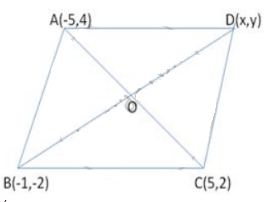
$A B=\sqrt{(-1+5)^2(-2-4)^2}=\sqrt{16+36}=\sqrt{52} \text { units }$
$B C=\sqrt{(-1-5)^2+(-2-2)^2}=\sqrt{36+36}=\sqrt{52} \text { units }$
$A C=\sqrt{(5+5)^2+(2-4)^2}=\sqrt{100+4}=\sqrt{104} \text { units }$
$A B^2+B C^2=52+52=104$
$A C^2=104$
$\because A B=A C $ and $A B^2+B C^2=A C^2$
$\therefore ABC$ is an isosceles right angled triangle.
Let the coordinates of $D$ be $( x , y )$
If $\ce{ABCD}$ is a square,
Midpoint of $AC =$ mid point of $BD$
$O\left(\frac{-5+5}{2}, \frac{4+2}{2}\right)=O\left(\frac{x-1}{2}, \frac{y-2}{2}\right)$
$O=\frac{x-1}{2}, 3=\frac{y-2}{2}$
$x=1, y=8$
Coordinates of $D$ are $(1,8)$ View full question & answer→Question 304 Marks
ABC is a triangle whose vertices are A(-4, 2), B(O, 2) and C(-2, -4). D. E and Fare the midpoint of the sides BC, CA and AB respectively. Prove that the centroid of the Δ ABC coincides with the centroid of the Δ DEF.
Answer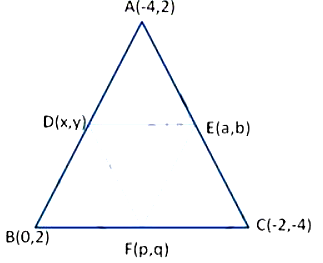
Let $D, E$ and $F$ be the midpoints of the sides $A B, A C$ and $B C$ of $\triangle A B C$ respectively.
$
\therefore AD : DB = BF : FC = AE : EC =1: 1
$
Coordinates of D are,
$
D ( x , y )= D \left(\frac{0-4}{2}, \frac{2+2}{3}\right)= D (-2,2)
$
Similarly ,
$
E(a, b)=E\left(\frac{-4-2}{2}, \frac{2-4}{2}\right)=E(-3,-1)
$
and,
$
F(p, q)=F\left(\frac{0-2}{2}, \frac{2-4}{2}\right)=F(-1,-1)
$
Coordinates of centroid of $\triangle ABC$ are,
$
=\left(\frac{-4-2+0}{3}, \frac{2-4+2}{3}\right)=(-2,0)
$
Coordinates of centroid of $\triangle D E F$ are ,
$
=\left(\frac{-2-3-1}{3}, \frac{2-1-1}{3}\right)=(-2,0)
$
Thud the centroid of $\triangle D E F$ coincides with centroid of $\triangle D E F$. View full question & answer→Question 314 Marks
$(4, 2)$ and $(-1, 5)$ are the adjacent vertices ofa parallelogram. $(-3, 2)$ are the coordinates of the points of intersection of its diagonals. Find the coordinates of the other two vertices.
Answer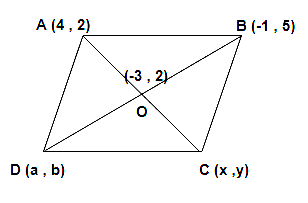
Let the coordinates of $C$ and $D$ be $( x , y )$ and $( a , b )$ respectively.
Midpoint of $AC$ is $O$ coordinates of $O$ are ,
$O(-3,2)=O\left(\frac{4+ x }{2}, \frac{2+ y }{2}\right)$
$-3=\frac{4+ x }{2}, 2=\frac{2+ y }{2}$
$-6=4+ x , 4=2+ y$
$x =-10, y =2$
$C (-10,2)$
Similarly, coordinates of midpoint of $DB,$ i.e. $O$ are,
$O(-3,2)=O\left(\frac{a-1}{2}, \frac{b+5}{2}\right)$
$-3=\frac{a-1}{2}, 2=\frac{b+5}{2}$
$-6=a-1,4=b+5$
$a=-5, b=-1$
$D(-5,-1)$
Thus, the coordinates of each other two vertices are $(-10,2)$ and $(-5-1)$ View full question & answer→Question 324 Marks
Find the ratio in which the point $P (2, 4)$ divides the line joining points $(-3, 1)$ and $(7, 6).$
Answer
Let the point $P$ divides $A B$ in the ratio $k: 1$.
Coordinates of $P$ are
$x=\frac{7 k-3}{k+1}$
$y=\frac{6 k+1}{k+1}$
But given, $P(x, y)=P(2,4)$
$\therefore 2=\frac{7 k -3}{ k +1}$
$\Rightarrow 2 k +2=7 k -3$
$\Rightarrow 5=5 k$
$\Rightarrow k =1$
$k : 1=1: 1$
or $4=\frac{6 k +1}{ k +1}$
$4 k +4=6 k +1$
$\Rightarrow 3=2 k$
$\Rightarrow k =\frac{3}{2}$
$k: 1=3: 2$ View full question & answer→Question 334 Marks
Show that the lines $x = O$ and $y = O$ trisect the line segment formed by joining the points $(-10, -4)$ and $(5, 8)$. Find the points of trisection.
Answer
Let $P(x, 0)$ lies on the line $y=0$
i.e. $x-$ axis and divides the line segment $A B$ in the ratio
Coordinates of $P$ are,
$P ( x , 0)= P \left(\frac{5 k -10}{ k +1}, \frac{8 k -4}{ k +1}\right)$
$\Rightarrow 0=\frac{8 k -4}{ k +1}, \frac{5 k -10}{ k +1}= x$
$\Rightarrow 8 k =4, \frac{5\left(\frac{1}{2}\right)-10}{\frac{1}{2}+ x }= x \ldots \ldots . . . $ from $(1)$
$\Rightarrow k =\frac{1}{2} \ldots \ldots . .(1), x =-5$
Hence $P(-5,0)$ divides $A B$ in the ratio $1: 2$ .
Let $Q(0, y)$ lies on the line $x=0$ i.e. $y -$ axis and
divides the line segment $A B$ in the ratio $k_1: 1$.
Coordinates of $Q$ are
$Q(0, y)=Q\left(\frac{5 k_1-10}{k_1+1}, \frac{8 k_1-4}{k_1+1}\right)$
$0=\frac{5 k_1-10}{k_1+1}, y=\frac{8 k_1-4}{k_1+1}$
$\Rightarrow 5 k_1=10, y=\frac{8(2)-4}{2+1} \ldots . . . $ from $(2)$
$\Rightarrow k_1=2 \ldots . \text { (2) } y=4$
Hence, $Q(O, 4)$ divides in the ratio $2 : 1$.
Hence proved Paid Qare the points of trisection of $AB$. View full question & answer→Question 344 Marks
Show that the line segment joining the points $(-3, 10)$ and $(6, -5)$ is trisected by the coordinates axis.
Answer
Let the coordinates of two points $x-$axis and $y-$axis be $P(x, O)$ and $G(0, y)$ respectively.
Let $P$ divides $A B$ in the ratio $k: 1$.
Coordinates of $P$ are
$P(x, 0)=P\left(\frac{6 k-3}{k+1}, \frac{-5 k+10}{k+1}\right)$
$\Rightarrow 0=\frac{-5 k+10}{k+1}$
$\Rightarrow 5 k=10$
$\Rightarrow k=2$
Hence $P$ divides $A B$ in the ratio $2: 1 .$
Let $Q$ divides $A B$ in the ratio $k_1: 1.$
Coordinates of $Q$ are,
$Q (0, y )= Q \left(\frac{6 k _1-3}{ k +1}, \frac{-5 k +10}{ k +1}\right)$
$\Rightarrow 0=\frac{6 k _1-3}{ k +1}$
$\Rightarrow 6 k _1=3$
$\Rightarrow k _1=\frac{1}{2}$
Hence $Q$ divides $A B$ in the ratio $1:2$
Hence proved, $P$ and $Q$ are the points of trisection. View full question & answer→Question 354 Marks
A (2, 5), B (-1, 2) and C (5, 8) are the vertices of triangle ABC. Point P and Q lie on AB and AC respectively, such that AP: PB = AQ: QC = 1: 2. Calculate the coordinates of P and Q. Also, show that 3PQ = BC.
Answer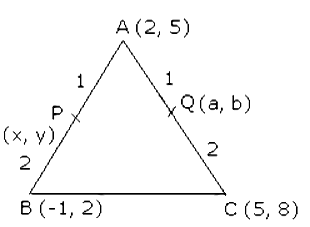
$AP : PB =1: 2$
Coordinates of $P$ are,
$
P(x, y)=P\left(\frac{-1+4}{2+1}, \frac{10+2}{2+1}\right)=P(1,4)
$
$AQ : QC =1: 2$
Coordinates of $Q$ are,
$
Q ( a , b )= Q \left(\frac{4+5}{2+1}, \frac{10+8}{2+1}\right)= Q (3,6)
$
Coordinates of P and Q are $(1,4)$ and $(3,6)$
$
P Q=\sqrt{(3-1)^2+(6-4)^2}=\sqrt{4+4}=2 \sqrt{2} \text { units }
$
$
BC =\sqrt{(5+1)^2+(8-2)^2}=\sqrt{36+36}=6 \sqrt{2} \text { units }
$
Hence proved, $3 PQ = BC$ View full question & answer→Question 364 Marks
Find the points of trisection of the segment joining $A ( -3, 7)$ and $B (3, -2). $
Answer
Let $P ( x , y )$ and $Q ( a , b )$ be the pcint of trisection of the line segment $AB$.
$AP : PB =1: 2$
Coordinates of $P$ are
$x=\frac{1 \times 3+2 \times-3}{1+2}=-1$
$y=\frac{1 \times-2+2 \times 7}{1+2}=4$
$P(-1,4)$
$AQ : QB =2: 1$
coordinates of $Q$ are,
$a=\frac{2 \times 3=1 \times-3}{2+1}=1$
$b=\frac{2 \times-2+1 \times 7}{2+1}=1$
$Q(1,1)$
$\therefore$ The points of trisection ae $(-1,4)$ and $(1,1)$. View full question & answer→Question 374 Marks
The origin $O (0, O), P (-6, 9)$ and $Q (12, -3)$ are vertices of triangle $\text{OPQ}$. Point M divides $OP$ in the ratio $1: 2$ and point $N$ divides $OQ$ in the ratio $1: 2$. Find the coordinates of points $M$ and $N$. Also, show that $3MN = PQ$.
Answer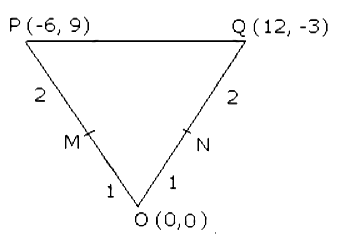
It is given that $M$ divides $O P$ in the ratio $1: 2$ and point $N$ divides $O Q$ in the ratio $1: 2$.
Using section formula, the coordinates of $M$ are
$\left(\frac{-6+0}{3}, \frac{9+0}{3}\right)=(-2,3)$
Using section formula, the coordinates of $N$ are
$\left(\frac{12+0}{3}, \frac{-3+0}{3}\right)=(4,-1)$
Thus, the ooordinates of $M$ and $N$ are $(-2,3)$ and $(4,-1)$ respectively.
Now, using distance formula, we have:
$P Q=\sqrt{(-6-12)^2+(9+3)^2}$
$=\sqrt{324+144}=\sqrt{468}$
$M N=\sqrt{(4+2)^2+(-1-3)^2}$
$=\sqrt{36+36}=\sqrt{52}$
It can be observed that :
$PQ =\sqrt{468}=\sqrt{9 \times 52}$
$=3 \sqrt{52}=3 MN$
Hence proved. View full question & answer→Question 384 Marks
Find the coordinate of $O$, the centre of a circle passing through $P(3,0), Q(2, \sqrt{5})$ and $R(-2 \sqrt{2}$ $,-1)$. Also find its radius.
Answer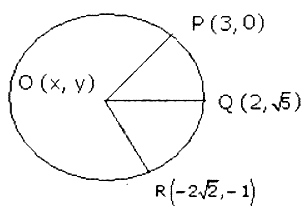
Let $O(x, y)$ be the centre of the circle
$O P=O Q \text { (radii of same circle) }$
$\Rightarrow O P^2=O Q^2$
$\left(\sqrt{(x-3)^2+(y-0)^2}\right)^2=\left(\sqrt{(x-2)^2+(y-\sqrt{5})^2}\right)^2$
$\Rightarrow x^2+9-6 x+y^2=x^2+4-4 x+y^2+5-2 \sqrt{5 y}$
$\Rightarrow-2 x+2 \sqrt{5} y=0$
$\Rightarrow-x+\sqrt{5} y=0\ldots(1)$
Similarly,$O Q=O R$
$\Rightarrow O Q^2=O R^2$
$\Rightarrow(x-2)^2+(y-\sqrt{5})^2=(x+2 \sqrt{2})^2+(y+1)^2$
$\Rightarrow x^2+4-4 x+y^2+5-2 \sqrt{5} y=x^2+8+4 \sqrt{2}+y^2+1+2 y$
$\Rightarrow-4 x-4 \sqrt{2} x-2 \sqrt{5} y=0$
$\Rightarrow-2 x-2 \sqrt{2} x-\sqrt{5} y-y=0 \ldots . . .(2)$
Putting $x=\sqrt{5} y$ from $(1)$ and $(2)$
$-2 \sqrt{5} y-2 \sqrt{10} y-\sqrt{5} y-y=0$
$(-3 \sqrt{5}-2 \sqrt{10}-1) y=0$
$y=0$ from $(1)$
$x=\sqrt{5}(0)=0$
$\Rightarrow x =0$
Thus, coordinates of $O$ are $(0,0)$.
Radius $=\sqrt{(0-3)^2+(0-0)^2}=\sqrt{9}=3$ units View full question & answer→Question 394 Marks
Find the coordinate of $O ,$ the centre of a circle passing through $A (8 , 12) , B (11 , 3),$ and $C (0 , 14).$ Also , find its radius.
Answer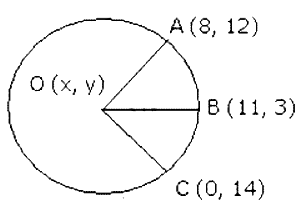
Let $O(x, y)$ be the centre of the circle.
$O A=O B \text { (radii of the same circle) }$
$\Rightarrow O A^2=O B^2$
$(x-8)^2+(y-12)^2=(x-11)^2+(y-3)^2$
$\Rightarrow x^2+64-16 x+y^2+144-24 y=x^2+121-22 x+y^2+9-6 y$
$\Rightarrow 6 x-18 y+78=0$
$\Rightarrow x-3 y+13=0$
$\text { similarly, } O B=O C$
$\therefore O B^2=O C^2$
$(x-11)^2+(y-3)^2=(x-0)^2+(y-14)^2$
$\Rightarrow x^2+121-22 x+y^2+9-6 y=x^2+y^2+196-28 y$
$\Rightarrow-22 x+22 y-66=0$
$\Rightarrow-x+y-3=0\ldots(2)$
$x-3 y+13=0\ldots(1)$
solving $(1) \ (2)$ we get,
$-2 y+10=0$
$\Rightarrow y=5$ from $(1)$
$x-15+13=0$
$\Rightarrow x =2$
Thus, coordinates of $O$ are $(2,5)$
Radius $=\sqrt{(2-8)^2+(5-12)^2}=\sqrt{36+49}=\sqrt{85}$ units View full question & answer→Question 404 Marks
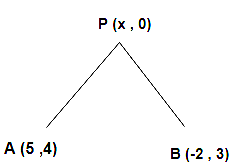
Find the point on the $x-$axis equidistant from the points $(5,4)$ and $(-2,3).$
AnswerLet the point on $x-$axis be $P (x,0)$
Given ,
$PA = PB$
$PA^2 = PB^2$
$(x - 5)^2 + (0 - 4)^2 = (x + 2)^2 + (0 - 3)^2$
$x^2 + 25 - 10x + 16 = x^2 + 4 + 4x + 9$
$\Rightarrow - 14 x + 28 = 0$
$\Rightarrow 14 x = 28$
$\Rightarrow x = 2$
\therefore The point on $x-$axis is $(2 , 0)$ View full question & answer→Question 414 Marks
$\ce{ABC}$ is an equilateral triangle . If the coordinates of $A$ and $B$ are $(1 , 1)$ and $(- 1 , -1) ,$ find the coordinates of $C.$
Answer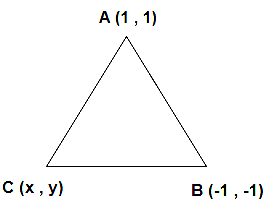
$A B C$ is an equilateral triangle.
$\therefore A C=B C \text { and } A B=B C$
$\Rightarrow A C^2=B C^2 \text { and } A B^2=B C^2$
$(x-1)^2+(y-1)^2=(x+1)^2+(y+1)^2$
$\Rightarrow x^2+1-2 x+y^2+1-2 y=x^2+1+2 x+y^2+1+2 y$
$\Rightarrow-4 x-4 y=0$
$\Rightarrow-4 x=4 y$
$\Rightarrow x=-y\ldots(1)$
$(1+1)^2+(1+1)^2=(x+1)^2+(y+1)^2$
$\Rightarrow 8=x^2+1+2 x+y^2+1+2 y$
$\Rightarrow 8=y^2+1+2 x+y^2+1+2 y$
$\Rightarrow 2 y^2-6=0$
$\Rightarrow y^2=3$
$\Rightarrow y= \pm \sqrt{3}$ From $(1)$
$\therefore x= \pm \sqrt{3}$ View full question & answer→Question 424 Marks
$PQR$ is an isosceles triangle . If two of its vertices are $P (2 , 0)$ and $Q (2 , 5) ,$ find the coordinates of $R$ if the length of each of the two equal sides is $3.$
Answer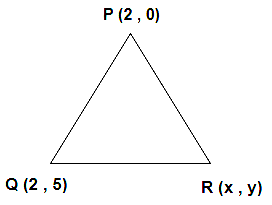
$P Q=C$
$\therefore P R=Q R=3 \text { units }$
Let the coordinates of $R$ be on,
$PR =\sqrt{( x -2)^2+( y -0)^2}$
$\Rightarrow 3=\sqrt{ x ^2+4-4 x + y ^2}$
squaring both sides ,
$\Rightarrow 9= x ^2-4 x + y ^2+4$
$\Rightarrow x ^2-4 x + y ^2-5=0$
$\Rightarrow x ^2+ y ^2-4 x =5\ldots(1)$
$\text { QR }=\sqrt{(x-2)^2+(y-5)^2}$
$\Rightarrow 3=\sqrt{x^2+4-4 x+y^2+25-10 y}$
$\Rightarrow 9=x^2+y^2-4 x-10 y+29$
$\Rightarrow 0=x^2+y^2-4 x-10 y+29$
$\text { From (1) } 0=5-10 y+20$
$10 y=25$
$y=\frac{5}{2}$
$\Rightarrow x^2+\frac{25}{4}-4 x-5=0$
$\Rightarrow 4 x^2+25-16 x-20=0$
$\Rightarrow 4 x^2-16 x+5=0$
$D=(-16)^2-4(4)(5)$
$=256-80$
$=176$
$\sqrt{ d }=\sqrt{176}=4 \sqrt{11}$
$x =\frac{16 \pm 4 \sqrt{11}}{2 \times 4}$
$=\frac{4 \pm 4 \sqrt{11}}{2}$
$=2+\frac{\sqrt{11}}{2}, 2-\frac{\sqrt{11}}{2}$
The coordinates of $R$ are $\left(2-\frac{\sqrt{11}}{2}, \frac{5}{2}\right)$ or $\left(2+\frac{\sqrt{11}}{2}, \frac{5}{2}\right)$ View full question & answer→Question 434 Marks
$\ce{ABCD}$ is a square . If the coordinates of $A$ and $C$ are $(5 , 4)$ and $(-1 , 6) ;$ find the coordinates of $B$ and $D.$
Answer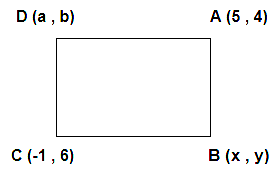
Given $\ce{ABCD}$ is a square.
$\therefore A B=B C ($all sides of a square are equal$)$
$\sqrt{( x -5)^2+( y -4)^2}=\sqrt{( x +1)^2+( y -6)^2}$
squaring both sides,
$x^2+25-10 x+y^2+16-8 y=x^2+1+2 x+y^2+36-12 y$
$\Rightarrow-12 x+4 y+4=0$
$\Rightarrow-3 x+y+1=0$
$y=3 x-1\ldots(1)$
Also, each angle in a square measures $90^{\circ}$
By pythogoras theorem,
$A B^2+B C^2=A C^2$
$\Rightarrow(5-x)^2+(4-y)^2+(x+1)^2+(y-6)^2=36+4$
$\Rightarrow 25+x^2-10 x+16+y^2-8 y+x^2+1+2 x+y^2+36-12 y$
$\Rightarrow 2 x^2+2 y^2-8 x-20 y+38=0$
$\Rightarrow x^2+y^2-4 x-10 y+19=0$
$\Rightarrow x^2+(3 x-1)^2-4 x-10(3 x-1)+19=0$
$\Rightarrow x^2+9 x^2+1-6 x-4 x-30 x+10 10=0$
$\Rightarrow 10 x^2-40 x+30=0$
$\Rightarrow x^2-4 x+3=0$
$\Rightarrow x^2-3 x-x+3=0$
$\Rightarrow x(x-3)-1(x-3)=0$
$\Rightarrow(x-1)(x-3)=0$
$x=1,3$
When,
$x=1, y=3(1)-1=2 (1,2)$
$x=3, y=3(3)-1=8 (3,8)$
Thus, coordinates of $B$ and $D$ are $(1,2)$ and $(3,8)$ View full question & answer→Question 444 Marks
Prove that the points (0 , 2) , (1 , 1) , (4 , 4) and (3 , 5) are the vertices of a rectangle.
Answer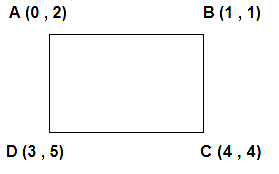
$A B=\sqrt{(0-1)^2+(2-1)^2}=\sqrt{2}$ units
$BC =\sqrt{(1-4)^2+(1-4)^2}=3 \sqrt{2}$ units
$C D=\sqrt{(4-3)^2+(4-5)^2}=\sqrt{2}$ units
$DA =\sqrt{(3-0)^2+(5-2)^2}=3 \sqrt{2}$ units
$A C=\sqrt{(4-0)^2+(4-2)^2}=\sqrt{20}=2 \sqrt{5}$ units
$BC =\sqrt{(3-1)^2+(5-1)^2}=\sqrt{20}=2 \sqrt{5}$ units
$\because A B=C D$ and $B C=D A$
Also, $AC = BD$
$\therefore ABCD$ is a rectangle. View full question & answer→Question 454 Marks
Prove that the points $(4 , 6) , (- 1 , 5) , (- 2, 0)$ and $(3 , 1)$ are the vertices of a rhombus.
Answer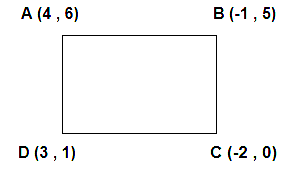
$AB =\sqrt{(4+1)^2+(6-5)^2}=\sqrt{25+1}=\sqrt{26} \text { units }$
$BC =\sqrt{(-1+2)^2+(5-0)^2}=\sqrt{1+25}=\sqrt{26} \text { units }$
$CD =\sqrt{(-2-3)^2+(0-1)^2}=\sqrt{25+1}=\sqrt{26} \text { units }$
$DA =\sqrt{(3-4)^2+(1-6)^2}=\sqrt{1+25}=\sqrt{26} \text { units }$
$AC =\sqrt{(4+2)^2+(6-0)^2}=\sqrt{36+36}=36 \sqrt{2} \text { units }$
$BD =\sqrt{(-1-3)^2+(5-1)^2}=\sqrt{36+36}=16 \sqrt{2} \text { units }$
$\because AB = BC = CD = DA $ and $ AC \neq BD$
$\therefore \ce{ABCD}$ is a rhombus. View full question & answer→Question 464 Marks
Prove that the points $(5 , 3) , (1 , 2), (2 , -2)$ and $(6 ,-1)$ are the vertices of a square.
Answer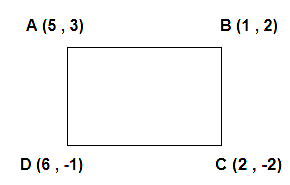
$A B=\sqrt{(5-1)^2+(3-2)^2}=\sqrt{16+1}=\sqrt{17} \text { units }$
$B C=\sqrt{(1-2)^2+(2+2)^2}=\sqrt{1+16}=\sqrt{17} \text { units }$
$C D=\sqrt{(6-2)^2+(-1+2)^2}=\sqrt{16+1}=\sqrt{17} \text { units }$
$D A=\sqrt{(6-5)^2+(-1-3)^2}=\sqrt{1+16}=\sqrt{17} \text { units }$
$A C=\sqrt{(5-2)^2+(3+2)^2}=\sqrt{9+25}=\sqrt{34} \text { units }$
$B D=\sqrt{(6-1)^2+(-1-2)^2}=\sqrt{25+9}=\sqrt{34} \text { units }$
$\because A B=B C=C D=D A \text { and } A C=B D$
$\therefore \text{ABCD}$ is a square. View full question & answer→Question 474 Marks
Find the relation between x and y if the point M (x,y) is equidistant from R (0,9) and T (14 , 11).
Answer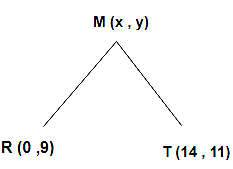
$
\begin{aligned}
& \text { Given : } M R=M T \\
& \therefore M R^2=M T^2 \\
& (x-0)^2+(y-9)^2=(x-14)^2+(y-11)^2 \\
& x^2+y^2+81-18 y=x^2+196-28 x+y^2+121-22 y \\
& 81-18 y=196-28 x+121-22 y \\
& 28 x-18 y+22 y=196+121-81 \\
& 28 x+4 y=236 \\
& 7 x+y-58=0
\end{aligned}
$ View full question & answer→Question 484 Marks
Prove that the points $(7 , 10) , (-2 , 5)$ and $(3 , -4)$ are vertices of an isosceles right angled triangle.
Answer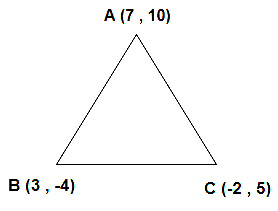
$A B=\sqrt{(7+2)^2+(10-5)^2}=\sqrt{81+25}=\sqrt{106} \text { units }$
$B C=\sqrt{(-2-3)^2+(5+4)^2}=\sqrt{25+81}=\sqrt{106} \text { units }$
$A C=\sqrt{(7-3)^2+(10+4)^2}=\sqrt{16+196}=\sqrt{212} \text { units }$
$\because A B=B C$
$\therefore ABC$ is an isosceleles triangle
$A B^2+B C^2=100+106=212$
$A C^2=212$
$\because A B^2+B C^2=A C^2$
$\therefore ABC$ is also a right angled triangle. View full question & answer→Question 494 Marks
$x (1,2),Y (3, -4)$ and $z (5,-6)$ are the vertices of a triangle . Find the circumcentre and the circumradius of the triangle.
Answer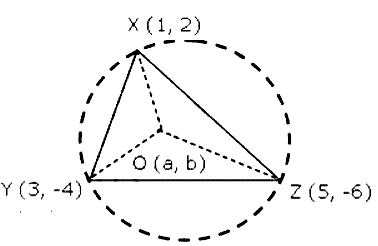
Circumcentre of $\triangle X Y Z$ will pass through the vertices $X, Y$ and $Z$
$O X=O Y \text { (radi of same circle), }$
$\Rightarrow O X^2=O Y^2$
$(a-1)^2+(b-2)^2=(a-3)^2+(b+4)^2$
$\Rightarrow 1-2 a+4-4 b=9-6 a+16+8 b$
$\Rightarrow 4 a-12 b=20$
$\Rightarrow a-3 b=5\ldots(1)$
$O Y=O Z ($radii of same circle$)$
$O Y^2=O Z^2$
$(a-3)^2+(b+4)^2=(a-5)^2+(b+6)^2$
$\Rightarrow 9-6 a+16+8 b=25-10 a+36+12 b$
$\Rightarrow 4 a-4 b=36$
$\Rightarrow a-b=9 \ldots \ldots . .(2)$
$a-3 b=5\ldots(1)$
$\underline{a-b=9}$
$-2 b=-4$
$b=2$
$a=11$
Circumcentre of $\triangle XYZ$ is $O (11,2)$
Circumradius $=\sqrt{(11-1)^2+(2-2)^2}=\sqrt{100}=10$ units View full question & answer→Question 504 Marks
$P(5 , -8) , Q (2 , -9)$ and $R(2 , 1)$ are the vertices of a triangle. Find tyhe circumcentre and the circumradius of the triangle.
Answer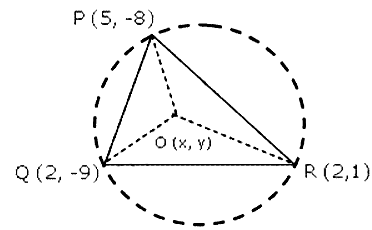
Circumcircle of $\triangle PQR$ will pass through its vertices $P , Q$ and $R$.
$O P=O Q$
$\Rightarrow O P^2=O Q^2$
$(x-5)^2+(y+8)^2=(x-2)^2+(y+9)^2$
$\Rightarrow 25-10 x+64+16 y=4-4 x+81+18 y$
$C-6 x-2 y+4=0$
$O Q=O R \ldots \text { (radii of square circle) }$
$O Q^2=O R^2$
$(x-2)^2+(y+9)^2=(x-2)^2+(y-1)^2$
$\Rightarrow 81+18 y=1-2 y$
$\Rightarrow 20 y=-80$
$y=-4 \ldots \ldots .(2)$
$-6 x+8+4=0 \ldots . .[\text { from }(2)]$
$\Rightarrow-6 x=-12$
$\Rightarrow x=2$
Circumcentre of $\triangle PQR$ is $O (2,-4)$
$\text { Circumcentre }=\sqrt{(2-5)^2+(-4+8)^2}$
$=\sqrt{9+16}$
$=\sqrt{25}$
$=5 \text { units }$ View full question & answer→