Questions

[4 marks sum]

🎯

Test yourself on this topic

9 questions · timed · auto-graded

Question 14 Marks
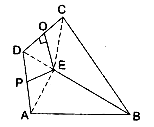
In Fig. ABCD is a quadrilateral in which AB = BC. E is the point of intersection of the right bisectors of AD and CD. Prove that BE bisects ∠ABC.
Answer
Given: A quadrilateral ABCD in which AB = BC. PE and QE are right bisectors or AD and CD respectively such that they meet at E.
To prove: BE bisects ∠ABC.
Construction: Join AE, DE and CE.
Proof: Since, PE is the right bisector of AD and E lies on it.
∴ AE = ED ...(i)
[∵ Points on the right bisector of a line segment are equidistant from the ends of the segment]
Also, QE is the right bisector of CD and E lies on it.
∴ ED = EC ...(ii)
From (i) and (ii), we get
AE = EC ...(iii)
Now, in Δs ABE and CBE, we have
AB = BC ...[Given]
BE = BE ...[Common]
and AE = EC ...[From (iii)]
So, by SSS criterion of congruence
ΔABE = ΔACE
⇒ ∠ABE = ∠CBE
⇒ BE bisects ∠ABC.
Hence, BE is the bisector of ∠ABC.
Hence proved.
View full question & answer
Question 24 Marks
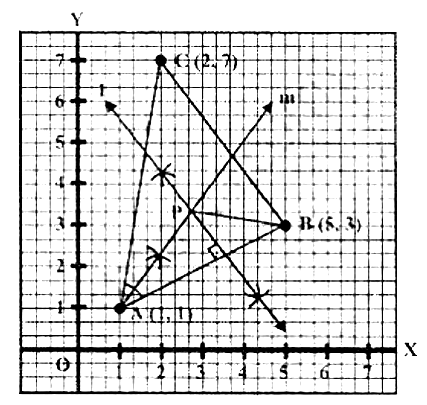
Use graph paper for this question. Take 2 cm = 1 unit on both the axis.
(i) Plot the points A(1,1), B(5,3) and C(2,7).
(ii) Construct the locus of points equidistant from A and B.
(iii) Construct the locus of points equidistant from AB and AC.
(iv) locate the point P such that PA = PB and P is equidistant from AB and AC.
(v) Measure and record the length PA in cm.
Answer

Steps of Construction:
i) Plot the points A(1,1), B(5,3) and C(2,7) on the graph and join AB, BC and CA.
ii) Draw the perpendicular bisector of AB and angle bisector of angle A which intersect each other at P.
P is the required point.
Since P lies on the perpendicular bisector of AB.
Therefore, P is equidistant from A and B.
Again,
Since P lies on the angle bisector of angle A.
Therefore, P is equidistant from AB and AC.
On measuring, the length of PA = 5.2 cm
View full question & answer
Question 34 Marks
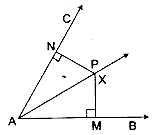
Given ∠BAC (Fig), determine the locus of a point which lies in the interior of ∠BAC and equidistant from two lines AB and AC.
Answer
Given: ∠BAC and an interior point P lying in the interior of ∠BAC such that PM = PN.
Construction: Join Ao and produced it to X.
Proof: In right Δs APM and APN we have
PM = PN ...[Given]
AP = AP ...[Common]
So, by RHS criterion of congruence

ΔAPM = ΔAPN
⇒ ∠PAM = ∠PAN ...[∵ Corresponding parts of congruent triangle are equal]
⇒ AP is the bisector of ∠BAC
⇒ P lies on the bisector of ∠BAC
Hence, the locus of P is the bisector of ∠BAc.
Now, we shall show that every point on the bisector of ∠BAC is equidistant from AB and AC.
So, let P be a point on the bisector AX of ∠BAC and PM ⊥ AB and PN ⊥ AC. Then, we have to prove that Pm = PN.
In Δs PAM and PAN, we have
∠PAM = ∠PAN ...[∵ AX is the bisector of ∠A]
∠PMA = ∠PNA ...[Each equal to 90°]
and AP = AP ...[Common]
So, by AAS criterion of congruence
ΔPAM = ΔPAN
⇒ PM = PN ...[∵ Corresponding parts of congruent triangles are equal]
Hence, the locus of point P is the ray AX which is the bisector of ∠BAC.
View full question & answer
Question 44 Marks
Ruler and compasses only may be used in this question. All construction lines and arcs must be clearly shown, and be of sufficient length and clarity to permit assessment.
(i) Construct a $\triangle A B C$, in which $B C=6 cm, A B=9 cm$ and $\angle A B C=60^{\circ}$.
(ii) Construct the locus of the vertices of the triangles with $B C$ as base, which are equal in area to $\triangle A B C$.
(iii) Mark the point $Q$ , in your construction, which would make $\triangle QBC$ equal in area to $\triangle ABC$, and isosceles.
(iv) Measure and record the length of $CQ .$
Answer
Steps of Constructions:
(i) (1) Mark a horizontal line XY on your paper and take $BC =6 cm$ on it.
(2) Construct $\angle A B C=60^{\circ}$ with arm $A B=9 cm$.
(3) Join $A$ and $C$ to get the required $\triangle A B C$.
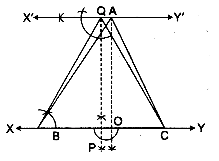
(ii) (1) Draw $A D \perp B C$.

(2) Construct a line $X^{\prime} Y^{\prime}$, perpendicular to $A D$, parallel to $X Y$ and passing through $A$.
(3) $X^{\prime} Y^{\prime}$, is the required locus of the vertices of $\Delta^5$ with base $B C$ and area to $\triangle A B C$.
[ $\because \Delta^5$ having same base and height an equal in area]
(iii) (1) Draw right bisector $P Q$ of $B C$, meeting $X^{\prime} Y^{\prime}$, in $Q$.
(2) Then $Q$ is the point such that $\triangle Q B C$ is an isosceles triangle and area $(\triangle Q B C)=$ area $(\triangle A B C)$.
(iv) On measuring, we find $CQ =8.4 cm$.
View full question & answer
Question 54 Marks
Ruler and compass only may be used in this question. All construction lines and arcs must be clearly shown, and be of sufficient length and clarity to permit assessment.
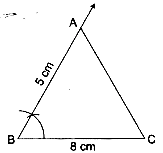
(i) Construct Δ ABC, in which BC = 8 cm, AB = 5 cm, ∠ ABC = 60°.
(ii) Construct the locus of point inside the triangle which are equidistant from BA and BC.
(iii) Construct the locus of points inside the triangle which are equidistant from B and C.
(iv) Mark as P, the point which is equidistant from AB, BC and also equidistant from B and C.
(v) Measure and record the length of PB.
Answer
(i) Steps of Construction:
1. Draw a line segment BC = 8 cm.
2. Make ∠CBX = 60°
3. Set off BA = 5 cm, along BX.
4. Join CA.
Then, ΔABC is the required triangle.
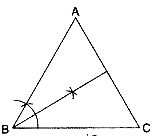
(ii) We know that the locus of point equidistant from two intersecting straight lines consist of a pair of straight lines that bisect the angles between the given straight lines.

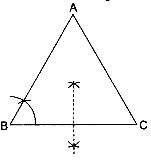
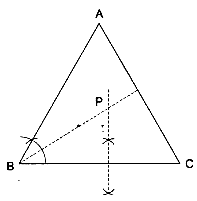
Therefore in this case is the angle bisector of angle B, It is shown in the adjoining figure.
(iii) We know that the locus of a point equidistant from two fixed points is the right bisector of the straight line joining the two fixed points.

Therefore, in this case the right bisector of side BC of ΔABC. It is shown in the given figure.
(iv) The point P, is the point in intersecting of angle bisector of ∠ABC and the right bisector of BC.

It is shown in the following figure.

(v) On measuring we find the length of PB = 3 cm.
View full question & answer
Question 64 Marks
Use ruler and compasses only for the following questions:
Construct triangle BCP, when CB = 5 cm, BP = 4 cm, ∠PBC = 45°.
Complete the rectangle ABCD such that :
(i) P is equidistant from AB and BC and
(ii) P is equidistant from C and D. Measure and write down the length of AB.
Answer
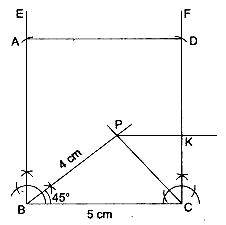
Given: BC = 5 cm, BP = 4 cm and ∠PBC = 45°
Steps of construction :
1. Constant ΔBCP with BC = 5 cm, BP = 4 cm and ∠PBC = 45°.
2. Draw perpendicular BE and CF and B and C respectively.

3. Draw perpendicular from on CF meeting CF in K.
4. Cut CD from CF, such that CK = KD.
5. Cut BA from BE, such that BA = CD.
6. Join AD.
Hence, ABCD is the required rectangle and AB = 5·7 cm.
View full question & answer
Question 74 Marks
Use ruler and compasses only for this question. Draw a circle of radius 4 cm and mark two chords AB and AC of the circle of length f 6 cm and 5 cm respectively.
(i) Construct the locus of points, inside the circle, that are equidistant from A and C. Prove your construction.
(ii) Construct the locus of points, inside the circle, that are equidistant from AB and AC.
Answer
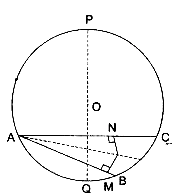
(I) Draw PQ, the perpendicular bisector of chord AC. PQ is the required locus, which is the diameter of the circle.
Reason: We know each point on the perpendicular bisector of AB is equidistant from A and B. Also the perpendicular bisector of a chord, passes through the centre of the circle and any chord passing through the centre of the circle is its diameter.

∴ PQ is the diameter of the circle.
(ii) Chords AB and AC intersects at M and N is a moving point such that LM = LN, where LM ⊥ AB and LN ⊥ AC
In right ΔALN and ΔALB
∠ANL = ∠ABL ...(90° each)
AL = AL ...(Common)
NL = BL ...[Given]
∴ ΔALN = ΔALB ...[R.H.S.]
Hence ∠MAL = ∠BAL ...c.p.c.t.
Thus, L lies on the bisector of ∠BAC.
Hence proved.
View full question & answer
Question 84 Marks
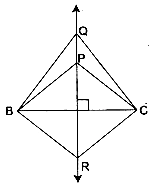
ΔPBC, ΔQBC and ΔRBC are three isosceles triangles on the same base BC. Show that P, Q and R are collinear.
Answer
Given: Three isosceles triangles PBC, QBC and RBC on the same base BC such that PB = PC, QB = QC and RB = RC.
To prove: P, Q, R are collinear.
Proof: Let l be the perpendicular bisector of BC. Since, the locus of points equidistant from B and C is the perpendicular of the segment joining them. Therefore,

ΔPBC is an isosceles
⇒ PB = PC
⇒ P lies on l ...(i)
ΔQBC is isosceles
⇒ QB = QC
⇒ Q lies on l ...(ii)
ΔRBC is an isosceles
⇒ RB = RC
⇒ R lies on l ...(iii)
From (i), (ii) and (iii), it follows that P, Q and R lie on L.
Hence, P, Q and R are collinear.
Hence proved.
View full question & answer
Question 94 Marks

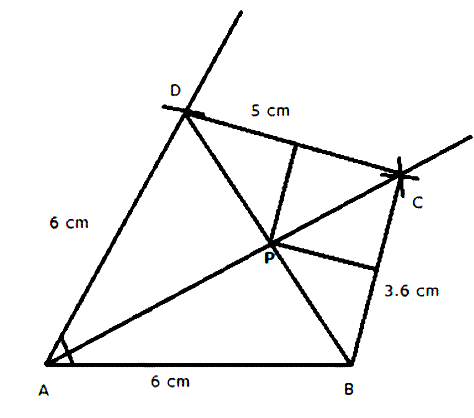
Without using set squares or protractor, construct a quadrilateral ABCD in which ∠ BAD = 45° , AD = AB = 6 cm, BC= 3.6 cm and CD=5 cm. Locate the point P on BD which is equidistant from BC and CD.
Without using set squares or protractor, construct a quadrilateral ABCD in which ∠ BAD = 45° , AD = AB = 6 cm, BC= 3.6 cm and CD=5 cm.
(i) Measure ∠BCD
(ii) Locate point P on BD which is equidistant from BC and CD.

Answer

Steps of construction:
(i) Draw a line AB = 6 cm.
(ii) Draw a ray making an angle of 45° with AB.
(iii) With a as centre, draw AD = 6 cm on the ray.
(iv) Draw an angle bisector of angle BAD.
(v) With Bas centre cut an arc BC = 3.6 cm on the angle bisector. (vi) With Das centre cut an arc CD = 5 cm on the angle bisector. ABCD is the required quadrilateral.
(vii) Join BD.
(viii) Draw perpendicular bisectors of CD and BC which meet BD on P. Pis the required point.
View full question & answer
[4 marks sum] - Mathematics STD 10 Questions - Vidyadip