Questions

[4 marks sum]

🎯

Test yourself on this topic

26 questions · timed · auto-graded

Question 14 Marks
 A circular hall, surmounted by a hemispherical roof, contains $5236 m^3$ of air. If the internal diameter of the room is equal to the height of the highest point of the roof from the floor, find the height of the hall.
Answer
diameter of the room $=$ height of the hall $\Rightarrow 2 r=h$
Volume of the hall =
But $\mathrm{r}=\frac{h}{2}$
$\Rightarrow \pi \frac{h^2}{4} h+\frac{2}{3} \pi \frac{h^3}{8}=5236$
$\Rightarrow \pi \frac{h^3}{4}+\frac{2}{24} \pi h^3=5236$
$\Rightarrow \pi h^3\left(\frac{1}{4}+\frac{2}{24}\right)=5236$
$\Rightarrow \pi h^3=\frac{5236 \times 24}{8}$
$\Rightarrow h^3=\frac{5236 \times 24 \times 7}{8 \times 22}$
$\Rightarrow h^3=4998$
$\Rightarrow h=17.09 \mathrm{~m}$
Height of the hall $=17.09 \mathrm{~m}$
View full question & answer
Question 24 Marks
A cylindrical bucket, whose base radius is 20 cm, is filled with water to a height of 25 cm. A heavy iron spherical ball of radius 10 cm is dropped to submerge completely in water in the bucket. Find the increase in the level of water.
Answer
Radius of sphere $=10 \mathrm{~cm}$
$
\begin{aligned}
& \text { Volume of sphere }=\frac{4}{3} \pi r^3 \\
& =\frac{4}{3} \times \frac{22}{7} \times 10 \times 10 \times 10 \mathrm{~cm}^3 \\
& =4190.476 \mathrm{~cm}^3
\end{aligned}
$
Therefore, Volume of water $=4190.476$
Radius of base of cylinder $=20 \mathrm{~cm}$
Let $\mathrm{h}$ be the height of the water
$
\begin{aligned}
& \Rightarrow \pi r^2 h=4190.476 \\
& \Rightarrow \frac{22}{7} \times 20 \times 20 \times h=4190.476 \\
& \Rightarrow 1257.143 h=4190.476 \\
& \Rightarrow \mathrm{h}=3.33 \mathrm{~cm}
\end{aligned}
$
Increase in water level $=3.33 \mathrm{~cm}$
View full question & answer
Question 34 Marks
The radius of a sphere is $9$ cm. It is melted and drawn into a wire of diameter $2$ mm. Find the length of the wire in metre.
Answer
Radius of sphere $=9 cm$
Volume of sphere $=\frac{4}{3} \pi r^3$
$=\frac{4}{3} \times \frac{22}{7} \times 9 \times 9 \times 9$
$=3054.857 cm ^3=30.55 \times 10^{-4} m ^3\ldots\ldots(i)$
Diameter of cylindrical wire $=2 mm$
Therefore, radius $=1 mm =0.001 m$
Let length of wire be $h$
$\therefore$ Volume $=\pi r^2 h$
$=\frac{22}{7} \times 0.001 \times 0.001 \times h$
$=3.142 h \times 10^{-6} m ^3\ldots \ldots(ii)$
From (i) and (ii)
$\Rightarrow 3.142 \times 10^{-6} h=30.55 \times 10^{-4}$
$\Rightarrow h=\frac{30.55 \times 10^{-4}}{3.142 \times 10^{-6}}$
$\Rightarrow h =972 m$
Length of the wire $=972 m$
View full question & answer
Question 44 Marks
A cylindrical beaker of 7 cm diameter is partly filled with water. Determine the number of spherical marbles of diameter 1.4 cm that are to be submerged in it to raise the water level by 5.6 cm
Answer
$
\begin{aligned}
& \text { Diameter of spherical marble }=1.4 \mathrm{~cm} \\
& \text { Therefore, radius }=0.7 \mathrm{~cm} \\
& \text { Volume of one ball }=\frac{4}{3} \pi r^3 \\
& =\frac{4}{3} \times \pi \times(0.7)^3 \mathrm{~cm}^3 \ldots \ldots \ldots \ldots . . . \text { (i) } \\
& \text { Diameter of beaker }=7 \mathrm{~cm} \\
& \text { Therefore, radius }=3.5 \mathrm{~cm} \\
& \text { Height of water }=5.6 \mathrm{~cm} \\
& \text { Volume of water }=\pi r^2 h \\
& =\pi \times(3.5)^2 \times 5.6 \mathrm{~cm}^3 \ldots \ldots \ldots \ldots \ldots \ldots \ldots . . . \text { (ii) } \\
& \text { No. of balls dropped }=\frac{\text { Volume of water }}{\text { Volume of ball }} \\
& =\frac{\pi \times(3.5)^2 \times 5.6}{\frac{4}{3} \times \pi \times(0.7)^3} \\
& =\frac{3 \times(3.5)^2 \times 5.6}{4 \times(0.7)^3} \\
& =150
\end{aligned}
$
No. of balls dropped $=150$
View full question & answer
Question 54 Marks
Find the length of the wire of diameter $4\ m$ that can be drawn from a solid sphere of radius $9\ m.$
Answer
Radius of solid sphere $=9 m$
Volume of sphere $=\frac{4}{3} \pi r^3$
$=\frac{4}{3} \times \frac{22}{7} \times 9 \times 9 \times 9$
$=3054.857 m ^3\ldots\ldots(i)$
Diameter of cylindrical wire $=4 m$
Therefore, radius $=2 m$
Let length of wire be h
$\therefore \text { Volume }=\pi r^2 h$
$=\frac{22}{7} \times 2 \times 2 \times h$
$=\frac{88 h}{7} m ^3 \ldots \ldots \ldots \ldots (ii)$
From (i) and (ii)
$\Rightarrow \frac{88 h}{7}=3054.857$
$\Rightarrow h=\frac{3054.857 \times 7}{88}$
$\Rightarrow h=243 m$
Length of the wire $=243 m$
View full question & answer
Question 64 Marks
A sphere has the same curved surface area as the curved surface area of a cone of height 36 cm and base radius 15 cm . Find the radius of the sphere .
Answer
Radius of cone $=15 \mathrm{~cm}$
Height of cone $=36 \mathrm{~cm}$
Curved surface of the cone $=\pi r l$
$
l=\sqrt{r^2+h^2}=\sqrt{15^2+36^2}=\sqrt{1521}=36
$
Curved surface of cone $=\frac{22}{7} \times 15 \times 39=1838.571 \mathrm{~cm}^2$
Curved surface of cone $=$ Curved surface of sphere
$
\begin{aligned}
& \Rightarrow 4 \pi r^2=1838.571 \\
& \Rightarrow 4 \times \frac{22}{7} \times r^2=1838.571 \\
& \Rightarrow r^2=\frac{1838.571 \times 7}{4 \times 22} \\
& \Rightarrow r^2=146.25 \\
& \Rightarrow r=12.09 \mathrm{~cm}
\end{aligned}
$
The radius of the sphere $=12.09 \mathrm{~cm}$
View full question & answer
Question 74 Marks
A solid metallic cylinder has a radius of 2 cm and is 45 cm tall. Find the number of metallic spheres of diameter 6 cm that can be made by recasting this cylinder .
Answer
Radius of the solid cylinder $(r)=2 \mathrm{~cm}$
Height of cylinder $(h)=45 \mathrm{~cm}$
Volume of cylinder $=\pi r^2 h$
$
\begin{aligned}
& =\frac{22}{7} \times 2 \times 2 \times 45 \\
& =\frac{3960}{7} \mathrm{~cm}^3
\end{aligned}
$
Diameter of metallic sphere $=6 \mathrm{~cm}$
Therefore, Radius $(r 1)=3 \mathrm{~cm}$
Volume of sphere $=\frac{4}{3} \pi(r 1)^3$
$
\begin{aligned}
& =\frac{4}{3} \times \frac{22}{7} \times 3 \times 3 \times 3 \\
& =\frac{792}{7} \mathrm{~cm}^3
\end{aligned}
$
Therefore, No. of spheres $=\frac{3960}{7}+\frac{792}{7}=5$
Number of spheres that can be made $=5$
View full question & answer
Question 84 Marks
A hollow metallic sphere is 2 cm thick all around and has an external diameter of 12 cm. Find the radius of the solid sphere made by recasting this hollow sphere.
Answer
External diameter of hollow sphere $=12 \mathrm{~cm}$
External radius $=\mathrm{R}=6 \mathrm{~cm}$
Internal diameter of hollow sphere $=(12-4) \mathrm{cm}=8 \mathrm{~cm}$
Internal radius $=r=4 \mathrm{~cm}$
Volume of metal used $=\frac{4}{3} \pi\left(R^3-r^3\right)$
$
\begin{aligned}
& =\frac{4}{3} \times \frac{22}{7} \times\left(6^3-4^3\right) \\
& =\frac{4}{3} \times \frac{22}{7} \times 152 \\
& =636.95 \mathrm{~cm}^3
\end{aligned}
$
Volume of metal used $=636.95 \mathrm{~cm}^3=$ volume of sdid sphere
$
\begin{aligned}
& \Rightarrow \frac{4}{3} \pi r^3=636.95 \\
& \Rightarrow \frac{4}{3} \times \frac{22}{7} \times r^3=636.95 \\
& \Rightarrow r^3=\frac{636.95 \times 3 \times 7}{4 \times 22} \\
& \Rightarrow r^3=151.99=152 \\
& \Rightarrow r=5.34 \mathrm{~cm}
\end{aligned}
$
Radius of the solid sphere $=5.34 \mathrm{~cm}$
View full question & answer
Question 94 Marks
A hollow sphere of internal and external diameters 4 cm and 8 cm respectively is melted into a cone of base diameter 8 cm. Find the height of the cone.
Answer
$
\begin{aligned}
& \text { External diameter }=8 \mathrm{~cm} \\
& \text { Therefore, Radius }(\mathrm{R})=4 \mathrm{~cm} \\
& \text { Internal diameter }=4 \mathrm{~cm} \\
& \text { Therefore, Radius }(\mathrm{r})=2 \mathrm{~cm} \\
& \text { Volume of metal used }=\frac{4}{3} \pi\left(R^3-r^3\right) \\
& =\frac{4}{3} \times \frac{22}{7} \times\left(4^3-2^3\right) \\
& =\frac{4}{3} \times \frac{22}{7} \times 56 \\
& =234.66 \mathrm{~cm}^3 \ldots \ldots \ldots \ldots \ldots . . . \text { (i) }
\end{aligned}
$
Diameter of the oone $=8 \mathrm{~cm}$
Therefore, radius $=4 \mathrm{~cm}$
Let height of the cone $=\mathrm{h}$
Volume $=\frac{1}{3} \pi r^2 h=\frac{1}{3} \times \frac{22}{7} \times 4 \times 4 \times h=\frac{352 h}{21}$.$\ldots(ii)$
From (i) and (ii)
$
\begin{aligned}
& \Rightarrow \frac{352 h}{21}=234.66 \\
& \Rightarrow 352 \mathrm{~h}=4927.86 \\
& \Rightarrow \mathrm{h}=13.99 \mathrm{~cm}=14 \mathrm{~cm}
\end{aligned}
$
The height of the cone $=14 \mathrm{~cm}$
View full question & answer
Question 104 Marks
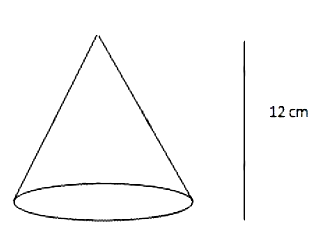
Find the radius of the circular base of the cone , if its volume is $154\ cm^3$ and the perpendicular height is $12\ cm$
Answer

$\text { Volume of the cone }=154\ cm ^3 $
$\Rightarrow \frac{1}{3} \times\left(\pi r^2\right) \times h=154 $
$\Rightarrow \frac{1}{3} \times\left(\pi r^2\right) \times 12=154 $
$\Rightarrow r^2=\frac{154 \times 3 \times 7}{12 \times 22} $
$\Rightarrow r^2=12.25 $
$\Rightarrow r=3.5\ cm$
Radius of the circular base of the cone is $3.5\ cm$
View full question & answer
Question 114 Marks
Sand from a cylindrical bucket $32$ cm in height and $18$ cm in radius is poured onto the ground making a conical heap $24$ cm high. Find the radius of the conical heap.
Answer
Height of the cylinder $= h_1=32 cm$
Radius of bucket $= r_1=18 cm$
Height of conical heap $= h_2=24 cm$
Let radius of conical heap $= r 2$
Volume of sand in the bucket = volume of sand in conical heap
$\Rightarrow \pi \times r 1^2 \times h 1=\frac{1}{3} \times \pi \times r 2^2 \times h_2 $
$\Rightarrow 18 \times 18 \times 32=\frac{1}{3} \times r 2^2 \times 24 $
$\Rightarrow r 2^2=\frac{10368 \times 3}{24} $
$\Rightarrow r 2^2=1296$
$\Rightarrow r 2=36 cm$
Radius of the conical heap $=36 cm$
View full question & answer
Question 124 Marks
A circus tent is cylindrical to a height of 5 m and conical above it. If its diameter is 42 m and slant height of the cone is 53 m, calculate the total area of the canvas required.
Answer
Height of the cylinder $=h=5 \mathrm{~m}$
Slant height of the cone $=\mathrm{I}=53 \mathrm{~m}$
Diameter $=42 \mathrm{~m} \Rightarrow$ radius $=\mathrm{r}=21 \mathrm{~m}$
Area of the canvas used = Curved surface area of cylinder + curved surface area of cone
$
\begin{aligned}
& =2 \pi r h+\pi r l \\
& =\left(2 \times \frac{22}{7} \times 21 \times 5\right)+\left(\frac{22}{7} \times 21 \times 53\right) \\
& =660+3498 \\
& =4158 \mathrm{~m}^2
\end{aligned}
$
Area of the canvas required $=4158 \mathrm{~m}^2$
View full question & answer
Question 134 Marks
A canvas tent is in the shape of a cylinder surmounted by a conical roof. The common diameter of the cone and the cylinder is 14 m. The height of the cylindrical part is 8 m and the height of the conical roof is 4 m. Find the area of the canvas used to make the tent.
Answer
Height of the cylindrical part $=\mathrm{H}=8 \mathrm{~m}$
Height of the conical part $=\mathrm{h}=4 \mathrm{~m}$
Diameter $=14 \mathrm{~m} \Rightarrow$ radius $=\mathrm{r}=7 \mathrm{~m}$
Slant height of the cone $=1=$
$
\begin{aligned}
& I=\sqrt{r^2+h^2} \\
& I=\sqrt{7^2+4^2} \\
& I=\sqrt{65}=8.06 \mathrm{~m}
\end{aligned}
$
Slant height of cone $=8.06 \mathrm{~m}$
Area of the canvas used = Curved surface area of cylinder + curved surface area of cone
$
\begin{aligned}
& =2 \pi r H+\pi r l \\
& =\left(2 \times \frac{22}{7} \times 7 \times 8\right)+\left(\frac{22}{7} \times 7 \times 8.06\right) \\
& =352+177.32 \\
& =529.32 \mathrm{~m}^2
\end{aligned}
$
Area of the canvas used $=529.32 \mathrm{~m}^2$
View full question & answer
Question 144 Marks
A conical tent requires $264 m^2$ of canvas. If the slant height is $12 \ m$ , find the vertical height of the cone.
Answer
Curved surface area of the tent $=264 \mathrm{~m}^2$
Slant height $(\mathrm{I})=12 \mathrm{~m}$.
$
\begin{aligned}
& \Rightarrow \pi r l=264 \\
& \Rightarrow \frac{22}{7} \times r \times 12=264 \\
& \Rightarrow r=\frac{264 \times 7}{22 \times 12} \\
& \Rightarrow r=7 \mathrm{~cm}
\end{aligned}
$
Let $h$ be the vertical height.
We know,
$
\begin{aligned}
& l^2=r^2+h^2 \\
& \Rightarrow h=\sqrt{l^2-r^2} \\
& \Rightarrow h=\sqrt{12^2-7^2} \\
& \Rightarrow h=\sqrt{144-49}=\sqrt{95} \\
& \Rightarrow \mathrm{h}=9.75 \mathrm{~m}
\end{aligned}
$
Vertical height of cone $=9.75 \mathrm{~m}$
View full question & answer
Question 154 Marks
The heights of two cones are in the ratio 1:3 and their base radii are in the ratio 3:1. Find the ratio of their volumes.
Answer
Let radius of first cone be $3 r$ and height be $h$, then radius of second cone will be rand height will be $3 h$.
Volume of cone $=\frac{1}{3} \times\left(\pi r^2\right) \times h$
Ratio of volumes of cone $=\frac{\text { Volume of first cone }}{\text { Volume of second cone }}$
$=\frac{\frac{1}{3} \times\left(\pi(3 r)^2\right) \times h}{\frac{1}{3} \times\left(\pi r^2\right) \times 3 h}$
$=\frac{\frac{1}{3} \pi 9 r^2 h}{\frac{1}{3} \pi r^2 3 h}$
$=\frac{3}{1}$
Ratio of volumes of cone $=3: 1$
View full question & answer
Question 164 Marks
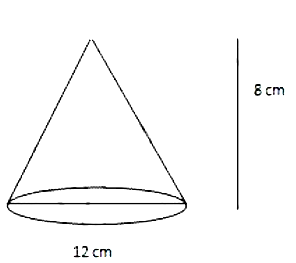
Find the curved surface area of a cone whose height is $8$ cm and base diameter is $12$ cm .
Answer

$\text { Diameter }=12 cm \Rightarrow r=6 cm $
$\text { Curved surface area }=\left(\pi r \sqrt{h^2+r^2}\right) $
$=\frac{22}{7} \times 6 \times \sqrt{8^2+6^2} $
$=\frac{22}{7} \times 6 \times \sqrt{100} $
$=\frac{22}{7} \times 6 \times 10 $
$=188.57$
Curved surface area $=188.57 cm ^2$
View full question & answer
Question 174 Marks
A hollow metallic cylindrical tube has an internal radius of 3.5 cm and height 21 cm. The thickness of the metal tube is 0.5 cm. The tube is melted and cast into a right circular cone of height 7 cm. Find the radius of the cone, correct to one decimal place. 
Answer
Internal radius of the hollow cylinder $=r=3.5 \mathrm{~cm}$
Height $=\mathrm{h}=21 \mathrm{~cm}$
Thickness of the metal $=0.5 \mathrm{~cm}$
Therefore, Outer radius $=\mathrm{R}=(3.5+0.5) \mathrm{cm}=4 \mathrm{~cm}$
Now, Volume of metal used $=\pi h\left(R^2-r^2\right)$
$
\begin{aligned}
& =\frac{22}{7} \times 21 \times\left(4^2-3.5^2\right) \\
& =\frac{22}{7} \times 21 \times(16-12.25) \\
& =\frac{22}{7} \times 21 \times 3.75 \\
& =247.5 \mathrm{~cm}^3
\end{aligned}
$
Volume of metal used $=247.5 \mathrm{~cm}^3$
Therefore, Volume of cone $=247.5 \mathrm{~cm}^3$ and height $=7 \mathrm{~cm}$ Let $\mathrm{r} 1$ be the radius of cone.
$
\begin{aligned}
& \therefore \text { Volume }=\frac{1}{3} \pi r 1^2 h \\
& \Rightarrow \frac{1}{3} \pi r 1^2 h=247.5 \\
& \Rightarrow \frac{1}{3} \times \frac{22}{7} \times r 1^2 \times 7=247.5 \\
& \Rightarrow r 1^2=\frac{247.5 \times 3 \times 7}{22 \times 7} \\
& \Rightarrow r 1^2=33.75 \\
& \Rightarrow r 1=5.8 \mathrm{~cm}
\end{aligned}
$
Radius of the cone $=5.8 \mathrm{~cm}$
View full question & answer
Question 184 Marks
A buoy is made in the form of a hemisphere surmounted by a right circular cone whose circular base coincides with the plane surface of the hemisphere. The radius of the base of the cone is 3.5 m and its volume is two-third the volume of hemisphere. Calculate the height of the cone and the surface area of the buoy, correct to two decimal places. 
Answer
Radius of hemispherical part $(\mathrm{r})=3.5 \mathrm{~m}=\frac{7}{2} \mathrm{~m}$
Therefore, Volume of hemisphere $=\frac{2}{3} \pi r^3$
$
\begin{aligned}
& =\frac{2}{3} \times \frac{22}{7} \times \frac{7}{2} \times \frac{7}{2} \times \frac{7}{2} \\
& =\frac{539}{6} \mathrm{~m}^3
\end{aligned}
$
Volume of conical part $=\frac{2}{3} \times \frac{539}{6} \mathrm{~m}^3$ (2/3 of hemisphere)
Let height of the cone $=\mathrm{h}$
Then,
$
\begin{aligned}
& \frac{1}{3} \pi r^2 h=\frac{2 \times 539}{3 \times 6} \\
& \Rightarrow \frac{1}{3} \times \frac{22}{7} \times \frac{7}{2} \times \frac{7}{2} \times h=\frac{2 \times 539}{3 \times 6} \\
& \Rightarrow h=\frac{539 \times 2 \times 2 \times 7 \times 3}{3 \times 6 \times 22 \times 7 \times 7} \\
& \Rightarrow \mathrm{h}=\frac{14}{3} \mathrm{~m}=4 \frac{2}{3} \mathrm{~m}=4.67 \mathrm{~m}
\end{aligned}
$
Height of the cone $=4.67 \mathrm{~m}$
Surface area of buoy $=2 \pi r^2+\pi r l$
But $l=\sqrt{r^2+h^2}$
$
\begin{aligned}
& l=\sqrt{\left(\frac{7}{2}\right)^2+\left(\frac{14}{3}\right)^2} \\
& =\sqrt{\frac{49}{4}+\frac{196}{9}}=\sqrt{\frac{1225}{36}}=\frac{35}{6} \mathrm{~m}
\end{aligned}
$
Therefore, surface area $=$
$
\begin{aligned}
& =\left(2 \times \frac{22}{7} \times \frac{7}{2} \times \frac{7}{2}\right)+\left(\frac{22}{7} \times \frac{7}{2} \times \frac{35}{6}\right) \mathrm{m}^2 \\
& =\frac{77}{1}+\frac{385}{6}=\frac{847}{6} \\
& =141.17 \mathrm{~m}^2
\end{aligned}
$
View full question & answer
Question 194 Marks
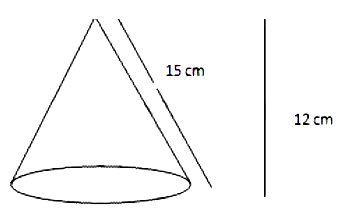
Find the volume of the right circular cone whose height is $12 \ cm$ and slant length is $15 \ cm . (\pi = 3.14)$
Answer


Slant length $=I=15 \ cm$
Height $= h =12 \ cm$
Radius of the base $=r$
We know ,
$l^2=h^2+r^2$
$\Rightarrow r^2=l^2-h^2$
$\Rightarrow r=\sqrt{l^2-h^2}$
$\Rightarrow r=\sqrt{15^2-12^2}$
$\Rightarrow r=9 \ cm$
Radius $=9 \ cm$
$\text {Volume }=\frac{1}{3} \times\left(\pi r^2\right) \times h$
$=\frac{1}{3} \times 3.14 \times 9 \times 9 \times 12$
$=1017.36 \ cm ^3$
Volume of the cone $=1017.36 \ cm ^3$
View full question & answer
Question 204 Marks
A hollow metallic cylindrical tube has an internal radius of 3.5 cm and height 21 cm. The thickness of the metal tube is 0.5 cm. The tube is melted and cast into a right circular cone of height 7 cm. Find the radius of the cone, correct to one decimal place. 
Answer
Internal radius of the hollow cylinder $=r=3.5 \mathrm{~cm}$
Height $=\mathrm{h}=21 \mathrm{~cm}$
Thickness of the metal $=0.5 \mathrm{~cm}$
Therefore, Outer radius $=R=(3.5+0.5) \mathrm{cm}=4 \mathrm{~cm}$
Now, Volume of metal used $=\pi h\left(R^2-r^2\right)$
$
\begin{aligned}
& =\frac{22}{7} \times 21 \times\left(4^2-3.5^2\right) \\
& =\frac{22}{7} \times 21 \times(16-12.25) \\
& =\frac{22}{7} \times 21 \times 3.75 \\
& =247.5 \mathrm{~cm}^3
\end{aligned}
$
Volume of metal used $=247.5 \mathrm{~cm}^3$
Therefore, Volume of cone $=247.5 \mathrm{~cm}^3$ and height $=7 \mathrm{~cm}$
Let $\mathrm{r} 1$ be the radius of cone.
$
\begin{aligned}
& \therefore \text { Volume }=\frac{1}{3} \pi r 1^2 h \\
& \Rightarrow \frac{1}{3} \pi r 1^2 h=247.5 \\
& \Rightarrow \frac{1}{3} \times \frac{22}{7} \times r 1^2 \times 7=247.5 \\
& \Rightarrow r 1^2=\frac{247.5 \times 3 \times 7}{22 \times 7} \\
& \Rightarrow r 1^2=33.75 \\
& \Rightarrow r 1=5.8 \mathrm{~cm}
\end{aligned}
$
Radius of the cone $=5.8 \mathrm{~cm}$
View full question & answer
Question 214 Marks
A conical tent with a capacity of $600\  m^3$ stands on a circular base of area $160\  m^2$ Find in $m^2$ the area of the canvas.
Answer
Area of the circular base $=160 \mathrm{~m}^2$
$\pi r^2=160$
$\Rightarrow r=\sqrt{\frac{160 \times 7}{22}}$
$\Rightarrow r=\sqrt{50.909}=7.134 \mathrm{~m}$
Therefore, radius $=7.134 \mathrm{~m}$
Capacity or Volume of the tent $=600 \mathrm{~m}^3$
$\frac{1}{3} \pi r^2 h=600$
$ \Rightarrow \frac{1}{3} \times \frac{22}{7} \times 7.13 \times 7.13 \times h=600$
$ \Rightarrow h=\frac{600 \times 3 \times 7}{7.13 \times 7.13 \times 22}$
$ \Rightarrow h=11.265 \mathrm{~m}$
Therefore, vertical height $=11.265 \mathrm{~m}$
We know slant height $(l)=$
$I=\sqrt{r^2+h^2}$
$ \Rightarrow l=\sqrt{7.134^2+11.265^2}$
$ \Rightarrow l=\sqrt{177.624}=13.327$
Therefore, slant height $=13.327 \mathrm{~m}$
The curved surface area $=\pi r l=\frac{22}{7} \times 7.134 \times 13.327=298.9 \mathrm{~m}^2$
Hence, the area of the canvas $=298.9 \mathrm{~m}^2$
View full question & answer
Question 224 Marks
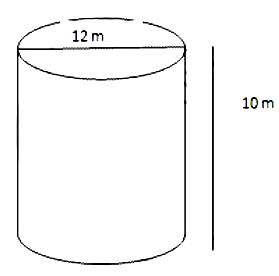
The diameter of a right circular cylinder is $12 m$ and the slant height is $10 m.$ Find its curved surface area and the total surface area . 
Answer

Diameter of the cylinder $=12 m $
$\Rightarrow$ radius $=6 m$
Curved surface area $=$ circumference of the base $\times$ height
$=2 \pi r \times h$
$=2 \times \frac{22}{7} \times 6 \times 10$
$=377.14 m ^2$
Curved Surface area $=377.14 m ^2$
Total surface area $=$ Curved surface area $+(2 \times$ base area$)$
$=2 \pi r h+2 \pi r^2$
$=2 \pi r(h+r)$
$=2 \times \frac{22}{7} \times 6 \times(10+6)$
$=2 \times \frac{22}{7} \times 6 \times 16$
$=603.42 m ^2$
Total Surface area $=603.42 m ^2$
View full question & answer
Question 234 Marks
Find the curved surface area , the total surface area and the volume of a cone if its :
Height = 8 cm , diameter = 12 cm
Answer
$
\begin{aligned}
& \text { Height }=8 \mathrm{~cm}, \text { diameter }=12 \mathrm{~cm} \\
& \text { Diameter }=12 \mathrm{~cm} \Rightarrow \mathrm{r}=6 \mathrm{~cm} \\
& \text { Curved surface area }=\left(\pi r \sqrt{h^2+r^2}\right) \\
& =\frac{22}{7} \times 6 \times \sqrt{8^2+6^2} \\
& =\frac{22}{7} \times 6 \times \sqrt{100} \\
& =\frac{22}{7} \times 6 \times 10 \\
& =188.57
\end{aligned}
$
Curved surface area $=188.57 \mathrm{~cm}^2$
Total surface area $=$ area of circular base + Curved surface area
$
\begin{aligned}
& =\pi r^2+\left(\pi r \sqrt{h^2+r^2}\right) \\
& =\frac{22}{7} \times 6 \times 6+188.57 \\
& =113.14+188.57 \\
& =301.71
\end{aligned}
$
Total surface area $=301.71 \mathrm{~cm}^2$
$
\begin{aligned}
& \text { Volume }=\frac{1}{3} \times\left(\pi r^2\right) \times h \\
& =\frac{1}{3} \times \frac{22}{7} \times 6 \times 6 \times 8 \\
& =301.71
\end{aligned}
$
Volume of the cone $=301.71 \mathrm{~cm}^3$
View full question & answer
Question 244 Marks
Find the curved surface area , the total surface area and the volume of a cone if its :
Height = 16 cm , diameter = 24 cm
Answer
$
\begin{aligned}
& \text { Height }=16 \mathrm{~cm}, \text { diameter }=24 \mathrm{~cm} \\
& \text { diameter }=24 \mathrm{~cm} \Rightarrow r=12 \mathrm{~cm} \\
& \text { Curved surface area }=\left(\pi r \sqrt{h^2+r^2}\right) \\
& =\frac{22}{7} \times 12 \times \sqrt{16^2+12^2} \\
& =\frac{22}{7} \times 12 \times \sqrt{400} \\
& =\frac{22}{7} \times 12 \times 20 \\
& =754.29
\end{aligned}
$
Curved surface area $=754.29 \mathrm{~cm}^2$
Total surface area $=$ area of circular base + Curved surface area
$
\begin{aligned}
& =\pi r^2+\left(\pi r \sqrt{h^2+r^2}\right) \\
& =\frac{22}{7} \times 12 \times 12+754.29 \\
& =452.57+754.29 \\
& =1206.86
\end{aligned}
$
Total surface area $=1206.86 \mathrm{~cm}^2$
$
\begin{aligned}
& \text { Volume }=\frac{1}{3} \times\left(\pi r^2\right) \times h \\
& =\frac{1}{3} \times \frac{22}{7} \times 12 \times 12 \times 16 \\
& =2413.71
\end{aligned}
$
Volume of the cone $=2413.71 \mathrm{~cm}^3$
View full question & answer
Question 254 Marks
Find the curved surface area , the total surface area and the volume of a cone if its :
Height = 15 cm , radius = 8 cm
Answer
$
\begin{aligned}
& \text { Height }=15 \mathrm{~cm}, \text { radius }=8 \mathrm{~cm} \\
& \text { Curved surface area }=\left(\pi r \sqrt{h^2+r^2}\right) \\
& =\frac{22}{7} \times 8 \times \sqrt{15^2+8^2} \\
& =\frac{22}{7} \times 8 \times \sqrt{289} \\
& =\frac{22}{7} \times 8 \times 17 \\
& =427.43
\end{aligned}
$
Curved surface area $=427.43 \mathrm{~cm}^2$
Total surface area $=$ area of circular base + curved surface area
$
\begin{aligned}
& =\pi r^2+\left(\pi r \sqrt{h^2+r^2}\right) \\
& =\frac{22}{7} \times 8 \times 8+427.43 \\
& =201.14+427.43 \\
& =628.57
\end{aligned}
$
Total surface area $=628.57 \mathrm{~cm}^2$
$
\begin{aligned}
& \text { Volume }=\frac{1}{3} \times\left(\pi r^2\right) \times h \\
& =\frac{1}{3} \times \frac{22}{7} \times 8 \times 8 \times 15 \\
& =1005.71
\end{aligned}
$
Volume of the cone $=1005.71 \mathrm{~cm}^3$
View full question & answer
Question 264 Marks
Find the curved surface area , the total surface area and the volume of a cone if its : Height $= 12 \ cm ,$ radius $= 5 \ cm$
Answer
$\text {Height }=12 \ cm , \text { radius }=5 \ cm$
$\text {Curved surface area }=\left(\pi r \sqrt{h^2+r^2}\right)$
$=\frac{22}{7} \times 5 \times \sqrt{12^2+5^2}$
$=\frac{22}{7} \times 5 \times \sqrt{169}$
$=\frac{22}{7} \times 5 \times 13$
$=204.29$
Curved surface area $=204.29 \ cm ^2$
Total surface area $=$ area of circular base $+$ curved surface area
$=\pi r^2+\left(\pi r \sqrt{h^2+r^2}\right)$
$=\frac{22}{7} \times 5 \times 5+204.29$
$=78.57+204.29$
$=282.86$
Total surface area $=282.86 \ cm ^2$
$\text { Volume }=\frac{1}{3} \times\left(\pi r^2\right) \times h$
$=\frac{1}{3} \times \frac{22}{7} \times 5 \times 5 \times 12$
$=314.29$
Volume of the cone $=314.29 \ cm ^3$
View full question & answer
[4 marks sum] - Mathematics STD 10 Questions - Vidyadip