Questions · Page 1 of 5

[2 Mark Question Answer]

🎯

Test yourself on this topic

50 questions · timed · auto-graded

Question 12 Marks
A box contains 7 red balls, 8 green balls and 5 white balls. A ball is drawn at random from the box. Find the probability that the ball is: neither red nor white.
Answer
Total number of balls in the box =7+8+5=20
Total possible outcomes = 20 = n(s)
Neither red ball nor white ball = green ball
Event of not drawing a red or white ball = E = number of green ball n(E)=8
Probability of drawing a white ball = $\frac{n(E)}{n(S)}=\frac{8}{20}=\frac{2}{5}$
View full question & answer
Question 22 Marks
A box contains 7 red balls, 8 green balls and 5 white balls. A ball is drawn at random from the box. Find the probability that the ball is: white
Answer
Total number of balls in the box =7+8+5=20 balls
Total possible outcomes=20=n(s)
Event of drawing a white ball=E= number of white balls
Probability of drawing a white ball= $\frac{n(E)}{n(s)}=\frac{5}{20}=\frac{1}{4}$
View full question & answer
Question 32 Marks
A man tosses two different coins (one of Rs 2 and another of Rs 5) simultaneously. What is the probability that he gets: at most one head?
Answer
When two coins are tosses simultaneously , the possiuble outcomes are {(H,H)(H,T)(T,H)(T,T)}
n(s)=4
The outcomes favourable to the event E,' at most one head are {(T,H)(H,T)(T,T)}
So, the number of outcomes favourable to E is 3=n(E)
Therefore, p(E)=
$\frac{n(E)}{n(s)}=\frac{3}{4}$
View full question & answer
Question 42 Marks
A man tosses two different coins (one of Rs 2 and another of Rs 5) simultaneously. What is the probability that he gets: at least one head?
Answer
When two coins are tossed simultaneossly, the possible outcomes are {(H,H)(H,T)(T,H)(T,T)}
n(s)=4
The outcomes favouraable to the event E,' at least one head' are
{(H,H)(H,T)(T,H)}
So, the number of outcomes favourable to E is 3=n(E)
Therefore, p(E)=$\frac{n(E)}{n(S)}=\frac{3}{4}$
View full question & answer
Question 52 Marks
A and B are friends. Ignoring the leap year, find the probability that both friends will have: the same birthday?
Answer
Out of the two friends, A's birthday can be any day of the year. Now, B's birthday can also be any day of 365 days in the year.
We assume that these 365 outcomes are qually likely.
P(A and B have the same birthday)
=1-p(both have different birthday)
=1- $\frac{364}{365}$ Using $\left.p\left(E^{\prime}\right)=1-p(E)\right]$
$\frac{1}{365}$
View full question & answer
Question 62 Marks
A and B are friends. Ignoring the leap year, find the probability that both friends will have: different birthdays?
Answer
Out of the two friends, A's birthday can be any day of the year. Now, B's birthday can also be any day of 365 days in the year.
We assume that these 365 outcomes are qually likely.
If A's birthday from B's the number of favourable outcomes for his birthday is 365-1=364
So, p(A's birthday is different from B,s birthday)=$\frac{364}{365}$
View full question & answer
Question 72 Marks
A box contains a certain number of balls. Some of these balls are marked A, some are marked B and the remaining are marked $C$. When a ball is drawn at random from the box $P(A)=\frac{1}{3}$ and $P(B)=\frac{1}{4}$. If there are $40$ balls in the box which are marked $C$, find the number of balls in the box.
Answer
$P(C)=1-[P(A)+P(B)]=$
$ 1-\left[\frac{1}{3}+\frac{1}{4}\right]=1-\frac{7}{12}=\frac{5}{12}$
Probability $=$ Number of favorable outcomes $/$ Total $\nu$ mberofallpossib $\leq$ outcomes
Given that 40 balls in the box are marked $C$.
$\Rightarrow \frac{5}{12}=\frac{40}{\text { Total number of all possible outcomes }} $
$\Rightarrow \text { Total number of all possible outcomes }=\frac{40 \times 12}{5}=96$
$\therefore$ the number of balls in the box is $96 .$
View full question & answer
Question 82 Marks
From a pack of 52 playing cards, all cards whose numbers are multiples of 3 are removed. A card is now drawn at random. What is the probability that the card drawn is An even-numbered red card?
Answer
No. of total cards $=52$
cards removed of 4 colours of multiples of 3
$
=3,6,9=4 \times 3=12
$
Remaining cards $=52-12=40$
An even number red cards $=2,4,8,10$ card $=2 x$
$
4=8
$
$\Rightarrow$ Probability $P(E)=\frac{8}{40}=\frac{1}{5}$
View full question & answer
Question 92 Marks
From a well shuffled deck of 52 cards, one card is drawn. Find the probability that the card drawn is: a face card
Answer
Total number of possible outcomes=52
n(s)=52
No.of face cards in a deck of52 cards=12(4kings,4queens and 4 jacks)
Event of drawing a face cards=E=(4kings,4queens and 4 jacks) n(E)=12
Probability of drawing a face card=$\frac{n(E)}{n(S)}=\frac{12}{52}=\frac{3}{13}$

View full question & answer
Question 102 Marks
Offices in Delhi are open for five days in a week (Monday to Friday). Two employees of an office remain absent for one day in the same particular week. Find the probability that they remain absent on: different days
Answer
Total number of possible outcomes $=5 \times 5=25$
The possible outcomes are :
MM,MT,MW,MTh,MF,TM,TT,TW,TTh,TF,WM,WT,WW,WTh,W F,ThM,ThT,ThM, ThT,Thw,ThTh,THF,FM,FT,FW,FTh,FF
$p$ (absent on diff days) $=1- p$ (absent on same days)
$
=1-\frac{1}{5}
$
$
=\frac{4}{5}
$
View full question & answer
Question 112 Marks
Cards marked with numbers 1, 2, 3 ……… 20 are well shuffled and a card is drawn at random. What is the probability that the number on the card is: a perfect square
Answer
Total possible outcomes $=20$
Favorable outcomes for a perfect square $=1,4,9,16$
Number of favorable outcomes $=4$
$
P(\text { a perfect square })=\frac{4}{20}=\frac{1}{5}
$
View full question & answer
Question 122 Marks
Cards marked with numbers 1, 2, 3 ……… 20 are well shuffled and a card is drawn at random. What is the probability that the number on the card is: divisible by 3
Answer
Total possible outcomes $=20$
Favorable outcomes for a number divisible by $3=3,6,9,12,15,18$
Number of favorable outcomes $=6$
$
P (\text { divisible by } 3)=\frac{6}{20}=\frac{3}{10}
$
View full question & answer
Question 132 Marks
Cards marked with numbers 1, 2, 3 ……… 20 are well shuffled and a card is drawn at random. What is the probability that the number on the card is: a prime number
Answer
Total possible outcomes=20 Favorable outcomes for a prime number= 2,3,5,7,11,13,17,19 Number of favorable outcomes=8 P(a prime number)= $\frac{8}{20}$=$\frac{2}{5}$
View full question & answer
Question 142 Marks
Three coins are tossed together. Write all the possible outcomes. Now, find the probability of getting: at least one tail
Answer
When three coins are tossed, possible outcomes are:
HHH, HHT, HTH,HTT,THH, THT,TTH,TTT
Total possible outcomes $=8$
Favorable outcomes for at least one tails = HHT,THH,HTH,HTT,THT,TTH,TTT
Number of favorable outcomes $=7$
$
P (\text { at least one tail })=\frac{7}{8}
$
View full question & answer
Question 152 Marks
Three coins are tossed together. Write all the possible outcomes. Now, find the probability of getting all tails
Answer
When three coins are tossed, possible outcomes are:
HHH, HHT,HTH, HTT, THH,THT,TTH,TTT
Total possible outcomes $=8$
Favorable outcomes for all tails= TTT
Number of favorable outcomes $=1$
$
P(\text { all tails })=\frac{1}{8}
$
View full question & answer
Question 162 Marks
Three coins are tossed together. Write all the possible outcomes. Now, find the probability of getting: at most two heads
Answer
When three coins are tossed, possible outcomes are:
HHH,HHT,HTH,HTT,THH,THT,TTH,TTT
Total possible outcomes=8
Favourable outcomes for at most two heads=HHT,THH,HTH,HTT,THT,TTH,TTT
Number of favoraable outcomes=7
p(at most two heads)=$\frac{7}{8}$
View full question & answer
Question 172 Marks
Three coins are tossed together. Write all the possible outcomes. Now, find the probability of getting: at least two heads
Answer
When three coins are tossed, possible outcomes are:
HHH,HHT,HTH,HTT,THH,THT,TTH,TTT
Total possible outcomes $=8$
Faavvorable outcomes for at least two heads= $HHT , THH , HTH , HHH$
Number of favorable outcomes $=4$
$P ($ at least two heads $)=\frac{4}{8}=\frac{1}{2}$
View full question & answer
Question 182 Marks
Three coins are tossed together. Write all the possible outcomes. Now, find the probability of getting: exactly two heads
Answer
When three coins are tossed, possible outcomes are:
HHH, HHT,HTH,HTT,THH,THT,TTH,TTT
Total possible outcomes $=8$
Favorable outcomes for exactly two heads $= HHT , THH , HTH$
Number of favorable outcomes $=3$
$p ($ exactly two heads $)=\frac{3}{8}$
View full question & answer
Question 192 Marks
Two dice (each bearing numbers 1 to 6) are rolled together. Find the probability that the sum of the numbers on the upper-most faces of two dice is: less than 6
Answer
When two dice are rolled, total number of possible outcomes $=36$
Favorable outcomes for the sum of numbers less than i.e. $2,3,4$, or 5 are :
$
\{(1,1)(1,2)(1,3)(1,4)(2,1)(2,2)(2,3)(3,1)(3,2)(4,1)\}
$
Number of favorable outcomes $=10$
$P($ getting a sum of less than 6$)=\frac{10}{36}=\frac{5}{18}$
View full question & answer
Question 202 Marks
Two dice (each bearing numbers 1 to 6) are rolled together. Find the probability that the sum of the numbers on the upper-most faces of two dice is: more than 10
Answer
When two dice are rolled, total number of possible outcomes $=36$
Favorable outcome for the sum of number more than 10.i.e. 11 or 12 are :
$
\{(5,6)(6,5)(6,6)\}
$
Number of favourable outcomes $=3$
$p($ getting a sum of number more than 10$)=\frac{3}{36}=\frac{1}{12}$
View full question & answer
Question 212 Marks
Two dice (each bearing numbers 1 to 6) are rolled together. Find the probability that the sum of the numbers on the upper-most faces of two dice is: between 5 and 8
Answer
When two dice rolled, total number of possible outcomes $=36$
Favorable outcomes for the sum of number between 5 and 8 i.e, 6 or 7 are:
$
\{(1,5)(1,6)(2,4)(2,5)(3,3)(3,4)(4,2)(4,3)(5,1)(5,2)(6,1)\}
$
Number of favorable outcomes $=11$
p(getting a sum of 6 or $7=\frac{11}{36}$
View full question & answer
Question 222 Marks
Two dice (each bearing numbers $1$ to $6$) are rolled together. Find the probability that the sum of the numbers on the upper-most faces of two dice is $: 7, 8$ or $9$
Answer
When two dice are rolled, total number of possible outcomes $=36$
Favorable outcome for the sum of number $7,8$ or $9$ are:
$\{(1,6)(2,5)(2,6)(3,4)(3,6)(4,3)(4,4)$
$(4,5)(5,2)(5,3)(5,4)(6,1)(6,2)(6,3)\}$
Number of favorable outcomes $=15$
$p($ getting a sum of 7,8 or 9$)=\frac{15}{36}=\frac{5}{12}$
View full question & answer
Question 232 Marks
Two dice (each bearing numbers 1 to 6) are rolled together. Find the probability that the sum of the numbers on the upper-most faces of two dice is: 4 or 5
Answer
When two dice are rolled, total number of possible outcomes $=36$
Favorable outcomes for the sum of numbers 4 or 5 are :
$
\{(1,3),(1,4),(2,2),(2,3)(3,1)(3,2)(4,1)\}
$
Number of favorable outcomes $=7$
$p($ getting a sum of 4 or 5$)=\frac{7}{36}$
View full question & answer
Question 242 Marks
A bag contains 100 identical marble stones which are numbered 1 to 100. If one stone is drawn at random from the bag, find the probability that it bears : a number divisible by 4 and 5
Answer
Total number of possible outcomes $=100$
Numbers which are divisible by 4 and $5=200,40,60,80,100$
Number of favourable outcomes $=5$
$p$ (number divisible by 4 and 5$)=\frac{5}{100}=\frac{1}{20}$
View full question & answer
Question 252 Marks
A bag contains $100$ identical marble stones which are numbered $1$ to $100.$ If one stone is drawn at random from the bag, find the probability that it bears: a number divisible by $4$ or $5$
Answer
Total number of possible outcomes $=100$
Number which are divisible by $4$ or
$5=4,5,8,10,12,15,16,20,24,25,28,30,32,35,36,40,44,45,48,50,5 $
$2,55,56,60,64,65,68,70,72,75,76,80,84,85,88,90,92,95,96,100$
Number of faavorable outcomes $=40$
$p$ (numer divisible by $4$ or 5$)=\frac{40}{100}=\frac{2}{5}$
View full question & answer
Question 262 Marks
A bag contains $100$ identical marble stones which are numbered $1$ to $100.$ If one stone is drawn at random from the bag, find the probability that it bears: a number divisible by $5$
Answer
Total number of possible outcomes $=100$
Number which are divisible by
$5=5,10, \ldots 15,20,25,30,35,40,45,50,55,60,65,70,75,80,85,90,95 }$
${100}$
Number of favorable outcomes $=20$
$p$ (number diviisible by 5$)=\frac{20}{100}=\frac{1}{5}$
View full question & answer
Question 272 Marks
A bag contains $100$ identical marble stones which are numbered $1$ to $100.$ If one stone is drawn at random from the bag, find the probability that it bears: a number divisible by $4$
Answer
Total number of possible outcomes $=100$
Number which are divisible by
$4=4,8,12,16,20,24,28,32,36,40,44,48,52,56,60,64,68,72,76,80 \text { , } $
$84,88,922,96,100$
Number of favorable outccomes $=25$
$p ($ number divisible by 4$)=\frac{25}{100}=\frac{1}{4}$
View full question & answer
Question 282 Marks
Suppose the pen drawn in (i) is defective and is not replaced. Now one more pen is drawn at random from the rest. What is the probability that this pen is:
a) defective
b) not defective?
Answer
If defective pen drawn in first draw is not reeplaced, total possible outcomes $=20-1=19$
a) Number of defctive pens $=3$
$
p(\text { defective pens })=\frac{3}{19}
$
b) Number of not defective pens $=16$
$
p(\text { not defective pens })=\frac{16}{19}
$
View full question & answer
Question 292 Marks
4 defective pens are accidentally mixed with 16 good ones. It is not possible to just look at a pen and tell whether or not it is defective. One pen is drawn at random from the lot. What is the probability that the pen is defective?
Answer
Total number of pens $=4+16=20$
Total possible outcomes $=20$
Number of defective pens $=4$
$p($ defective pen $)=\frac{4}{20}=\frac{1}{5}$
View full question & answer
Question 302 Marks
A dice is thrown once. What is the probability of getting a number: less than or equal to 2?
Answer
Number of possible outcomes when dice is thrown ={1,2,3,4,5,6}
n(S)=6
Event of getting a number less than or equal to 2=E{1,2} n(E)=2
Probability of getting a number less than or equal to 2=
$\frac{n(E)}{n(s)}=\frac{2}{6}=\frac{1}{3}$
View full question & answer
Question 312 Marks
A box contains 150 bulbs out of which 15 are defective. It is not possible to just look at a bulb and tell whether or not it is defective. One bulb is taken out at random from this box. Calculate the probability that the bulb taken out is: a good one
Answer
Total number of possible outcome $=150$
Out of 150 bulbs, 15 are defective
Number of bulbs which are good 150-15=135
$P($ taking out a good bulb $)=\frac{135}{150}=\frac{9}{10}$
View full question & answer
Question 322 Marks
A dice is thrown once. What is the probability of getting a number: greater than 2?
Answer
Number of possible outcomes when dice is throw={1,2,3,4,5,6}
n(S)=6
Event of getting a number greater than 2=E={3,4,5,6}
n(E)=4
Probability of getting a number greater than 2 $=\frac{n(E)}{n(S)}=\frac{4}{6}=\frac{2}{3}$
View full question & answer
Question 332 Marks
From a deck of 52 cards, all the face cards are removed and then the remaining cards are shuffled. Now one card is drawn from the remaining deck. Find the probability that the card drawn is: a king of black color
Answer
Therefore are 12 face card in a deck.
Therefore, possible number of outcomes $=52-12=40$
Since all face cards are removed
Number of favorable outcomes for a king of black color $=$ 0
$p($ getting a king of black color $)=\frac{0}{40}=0$
View full question & answer
Question 342 Marks
From a deck of 52 cards, all the face cards are removed and then the remaining cards are shuffled. Now one card is drawn from the remaining deck. Find the probability that the card drawn is : 8 of red color
Answer
There are 12 face cards in a deck.
Therefore, possible number of outcomes $=52-12=40$
Number of favorable outcomes for 8 of red color $=2$ $p\left(\right.$ getting a card with 8 of red color) $=\frac{2}{40}=\frac{1}{20}$
View full question & answer
Question 352 Marks
From a deck of 52 cards, all the face cards are removed and then the remaining cards are shuffled. Now one card is drawn from the remaining deck. Find the probability that the card drawn is: a black card
Answer
There are 12 face cards in a deck
Therefore, possible number of outcomes $=52-12=40$
Number of favourable outcome for black $=26$ cards- 6 face cards $=20$
$
P ( a \text { black card })=\frac{20}{40}=\frac{1}{2}
$
View full question & answer
Question 362 Marks
One card is drawn from a well shuffled deck of 52 cards. Find the probability of getting : a diamond or a spade
Answer
Total possible outcomes $=52$
Number of favorable outcomes for a diamond or a spade $=13+13=26$
Number of favorable outcomes $=26$
$P ($ getting a diamond or a spade $)=\frac{26}{52}=\frac{1}{2}$
View full question & answer
Question 372 Marks
One card is drawn from a well shuffled deck of 52 cards. Find the probability of getting: a diamond
Answer
Total possible outcomes $=52$
Number of favorable outcomes for a diamond $=13$
Number of favorable outcomes $=13$
$P($ getting a diamond $)=\frac{13}{52}=\frac{1}{4}$
View full question & answer
Question 382 Marks
One card is drawn from a well shuffled deck of 52 cards. Find the probability of getting: the jack or the queen of the hearts
Answer
Total possible outcomes $=52$
Favorable outcomes for jack or queen of hearts $=1$ jack +1 queen
Number of favrable outcomes $=2$
$p\left(\right.$ jack or queen of hearts) $=\frac{2}{52}=\frac{1}{26}$
View full question & answer
Question 392 Marks
One card is drawn from a well shuffled deck of 52 cards. Find the probability of getting: a black face card
Answer
Total possible outcomes $=52$
Number of black cards $=26$
Number of black face cards $=6$
Number of favorable outcome $=6$
$P($ black face card $)=\frac{6}{52}=\frac{3}{26}$
View full question & answer
Question 402 Marks
One card is drawn from a well shuffled deck of 52 cards. Find the probability of getting: a queen of red color
Answer
Total possible outcomes $=52$
Number queen of redd color $=2$
Number of favorable outcome $=2$
$p(q u e e n$ of red color $)=\frac{2}{52}=\frac{1}{26}$
View full question & answer
Question 412 Marks
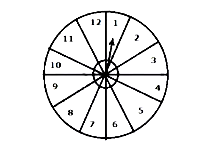
A game consists of spinning arrow which ccomes to rest pointing at one of the number 1,2,3,4,5,6,7,8,9,10,11,12; as shown below

If the outcomes are equally likely, find the probability that the pointer will point at :
(1) 6
(2) an even number
(3) a prime number
(4) a number greater than 8
(5) a number less than or equal to 9
(6) a number between 3 and 11
Answer
Total number of possible outcomes =12
(1) Number of favorable outcomes for 6=1
P(the pointer will point a 6) =$\frac{1}{12}$
(2)favorable outcomes for an even number are 2,4,6,8,10,12
Number of favorable outcomes=6
P( the pointer will be at an even number)=$\frac{6}{12}=\frac{1}{2}$
(3) Favorable outcomes for a prime number are 2,3,5,7,11
Number of favorable outcomes=5
|p(the pointer will be at a prime number)=$\frac{5}{12}$
(4) Favourable outcomes for a number greater than 8 are 9,10,11,12
Number of favorable outcomes=4
P(the pointer will be at a number greater than 8 )
$=\frac{4}{12}=\frac{1}{3}$
(5) Favorable outcomes for a number less than or equal to are 1,2,,3,4,5,6,7,8,9
Number of favorable outcome =9
p(the pointer will be at a number less than or equal to 9)=
$\frac{9}{12}=\frac{3}{4}$
(6) Favorable outcomes for a number between 3 and 11 are 4,5,6,7,8,9,10
Number of favorable outcomes=7
P(the pointer will be at a number 3 and 11) =$\frac{7}{12}$
 
View full question & answer
Question 422 Marks
A bag contains twenty Rs 5 coins, fifty Rs 2 coins and thirty Re 1 coins. If it is equally likely that one of the coins will fall down when the bag is turned upside down, what is the probability that the coin: will not be a Rs 2 coin?
Answer
Total number of coins=20+50+30=100
Total possible outcomes=100=n(s)
Number of favorable outcomes for not a Rs 1 or Rs 5 coins=30+20+50=n(E)
Probability (not Rs 2 coin)=$=\frac{n(E)}{n(S)}=\frac{50}{100}=\frac{1}{2}$
View full question & answer
Question 432 Marks
A bag contains twenty Rs 5 coins, fifty Rs 2 coins and thirty Re 1 coins. If it is equally likely that one of the coins will fall down when the bag is turned upside down, what is the probability that the coin: will be a Re 1 coin?
Answer
Total number of coins = 20+50+30=100
Total possible outcomes=100=n(S)
Number of favorable outcomes for Re 1 coins=30=n(s)
Probability (Re 1 coin)=$\frac{n(E)}{n(S)}=\frac{30}{100}=\frac{3}{10}$
View full question & answer
Question 442 Marks
A bag contains 10 red balls, 16 white balls and 8 green balls. A ball is drawn out of the bag at random. What is the probability that the ball drawn will be: white or green?
Answer
Total number of possible outcomes=10+16+8=34
n(s)=34
Number of favorable outcomes for white or green ball =16+8=24 =n(E)
Probability for drawing s white or green ball=
$\frac{n(E)}{n(S)} = \frac{24}{34}=\frac{12}{17}$
View full question & answer
Question 452 Marks
A bag contains 10 red balls, 16 white balls and 8 green balls. A ball is drawn out of the bag at random. What is the probability that the ball drawn will be : neither red nor green?
Answer
Total number of possible outcomes = 10+16+8=34 balls
n(s)=34
Favorable outcomes for neither a red nor a green ball=favourable outcomes for white ball number of favorable outcomes for white ball=16=n(E)
Probability for not drawing a red or green ball = $\frac{n(E)}{n(s)}=\frac{16}{34}=\frac{8}{17}$
View full question & answer
Question 462 Marks
A bag contains 10 red balls, 16 white balls and 8 green balls. A ball is drawn out of the bag at random. What is the probability that the ball drawn will be : not red?
Answer
Total number of possible outcomes = 10+16+8=34 balls
n(s)=34
Favorable outcomes for not a red ball= favourable outcomes for white or green ball
Number of favorable outcome for white or green ball = 16 + 8 = 24 = n(E)
Probability for not drawing a red ball = $\frac{n(E)}{n(s)}=\frac{24}{34}=\frac{12}{17}$
View full question & answer
Question 472 Marks
The probability that two boys do not have the same birthday is 0.897. What is the probability that the two boys have the same birthday?
Answer
P(do not have the same birthday)+P(have same birthday) = 1
0.897 + P(have same birthday) = 1
P(have same birthday) = 1 – 0.897
P(have same birthday) = 0.103
View full question & answer
Question 482 Marks
A bag contains 3 red balls, 4 blue balls and 1 yellow ball, all the balls being identical in shape and size. If a ball is taken out of the bag without looking into it; find the probability that the ball is: neither yellow nor red
Answer
Total number of balls in the bag=3+4+1=8
Number of possible outcomes=8=n(s)
Neithher yellow ball nor red ball means a blue ball
Event of not drawing a yellow or red ball=E=4
n(E)=4
Probability of not drawing a yellow or red ball=$\frac{n(E)}{n(S)}=\frac{4}{8}=\frac{1}{2}$
View full question & answer
Question 492 Marks
A bag contains 3 red balls, 4 blue balls and 1 yellow ball, all the balls being identical in shape and size. If a ball is taken out of the bag without looking into it; find the probability that the ball is: not yellow
Answer
Total number of balls in the bag=3+4+1=8 balls
Number of possible outcomes =8=n(s)
Probability of not drrawing a yellow ball=1- Probability of drawing a yellow ball Probability of not drawing a yellow ball$=1-\frac{1}{8}=\frac{8-1}{8}=\frac{7}{8}$
View full question & answer
Question 502 Marks
A bag contains 3 red balls, 4 blue balls and 1 yellow ball, all the balls being identical in shape and size. If a ball is taken out of the bag without looking into it; find the probability that the ball is: red
Answer
Total number of balls in the bag=3+4+1=8 balls
Number of possible outcomes=8=n(s)
Event of drawing a red ball ={R,R,R}
n(E)=3
Probability of drawing a reddd ball=$\frac{n(E)}{n(S)}=\frac{3}{8}$
View full question & answer
[2 Mark Question Answer] - Mathematics STD 10 Questions - Vidyadip