Question 13 Marks
A plane left $30$ minutes later than the scheduled time and in order to reach its destination $1500$ km away in time, it has to increase its speed by $250$ km/hr from its usual speed. Find its usual speed.
AnswerLet the usual speed of plane be x km/hr
Distance $= 1500$ km
From the given information we have
$\frac{1500}{x}-\frac{1500}{x+250}=\frac{30}{60}$
$\frac{1500 x+1500 \times 250-1500 x}{x(x+250)}=\frac{1}{2}$
$\frac{1500 \times 250}{x^2+250 x}=\frac{1}{2}$
$x^2+250 x-750000=0$
$x^2+1000 x-750 x-750000=0$
$(x + 1000)(x - 750) = 0$
$x = -1000, 750$
Since speed cannnot be negative So $x = 750$
Hence the usual speed of plane is $750$ km/hr
View full question & answer→Question 23 Marks
$Rs.6500$ was divided equally among a certain number of persons. Had there been $15$ persons more, each would have got $Rs. 30$ less. Find the original number of persons.
AnswerLet the original number of persons be $x$
Total money which was divided $= Rs.6500$
Each person share $=\operatorname{Rs} \frac{6500}{ x }$
From the given information
$\frac{6500}{x}-\frac{6500}{x+15}=30$
$\frac{3250}{x(x+15)}=1$
$x^2+15 x-3250=0$
$x^2+65 x-50 x-3250=0$
$x(x + 65)(x - 50) = 0$
$x = -65, 50$
Since the number of persons cannot be negative
hence the original number s of person is $50$
View full question & answer→Question 33 Marks
A trader buys x articles for a total cost of Rs 600.
(i) Write down the cost of one article in terms of x.
If the cost per article were Rs 5 more, the number of articles that can be bought for Rs 600 would be four less.
(ii) Write down the equation in x for the above situation and solve it to find x.
AnswerNumber of articles $= x$
The total cost of articles $= Rs.600$
$1)$ Cost of one article $=\operatorname{Rs} \frac{600}{ x }$
$2)$ From the given information we have
$\frac{600}{x-4}-\frac{600}{x}=5$
$\frac{600 x-600 x+2400}{x(x-4)}=5$
$\frac{480}{x(x-4)}=1$
$x^2-4 x-480=0$
$x^2-24 x+20 x-480=0$
$x(x - 24) + 20(x - 24) = 0$
$(x - 24)(x + 20) = 0$
$x = 24, -20$
Since number of article cannnot be negative So $x = 24.$
View full question & answer→Question 43 Marks
The distance by road between two towns A and B is 216 km, and by rail, it is 208 km. A car travels at a speed of x km/hr and the train travels at a speed which is 16 km/hr faster than the car. Calculate:
(1) the time is taken by the car to reach town B from A, in terms of x;
(2) the time is taken by the train to reach town B from A, in terms of x.
(3) If the train takes 2 hours less than the car, to reach town B, obtain an equation in x and solve it.
(4) Hence, find the speed of the train.
AnswerSpeed of car $= x\ km/hr$
Speed of train $= (x + 16)\ km/hr$
$1)$ we know Time $=\frac{\text { Distance }}{\text { Speed }}$
Time is taken by the car to reach town B From $A=\frac{216}{x}$ hrs
$2)$ Time taken by the train to reach town B from $A=\frac{208}{x+16}$ hrs
$3)$ From the given information
$\frac{216}{x}-\frac{208}{x+16}=2$
$\frac{216 x+3456-208 x}{x(x+16)}=2$
$\frac{8 x+3456}{x(x+16)}=2$
$4 x+1728=x^2+16 x$
$x^2+12 x-1728=0$
$x^2+48 x-36 x-1728=0$
$x(x+48)-36(x+48)=0$
$(x + 48)(x - 36) = 0$
$x = -48, 36$
But speed cannnot be negative So $x = 36$
$4)$ Speed of train $= (36 + 16)\ km/ hr = 52\ km/hr$
View full question & answer→Question 53 Marks
In a two-digit number, the ten’s digit is bigger. The product of the digits is 27 and the difference between two digits is 6. Find the number.
AnswerGiven, the difference between the two digits is 6 and the ten’s digit is bigger than the unit’s digit.
So, let the unit’s digit be x and ten’s digit be (x + 6).
From the given condition, we have:
x(x + 6) = 27
x² + 6x – 27 = 0
x² + 9x – 3x – 27 = 0
x(x + 9) – 3(x + 9) = 0
(x + 9) (x – 3) = 0
x = -9, 3
Since, the digits of a number cannot be negative. So, x = 3.
Unit’s digit = 3
Ten’s digit = 9
Thus, the number is 93.
View full question & answer→Question 63 Marks
In an auditorium, seats were arranged in rows and columns. The number of rows was equal to the number of seats in each row. When the number of rows was doubled and the number of seats in each row was reduced by $10,$ the total number of seats increased by $300.$ Find:
(1) the number of rows in the original arrangement.
(2) the number of seats in the auditorium after re-arrangement.
AnswerLet the number of rows in the original arrangement be $x.$
Then, the number of seats in each row in original arrangement $= x$
Total number of seats $= x \times x = x^2$
From the given information,
$2x(x – 10) = x^2 + 300$
$2x^2 – 20x = x^2 + 300$
$x^2 – 20x – 300 = 0$
$(x – 30) (x + 10) = 0$
$x = 30, -10$
Since, the number of rows or seats cannot be negative.
So, $x = 30.$
$1)$ The number of rows in the original arrangement $= x = 30$
$2)$ The number of seats after re-arrangement $= x^2 + 300 = 900 + 300 = 1200$
View full question & answer→Question 73 Marks
$Rs.250$ is divided equally among a certain number of children. If there were $25$ children more, each would have received $50$ paise less. Find the number of children
AnswerLet the number of children be $x.$
It is given that $Rs.250$ is divided amongst x students.
So money received bv each child $=Rs.\frac{250}{ x }$
if there were $25$ children more then
Money received by each child $=R s \frac{250}{x+25}$
From the given information
$\frac{250}{x}-\frac{250}{x+25}=\frac{50}{100} $
$ \frac{250 x+6250-250 x}{x(x+25)}=\frac{1}{2}$
$\frac{6250}{x^2+25 x}=\frac{1}{2} $
$ x^2+25 x-12500=0 $
$ (x+125)(x-100)=0 $
$ x=-125,100$
Since the number of student cannot be negative so $x = 100$
Hence the number of students is $100$
View full question & answer→Question 83 Marks
The speed of a boat in still water is $15\ km/hr.$ It can go $30\ km$ upstream and return downstream to the original point in $4$ hours $30$ minutes. Find the speed of the stream.
AnswerLet the speed of the stream be x km/hr.
$\therefore$ Speed of the boat downstream $= (15 + x)\ km/hr$
`Speed of the boat upstream $= (15 – x)\ km/hr$
Time taken to come back $=\frac{30}{15-x}$
From the given information
$\frac{30}{15+x}+\frac{30}{15-x}=4 \frac{30}{60}$
$\frac{30}{15+x}+\frac{30}{15-x}=\frac{9}{2}$
$\frac{450-30 x+450+30 x}{(15+x)(15-x)}=\frac{9}{2}$
$\frac{900}{225-x^2}=\frac{9}{2}$
$\frac{100}{225+x^2}=\frac{1}{2}$
$225-x^2=200$
$x^2=25$
$x= \pm 5$
But, $x$ cannot be negative, so, $x = 5.$
Thus, the speed of the stream is $5\ km/hr.$
View full question & answer→Question 93 Marks
The product of the digits of a two digit number is $24.$ If its unit’s digit exceeds twice its ten’s digit by $2;$ find the number.
AnswerLet the ten’s and unit’s digit of the required number be x and y respectively.
From the given information,
$x x y = 24$
$y=\frac{24}{x}$
Also $y = 2x + 2$ [Using $(1)$]
$\frac{24}{x}=2 x^2+2 x$
$2 x^2+2 x-24=0$
$x^2+x-12=0$
$(x + 4)(x - 3) = 0$
$x = -4,3$
The digit of a number cannot be negative so $x = 3$
$\therefore y =\frac{24}{3}=8$
Thus the required number is $38$
View full question & answer→Question 103 Marks
A stone is thrown vertically downwards and the formula $d = 16t^2 + 4t$ gives the distance, d metres, that it falls in t seconds. How long does it take to fall $420$ metres?
AnswerFrom the given information,
$16 t^2+4 t=420 $
$ 4 t^2+t-105=0 $
$ 4 t^2-20 t+21 t-105=0 $
$ 4 t(t-5)+21(t-5)=0 $
$ (4 t+21)(t-5)=0 $
$t=--\frac{21}{4}, 5$
But, time cannot be negative.
Thus, the required time taken is $5$ seconds.
View full question & answer→Question 113 Marks
A trader bought a number of articles for $Rs.1,200.$ Ten were damaged and he sold each of the remaining articles at $Rs.2$ more than what he paid for it, thus getting a profit of $Rs.60$ on the whole transaction. Taking the number of articles he bought as x, form an equation in x and solve it.
AnswerNumber of articles bought by the trader $= x$
It is given that the trader bought the articles for $Rs.1200.$
So the cost of one article $=\operatorname{Rs} \frac{1200}{x}$
Ten articles were damaged So the number of articles left $= x - 10$
The selling price of each of $(x - 10)$ articles Rs $(x-10)\left(\frac{1200}{x}+2\right)$
Profit $= Rs.60$
$\therefore(x-10)\left(\frac{1200}{x}+2\right)-1200=60$
$1200 + 2x - 12000/x - 20 - 1200 = 60$
$2 x-\frac{12000}{x}-80=0$
$ 2 x^2-80 x-12000=0$
$ x^2-40 x-6000=0 $
$ x^2-100 x+60 x-6000=0$
$ x(x-100)+60(x-100)=0$
$ x=100,-60$
Number of articles cannot be negative. So,$ x = 100.$
View full question & answer→Question 123 Marks
An employer finds that if he increased the weekly wages of each worker by $Rs.5$ and employs five workers less, he increases his weekly wage bill from $Rs.3,150$ to $Rs.3,250.$ Taking the original weekly wage of each worker as Rs x; obtain an equation in x and then solve it to find the weekly wages of each worker.
AnswerThe original weekly wage of each worker $= Rs.x$
The original weekly wage bill of employer = Rs 3150
Number of workers $= 3150/x$
New weekly wages of each worker $= Rs (x + 5)$
The new weekly wage bill of employer $= Rs 3250$
Number of workers $=\frac{3250}{x+5}$
From the given condition
$\frac{3150}{x}-5=\frac{3250}{x+5}$
$\frac{3150-5 x}{x}=\frac{3250}{x+5}$
$3150 x-5 x^2+15750-25 x=3250 x$
$-5 x^2+15750-125 x=0$
$x^2+70 x-45 x-3150=0$
$x(x + 70) - 45(x + 70) = 0$
$(x + 70)(x - 45) = 0$
$x = -70, 45$
Since wage cannot be negative $x = 45$
Thus the original weekly wage of each worker is $Rs.45$
View full question & answer→Question 133 Marks
A trader bought an article for Rs x and sold it for $Rs.52,$ thereby making a profit of $(x – 10)$ per cent on his outlay. Calculate the cost price.
AnswerC.P. of the article $= Rs.x$
S.P. of the article $= Rs.52$
Profit $= Rs (52 – x)$
We know:
$\text { Profit } \%=\frac{\text { Profit }}{\text { C.P. }} \times 100$
$\therefore x-10=\frac{52-x}{x} \times 100$
$x^2-10 x=5200-100 x$
$x^2+90 x-5200=0$
$(x + 130)(x - 40) = 0$
$x = -130, 40$
Since, C.P. cannot be negative. So,$ x = 40.$
Thus, the cost price of the article is $Rs.40.$
View full question & answer→Question 143 Marks
A man bought an article for Rs x and sold it for Rs $16.$ If his loss was x per cent, find the cost price of the article.
AnswerC.P. of the article $= Rs.x$
S.P. of the article $= Rs.16$
Loss $= Rs.(x – 16)$
We know:
$\text { Loss\% }=\frac{\text { Loss }}{C P} \times 100$
$\therefore x=\frac{x-16}{x} \times 100$
$x^2=100 x-1600$
$x^2-100 x+1600=0$
$(x - 80)(x - 20) = 0$
$x = 80, 20$
Thus, the cost price of the article is $Rs.20$ or $Rs.80.$
View full question & answer→Question 153 Marks
By selling a chair for $Rs.75,$ Mohan gained as much per cent as its cost. Calculate the cost of the chair.
AnswerLet the C.P. of the chair be Rs x
S.P. of chair $= Rs.75$
Profit $= Rs (75 – x)$
We know:
$\text { Profit }=\frac{\text { Profit }}{\text { C.P. }} \times 100$
$ \therefore x=\frac{75-x}{x} \times 100 $
$ x^2=7500-100 x $
$x^2+100 x-7500=0$
$(x + 150)(x - 50) = 0$
$x = -150, 50$
But, C.P. cannot be negative. So, $x = 50.$
Hence, the cost of the chair is $Rs.50.$
View full question & answer→Question 163 Marks
Two squares have sides x cm and $(x + 4) \ cm$. The sum of their area is $656$ sq. cm. Express this as an algebraic equation in x and solve the equation to find the sides of the squares.
AnswerGiven that, two squares have sides x cm and $(x + 4) \ cm.$
Sum of their area $= 656 cm^2$
$\therefore x^2 + (x + 4)^2 = 656$
$x^2 + x^2 + 16 + 8x = 656$
$2x^2 + 8x – 640 = 0$
$x^2 + 4x – 320 = 0$
$x^2 + 20x – 16x – 320 = 0$
$x(x + 20) – 16(x + 20) = 0$
$(x + 20) (x – 16) = 0$
$x = -20, 16$
But, x being side, cannot be negative.
So,$ x = 16$
Thus, the sides of the two squares are $16 \ cm$ and $20 \ cm.$
View full question & answer→Question 173 Marks
A footpath of uniform width runs round the inside of a rectangular field $32\ m$ long and $24\ m$ wide. If the path occupies $208\ m^2,$ find the width of the footpath.
AnswerLet w be the width of the footpath.
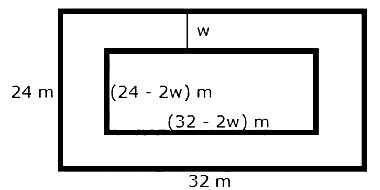
Area of the path $=$ Area of outer rectangle $–$ Area of inner rectangle
$\therefore 208 = (32)(24) – (32 – 2w)(24 – 2w)$
$208 = 768 – 768 + 64w + 48w – 4w^2$
$4w^2 – 112w + 208 = 0$
$w^2 – 28w + 52 = 0$
$w^2 – 26w – 2w + 52 = 0$
$w(w – 26) – 2(w – 26) = 0$
$(w – 26) (w – 2) = 0$
$w = 26, 2$
If $w = 26,$ then breadth of inner rectangle $= (24 – 52)\ m = -28\ m,$ which is not possible.
Hence, the width of the footpath is $2\ m.$ View full question & answer→Question 183 Marks
The perimeter of a rectangle is $104\ m$ and its area is $640\ m^2.$ Find its length and breadth.
AnswerLet the length and the breadth of the rectangle be $x\ m$ and $y\ m.$
Perimeter $= 2(x + y) m$
$\therefore 104 = 2(x + y)$
$x + y = 52$
$y = 52 – x$
Area $= 640 m^2$
$\therefore xy = 640$
$x(52 – x) = 640$
$x^2 – 52x + 640 = 0$
$x^2 – 32x – 20x + 640 = 0$
$x(x – 32) – 20 (x – 32) = 0$
$(x – 32) (x – 20) = 0$
$x = 32, 20$
When $x = 32, y = 52 – 32 = 20$
When $x = 20, y = 52 – 20 = 32$
Thus, the length and breadth of the rectangle are $32\ cm$ and $20\ cm.$
View full question & answer→Question 193 Marks
The diagonal of a rectangle is $60\ m$ more than its shorter side and the larger side is $30\ m$ more than the shorter side. Find the sides of the rectangle.
Answer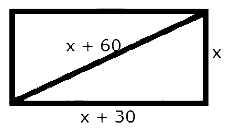
Let the shorter side be $x\ m.$
Length of the other side $= (x + 30)\ m$
Length of hypotenuse $= (x + 60)\ m$
Using Pythagoras theorem,
$(x + 60)^2 = x^2 + (x + 30)^2$
$x^2 + 3600 + 120x = x^2 + x^2 + 900 + 60x$
$x^2 – 60x – 2700 = 0$
$x^2 – 90x + 30x – 2700 = 0$
$x(x – 90) + 30(x – 90) = 0$
$(x – 90) (x + 30) = 0$
$x = 90, -30$
But, $x$ cannot be negative. So, $x = 90.$
Thus, the sides of the rectangle are $90 m$ and $(90 + 30)\ m = 120\ m.$ View full question & answer→Question 203 Marks
The hypotenuse of a right-angled triangle exceeds one side by $1\ cm$ and the other side by $18\ cm;$ find the lengths of the sides of the triangle.
AnswerLet one hypotenuse of the triangle be $x\ cm.$
From the given information,
Length of one side $= (x – 1)\ cm$
Length of other side $= (x – 18)\ cm$
Using Pythagoras theorem,
$x^2 = (x – 1)^2 + (x – 18)^2$
$x^2 = x^2 + 1 – 2x + x^2 + 324 – 36x$
$x^2 – 38x + 325 = 0$
$x^2 – 13x – 25x + 325 = 0$
$x(x – 13) – 25(x – 13) = 0$
$(x – 13) (x – 25) = 0$
$x = 13, 25$
When $x = 13, x – 18 = 13 – 18 = -5, $ which being negative, is not possible.
So, $x = 25$
Thus, the lengths of the sides of the triangle are $x = 25\ cm, (x – 1) = 24\ cm$ and $(x – 18) = 7\ cm.$
View full question & answer→Question 213 Marks
The sides of a right-angled triangle are $(x – 1)\ cm, 3x\ cm$ and $(3x + 1)\ cm.$ Find:(1) the value of $x,$
(2) the lengths of its sides,
(3) its area.
AnswerLonger side $=$ Hypotenuse $= (3x + 1) \ cm$
Lengths of other two sides are $(x – 1)\ cm$ and $3x\ cm$.
Using Pythagoras theorem,
$(3x + 1)^2 = (x – 1)^2 + (3x)^2$
$9x^2 + 1 + 6x = x^2 + 1 – 2x + 9x^2$
$x^2 – 8x = 0$
$x(x – 8) = 0$
$x = 0, 8$
But, if $x = 0,$ then one side $= 3x = 0,$ which is not possible.
So, $x = 8$
Thus, the lengths of the sides of the triangle are $(x – 1)\ cm = 7\ cm, 3x\ cm = 24\ cm$ and $(3x + 1)\ cm = 25\ cm.$
Area of the triangle $= \frac{1}{2} \times 7\ cm \times 24 cm = 84\ cm^2$
View full question & answer→Question 223 Marks
The hypotenuse of a right-angled triangle is $26\ cm$ and the sum of other two sides is $34\ cm$. Find the lengths of its sides.
AnswerHypotenuse $= 26\ cm$
The sum of other two sides is $34 cm.$
So, let the other two sides be $x\ cm$ and $(34 – x)\ cm.$
Using Pythagoras theorem,
$(26)^2 = x^2 + (34 – x)^2$
$676 = x^2 + x^2 + 1156 – 68x$
$2x^2 – 68x + 480 = 0$
$x^2 – 34x + 240 = 0$
$x^2 – 10x – 24x + 240 = 0$
$x(x – 10) – 24(x – 10) = 0$
$(x – 10) (x – 24) = 0$
$x = 10, 24$
When $x = 10, (34 – x) = 24$
When $x = 24, (34 – x) = 10$
Thus, the lengths the three sides of the right-angled triangle are $10\ cm, 24\ cm$ and $26\ cm.$
View full question & answer→Question 233 Marks
Two natural numbers differ by $3.$ Find the numbers, if the sum of their reciprocals is $7/10.$
AnswerLet the numbers be x and $x + 3$
From the given information
$\frac{1}{x}+\frac{1}{x+3}=\frac{7}{10} $
$ \frac{x+3+x}{x(x+3)}=\frac{7}{10} $
$ \frac{2 x+30}{x^2+3 x}=\frac{7}{10} $
$ 20 x+30=7 x^2+21 x $
$ 7 x^2+x-30=0 $
$ 7 x^2-14 x+15 x-30=0 $
$7 x(x-2)+15(x-2)=0 $
$ (x-2)(7 x+15)=0 $
$x=2, \frac{-15}{7}$
Since x is a natural number so $x= 2$
Thus the number are $2$ and $5$
View full question & answer→Question 243 Marks
The sum of a number and its reciprocal is $4.25.$ Find the number.
AnswerLet the numbe be x and $\frac{1}{x}$
For the given information
$x+\frac{1}{x}=4.25 $
$\frac{x^2+1}{x}=\frac{425}{100}=\frac{17}{4} $
$ 4 x^2-17 x+4=0 $
$ 4 x^2-17 x+4=0$
$ 4 x(x-4)-1(x-4)=0 $
$(x-4)(4 x-1)=0 $
$ x=4,1 / 4$
$x=4 \Rightarrow \frac{1}{x}=\frac{1}{4} $
$ x=\frac{1}{4} \Rightarrow x=4$
Thus the number are $4$ and $1/4$
View full question & answer→Question 253 Marks
Find the two natural numbers which differ by $5$ and the sum of whose squares is $97$.
AnswerLet the two numbers be $x$ and $x + 5$.
From the given information,
$x^2 + (x + 5)^2 = 97$
$2x^2 + 10x + 25 – 97 = 0$
$2x^2 + 10x – 72 = 0$
$x^2 + 5x – 36 = 0$
$(x + 9) (x – 4) = 0$
$x = -9$ or $4$
Since, $-9$ is not a natural number. So, $x = 4$.
Thus, the numbers are $4$ and $9$.
View full question & answer→Question 263 Marks
A can do a piece of work in ‘x’ days and B can do the same work in (x + 16) days. If both working together can do it in 15 days; calculate ‘x’.
AnswerWork done by A in one day = 1/x
Work done by B in one day$=\frac{1}{x+16}$
Together A and B can do the work in 15 days. Therefore we have
$\frac{1}{x}+\frac{1}{x+16}=\frac{1}{15}$
$\frac{x+16+x}{x(x+16)}=\frac{1}{15}$
$\frac{2 x+16}{x^2+16 x}=\frac{1}{15}$
$30 x+240=x^2+16 x$
$x^2-14 x-240=0$
$(x-24)(x+10)=0$
$x=24,-10$
Since x cannnot be negative
Thus x = 24
View full question & answer→Question 273 Marks
Divide $20$ into two parts such that three times the square of one part exceeds the other part by $10.$
AnswerLet the two parts be $x$ and $y.$
From the given information,
$x + y = 20 \Rightarrow y = 20 – x$
$3x^2 = (20 – x) + 10$
$3x^2 = 30 – x$
$3x^2 + x – 30 = 0$
$3x^2 – 9x + 10x – 30 = 0$
$3x(x – 3) + 10(x – 3) = 0$
$(x – 3) (3x + 10) = 0$
$x = 3, -10/3$
Since, $x$ cannot be equal to $-10/3,$ so, $x = 3.$
Thus, one part is $3$ and other part is $20 – 3 = 17.$
View full question & answer→Question 283 Marks
Three positive numbers are in the ratio $1/2 : 1/3 : 1/4$. Find the numbers if the sum of their squares is $244.$
AnswerGiven, three positive numbers are in the ratio
$\frac{1}{2}: \frac{1}{3}: \frac{1}{4}=6: 4: 3$
Let the numbers be $6x, 4x$ and $3x.$
From the given information,
$(6x)^2 + (4x)^2 + (3x)^2 = 244$
$36x^2 + 16x^2 + 9x^2 = 244$
$61x^2 = 244$
$x^2 = 4$
$x = ± 2$
Since, the numbers are positive, so $x = 2.$
Thus, the numbers are $12, 8$ and $6.$
View full question & answer→Question 293 Marks
The denominator of a fraction is one more than twice the numerator. If the sum of the fraction and its reciprocal is $2.9;$ find the fraction.
AnswerLet the required fraction be$\frac{x}{2 x+1}$
From the given information
$\frac{x}{2 x+1}+\frac{2 x+1}{x}=2.9 $
$\frac{x^2+4 x^2+1+4 x}{x(2 x+1)}=\frac{29}{10}$
$ \frac{5 x^2+1+4 x}{2 x^2+x}=\frac{29}{10} $
$8 x^2-11 x-10=0 $
$x=\frac{11 \pm \sqrt{121+320}}{16} $
$ x=\frac{11 \pm \sqrt{441}}{16} $
$x=\frac{11 \pm 21}{16} $
$ x=2,-\frac{5}{8}$
Thus the required fraction is $\frac{2}{5}$
View full question & answer→