Questions

[3 Mark Question Answer]

🎯

Test yourself on this topic

20 questions · timed · auto-graded

Question 13 Marks
The input and output voltages of a transformer are 220 V and 44V respectively. Find the current in input circuit if the output current is 2 A.
Answer
Output current $I _{ S }=2 A , E _{ S }=44 V$.
Input current $I_p=?, E_p=220 V$.
We know that $=E_s I_s=E_p I_p$
$
I_p=\frac{44 \times 2 A }{220}=0.4 A
$
View full question & answer
Question 23 Marks
The input and output voltage of a transformer are 220 V and 44 V respectively. Find: the turns ratio.
Answer
We know that
$
\frac{ E _{ p }}{ E _{ s }}=\frac{ N _{ p }}{ N _{ s }}
$
So turns ratio
$
\frac{ N _{ s }}{ N _{ p }}=\frac{44}{220}=1.5
$
View full question & answer
Question 33 Marks

Name the transformer used in the
(i) power generating station,
(ii) power sub-station.

State the function of each transformer.

Answer
(i) Step-up transformer.

In power generating stations the alternating current generated is first stepped up from 11 kV to 132 kV.

(ii) Step-down transformer.

At the power sub-station, voltage is stepped down before its distribution to the consumers.

Transformers are used so as to reduce the loss of energy in the form of heat in the line wires used for transmission.

View full question & answer
Question 43 Marks
Give two points of difference between a step-up transformer and step-down transformer.
Answer
Step up transformer Step down transformer
It increases the a.c. voltage and decrease the current. It decreases the a.c. voltage and increase the current.
The wire of primary coil is thicker than that in the secondary coil. The wire in the secondary coil is thicker than that in the primary coil.
View full question & answer
Question 53 Marks
What is the function of a transformer in an a.c. circuit? How do the input and output powers in a transformer compare?
Answer
A transformer is a device by which the amplitude of an alternating e.m.f. can be increased or decreased.
For an ideal transformer, when there is no loss of energy, the output power is equal to input power i.e.,
Power in secondary coil = power in primary coil
$E_SL_S = E_PL_S$​​​​​​​
View full question & answer
Question 63 Marks

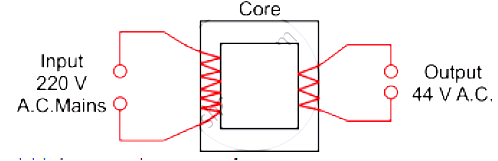
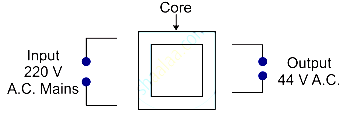
The following diagram shows the core of a transformer and its input and output connections.


(a) state the material used for core and describe its structure.
(b) complete the diagram of the transformer and connections by labelling all parts joined by you.
(c) Name the transformer: Step-up or step down?

Answer
(a) Soft iron core is used. The core is made up from the thin laminated sheets of soft iron of T and U shape, placed alternately one above the other and insulated from each other by paint or varnish coating over them.(b)


(c) It is a step down transformer.
View full question & answer
Question 73 Marks

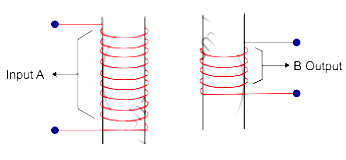
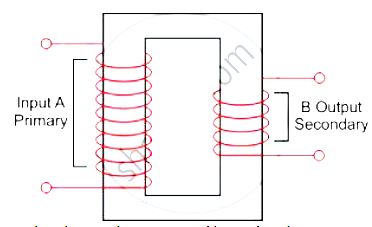
Complete the following diagram of a transformer and name the parts labelled A and B. name the part you have drawn to complete the diagram. What is the material of this part? Is this transformer a step up or step down? Give reason.

Answer


A is the primary coil. B is the secondary coil. We have drawn laminated core in the diagram. The material of this part is soft iron. This transformer a step-down transformer because the number of turns in primary coil is much greater than that in the secondary coil.

View full question & answer
Question 83 Marks
Name and state the principle of a simple a.c. generator what is its use?
Answer
An A.C. generator works on the principle of 'electromagnetic induction'.
Statement : Whenever a coil is rotated in a magnetic field, the magnetic flux linked with the coil changes, and therefore, an EMF is induced between the ends of the coil. Thus, a generator acts like a source of current if an external circuit containing load is connected between the ends of its coil.
View full question & answer
Question 93 Marks
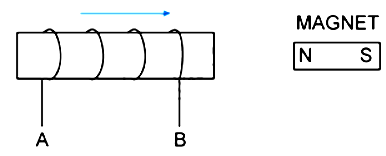
The diagram in shows a coil of several turns of copper wire near a magnet NS. The coil is moved in the direction of arrow shown in the diagram.


(i) In what direction does the induced current flow in the coil?
(ii) Name the law used to arrive at the conclusion in part (i).
(iii) How would the current in coil be altered if
(a) the coil has twice the number of turns,
(b) the coil was made to move three times fast?
Answer

(i) When the coil is moved in the direction of magnet the North pole generates near this end and current starts flowing from A to B.

(ii) Lenz's law.

(iii) (a)Current is directly proportional to the number of turns, therefore it will also become 2 times

(b) Current becomes thrice.

View full question & answer
Question 103 Marks
Explain the significance of Lenz’s law to show the conservation of energy in electromagnetic induction.
Answer
Lenz's law implies the law of conservation of energy. It shows that the mechanical energy spent in doing work, against the opposing force experienced by the moving magnet, is transformed into the electrical energy due to which current flows in the solenoid.
View full question & answer
Question 113 Marks
Name and state the law which determines the direction of induced current.

or

State Fleming’s right-hand rule.

Answer
Fleming's right hand rule: Stretch the forefinger, middle finger and the thumb of your right hand mutually perpendicular to each other. If the forefinger indicates the direction of magnetic field and the thumb will indicates the direction of motion of conductor, then the middle finger indicates the direction of induced current.
View full question & answer
Question 123 Marks
principle of an electric motor ?
Answer
Principle: An electric motor (dc motor) works on the principle that when an electric current is passed through a conductor placed normally in a magnetic field, a force acts on the conductor as a result of which the conductor begins to move and mechanical energy is obtained.
View full question & answer
Question 133 Marks
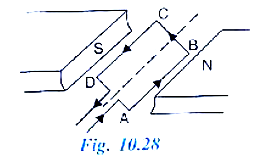
A coil ABCD mounted on an axle is placed between the poles N and S of a permanent magnet as shown in Fig. 10.28


(a) In which direction will the coil begin to rotate when current is passed through the coil in direction ABCD by connecting a battery at the ends A and D of the coil?
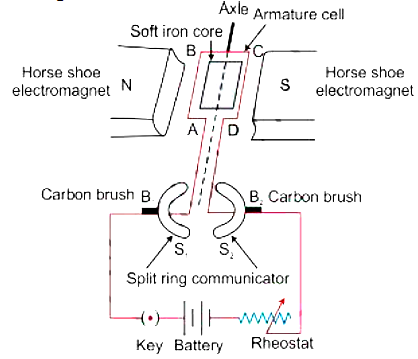
(b) Why is a commutator necessary for continuous rotation of the coil?
(c) Complete the diagram with commutator, ets. For the flow of current in the coil?
Answer
(a)The coil begins to rotate in anticlockwise direction.
(b) This is because, after half rotation, the arms AB and CD get interchanged, so the direction of torque on coil reverses. To keep the coil rotating in same direction, commutator is needed to change the direction of current in the coil after each half rotation of coil.


View full question & answer
Question 143 Marks
Name and state the law which is used to determine the direction of force on a current carrying conductor placed in a magnetic field.
Answer
Fleming's left hand rule: Stretch the forefinger, middle finger and the thumb of your left hand mutually perpendicular to each other. If the forefinger indicates the direction of magnetic field and the middle finger indicates the direction of current, then the thumb will indicate the direction of motion of conductor.
View full question & answer
Question 153 Marks
Name three factors on which the magnitude of force on a current carrying conductor placed in a magnetic field depends and state how does the force depend on the factors stated by you.
Answer
The magnitude of force on a current carrying conductor placed in a magnetic field depends on:
(i) On strength of magnetic field B.
(ii) On current I in the conductor.
(iii) On length of conductor.
Magnitude of force on a current carrying conductor placed in a magnetic field depends directly on these three factors.
View full question & answer
Question 163 Marks
State a law, which determines the direction of magnetic field around a current carrying wire.
Answer
Right hand thumb rule determines the direction of magnetic field around a current carrying wire.
It states that if we hold the current carrying conductor in right hand such that the thumb points in the direction of flow of current, then the fingers encircle the wire in the direction of the magnetic fields lines.
View full question & answer
Question 173 Marks
State two differences between an electromagnet and a permanent magnet.
Answer
Electromagnet Permanent magnet
It is made up of soft iron It is made up of steel.
The magnetic field strength can be changed. The magnetic field strength cannot be changed.
The electromagnets of very strong field can be made. The permanent magnets are not so strong.
View full question & answer
Question 183 Marks
State two ways through which the strength of an electromagnet can be increased.
Answer
the strength of an electromagnet can be increased by following ways:
(i) By increasing the number of turns of winding in the solenoid.
(ii) By increasing the current through the solenoid.
View full question & answer
Question 193 Marks
Name two factors on which the strength of magnetic field of an electromagnet depends and state how does it depend on the factors stated by you.
Answer
The strength of magnetic field of an electromagnet depends on:

(i) Number of turns: The strength of magnetic increases on increasing the number of turns of winding in the solenoid.
(ii) Current: The strength of magnetic field increases on increasing the current through the solenoid.

View full question & answer
Question 203 Marks
(a) What name is given to a cylindrical coil of diameter less than its length? (b) If a piece of soft iron is placed inside the coil mentioned in part (a) and current is passed in the coil from a battery, what name is then given to the device so obtained? (c) Give one use of the device mentioned in part (b).
Answer
>(a) Solenoid is a cylindrical coil of diameter less than its length. >(b) The device so obtained is electromagnet. >(c) It is used in electric relay.
View full question & answer