Questions

[5 Mark Question Answer]

🎯

Test yourself on this topic

11 questions · timed · auto-graded

Question 15 Marks
A faulty balance of unequal arms and pans of unequal weights is used to find the true weight of a metal. By double weighing the weights are found to be 1210 g and 1000 g. Calculate the true weight of the metal.
Answer
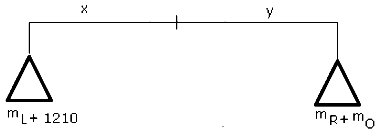
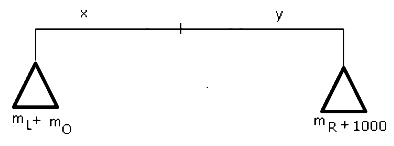


$\begin{aligned} & \left(m_L+1210\right) x=\left(m_R+m_o\right) y........(1) \\ & \left(m_L+m_0\right) x=\left(m_R+1000\right) y.......(2)\end{aligned}$
$ m_L x=m_R y......(3)
$
Equations when the two pans are empty from (1)
$m_L x+1210 x=m_R y+m_O y$
$ \Rightarrow 1210 x=m_{\circ}y.......(4) (using 3) $
from (2) $\begin{aligned} & m_L+m_O x=m_R+1000 y \\ & \Rightarrow m_0 x=1000 y \text {................(5) (using 3) }\end{aligned}$
$\begin{aligned} & \text { dividing equation (4) \& (5) } \\ & \frac{\mathrm{m}_{\mathrm{o}}}{1000}=\frac{1210}{\mathrm{~m}_{\mathrm{o}}} \\ & \Rightarrow \mathrm{mO}=\sqrt{1210 \times 1000}=1100 \mathrm{~g}\end{aligned}$
View full question & answer
Question 25 Marks
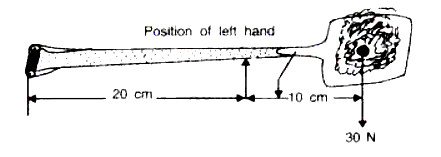
Fig. shows a spade. It is being used to lift soil weighing 30N from the ground.

(a) Mark the direction of the least force on the handle necessary to keep the spade balanced.
(b) Calculate the least force on the handle necessary to keep the spade balanced (the weight of the spade is negligible).
(c) If the left hand was move towards the soil on the spade, would the force on the handle necessary to keep the soil balance the greater or less? Give a reason for your answer.
(d) To which class of lever does the spade belong?
Answer
(a) Diagram showing the direction of application of least force on the handle:E.2.2.
(b) Given,load,L $=30 \mathrm{~N}$
Let effort = E
Effort - arm $=20 \mathrm{~cm}$
load $-\operatorname{arm}=20+10=30 \mathrm{~cm}$
Now, load x load - arm $=$ effort $x$ effort - arm
effort $=\frac{30 \times 30}{20}=45 \mathrm{~N}$
(c) On moving the left hand towards the soil on the spade, the lenght of effort arm will increase and effort being inversely proportional to the lenght of effort arm, the force or effort necessary to keep the soil balanced would be less.
(d) A spade belongs to class III lever.
View full question & answer
Question 35 Marks
 If $60 \%$ of the potential energy available in a waterfall is converted into heat energy, find the height of the waterfall, when the temperature difference between the top and the bottom of the fall is $0.21^{\circ} C$ (sp. Heat cap. Of water $=4200 J / kgK$ ).
Answer
Given, Sp. heat capacity of water, $s=4200 \mathrm{~J} / \mathrm{KgK}$
Temperature difference, $\Delta t=0.21^{\circ} \mathrm{C}$
Let ' $h$ ' be the height of the waterfall and ' $m$ ' be the mass of water.
Then, P.E of the water $=\mathrm{mgh}$
Given that, heat energy, $\mathrm{H}=60 \%$ of P.E
or, $4200 \times 0.21=0.6 \times 10 \times h$
or, $h=\frac{4200 \times 0.21}{0.6 \times 10}=\frac{882}{6}=147 \mathrm{~m}$
View full question & answer
Question 45 Marks
 A lead bullet moving at $70 ms^{-1}$ is brought to rest on hitting a target. If $80 \%$ of its energy is converted into heat energy, find the rise in temperature ( Sp . Heat cap. Of lead is $140 J / kgK$ ).
Answer
Given,initial velocity, u $=70 \mathrm{~m} / \mathrm{s}$
final velocity, $v=0 \mathrm{~m} / \mathrm{s}$
$\mathrm{sp}$. heat capacity of lead, $\mathrm{s}=140 \mathrm{~J} / \mathrm{kgK}$
Let $\Delta \mathrm{t}$ be the change in temperature
K.E possessed by the bullet $=\frac{1}{2} \mathrm{~m}(70)^2=2450 \mathrm{~m}$ joules
Heat energy $=80 \%$ of K.E $=\frac{80}{100} \times 2450 \mathrm{~m}=1960 \mathrm{~m}$ joules We know that, $\mathrm{H}=\mathrm{ms} \Delta \mathrm{t}$
or, $1960 m=m \times 140 \times \Delta t$
or, $\Delta t=\frac{1960}{40}=14{ }^{\circ} \mathrm{C}$
View full question & answer
Question 55 Marks
 A bullet of mass $25 \ g$ has a velocity of $600 ms^{-1}$. What is the kinetic energy of the bullet? If it penetrates $50 \ cm$ into a target, find the resistive force offered by the target.
Answer
Given, mass $\mathrm{m}=25 \mathrm{~g}=\frac{25}{1000} \mathrm{~kg}=\frac{1}{40}
\mathrm{~kg}$
initial velocity $u=600 \mathrm{~m} / \mathrm{s}$
final velocity $\mathrm{v}=0 \mathrm{~m} / \mathrm{s}$
Distance traveled, $\mathrm{s}=50 \mathrm{~cm}=0.5 \mathrm{~m}$
Now, $K.E$ of the bullet $=\frac{1}{2}$ mu2 $=\frac{1}{2}\left(\frac{1}{40}\right)(600)^2$
or, $K.E =4500 \mathrm{~J}$
let $\mathrm{F}$ be the resistive force
According to work energy theorem,
work done $=$ change in $K.E$
or, work done $=\frac{1}{2} m(v-u)^2=\frac{1}{2}\left(\frac{1}{40}\right)(0-600)^2=-4500 \mathrm{~J}$
Also, we know that: work done = force $x$ displacement
$\therefore-4500=F \times 0.5$
or, $F=-\frac{4500}{0.5}=-9000 \mathrm{~N}$
Hence, the resistive force is $9000 \mathrm{~N}$.
View full question & answer
Question 65 Marks
When an elevator starts to move down suddenly we experience 'weightlessness'. Explain.
Answer
When an elevator begins to move downwards in an accelerated mode, the forces acting on the body are the following:
a.Weight of the body acting downwards
b.Normal reaction of the floor acting upwards
c.The centrifugal force acting on the body, acting upwards.
Weight of the body is due to gravitational force on the body acting downwards.
Normal reaction is the force that is exerted by the elevator floor in response to the force with which the body presses itself against the floor.
The centrifugal force here is fictious force that acts on the body in the direction opposite to the acceleration of the reference frame, here it is, the elevator floor. It is given by ma, where m is the mass of the body & a is the accelaration of the elevator floor. Centrifugal force is directed opposite to the acceleration of the elevator floor.
Weightlessness is the condition of the zero apparent weight.
When the acceleration of the elevator is such that the upward centrifugal force Fc completely balances the downward weight Wt. of the body, the resultant normal reaction (N =Fc - Wt.) of the body is reduce dto zero. That's whene the body on the elevator floor will experience the state of weightlessness.
View full question & answer
Question 75 Marks
The following are some of the energy transformations.
A. Electrical to light
B. Work to heat
C. Chemical to light
D. Electrical to sound
E. Mechanical to electrical
Identify the energy transformation that takes place in the following by inserting the corresponding letter in the shape provided.
(i) A candle flame
(ii) A torch is lighted
(iii) A microphone is used in a meeting
(iv) A cycle dynamo
(v) A piece of metal is being filed
Answer
(i) A candle flame - (C). Chemical to light

(ii) A torch is lighted - (A). Electrical to light

(iii) A microphone is used in a meeting - (D). Electrical to sound

(iv) A cycle dynamo - (E). Mechanical to electrical

(v) A piece of metal is being filed - (B). Work to heat

View full question & answer
Question 85 Marks
List any six forms of energy and write a short note on each of them.
Answer
Six forms of energy:
1. Solar energy: The energy radiated by the sun is called the solar energy. Inside the sun, energy is produced by nuclear fusion reaction. Solar energy cannot be used to do work directly, because it is too diffused and is not always uniformly available. However, a number of devices such as solar panels, solar cells etc. have been invented to make use of solar energy.
2. Heat energy: The energy released on burning coal, oil, wood or gas is the heat energy. The stem possesses heat energy it has capacity to do work.
3. Light energy: It is the form of energy in presence of which other objects are seen. The natural source of light energy is sun. Many other sources of heat energy also give light energy.
4. Chemical or fuel energy: The energy possessed by fossil fuels such as coal, petroleum and natural gas is called chemical energy or fuel energy. These fuels are formed from the decayed remains of dead plants and animals that lived millions of years ago. In the interior of earth, due to high pressure and temperature the remains slowly changed into fossil fuels.
5. Hydro energy: The energy possessed by fast moving water is called the hydro energy. This energy is used to generate electricity in hydroelectric power stations. For this, dams are built across the rivers high up in the hills to store water. Water is allowed to run down the pipes and the energy of running water is used to turn a turbine. The turbine drives generators to produce electrical energy.
6. Nuclear energy: The energy released during the processes of nuclear fission and fusion is called nuclear (or atomic) energy. In both these processes, there is loss in mass which converts into energy in accordance with Einstein's mass-energy relation, $E = mc ^2$.
View full question & answer
Question 95 Marks
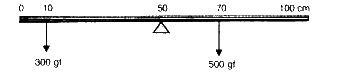
Fig. shows a uniform meter scale weighing 200 gf. Provided at its centre. Two weights 300 gf and 500 gf are suspended from the ruler as shown in the diagram. Calculate the resultant torque of the ruler and hence calculate the distance from mid-point where a 100 gf should be suspended to balance the meter scale.
Answer
Resultant torque = sum of clockwise moments - sum of anticlockwise moments

Taking, moments about the mid point

Resulttant torque = (300 x 40) - (500 x 20)

or, Resultant torque = 12000 - 10000 = 2000 gf-cm

Let a mass of 100 gf be suspended at a distance 'd' from the mid point towards the right side,

so as to balance the metre scale.

Then, in balanced condition:

sum of clockwise moments = sum of anticlockwise moments

(300 x 40) = (500 x 20) + (100 x d)

or, 12000 = 10000 + 100d

or, 100d = 2000

or,d = 20cm to the right of the mid-point

View full question & answer
Question 105 Marks
What is the difference between mass and weight?
Answer
Mass Weight

1. It is the measure of quantity of matter contained in the body, at rest.

1. It is the force with which the earth attracts a body.

2. It is a scalar quantity.

2. It is a vector quantity.

3. ITS SI unit is kg.

3. Its SI unit is newton (N).

4. It is measured by a physical or beam balance.

4. It is measured by a spring balance which is calibrated to read in newton.

5. It is constant for a body and does not change by changing the place of a body.

5. It is not constant for a body, but varies from place to place on the earths surface and also with altitude and depth from the earth's surface.
View full question & answer
Question 115 Marks
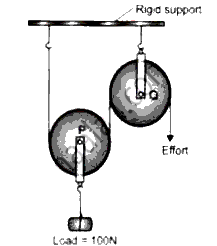
The diagram below shows a pulley arrangement.
|
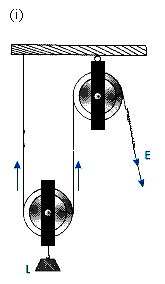
(i) In the diagram, mark the direction of the forces due to tension, acting on the pulley P.
(ii) What is the purpose of the pulley Q?
(iii) If the tension is T newton, deduce the relation between T and E.
(iv) Calculate the velocity ratio of the arrangement.
(v) Assuming that the efficiency of the system is 100%, what is the mechanical advantage?
(vi) Calculate the value of E
Answer

(ii) The purpose of the pulley Q is to change the direction of application of effort to a convenient direction.
(iii) In the diagram, T = E
(iv) If the free end of the string moves, through the distance x, the load will rise by a distance x/2.
Threfore, V.R = distance moved y the effort arm / distance moved by the load $=\frac{x}{x / 2}=2$
(v) In equilibrium,L = 2T and E = T
efficiency = M.A / V. R
or, $1=\frac{ M A }{2}$
$
\Rightarrow M . A =2
$
(vi) $M \cdot A=\frac{L}{E}$
$
\Rightarrow E=\frac{L}{M \cdot A}=\frac{100}{2}=50 N
$
View full question & answer
[5 Mark Question Answer] - Physics STD 10 Questions - Vidyadip