Questions

[5 Mark Question Answer]

🎯

Test yourself on this topic

8 questions · timed · auto-graded

Question 15 Marks
Explain how you will determine the position of the centre of gravity experimentally for a triangular lamina (or a triangular piece of cardboard)
Answer
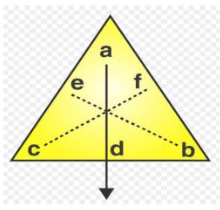
Take a triangular lamina. Make three fine holes at a, b, c near the edge of the triangular lamina. Now suspend the given lamina along with a plumb line from hole 'a'. Check that the lamina is free to oscillate about the point of suspension. When lamina has come to rest, draw straight line ad along the plumb line. Repeat the experiment by suspending the lamina through hole 'b' and then through hole 'c' for which we get straight lines to be and cf respectively. It is noticed that the lines ad, be and cf intersect each other at a common point G which is the position of the centre of gravity of triangular lamina i.e. the point of intersection of medians.
Image
View full question & answer
Question 25 Marks
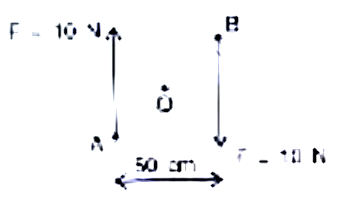
The figure shows two forces each of magnitude 10 N acting at the point A and B at a separation of 50 cm, in opposite directions. Calculate the resultant moment of two forces about the point A, B and
O, situated exactly at the middle of the two forces.

Answer
Perpendicular distance of point A from the force F = 10 N at B is 0.5m, while it is zero from the force F = 10 N at A

Hence moment of force about A is

= 10 N x 0.5m = 5 Nm(clockwise)

Perpendicular distance of the point B from the Force F = 10 N at A is 0.5m while it is zero from the force F = 10 N at B.

Hence moment of force about B is

= 10N x 0.5m = 5Nm (clockwise)

Perpendicular distance of point O from either of the forces F = 10N is 0.25 m

The moment if force F (=10N) at A about O = 10N x 0.25m

= 2.5 Nm (clockwise)

And a moment of force F (=10N) at B about O

= 10 N x 0.25m = 2.5 Nm(clockwise)

Hence total moment of the two forces about O

= 2.5 + 2.5 = 5 Nm (clockwise)

View full question & answer
Question 35 Marks
A uniform metre rule of weight 10gf is pivoted at its 0 mark.

How can it be made horizontal by applying a least force ?

Answer
From the principle of moments,
Anticlockwise moment= Clockwise moment
$10 gf \times 50 cm = W \times 100 cm$
So, $W=\frac{10 gf \times 50 cm }{100 cm }=5 gf$
By applying a force $5 gf$ upwards at the $100 cm$ mark, rule can be made horizontal.
View full question & answer
Question 45 Marks
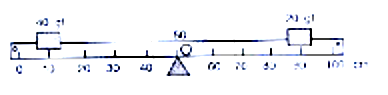
The figure shows a uniform metre rule placed on a function at its mid-point O and having a weight 40 gf at the 10 cm mark and a weight of 20 gf at the 9.0 cm mark.Is the metre rule in equilibrium?
If not how will the rule turn?
Answer
Anticlockwise moment = 40 gf x (50 - 10) cm

= 40 gf x 40 cm = 1600 gf x cm

The clockwise moment is not equal to the clockwise moment. Hence the metre rule is not in equilibrium and it will turn anticlockwise.

View full question & answer
Question 55 Marks
When does a body rotate? State one way to change the direction of rotation of a body. Given a suitable example to explain your answer.
Answer
When the body is pivoted at a point, the force applied on the body at a suitable point rotates the body about the axis passing through the pivoted point.
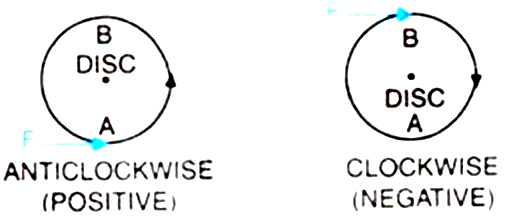
The direction of rotation can be changed by changing the point of application of force. The given figure shows the anticlockwise and clockwise moment s produced in a disc pivoted at its centre by changing the point of application of force F from A to B


View full question & answer
Question 65 Marks
Describe a simple experiment to verify the principle of moments, if you are supplied with a metre rule, a fulcrum and two springs with slotted weights.
Answer
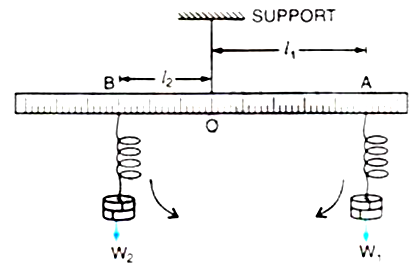
Suspend a metre rule horizontally from a fixed support by means of a strong thread at $O$ as shown. Now suspend two spring balances with some slotted weights $W _1$ and $W _2$ on them on either side of the thread. The scale may tilt to one side. Now adjust the distances of two spring balances from the support by keeping one at $A$ and the other at $B$ in such a way that the scale again becomes horizontal.

Let the weight suspended on the right side of thread from the spring balance at A be $W _1$ at distance $O A= I _1$, while the weight suspended on the left side of thread from the spring balance at $B$ be $W_2$ at distance $O B=I_2$. The weight $W _1$ tends to turn the scale clockwise, while the weight $W _2$ tend to turn the scale anticlockwise.
Clockwise moment $= W_1 x l_1$
Anticlockwise moment $= W_2 x l_2$​​​​​​​
In equilibrium, when the scale is horizontal, it is found that
Clockwise moment = Anticlockwise moment
i.e., $W_1 x l_1 = W_2 x l_2​​​​​​​$​​​​​​​
This verifies the principle of moments.
View full question & answer
Question 75 Marks
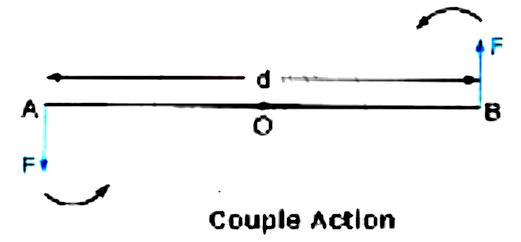
Prove that Moment of couple = Force x couple arm.
Answer

At A and B, two equal and opposite forces each of magnitude F are applied. The two forces rotate the bar in the anticlockwise direction. The perpendicular distance between two forces is AB which is called couple arm.

Moment of Force F at the end A

= F x OA (anticlockwise)
Moment of force F at the end B
= F x OB (anticlockwise)
Total moment of couple = F x OA + F x OB
= F x (OA + OB) = F x AB
= F x d (anticlockwise)
= Either force x perpendicular distance between the two forces (or couple arm)
Thus, Moment of couple = Force x Couple arm
View full question & answer
Question 85 Marks
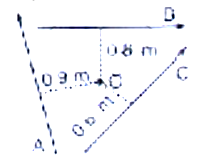
A, B and C are the three forces each of magnitude 4 n acting in the plane of the paper as shown in
Figure. The point O lies in the same plane.

(1) Which force has the least moment about O? Give a reason.
(2) which force has the greatest moment about O? Give a reason.
(3) Name the forces producing (a) Clockwise (b) anticlockwise moments.
(4) what is the resultant torque about the point O?
Answer
1) We know that
Moment of Force $=$ Force $x$ Perpendicular distance
Since the perpendicular distance of vector $C$ is least from the point $O$.
Vector $C$ will have the least moment about $O$.
2) We know that
Moment of force $=$ Force $x$ Perpendicular distance
Since the perpendicular distance of vector $A$ is greatest from the point O.
Vector A will have the greatest moment about $O$.
3.a) Vector A and B will produce clockwise moments.
Explanation: if the turning effect on the body is clockwise.
The moment if force is called clockwise moment and it is taken as negative.
3.b) Vector C will produce anticlockwise moment.
Explanation $L$ if the turning effect on the body is anticlockwise.
Moment of force is called anticlockwise moment and it is taken as positive.
4) Resultant torque about point $O=$ sum of torques due to vectors $A, B$ and $C$
$\therefore$ Resultant torque about point $O$.
$
\begin{aligned}
& =-(4 \times 0.9)-(4 \times 0.8)+(4 \times 0.6) Nm \\
& =-3.6-3.2+2.4 \\
& =-4.4 Nm
\end{aligned}
$
The negative sign suggests that the resultant torque is in the clockwise direction.
View full question & answer