Questions

[5 Mark Question Answer]

🎯

Test yourself on this topic

17 questions · timed · auto-graded

Question 15 Marks
In fission of one uranium - $235$ nucleus, the loss in mass is $0.2$ a.m.u. Calculate the energy released.
Answer
$1 a.m.u. = 1.66 \times 10^{-27} kg$
$\rightarrow 0.2 a.m.u. = 0.2 \times 1.66 \times 10^{-27} kg$
$\triangle m = 0.332 \triangle 10^{-27} kg$
$E = 0.332 \times 10^{-27} kg \times (3 \times 10^8)^2$
$E = 2.988 \times 10^{-11} J$
$E = `(2.998 xx 10^-11 "J")/(1.3 xx 10^-13)`$
View full question & answer
Question 25 Marks
What do you mean by the chain reaction in nuclear fission ? How is it controlled ?
Answer
A chain reaction is a series of nuclear fissions whereby the neutrons produced in each fission cause additional fissions, releasing enormous amount of energy.

It is controlled by absorbing some of the neutrons emitted in the fission process by means of moderators like graphite, heavy water, etc. then the energy obtained in fission can be utilized for the constructive purposes

View full question & answer
Question 35 Marks
(a) Write one nuclear fusion reaction.

(b) State the approximate value of energy released in the reaction mentioned in part (a).

(c) Give reason for the release of energy stated in part (b).

Answer
$\ce{\underset{\text{(deuterium)}}{^2_1H} + \underset{\text{(deuterium)}}{^2_1H} -> \underset{\text{(helium isotope)}}{^3_2He}} + \underset{\text{(neutron)}}{^1_0n} + 3.3 \text{MeV}$

$\ce{\underset{\text{(helium isotope)}}{^3_2He} + \underset{\text{(deuterium)}}{^2_1H} -> \underset{\text{(helium) }}{^4_2He}} + \underset{\text{(proton)}}{^1_1H} + 18.3 \text{MeV}$

In all three deuterium nuclei fuse to form a helium nucleus with a release of 21·6 MeV energy.

When two deuterium nuclei $\ce {^2_1H}$ fuse , nucleus of helium isotope $\ce {^3_2He}$ is formed and 3·3 MeV energy is released. This helium isotope again gets fused with one deuterium nucleus to form a helium nucleus $\ce {^4_2He}$ and 18·3 MeV of energy is released in this process.

View full question & answer
Question 45 Marks
Why is a very high temperature required for the process of nuclear fusion? State the approximate temperature required.
Answer
When two nuclei approach each other, due to their positive charge, the electrostatic force of repulsion between them becomes too strong that they do not fuse. Thus, nuclear fusion is not possible at ordinary temperature and ordinary pressure.
Hence to make the fusion possible, a high temperature of approximately $10^7 K$ and high pressure is required. At such a high temperature, due to thermal agitations both nuclei acquire sufficient kinetic energy so as to overcome the force of repulsion between them when they approach each other, and so they get fused.
View full question & answer
Question 55 Marks
What is nuclear fission? Give one example and write its nuclear reaction.
Answer

Nuclear fission is the process in which a heavy nucleus is splits into two light nuclei nearly of the same size by bombarding it with slow neutrons.

When uranium with Z = 92 is bombarded with neutron, it splits into two fragments namely barium (Z = 56) and krypton (Z = 36) and a large amount of energy is released which appears due to decrease in the mass

$\ce {^235_92 U + ^1_0n -> (^236_92U) -> ^144_56Ba + ^89_36Kr + 3^1_0n + Energy}$

View full question & answer
Question 65 Marks
Give two differences between the radioactive decay and nuclear fission.
Answer

Radioactive decay

Nuclear Fission

It is a self process.

It does not occur by itself. Neutrons are bombarded on a heavy nucleus.

The nucleus emits either the a or b particles

with the emission of energy in form of g rays which is not very large.

A tremendous amount of energy is released when a heavy nucleus is bombarded with neutrons and the nucleus splits in two nearly equal fragments.

The rate of radioactive decay cannot be controlled.

The rate of nuclear fission can be controlled.

View full question & answer
Question 75 Marks
What do you mean by background radiations? Name its sources. Is it possible for us to keep ourselves away from it?
Answer
The low temperature microwave radiation that arrives at the earth's surface from all directions of outer space is called background radiation.
Sources of background radiations are:
(a) Radiation from the sun.
(b) Rocks in the earth which contain traces of radioactive substances.
(c) Naturally occurring isotopes.
(d) Artificial radioisotopes.
No, it is not possible to keep ourselves away from these radiations.
View full question & answer
Question 85 Marks
Arrange the $\alpha , \beta,$ and $γ$ radiation in ascending order of their biological damage. Give reason.
Answer
$a < \beta < γ$
An $\alpha$-particle rapidly loses its energy as it moves through a medium and therefore its penetrating power is quite small. It can penetrate only through $3-8 cm$ in air. It can easily be stopped by a thin card sheet or a thick paper. The penetrating power of $\beta$-particles is more than that of the $\alpha$-particles. They can pass through nearly 5 m in air, through thin card sheet, and even through thin aluminium foil, but a 5 mm thick aluminium sheet can stop them. Whereas, the penetrating power of $\gamma$-rays is high. It is about $10^4$ times that of $\alpha$-particles and $10^2$ times that of $\beta$ particles. They can pass through 500 m in air or through 30 cm thick sheet of iron. Thick sheet of lead is required to stop them.
View full question & answer
Question 95 Marks
A nucleus $\ce {^A_Z X}$ emits 2 α particles and 1 β particles to form a nucleus $\ce {^222_85 R}$. Find the atomic nucleus and mass number of X.
Answer
After emiiting two alpha particles

Atomic number = Z - 4

Mass number = A - 8

After emitting a beta particle

Atomic number = Z - 4 + 1

mass number = A - 8

Final atomic number = 85

85 = Z - 4 + 1

Z = 88

Final mss number 222

222 = A - 8

A = 230

View full question & answer
Question 105 Marks
What changes occurs in the nucleus of radioactive elements when it emits (a) an alpha particle (b) beta particle and (c) gamma radiations? Give one example in each case in support of your answer.
Answer

The following changes occur when an atom emits

An alpha particle: atomic number decreases by 2 and mass number decreases by 4.

Example: $\ce{^238_92 U -> ^234_90 Th + ^4_2 He}$

A beta particle: atomic number increases by one, but mass number does not change.

Example: $\ce{^14_6 C -> ^14_7 N + ^0_-1 β}$

Gamma particle: it does not change anything in the nucleus, the energy of the nucleus decreases.

number does not change.

Example: $\ce{^A_Z X^* -> ^A_Z X + γ}$

View full question & answer
Question 115 Marks
What happens to the position of an element in the periodic table when it emits an alpha particle
Answer

After emitting an alpha particle the daughter element occupies two places to the left of the parent element in the periodic table.

Reason: If a parent nucleus X becomes a new daughter nucleus Y as a result of -decay, then the -decay can be represented as:

$\ce{\underset{\text{parent nucleus}}{^A_Z X} ->[Alpha decay] \underset{\text{Daughter nucleus}}{^{A-4}_{z-2}Y} + \underset{\text{α-particle}}{^4_2 He}}$

Thus, the resulting nucleus has an atomic number equal to (Z-2). Hence, it shifts two places to the left of the parent element in the periodic table.

(b) After emitting a β

-particle, the daughter element occupies one place to the right of the parent element in the periodic table.

Reason: If a parent nucleus X becomes a new daughter nucleus Y as a result of -decay, then the -decay can be represented as:

$\ce{\underset{\text{parent nucleus}}{^A_Z X} ->[β particle] \underset{\text{Daughter nucleus}}{^{A}_{z+1}Y} + \underset{\text{β-particle}}{^0_-1e}}$

Thus, the resulting nucleus has an atomic number equal to (Z+1). Hence, it shifts one place to the right of the parent element in the periodic table.

(c) After emitting -radiation, the element occupies the same position in the periodic table.

Reason: If a parent nucleus X becomes a new daughter nucleus Y as a result of -decay, then the -decay can be represented as:

$\ce{\underset{\text{parent nucleus}}{^A_Z X} ->[γ particle] \underset{\text{Daughter nucleus}}{^{A}_{z}Y} + \underset{\text{γ-particle}}{γ}}$

Thus, the resulting nucleus has atomic number equal to Z. Hence, it occupies the same position as the parent element in the periodic table.
View full question & answer
Question 125 Marks
What kind of change takes place in a nucleus when a β - particle is emitted? Express it by an equation. State whether
(a) atomic number and
(b) mass number are conserved in a radioactive β - decay ?
Answer
On emitting a β particle, the number of nucleons in the nucleus (i.e. protons and neutrons) remains same, but the number of neutrons is decreased by one and the number of protons is increased by one.

If a radioactive nucleus P with mass number A and atomic number Z emits a beta particle to form a daughter nucleus Q with mass number A and atomic number Z+1, then the change can be represented as follows:

$\ce{^A_Z P ->[β particle]} $ $\ce {^A_{z+1} Q} + {^0_{-1} e} $

(a) Atomic number 'Z' is not conserved. It is increased by 1.

(b) Mass number A is conserved.

View full question & answer
Question 135 Marks
'Radioactivity is a nuclear phenomenon'. Comment on this statement.
Answer
Any physical changes (such as change in pressure and temperature) or chemical changes (such as excessive heating, freezing, action of strong electric and magnetic fields, chemical treatment, oxidation etc.) do not alter the rate of decay of the radioactive substance. This clearly shows that the phenomenon of radioactivity cannot be due to the orbital electrons which could easily be affected by such changes. The radioactivity should therefore be the property of the nucleus. Thus radioactivity is a nuclear phenomenon.
View full question & answer
Question 145 Marks
State following four properties each of $\alpha , \beta$ and $γ$ radiations: (a) Nature, (b) Charge, (c) Mass and (d) Effect of electric field.
Answer
Property α - particle β - particle γ - particle
Nature Stream of positively charged particles, i.e. helium nuclei Stream of negatively charged particles, i.e. energetic electrons. Highly energetic electromagnetic radiation.
Charge Positive charge (Two times that of a proton) $= + 3.2 x 10^{-19} C (or +2e)$ Negative charge $= - 1.6 x 10^{-19} C (or -e)$ No charge
Mass Four times the mass of proton i.e., $6.68 x 10^{-27} kg$ Equal to the mass of electron, i.e. $9.1 x 10^{-31} kg$ No mass (Rest mass is zero)
Effect of electric field Less deflected More deflected than alpha particles but in direction opposite to those of α particles Unaffected
View full question & answer
Question 155 Marks
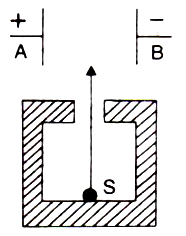
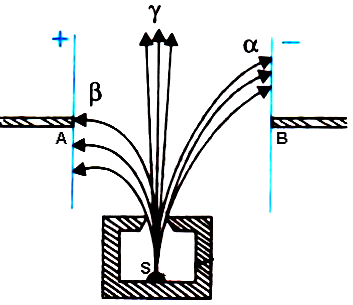
In following Figure shows a radioactive source S in a thick lead walled container having a narrow opening. The radiations pass through an electric field between the plates A and B.


(a) Complete the diagram to show the paths of α , β and γ radiations.
(b) Why is the source S kept in a thick lead walled container with a narrow opening?
(c) Name the radiation which is unaffected by the electrostatic field.
(d) Which radiation is defleced the most. Given reason.
(e) Which among the three radiations causes the least biological damage?
Answer
(a)


(b) The radioactive substances are kept in thick lead containers with a very narrow opening, so as to stop radiations coming out from other directions because they may cause biological damage.(c) Gamma radiations.(d) Beta radiations.(e) Alpha particle.
View full question & answer
Question 165 Marks
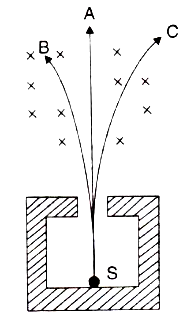
The diagram in figure shows a radioactive source S placed in a thick lead walled container. The radiations given off are allowed to pass through a magnetic field. The magnetic field (shown as x) acts perpendicular to the plane of paper inwards. Arrows shows the paths of the radiation A, B and C.


(a) Name the radiations labelled A, B and C.
(b) Explain clearly how you used the diagram to arrive at the answer in part(a).
Answer

Radiations labeled A, B and C are γ , α and β respectively.

Radiation labeled A is gamma radiation because they have no charge and hence under action of magnetic field they go undeflected.

Radiation B is alpha radiation because its mass is large and it would be deflected less in comparison to beta radiation. The direction of deflection is given by Fleming's left hand rule. Also directions of deflection of alpha and beta radiations are opposite as they have opposite charge.

View full question & answer
Question 175 Marks
A radioactive source emits three types of radiations.
(a) Which radiation has zero mass?
(b) Name the radiation which has the lowest ionizing power.
(c) Name the radiation which has the lowest penetrating power.
(d) Give the charge and mass of particles composing the radiation in part $(c).$
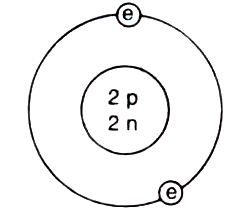
(e) When the particle referred to in part $(c)$ becomes neutral, they are found to be the atoms of rare gas. Name this rare gas and draw a model of its neutral atom.
(f) From which part of the atom do these radiations come?
Answer
(a) Gamma radiations have zero mass.
(b) Gamma radiations have the lowest ionizing power.
(c) Alpha particles have lowest penetrating power.
(d) Alpha particle has positive charge equal to $3.2 \times 10^{-19}C$ and rest mass equal to $4$ times the mass of proton i.e. $6.68 x 10^{-27} kg.$
(e) The gas is Helium.


(f) These radiations come from nucleus of the atom.
View full question & answer