Questions

[5 Mark Question Answer]

🎯

Test yourself on this topic

11 questions · timed · auto-graded

Question 15 Marks
During sunset and sunrise, the sun is seen when it is slightly below the horizon. Give reason.
Answer
Light rays from the sun while coming towards earth suffers successive refractions from a rarer to a denser medium and so it bends towards the normal at each refraction. These rays on earth appear to be coming from an apparent position of the sun which is higher than its actual position. Thus, the sun is seen even when it is slightly below the horizon during sunset and sunrise.
View full question & answer
Question 25 Marks
Explain briefly what causes the twinkling of stars at night.
Answer
Stars are very far from us. The light ray coming from a star undergoes successive refractions on entering the earth’s atmosphere and bends towards the normal. Hence, an apparent image of the star is seen. Simultaneously due to the movement of air, the refractive index of layers of atmosphere keeps on changing, i.e., the apparent position of star keeps changing. Thus, the star appears to twinkle.
View full question & answer
Question 35 Marks
State the Snell’s laws of refraction of light.
Answer
Laws of refraction of light:
(i) The incident ray, refracted ray and normal at the point of incidence all lie in the same plane.
(ii) The ratio of the sine of the angle of incidence to the sine of the angle of refraction is a constant quantity known as the refractive index of the medium.
$\mu =\frac{\operatorname{Sin} i}{\operatorname{Sin} r}$
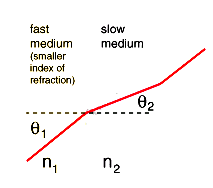
Snell's Law
$\frac{ n _1}{ n _2}=\frac{\operatorname{Sin} \theta_2}{\operatorname{Sin} \theta_1}$
Image
View full question & answer
Question 45 Marks
Why do diamonds sparkle?
Answer
Critical angle for diamond is quite less and is only 24°. Besides these diamonds are cut very sharp, making a large number of the refracting surfaces. Hence when a ray of light enters a diamond, it suffers a series of total internal reflections on account of a very small critical angle. This makes a ray of light literally trapped within the diamond for a little time and this trapped light energy makes a diamond sparkle.
View full question & answer
Question 55 Marks
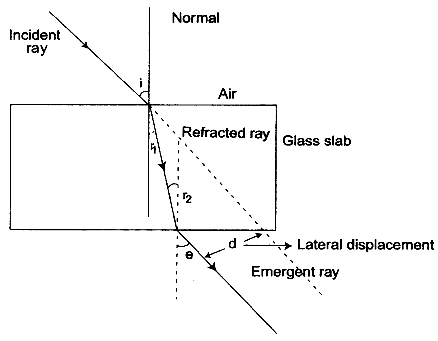
A ray of monochromatic light is incident from the air on a glass slab:
(i) Draw a labelled ray diagram showing the change in the path of the ray till it emerges from the glass slab.
(ii) Name the two rays that are parallel to each other.
(iii) Mark the lateral displacement in your diagram.
Answer
(i) Ray diagram of monochromatic light

(ii) Incident ray and emergent rays are parallel to each other.
(iii) Lateral displacement is marked by d in the diagram.
View full question & answer
Question 65 Marks
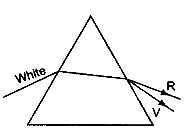
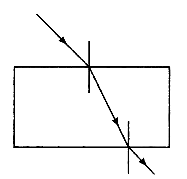
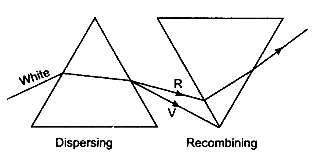
Light passes through a rectangular glass slab and through a triangular glass prism. In what way does the direction of the two emergent beams differ and why?
Answer
In rectangular glass slab, the ray undergoes the only refraction and emerges out parallel. In a prism, the emerging ray is not parallel but split due to change in wavelength of different colour of light. The shape of the glass slab with two prisms up and down splits light but recombines it into one.


View full question & answer
Question 75 Marks
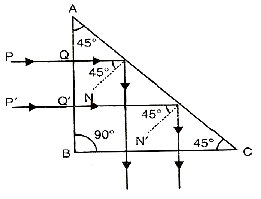
Show with the help of a diagram how a total reflecting prism can be used to turn a ray of light through 90°. Name one instrument in which such a prism is used.
Answer

As shown in diagram, a beam of light is incident on face AB of the prism normally so it passes undeviated and strikes the face AC where it makes an angle of 45° with the normal to AC. Because here the incident angle is more than critical angle so rays suffer total internal reflection and reflect at angle of 45°. The beam then strikes face BC, where it is incident normally and so passes undeviated. As a result the incident beam gets deviated through 90°.Such a prism is used in periscope.
View full question & answer
Question 85 Marks
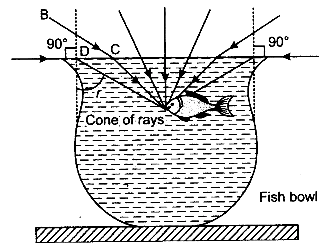
Explain with the help of a diagram of how fish is able to see the objects above it.
Answer
A fish can see everything above it in clear water irrespective of its position in different depths. The critical angle for water is 48.5°. The angle of the cone of vision for the fish is twice this angle.

Hence it is 97°. All the objects outside water but in this cone of vision Will be seen by the fish. Outside this range, the fish will see all the objects in the surrounding area (see figure). Those objects which are at the bottom will be seen by the fish due to total internal reflection taking place at the water-air interface.
View full question & answer
Question 95 Marks
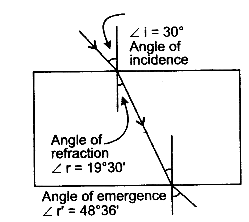
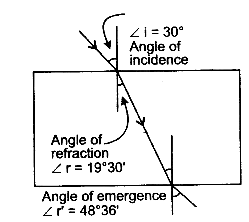
Trace a ray of light incident at $30^{\circ}$ on a surface if travelling from glass to air. What is the angle of refraction in this case? (R.I. for glass $=3 / 2$ ).
Answer

For a ray of light from glass to air R.I. is denoted $as _g\mu _a.$
${ }_{ g } \mu_{ a }=\frac{1}{{ }_{ a } \mu_{ g }}$
$\therefore \frac{\sin i }{\sin r \prime}=\frac{1}{ a \mu_{ g }}$
sin$ r′ = _a\mu _g \times \sin i$
and ${ }_a \mu_g=\frac{3}{2}$
$=\frac{3}{4}$
$= 0.7500$
$\therefore r′ = 48^\circ 36′$
Angle of refraction for glass to air $= 48^\circ 36′.$
View full question & answer
Question 105 Marks
Trace a ray of light incident at 30° on a surface if travelling from air to glass. What is the angle of refraction in this case? (R.I. for glass = 3/2).
Answer

${ }_{ a } \mu_{ g }=\frac{\sin i }{\sin r }$
$\therefore \frac{3}{2}=\frac{\sin 30^{\circ}}{\sin r}$
$\therefore \operatorname{Sin} r=\frac{2}{3} \times \sin 30^{\circ}$
But $\sin 30^{\circ}=\frac{1}{2}$
$\therefore \sin r=\frac{2}{3} \times \frac{1}{2}$
$=\frac{1}{3}$
∴ sin r = 0.3334
∴ sin r = 19°30′.
Angle of refraction for air to glass = 19°30′.
View full question & answer
Question 115 Marks
How will you verify the laws of refraction or how the refractive index of glass is determined in the laboratory?
Answer
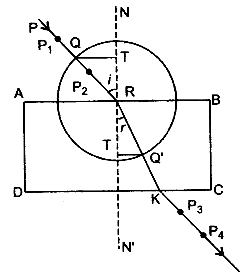
Place a white sheet of paper on a drawing board. Put a rectangular slab of glass on this white sheet and trace out its boundary ABCD. At any point R on the edge AB, draw a normal NN’. Draw an incident ray PR at any angle say 30°. Fix two pins P1 and P2 vertically on the line PR and at a distance not less than 3 cm from each other. Looking through the other side of the block, fix two pins, P3 and P4 vertically on the white sheet, such that all the four pins P1, P2, P3, and P4 appear to be in a straight line as seen through the glass block. Mark the pinpoints with a fine pencil, remove the block and join the points P3 and P4 by the straight line RS

PR represents the incident ray and RS represents the refracted ray. ∠PRN and ∠KRN’ are respectively angles of incidence and refraction.
With R as centre and convenient radius, draw a circle cutting the incident ray at Q and the refracted ray at Q’.
From Q and Q’, draw perpendiculars QT and QT’ on the normal NN’
Now $\sin i =\frac{ QT }{ OR }$
and $\operatorname{Sin} r=\frac{Q^{\prime} T^{\prime}}{Q^{\prime} T^{\prime}}$
$\mu=\frac{\operatorname{Sin} i }{\operatorname{Sin} r }=\frac{ QT }{ QR } \cdot \frac{ Q ^{\prime} R }{ Q ^{\prime} T ^{\prime}}=\frac{ QT }{ Q ^{\prime} T ^{\prime}}$
Since QR = Q’R being the radius of the same circle.
Repeat this experiment for other angles of incidence, say 45° and 60°, and find μ.
It is found that for different values of i the ratio.
$\frac{\sin i }{\operatorname{Sin} r }=$ constan $t$
Thus, it is verified that,
(i) $\frac{\sin i}{\operatorname{Sin} r}$ is a constant and is equal to ${ }_a \mu_g$.
(ii) The incident the refracted ray and normal line in the same plane.
View full question & answer
[5 Mark Question Answer] - Physics STD 10 Questions - Vidyadip