Questions

[5 Mark Question Answer]

🎯

Test yourself on this topic

26 questions · timed · auto-graded

Question 15 Marks
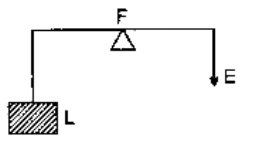
A man raises a load of 360 kgf using a block and tackle system of 3 pulleys. If the efficiency of the pulley system is 60%, what effort is applied by the man?
Answer
Given: L = 360 kgf, E = ?, Efficiency = 60% = 0.6,
Velocity ratio = No. of pulley in the system = 3.
Mechanical advantage (M.A.) = V.R. × Efficiency
= 3 × 0.6
= 1.8
But, M.A. $=\frac{\operatorname{Load}( L )}{\operatorname{Effort}( E )}$
$\therefore$ Effort $(E)=\frac{\operatorname{Load}( L )}{\text { M.A. }}$
$=\frac{360}{1.8}$
= 200 kgf.
View full question & answer
Question 25 Marks
A boy lifts a load of $40$ kgf through a vertical height of $2$ m in $5$ s by using a single fixed pulley when he applies an effort of $48$ kgf . Calculate:
(i) the mechanical advantage, and
(ii) the efficiency of the pulley. Why is the efficiency of the pulley is not $100 \%$ ?
(iii) the energy gained by the load in $5$ s , and
(iv) the power developed by the boy in raising the load.
Answer
Given:
$L = 40 kgf,$
$d_L = 2m,$
$t = 5 s,$
$E = 48$ Kgf.
(i) Mechanical advantage (M.A.) =
$\frac{ L }{ E }=\frac{40}{48}=\frac{5}{6}=0.833$
(ii) If the effort moves a distance d downwards, the load also moves a distance d upwards. So velocity ratio (V.R.) = d/d = 1,
Efficiency $=\frac{\text { M.A. }}{\text { V.R. }}=\frac{0.833}{1}$
= 0.833 (or 83.3%).
The efficiency of the pulley is not 100% because some energy is wasted in overcoming the friction in the pulley bearings.
(iii) The energy gained by the load in 5s = Load × Displacement of load in 5s
$= 40 kgf \times 2m$
$= 80 kgf \times m$.
(iv) Power developed by the boy =
$\frac{\text { Effort } \times \text { Displacement of effort }}{\text { Time }}=\frac{48 kgf \times 2 m }{5 s }$
$= 19.2 kgf \times ms^{−1}.$
View full question & answer
Question 35 Marks
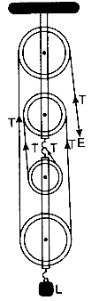
A ‘block and tackle’ system used 3 pulleys in the lower block and 4 pulleys in the upper block. What is the ‘velocity ratio’ of this system? If the load is to be lifted by a person capable of applying a maximum effort of 1000 N, what is the maximum load than can be lifted under ideal conditions?
The actual maximum load that gets lifted turns out to be 6300 N. What are the values of the actual M.A. and efficiency of the set-up?
Answer
There being 7 pulleys in all, the load is supported by 7 strands of string. Hence it gets lifted only through 1/7 th of the distance through which the effort is applied. Hence the velocity ratio of the setup has a value 7.
Under ideal conditions, M.A. = V.R. = 7
Hence, the maximum load that can be lifted under ideal conditions is:
Effort × 7 = 1000 N × 7 = 7000 N.
Under actual conditions, Load = 6300 N
and Effort = 1000 N
Hence, Actual M.A. $=\frac{6300 N }{1000 N }=6.3$
Also Efficiency $=\frac{\text { M.A. }}{\text { V.R. }}=\frac{6.3}{7}$
= 0.9 = 90%.
View full question & answer
Question 45 Marks
If the weight of the movable pulley is W, obtain the expression for MA, VR, and efficiency.
Answer
If the weight of the movable pulley with its frame is W, in equilibrium
E = T
L + W = 2T
Or L + W = 2E
⇒ L = 2E − W
$M A=\frac{L}{E}=\frac{2 E-W}{E}=2-\frac{W}{E}$
VR will remain same, $h =\frac{ MA }{ VR }$
$=\frac{2-\frac{W}{E}}{2}=1-\frac{W}{2 E}$
f W << 2E, then 2E = L
Or $h=\left(1-\frac{W}{L}\right)$
View full question & answer
Question 55 Marks
A cook used a ‘fire tong pair’ of length 32 cm. to lift a piece of burning coal of mass 500 g. If he applies his effort at a distance of 8 cm from the fulcrum, what is his effort? Assume friction etc. to be absent. Also, obtain values of the M.A. and the V.R. of this ‘machine’.
Answer
The ‘fire tong pair’ is a lever of class III in which the point of application of the effort is in between the load and the fulcrum. Hence, when friction, etc., are assumed absent, we have:
Effort × 8 cm = 0.5 kgf × 32 cm
Effort $=0.5 kgf \times \frac{32 cm }{8 cm }$
= 2.0 kgf.
Thus, M.A. =
$\frac{\text { Load }}{\text { Effort }}=\frac{0.5}{2.0}=\frac{1}{4}=0.25$.
Also, V.R. =
$\frac{\text { Effort arm }}{\text { Load arm }}=\frac{8 cm }{32 cm }=0.25$.

View full question & answer
Question 65 Marks
The mechanical advantage of a machine is 5 and its efficiency is $80\%$. It is used to lift a load of 200 kgf to a height of $20 m.$ Calculate:
(i) The effort required, and
(ii) The work done on the machine $(g = 10 ms^{−2}).$
Answer
Given: M.A. $=5$, Efficiency $=80 \%=0.8$
Load $L =200 kgf =200 \times 10 N=2,000 N, d _{ L }=20 m$.
(i) $M \cdot A \cdot=\frac{L}{E}$
$\therefore$ Effort, $E=\frac{L}{\text { M.A. }}=\frac{200}{5} kgf$
$= 40$ kgf.
(ii) Work output = Load × Displacement of load
$= 2,000 N \times 20 m$
$= 40,000 J$
Efficiency $=\frac{\text { Work output }}{\text { Work input }}$
$\therefore Work input =$
$\frac{\text { Work output }}{\text { Efficiency }}=\frac{40000}{0.8}$
$= 50,000 J.$
 
View full question & answer
Question 75 Marks
The mechanical advantage of a machine is 5 and its efficiency is $80\%$. It is used to lift a load of 200 kgf to a height of $20 m.$ Calculate:
(i) The effort required, and
(ii) The work done on the machine $(g = 10 ms^{−2}).$
Answer
Given: M.A. = 5, Efficiency $= 80\% = 0.8$
Load $L = 200$ kgf $= 200 \times 10 N = 2,000 N, d_L = 20 m.$
(i) M.A. $=\frac{L}{E}$
$\therefore$ Effort, $E=\frac{L}{\text { M.A. }}=\frac{200}{5} kgf$
= 40 kgf.
(ii) Work output = Load × Displacement of load
$= 2,000 N \times 20 m$
$= 40,000 J$
Efficiency $=\frac{\text { Work output }}{\text { Work input }}$
$\therefore$ Work input $=$
$\frac{\text { Work output }}{\text { Efficiency }}=\frac{40000}{0.8}$
$= 50,000 J.$
View full question & answer
Question 85 Marks
A machine is driven by a $50$ kg mass falling at a rate of $10.0$ m in $5 s$ . It lifts n load of 250 kgf . Taking the force of gravity on 1 kg mass as 10 N . Calculate the power input to the machine. If the efficiency of the machine is $60 \%$, find the height to which the load is raised in $5 s $.
Answer
Given : Effort $E = 50 Kgf = 50 \times 10 N = 500 N, d_E = 10.0 m, t = 5s.$
$L = 250 kgf = 250 \times 10 N = 2500 N$, efficiency $= 60\% = 0.6$
Power input to the machine =
$\frac{\text { Effort } \times \text { Displacement of effort }}{\text { Time }}$
$=\frac{500 \times 10.0}{5}$
$= 1000 W.$
Let the load is raised to a height $d_L$​​​​​​​ in $5s$, then
Efficiency =
$\frac{\text { Power output }}{\text { Power input }}=\frac{ L \times\left( d _{ L } / t \right)}{ E \times\left( d _{ E } / t \right)}$
or $0.6=\frac{2500 \times d _{ L }}{500 \times 10}$
or $d _{ L }=\frac{500 \times 10 \times 0.6}{2500}$
$= 1.2 m.$
View full question & answer
Question 95 Marks
What is a block and tackle system of pulleys? What precautions would you observe while rounding the string so that the effort is applied in the downward direction?
Answer
A block and tackle system of pulleys consists of two blocks of pulleys, each block having one or more than one pulleys. The upper block of pulleys is fixed to a rigid support and the lower block of pulleys is movable. The number of pulleys in the movable block is either equal or one less than the number of pulleys in the fixed block.
While rounding the string, its one end is attached to the hook of the movable block if the number of pulleys in the fixed block is more than that in the movable block or to the hook of the fixed block if the number of pulleys is the same in both the blocks.
View full question & answer
Question 105 Marks
The following are an example of levers. State the class of lever to which each one belongs giving the relative positions of Load (L), Effort (E), Fulcrum (F):
(i) Scissors (ii) Sugar tongs (iii) Nutcracker (iv) Pliers.
Answer
Name of Lever Lever Class Fulcrum Position of Effort Load
(i) Scissors First At centre One end Other end
(ii) Sugar tongs Third One end At centre Other end
(iii) Nutcracker Second One end Other end At centre
(iv) Pliers First At centre One end Other end
View full question & answer
Question 115 Marks
Shears, used for cutting metals and scissors used for cutting clothes are both examples of levers of the first order. However, whereas the shears always have short blades and long handles, the scissors often have blades much longer than the handles. Explain, why this is so?
Answer
The mechanical advantage of an (ideal) liver equals the ratio between-the effort arm to the load arm.
For the shears (used for cutting metals), the ‘load’ is really a formidable one. Therefore, we need a large mechanical advantage to keep the applied effort within reasonable limits. To ensure this, the shears are made to have short blades (small load arm) and long handles (long effort arm).
For the scissors (used for cutting clothes), the ‘load’ is an almost negligible one. Mechanical advantage, therefore, there may be more or less than one. The scissors, therefore, often have blades much longer than the handles.
View full question & answer
Question 125 Marks
What is the relation between the mechanical advantage and the number of strands of string used to support the load, in a ‘block and tackle’ set-up?
Answer
The mechanical advantage is equal to the number of strands of string, used to support the load, only if the ‘block and tackle set up’ can be assumed to be ideal (absence of friction, etc.) and the lower blocks of pulleys have negligible weight. Both these conditions cannot be satisfied in actual practice. Hence, in practical situations, the M.A. of a ‘block and tackle set up’ is always less than the fire number of strands of string used to support the load.
View full question & answer
Question 135 Marks
Establish a relationship between efficiency, $M.A.$, and $V.R.$
Answer
Let a machine overcome a load $L$ by applying an effort $E$. In time $t$, the displacement of effort is $d _{ E }$, and displacement of load is $d _{ L }$. Then
Work input $=$ Effort $\times$ Displacement of effort $=E \times d_E$
Work output $=$ Load $\times$ Diaplacement of load $=L \times d_L$
Efficiency =
$\frac{\text { Work output }}{\text { Work input }}=\frac{ L \times d _{ L }}{ E \times d _{ E }}=\frac{ L / E }{ d _{ E } / d _{ L }}$
$L / E = M.A$. and $d_E / d_L= V.R.$
Efficiency $=\frac{\text { M.A. }}{\text { V.R. }}$
$M.A. = V.R. \times $ Efficiency.
View full question & answer
Question 145 Marks
State four ways in which machines are useful to us?
Answer
Machines are useful to us in the following ways:
(1) In lifting a heavy load by applying less effort.
(2) In changing the point of application of effort to a convenient point.
(3) In changing the direction of effort in a convenient direction.
(4) For obtaining a gain in speed.
View full question & answer
Question 155 Marks
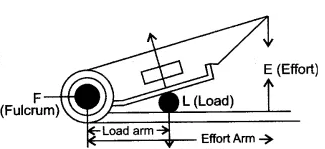
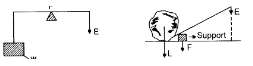
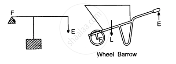
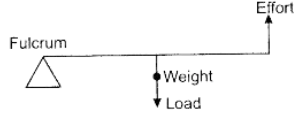
When we want to use a machine as a force multiplier, which class of lever should we preferably use? Give a simple diagram of such a lever.
Image
Answer
Though we can use either first class of lever or second class of lever, for multiplying force, we should preferably use a second class of lever. This is because the mechanical advantage of the second class of lever is always greater than one. A simple diagram of the second class of lever is shown alongside. The wheelbarrow, the bottle opener, and the mango cutter are some of the practical forms of the second class of lever.
View full question & answer
Question 165 Marks
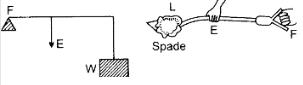
Draw a labelled sketch of a second class lever. Give one example of such a lever.
Answer
A labelled diagram of a second class lever is given below. Its example is a nut-cracker.Second Class Lever

Example of a second class lever (Nut-cracker)
Image
View full question & answer
Question 175 Marks
In the alongside the figure of two pulleys shown a system in which one pulley is fixed and the other is movable. What is the velocity ratio of the system?
An effort of $600 \ N$ is needed to lift a weight of $1000 \ N$. What are the mechanical advantage and efficiency of the pulley system?
Answer
If there are n movable pulleys connected to a fixed pulley, then the velocity ratio is

$V.R = 2^n$​​​​​​​
Velocity ratio of the system $= 2.$
Mechanical Advantage =
$\frac{\text { Load }}{\text { Effort }}=\frac{1000}{600}$
$=\frac{5}{3}$
Efficiency $=\frac{\text { M.A. }}{\text { V.R. }}$
$=\frac{5 / 3}{2}=\frac{5}{3 \times 2}=\frac{5}{6}$
$= 83.3\%.$
View full question & answer
Question 185 Marks
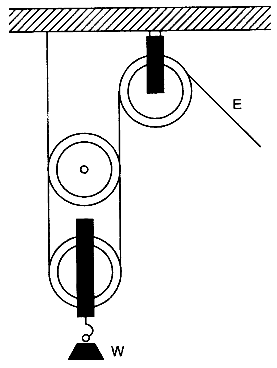
The pulley system shown in the figure is to be used to lift a load W. If the man applying the effort cannot apply a force exceeding 1000 N, what is the maximum load that can be lifted?
The actual load that the man is finally able to lift turns out to be 2700 N. What are the values of the actual M.A., obtained, and the efficiency of the actual set-up?
Answer
The load lifted would be a maximum when conditions are ideal. Since this set-up uses three strands of string, the load gets raised only through 1/3rd of the distance through which the effort moves.
Image
Hence,
Velocity ratio =
$\frac{\text { Distance moved by the effort }}{\text { Distance moved by the load }}$
$=\frac{1}{1 / 3}=3$.
Under ideal conditions, V.R. = M.A.
Hence, Ideal M.A. of the set-up = 3.
∴ Maximum load that can be lifted = Effort × 3 = 100 N × 3
= 3000 N.
Under actual conditions, M.A. $=\frac{\text { Load }}{\text { Effort }}$
$=\frac{2700 N }{1000 N }$
= 2.7
Efficiency $=\frac{\text { M.A. }}{\text { V.R. }}=\frac{2.7}{3}$
= 0.9 = 90%.
 
View full question & answer
Question 195 Marks
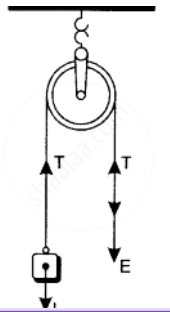
Draw a diagram of a single fixed pulley and obtain expressions for its:
(i) Mechanical advantage,
(ii) Velocity ratio, and
(iii) Efficiency, in the ideal case.
Answer
The diagram of a single fixed pulley is shown alongside. If T is the tension in each strand of the string and in the ideal case string is massless and there is no friction in the pulley bearings, then in equilibrium, E = T and L = T
Image
(i) Mechanical advantage $=\frac{ L }{ E }=\frac{ T }{ T }=1$
(ii) If the effort E moves a distance d downwards, the load L moves the same distance d upwards.
So, velocity ratio $=\frac{ d _{ E }}{ d _{ L }}=\frac{ d }{ d }=1$
$\begin{aligned} & \text { (iii) Efficiency }=\frac{\text { M.A. }}{\text { V.R. }}=\frac{1}{1}=1 \text { (or } \\ & 100 \% \text { ). }\end{aligned}$
View full question & answer
Question 205 Marks
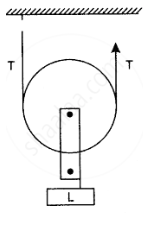
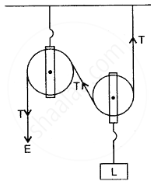
Draw the diagram of a single movable pulley and obtain its mechanical advantage, velocity ratio, and efficiency.
Answer
Since it is inconvenient to apply the effort in an upward direction, a single fixed pulley is used to change the direction of effort.
Image
Image
In equilibrium, $L = T + T = 2T$
$E = T$
Mechanical advantage =
$\frac{\operatorname{Load}( L )}{\operatorname{Effort}( E )}=\frac{2 T }{ T }=2$
As the effort is pulled down through a distance $d_E$, the two segments of the thread carrying the movable pulley and the load goes up by $d _{ E } / 2$.
Hence, $d_L=d_E / 2$
Velocity ratio $(V R)=\frac{ d _{ E }}{ d _{ L }}$
$=\frac{ d _{ E }}{\frac{ d _{ E }}{2}}$
$= 2$.
Efficiency $=\frac{\text { MA }}{\text { VR }}$
$=\frac{2}{2}$
$= 1$ or $100\%.$
View full question & answer
Question 215 Marks
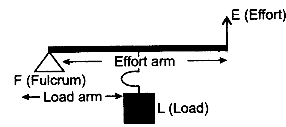
State the types (or kinds) of lever, and give two examples of each kind.
Answer
There are three kinds of the lever, depending upon the different positions of the load, fulcrum and the effort.
Type I: When fulcrum is in the middle.
Image
Type II: When the load is between the fulcrum and the effort
Image
Type III: When the effort lies between the fulcrum and load.
Image
View full question & answer
Question 225 Marks
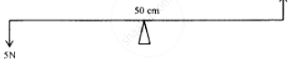
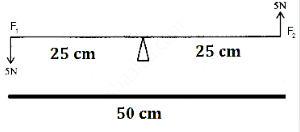
Two forces each of 5N act vertically upwards and downwards respectively on the two ends of a uniform metre rule which is placed at its mid-point as shown in the diagram. Determine the magnitude of the resultant moment of these forces about the midpoint.
Image
Answer
Image
Moment of force F1 = 5 ⨯ 25 = 125
Moment of force F2 = 5 ⨯ 25 = 125
Since both the forces are acting in anticlockwise direction, the resultant moment of force is the sum of the two moments.
∴ Resultant moment of force = 125 + 125 = 250
View full question & answer
Question 235 Marks
The diagram shows the use of a lever.
(i) State the principle of moments as applied to the above lever.
(ii) Which class of lever is this? Give an example of this class of lever.
(iii) If FA = 100 cm, AB = 90 cm, calculate the minimum effort required to lift the load.
Answer
(i) Sum of the clockwise moments about the fulcrum is equal to the sum of the anti-clockwise moments about the fulcrum.<
(ii) Lever of class III,
Example: forceps or a pair of tongs.
(iii) E × 100 = 190 × 20
∴ E = 38 N.
View full question & answer
Question 245 Marks
What is a lever?
Answer
Image
A lever is a special case of the application of the law of moments. It is a rigid bar, straight or bent, which is capable of rotation about a fixed point or a fixed-line, called the axis of rotation. This fixed point or the axis of rotation is called the fulcrum. An effort E is applied at point A of the lever to overcome resistance (or load) at another point B, as shown in the diagram.
View full question & answer
Question 255 Marks
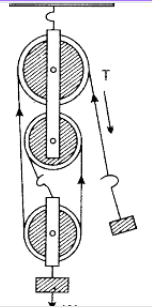
Draw a diagram showing a block and tackle system of 4 pulleys.
Image
(i) State, how many strands of tackle support the load?
(ii) Draw arrows to represent tension in each strand.
(iii) Find the mechanical advantage of the system, stating the assumptions made.
(iv) If the load is pulled up by a distance 1m, how much does the effort end move?
Answer
The adjacent diagram shows a block and tackle system of 4 pulleys.
(i) Four strands of tackle support the load.
(ii) The tension in each strand is shown by the arrow marked as T.
(iii) If we neglect the friction of the pulleys and weight of the pulleys in the lower block, then:
L = 4T
and E = T
$\therefore M \cdot A .=\frac{ L }{ E }$
$=\frac{4 T }{ T }$
= 4.
(iv) If the load is pulled up by a distance 1m, the effort end moves by 4 m.
View full question & answer
Question 265 Marks
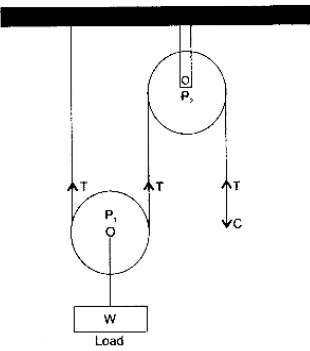
The alongside figure shows the combination of a movable pulley $P_1$ with a fixed pulley $P_2$ used for lifting up a load $W$
Image
(i) State the function of the fixed pulley $P_2.​​​​​​​$​​​​​​​
(ii) If the free end of the string moves through a distance x, find the distance by which the load W is raised.
(iii) Calculate the force to be applied at C to just raise the load $W = 20$ kgf, neglecting the weight of the pulley $P_1​​​​​​​$​​​​​​​ and friction.
Answer
(i) It is quite difficult to apply effort in the upward direction if no fixed pulley $P _2$ is used. The fixed pulley changes the direction of effort from upwards to downwards, making the application of the effort more convenient and easier.
(ii) As the movable pulley doubles the effort,
$\therefore$ Force, $L =2 T$
i.e., $W=2 T$
Mechanical advantage M.A. $=\frac{2 T}{T}=2$
and V.R. =
$\frac{\text { Distance travelled by effort }}{\text { Distance travelled by load }}=\frac{2 x}{x}=2$
The distance travelled by load is half the distance moved by effort $= x / 2$.
(iii) Since $W =2 T$ or $20 kgf =2 T$ Here, $T =$ effort
$\therefore$ Effort applied $=\frac{20}{2}=10 kgf$.
View full question & answer
[5 Mark Question Answer] - Physics STD 10 Questions - Vidyadip