Questions

[2 Mark Question Answer]

🎯

Test yourself on this topic

18 questions · timed · auto-graded

Question 12 Marks
Differentiate between the luminous and non-luminous bodies. Give two examples of each.
Answer
Luminous
The bodies which have the light of their own e.g. sun stars, bulb, candle, oil lamp, torch, a lantern.
Non-Luminous
The bodies-which do not have their own Light. e.g. moon, chair, table. When light falls on them, they become visible.
View full question & answer
Question 42 Marks
What is an eclipse? Name the two types of eclipses.
Answer
Eclipses are examples of the formation of shadows in nature.
There are two kinds of eclipses:
  1. Lunar eclipse (the eclipse of the moon), and
  2. Solar eclipse (the eclipse of the sun).
    A lunar eclipse is due to the formation of the shadow of the earth on the moon and solar eclipse is due to the formation of the shadow of the moon on earth.
View full question & answer
Question 52 Marks
Why are shadows at noon shorter than in the morning or in the evening?
Answer
At noon the sun is directly overhead. So, the sun rays fall vertically on the body. Hence the shadow is very short. In the morning and evenings, the sun rays fall in an inclined position. So, the shadows are long.
View full question & answer
Question 62 Marks
Why is it that the birds flying in the sky do not cast their shadow on the earth?
Answer
We do not see the shadow of a bird flying high up in the air because in their shadow, the umbra is absent and the penumbra is too large and too faint that it is not visible as the distance of screen (i.e. earth) is very large from the object (i.e. bird).
View full question & answer
Question 72 Marks
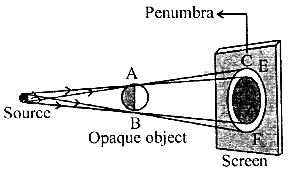
State the conditions when only the penumbra of an opaque object is obtained on the screen.
Answer
If the size of the source of light is bigger than the size of the opaque object, the size of the umbra is very small. If the screen is moved away from the object, the umbra vanishes and only the penumbra remains.
View full question & answer
Question 92 Marks
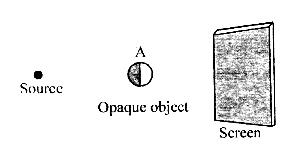
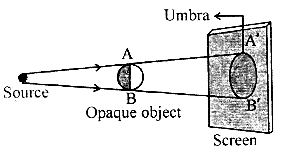
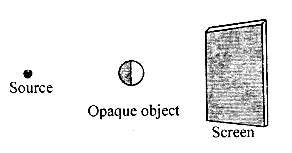
In the following diagram, draw rays to form umbra on the screen.
Answer
A’B’ – umbra
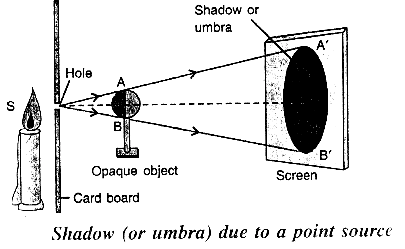
Umbra alone is obtained on the screen when the opaque object is illuminated by a point source of light.
View full question & answer
Question 112 Marks
What is a shadow? Give a reason for its formation.
Answer
When light falls on an opaque object, light is obstructed and a dark patch on a screen kept behind is called a shadow. This is because light propagates in straight line. If the distance between the object and screen is less, the shadow will be (umbra) dark and smaller.
If the distance is increased shadow will be dim and larger.
View full question & answer
Question 122 Marks
State the effect on the image in a pinhole camera if the hole is made bigger.
Answer
If the hole is bigger than a pinhole, again a blurred image is seen. The reason is that a bigger hole is equivalent to a large number of pinholes. Each pinhole produces one image. These images overlap each other resulting in a blurred image.
View full question & answer
Question 132 Marks
How is the image affected in a pinhole camera when another fine hole is made near the first pinhole?
Answer
If another pin hole is made near the first pin hole, two images are formed on the screen, one due to each of the two pin holes. If the holes are very close, the two images tend to overlap each other. As a result, a blurred image will be seen.
View full question & answer
Question 142 Marks
Is the image obtained in a pinhole camera erect or inverted? Give reason for your answer.
Answer
Image obtained in a pinhole camera is inverted.
The reason is that the light travels in a straight-line path. Hence light from the upper point of the candle passes through the pinhole and strikes the tracing paper in the lower point. Similarly, light from the lower point of the candle passes through the pinhole and strikes the tracing paper at the upper point.
View full question & answer
Question 152 Marks
State two factors that affect the size of the image formed in a pinhole camera.
Answer
Factors affecting the size of the image :
The size of the image depends on the following two factors:
  1. The distance of screen (i.e. tracing paper) from the pinhole, and
  2. The distance of the object (i.e. candle) in front of the pinhole.
View full question & answer
Question 162 Marks
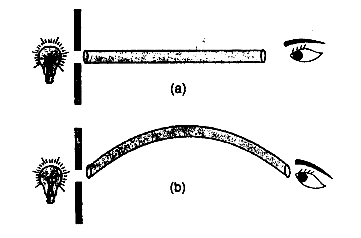
In which of the following two arrangements (a) and (b) shown in the diagram, you can see the light of the bulb? Explain Your answer
Answer
We can see the light of the bulb in the arrangement (a).
This is so because in arrangement ‘a’ the rod is straight and light travels in a straight-line path.
Whereas in arrangement ‘b’ the rod is bent. So the light cannot pass through it.
View full question & answer
Question 172 Marks
Can a transparent medium form an image? Explain your answer.
Answer
No, a transparent medium cannot form an image. All the light that passes through a transparent medium completely passes through the substance. For the formation of the image, it is just that the light rays get reflected through the surface.
View full question & answer
Question 182 Marks
What happens in a solar eclipse?
Answer
A solar eclipse occurs when the moon comes in between the Sun and the Earth and casts its shadow on the earth. In such a case, the moon being smaller in size casts its shadow only on a limited region on the earth.
View full question & answer
[2 Mark Question Answer] - PHYSICS STD 6 Questions - Vidyadip