Questions

[5 Mark Question Answer]

🎯

Test yourself on this topic

6 questions · timed · auto-graded

Question 14 Marks
State any five methods to cheek water pollution.
Answer
Methods to check water pollution are :
  1. The chemical waste released from industries should be treated for removal of toxic substances before it is released into water bodies.
  2. Domestic sewage should be treated before it is released into water bodies.
  3. Excessive use of insecticides and pesticides should be reduced. Organic farming should be encouraged.
  4. Activities like bathing animals and washing clothes in water bodies should be avoided.
  5. Things like paint, oil, polishes and chemicals should not be thrown into drains and water bodies.
View full question & answer
Question 24 Marks
What is water pollution ? Mention three causes for water pollution.
Answer
The release of substances into surface water or groundwater which makes the water unfit for use by humans or affects living organisms and their environment is called water pollution. Causes of water pollution –
1. Domestic sewage/wastes – Untreated sewage from cities and towns contains disease – causing microorganisms. When it is discharged into water bodies, the water gets contaminated.
2. Chemical pollution – Water gets contaminated by harmful . chemicals Industrial waste contains poisonous chemicals which affects the quality of water when discharged into it carelessly. Use of pesticides and fertilizers in agricultural fields pollute the groundwater. Accidental oil -spills in the oceans and seas damage marine life too.
3. Thermal pollution – Thermal power plants and oil refineries use large quantities of water for cooling purposes. They release this water at a very high temperature into nearly water bodies (rivers). This leads to thermal pollution of water. Heat decreases the capacity of water to hold dissolved oxygen. This reduced oxygen content badly affects fish and other aquatic animals.
View full question & answer
Question 44 Marks
Explain ‘anomalous expansion of water’ and its significance.
Answer
Generally, substances contract when they are cooled. However, water shows an anomalous or unusual behaviour. It contracts until the temperature reaches 4°C and it expands when it is cooled below 4°C. This is called anomalous expansion of water. The density of water is maximum at 4°C. As water is cooled below 4°C, it expands instead of contracting. Hence, its volume increases which means the density decreases. Hence, density of ice at 0°C is less than the density of water. Therefore, ice floats on the surface of water.
The anomalous expansion of water is helpful for aquatic life in frozen ponds and lakes to survive during winters or in cold regions. When the temperature falls to 0°C or below, the water on the surface of the ponds or lakes cools and freezes first to form ice. Ice floats over water. Being a bad conductor of • heat, ice does not allow heat to reach the bottom of the pond or lakes and hence the water at the bottom does not freeze. As a result, aquatic animals survive underneath.
View full question & answer
Question 54 Marks
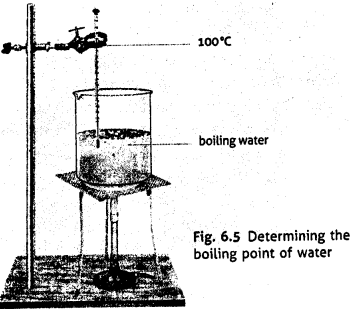
Describe experimentally with the help of a labelled diagram, the determination of the boiling point of pure water.
Answer
Aini: To determine the boiling point of water Materials Required : A beaker, a wire gauze, a tripod stand, a Bunsen burner, a thermonjeter, distilled water.
Procedure :
  1. Pour some distilled water in a beaker.
  2. Set up the apparatus as shown in the figure below.
  3. The bulb of the thermometer should just dip in the water.
  4. Note the temperature on the thermometer. Heat the water till .it boils.
Observation : As the water boils, the temperature reaches 100°C and becomes constant.
Conclusion : The boiling point of pure water is 100°C.
Image
View full question & answer
Question 64 Marks
Mention the ways by which
a. suspended impurities can be removed from drinking water.
b. germs present in drinking water are destroyed.
Answer
(a) The suspended impurities from water is removed by the following methods,
  1. Sedimentation – Water is fed into the sedimentation tanks. The large solid particles are allowed to settle down as sediment.
  2. Loading – In the loading tank, water is treated with potash alum to increase the rate of sedimentation. Fine suspended particles become heavy after mixing with potash alum and settle down at the bottom of the tank.
  3. Filteration – Following loading, water is passed through Alteration tank. The filteration tank has filter beds that contain layers of fine sand, gravel and charcoal. The filter beds remove all suspended impurities from the water.
(b) Germs present in drinking water can be destroyed by –
  1. Chlorination – The filtered water is treated by bleaching powder which releases chlorine when dissolved in water and destroys harmful microorganisms in it. The addition of chlorine to drinking water is called chlorination.
  2. UV radiation – These destroy harmful microorganisms from water. It does not affect the taste and odour of the water.
  3. Ozonization – Ozone gas is also used to disinfect drinking water. It does not affect the taste and odour of water.
View full question & answer
[5 Mark Question Answer] - CHEMISTRY STD 7 Questions - Vidyadip