Questions

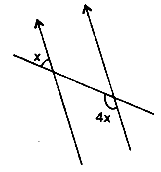
[3 marks sum]

🎯

Test yourself on this topic

30 questions · timed · auto-graded

Question 13 Marks
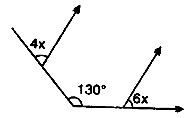
Find $x$ in the following case:
Answer
In the figure,
From 0, draw a line parallel to the given parallel lines
$\therefore \angle 1=4 x$ and $\angle 2=6 x$ ..........(corresponding angles)
But $\angle 1+\angle 2=130^{\circ}$
$ \Rightarrow 4 \mathrm{x}+6 \mathrm{x}=130^{\circ} $
$ \Rightarrow 10 x=130^{\circ} $
$ \therefore x=\frac{130^{\circ}}{10}=13^{\circ} $
View full question & answer
Question 23 Marks
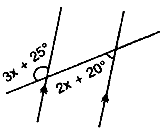
Find $x$ in the following case:
Answer
In the figure,
$\because$ Lines are parallel
$\therefore \angle 1+2 \mathrm{x}=20^{\circ}$ ........(alternate angles)
But $\angle 1+3 x+25^{\circ}=180^{\circ}$ ...........(linear pair)
$ \Rightarrow 2 \mathrm{x}+20^{\circ}+3 \mathrm{x}+25^{\circ}=180^{\circ} $
$ \Rightarrow 5 \mathrm{x}+45^{\circ}=180^{\circ} $
$ \Rightarrow 5 \mathrm{x}=180^{\circ}-45^{\circ}=135^{\circ} $
$ \therefore x=\frac{135^{\circ}}{5}=27^{\circ} $
View full question & answer
Question 33 Marks
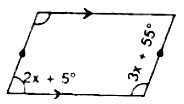
Find $x$ in the following case:
Answer
In the figure,
$\because$ Lines are parallel
$\therefore 2 x+5^{\circ}+3 x+55^{\circ}=180^{\circ}$............. (co-interior angles)
$ \Rightarrow 5 \mathrm{x}+60^{\circ}=180^{\circ} $
$ \Rightarrow 5 \mathrm{x}=180^{\circ}-60^{\circ}=120^{\circ} $
$ \therefore x=\frac{120^{\circ}}{5}=24^{\circ} $
Hence $x=24^{\circ}$
View full question & answer
Question 43 Marks
Find $x$ in the following case:
Answer
In the figure,
$\because$ Lines are parallel
$\therefore \angle 1+4 \mathrm{x}=180^{\circ}$........... (co-interior angles)
But $\angle 1=x$.......... (vertically opposite angles)
$ \therefore \mathrm{x}+4 \mathrm{x}=180^{\circ} $
$ \Rightarrow 5 \mathrm{x}=180^{\circ} $
$ \Rightarrow x=\frac{180^{\circ}}{5}=36^{\circ} $ Hence $x=36^{\circ}$
View full question & answer
Question 53 Marks
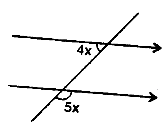
Find $x$ in the following case:
Answer
In the figure,
$\because$ Lines are parallel
$\therefore 4 \mathrm{x}+1=180^{\circ}$.......... (co-interior angles)
But $\angle 1=5 x$ ...........(vertically opposite angles)
$\therefore 4 \mathrm{x}+5 \mathrm{x}=180^{\circ}$
$\Rightarrow 9 \mathrm{x}=180^{\circ}$
Hence $x=\frac{180^{\circ}}{9}=20^{\circ}$
View full question & answer
Question 63 Marks
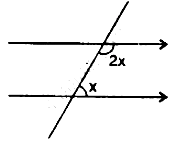
Find $x$ in the following case:
Answer
In the figure,
$\because$ Lines are parallel
$ \therefore 2 x+x=180^{\circ} $..........(co-interior angles)
$ \begin{aligned} & \Rightarrow 3 x=180^{\circ} \\ & \Rightarrow x=\frac{180^{\circ}}{3}=60^{\circ} \end{aligned} $
View full question & answer
Question 73 Marks
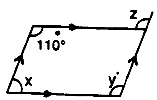
In the given figure, the directed lines are parallel to each other. Find the unknown angles.
Answer
∵ Lines are parallel
∴ x + 110° = 180° .......(co-interior angles)
x = 180°− 110° = 70°
and x + y = 180° ..........(co-interior angles)
⇒ 70° + y = 180°
⇒ y = 180°− 70° = 110°
z = y ...........(corresponding angles)
∴ z = 110°
Hence x = 70°, y = 110°, z = 110°
View full question & answer
Question 83 Marks
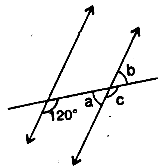
In the given figure, the directed lines are parallel to each other. Find the unknown angles.

Answer
∵ Lines are parallel
∴ c = 120°
a + 120° = 180° .......(co-interior angles)
∴ a = 180°− 120° = 60°
But a = b .........(vertically opposite angles)
∴ b = 60°
hence a = 60°, b = 60° and c = 120°
View full question & answer
Question 93 Marks
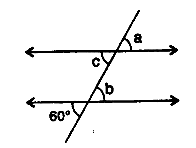
In the given figure, the directed lines are parallel to each other. Find the unknown angles.
Answer
∵ Lines are parallel
∴ a = b ......(corresponding angles)
a = c
∴ a = b = c
But b = 60° ........(vertically opposite angles)
∴ a = b = c = 60°
View full question & answer
Question 103 Marks
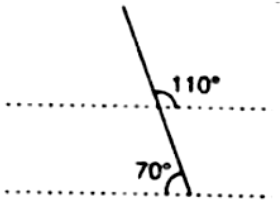
Which pair of the dotted line, segments, in the following figure, are parallel. Give reason:
Image
Answer
∠1 = 110° ......(vertically opposite angles)
If lines are parallel then
∠1 + 70° = 180° ........(co-interior angles)
⇒110° + 70°= 180°
⇒180° =180°
Which is correct.
∴ Lines are parallel.
View full question & answer
Question 113 Marks
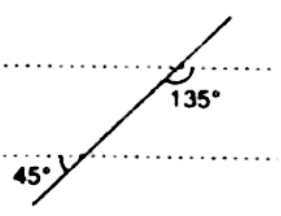
Which pair of the dotted line, segments, in the following figure, are parallel. Give reason:
Image
Answer
In figure,
∠1 = 45° ........(vertically opposite angles)
Lines are parallel if
∠1 + 135° = 180° .........(co-interior angles)
⇒ 45°+ 135° = 180°
⇒ 180° = 180° which is true.
Hence, the lines are parallel.
View full question & answer
Question 123 Marks
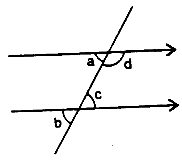
In the given figure, the arrows indicate parallel lines. State which angles are equal. Give a reason.
Answer
In the figure,
a = b .......(corresponding angles)
b = c .............(vertically opposite angles)
a = c ..........(alternate angles)
∴ a = b = c
View full question & answer
Question 133 Marks
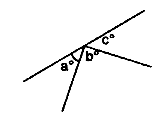
In the adjoining figure, if $b^{\circ}=a^{\circ}+c^{\circ}$, find $b$.
Answer
$a ^{\circ}+ b ^{\circ}+ c ^{\circ}=180^{\circ} \text {............(straight angle) } $
$\text { But } b ^{\circ}= a ^{\circ}+ c ^{\circ} \ldots . . . . \text { (given) } $
$\therefore a ^{\circ}+ c ^{\circ}+ b ^{\circ}=180^{\circ} $
$\Rightarrow b ^{\circ}+ b ^{\circ}=180^{\circ} $
$\Rightarrow 2 b ^{\circ}=180^{\circ} $
$\Rightarrow b ^{\circ}=\frac{180^{\circ}}{2}=90^{\circ}$
Hence $b^{\circ}=90^{\circ}$
View full question & answer
Question 143 Marks
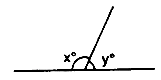
In the given figure, if $x=2 y$, find $x$ and $y$
Answer
$x^{\circ}+y^{\circ}=180^{\circ}$.......(straight angle)
But $x=2 y$ .....(given)
$\therefore 2 y + y =180^{\circ} $
$\Rightarrow 3 y =180^{\circ} $
$\Rightarrow y =\frac{180^{\circ}}{3}=60^{\circ}$
Hence $y=60^{\circ}$
and $x=2 y=2 \times 60^{\circ}=120^{\circ}$
View full question & answer
Question 153 Marks
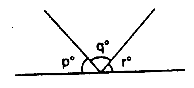
In the given figure. $p^{\circ}=q^{\circ}=r^{\circ}$, find each.
Answer
$p^{\circ}+q^{\circ}=r^{\circ}=180^{\circ}$
(straight angle)
But $p^{\circ}=q^{\circ}=r^{\circ}$ (given)
$\therefore p ^{\circ}+ p ^{\circ}+ p ^{\circ}=180^{\circ} $
$\Rightarrow 3 p ^{\circ}=180^{\circ} $
$\Rightarrow p ^{\circ}=\frac{180^{\circ}}{3}=60^{\circ}$
Hence $p^{\circ}=q^{\circ}=r^{\circ}=60^{\circ}$
View full question & answer
Question 163 Marks
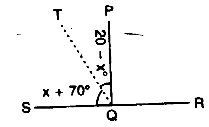
In the given figure, find $\angle P Q R$.
Answer
SQR is a straight line
∴ ∠SQT + ∠TQP + ∠PQR = 180°
⇒ x + 70° + 20° – x + ∠PQR = 180°
⇒ 90° + ∠PQR = 180°
⇒ ∠PQR = 180°− 90° = 90°
Hence ∠PQR = 90°
View full question & answer
Question 173 Marks
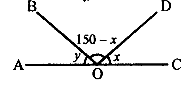
Find $y$ in the given figure.
Answer
∵ AOC is a straight line
∴ ∠AOB + ∠BOD + ∠DOC = 180°
⇒ y + 150°− x + x = 180°
⇒ y + 150° = 180°
⇒ y = 180°− 150° = 30°
Hence, y = 30°
View full question & answer
Question 183 Marks
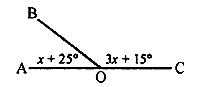
In the given figure, $B A C$ is a straight line. Find:
(i) $x$
(ii) $\angle AOB$
(iii) $\angle B O C$
Answer
$\because \angle A O B$ and $\angle C O B$ are linear pairs
$\therefore \angle \mathrm{AOB}+\angle \mathrm{COB}=180^{\circ}$
$\Rightarrow \mathrm{x}+25^{\circ}+3 \mathrm{x}+15^{\circ}=180^{\circ}$
$\Rightarrow 4 \mathrm{x}+40^{\circ}=180^{\circ}$
$\Rightarrow 4 \mathrm{x}=180^{\circ}-40^{\circ}=140^{\circ}$
(i) $\Rightarrow x=\frac{140^{\circ}}{4}=35^{\circ}$
Hence, $x=35^{\circ}$
(ii) $\angle \mathrm{AOB}=\mathrm{x}+25^{\circ}=35^{\circ}+25^{\circ}=60^{\circ}$
(iii) $\angle \mathrm{BOC}=3 \mathrm{x}+15^{\circ}=3 \times 35^{\circ}+15^{\circ}$
$=105^{\circ}+15^{\circ}=120^{\circ}$
View full question & answer
Question 193 Marks
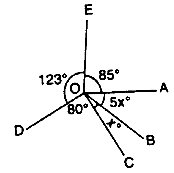
In the given figure, find $\angle A O B$ and $\angle B O C$.
Answer
In the figure,
$5 x+x+80^{\circ}+123^{\circ}+85^{\circ}=360^{\circ} \ldots . .($ Angles at a point $)$
$ \Rightarrow 6 \mathrm{x}+80^{\circ}+123^{\circ}+85^{\circ}=360^{\circ} $
$ \Rightarrow 6 x+288^{\circ}=360^{\circ} $
$ \Rightarrow 6 \mathrm{x}=360^{\circ}-288^{\circ}=72^{\circ} $
$ \Rightarrow \mathrm{x}=\frac{72^{\circ}}{6}=12^{\circ} $
Now, $\angle A O B=5 x=5 \times 12^{\circ}=60^{\circ}$
and $\angle B O C=x=12^{\circ}$
View full question & answer
Question 203 Marks
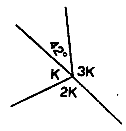
Find $k$ of the given figure.
Answer
In the fig.,
$ k+2 k+3 k+42^{\circ}=360^{\circ} $.......(Angles at a point)
$ \Rightarrow 6 \mathrm{k}+42^{\circ}=360^{\circ} $
$ \Rightarrow 6 \mathrm{k}=360^{\circ}-42^{\circ}=318^{\circ} $
$ \Rightarrow \mathrm{k}=\frac{318^{\circ}}{6}=53^{\circ} $
$ \therefore \mathrm{k}=53^{\circ} $
View full question & answer
Question 213 Marks
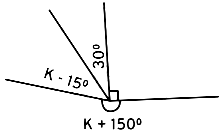
Find $K$ in the given figure.
Answer

$\begin{aligned} & \mathrm{K}+150^{\circ}+90^{\circ}+30^{\circ}+\mathrm{K}-15^{\circ}=360^{\circ} \\ & 2 \mathrm{~K}+270^{\circ}-15^{\circ}=360^{\circ} \\ & 2 \mathrm{~K}+255^{\circ}=360^{\circ} \\ & 2 \mathrm{~K}=360^{\circ}-255^{\circ} \\ & 2 \mathrm{~K}=105^{\circ} \\ & \mathrm{K}=\frac{105}{2}=52.5 \\ & \mathrm{~K}=52.5^{\circ}=52^{\circ} 30^{\prime}\end{aligned}$
View full question & answer
Question 223 Marks
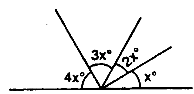
Use the adjacent figure, to find angle $x$ and its supplement.
Answer
In the given fig.
$x+2 x+3 x+4 x=180^{\circ} \ldots . .($ Straight angle $)$
$ \begin{aligned} & \Rightarrow 10 x=180^{\circ} \\ & \Rightarrow x=\frac{180^{\circ}}{10}=18^{\circ} \end{aligned} $
$ \therefore \mathrm{x}=18^{\circ} $
Its supplymentary angle $=180^{\circ}-18^{\circ}=162^{\circ}$
View full question & answer
Question 233 Marks
10% of x° is the complement of 40% of 2x°. Find x
Answer
$\because 10 \%$ of $x^{\circ}$ is the complement of $40 \%$ of $2 x^{\circ}$
$\therefore 10 \%$ of $x^{\circ}+40 \%$ of $2 x^{\circ}=90^{\circ}$
$ \begin{aligned} & \Rightarrow \frac{10}{100} \mathrm{x}+\frac{40}{100} \times 2 \mathrm{x}=90^{\circ} \\ & \Rightarrow \frac{10 \mathrm{x}}{100}+\frac{80 \mathrm{x}}{100}=90^{\circ} \\ & \Rightarrow \frac{90 \mathrm{x}}{100}=90^{\circ} \\ & \therefore x=\frac{90 \times 100}{90}=100^{\circ} \end{aligned} $
Hence $x=100^{\circ}$
View full question & answer
Question 243 Marks
$20\%$ of an angle is the supplement of $60^\circ$ . Find the angle.
Answer
Let the angle $=x$
$20 \%$ of $x .$
$\frac{20}{100} \times x=120^{\circ}$
$x=120 \times \frac{100}{20}$
$x=600^{\circ}$
Supplement of $60^{\circ}$
$=180^{\circ}-60^{\circ}=120^{\circ}$
View full question & answer
Question 253 Marks
Three angles which add up to 180° are in the ratio 2 : 3 : 7. Find them.
Answer
Ratio of three angles $=2: 3: 7$
Let first angle be $=2 x$
second angle $=3 x$
and third angle $=7 x$
$\therefore 2 x+3 x+7 x=180^{\circ}$
$\Rightarrow 12 \mathrm{x}=180^{\circ}$
$\Rightarrow x=\frac{180^{\circ}}{12}=15^{\circ}$
$\therefore$ First angle $=2 \mathrm{x}=2 \times 15^{\circ}=30^{\circ}$
second angle $=3 x=3 \times 15^{\circ}=45^{\circ}$
and third angle $=7 \mathrm{x}=7 \times 15^{\circ}=105^{\circ}$
Hence, the angles are $30^{\circ}, 45^{\circ}$ and $105^{\circ}$
View full question & answer
Question 263 Marks
If two supplementary angles are in the ratio 2 : 7, find them.
Answer
Ratio between two supplementary angles $=2: 7$
Let the angles be $2 x$ and $7 x$
$ \therefore 2 \mathrm{x}+7 \mathrm{x}=180^{\circ} $
$ \Rightarrow 9 x=180^{\circ} $
$ \Rightarrow x=\frac{180^{\circ}}{9}=20^{\circ} $
$\therefore$ First Angle is $2 \mathrm{x}=2 \times 20^{\circ}=40^{\circ}$
Second Angle is $7 \mathrm{x}=7 \times 20^{\circ}=140^{\circ}$
View full question & answer
Question 273 Marks
If two complementary angles are in the ratio 1 : 5, find them.
Answer
Two complementary angles are in the ratio $=1: 5$
Let these angles be $x$ and $5 x$
$ \therefore x+5 x=90^{\circ} $
$ \Rightarrow 6 \mathrm{x}=90^{\circ} $
$ \Rightarrow x=\frac{90^{\circ}}{6}=15^{\circ} $
$\therefore$ Angles will be $15^{\circ}$ and $15^{\circ} \times 5=75^{\circ}$
View full question & answer
Question 283 Marks
If 3x + 18° and 2x + 25° are supplementary, find the value of x.
Answer

$\begin{aligned} & \because 3 x+18^{\circ} \text { and } 2 x+25^{\circ} \text { are supplementary angles } \\ & \therefore 3 x+18^{\circ}+2 x+25^{\circ}=180^{\circ} \\ & \Rightarrow 5 x+43^{\circ}=180^{\circ} \\ & \Rightarrow 5 x=180^{\circ}-43^{\circ}=137^{\circ} \\ & \Rightarrow x=\frac{137^{\circ}}{5}=27.4^{\circ} \text { or } 27^{\circ} 24^{\prime}\end{aligned}$
View full question & answer
Question 293 Marks
Write the supplement of $\frac{1}{5}$ of a right angle
Answer
Supplement of $\frac{1}{5}$ of a right angle
$=180^{\circ}-\frac{1}{5}$ of a right angle
$ \begin{aligned} & =180^{\circ}-\frac{1}{5} \times 90^{\circ} \\ & =180^{\circ}-18^{\circ}=162^{\circ} \end{aligned} $
View full question & answer
Question 303 Marks
Write the supplement of (90 + a + b)°
Answer
Supplement of (90 + a + b)°
= 180°− (90 + a + b)°
= 180°− 90°− a°− b°
= 9°− a°− b°
= (90 − a − b)°
View full question & answer
[3 marks sum] - MATHS STD 7 Questions - Vidyadip