Questions

[4 marks sum]

🎯

Test yourself on this topic

9 questions · timed · auto-graded

Question 14 Marks
In triangle $PQR,$ angle $Q = 90^\circ$, find:$ PQ,$ if $PR = 34\ cm$ and $QR = 30\ cm$
Answer
Given:
$PR =34 cm$
$QR =30 cm$
$PQ =?$
$\angle PQR =90^{\circ}$
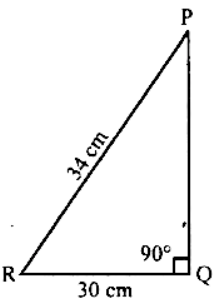
Image
According to Pythagoras Theorem,
$ (P R)^2=(P Q)^2+(Q R)^2$
$(34)^2=P Q^2+(30)^2$
$1156=P Q^2+900$
$1156-900=P Q^2$
$256=P Q^2$
$\therefore P Q=\sqrt{256}=16 cm$
View full question & answer
Question 24 Marks
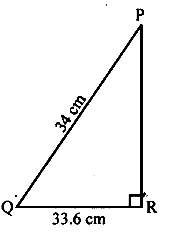
Triangle PQR is right-angled at vertex R. Calculate the length of PR, if: PQ = 34 cm and QR = 33.6 cm.
Answer
Given: $\triangle P Q R$ right angled at $R$ and$
P Q=34 cm , Q R=33.6 cm
$

To find: Length of PR.
According to Pythagoras' Theorem,
$
\begin{aligned}
& P^2+Q^2=P Q^2 \\
& P^2+33.6^2=34^2 \\
& P^2+1128.96=1156 \\
& P R^2=1156-1128.96 \\
& P R=\sqrt{27.04} \\
& \therefore P R=5.2 cm
\end{aligned}
$
View full question & answer
Question 34 Marks
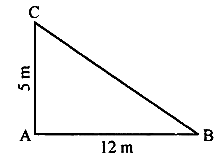
A boy first goes 5 m due north and then 12 m due east. Find the distance between the initial and the final position of the boy.
Answer
Given: Direction of north $=5 m$ i.e. AC Direction of east $=12 m$ i.e. $AB$

To find: $B C$
According to Pythagoras Theorem, In right angled $\triangle A B C$
$
\begin{aligned}
& (B C)^2=(A C)^2+(A B)^2 \\
& (B C)^2=(5)^2+(12)^2 \\
& (B C)^2=25+144 \\
& (B C)^2=169 \\
& \therefore B C=\sqrt{169}=\sqrt{13 \times 13}=13 m
\end{aligned}
$
View full question & answer
Question 44 Marks
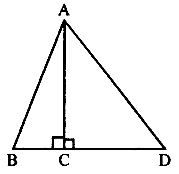
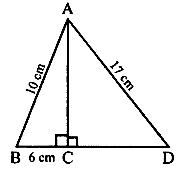
In the given figure, angle $A C B=90^{\circ}=$ angle $A C D$. If $A B=10 m , B C$ $=6 cm$ and $A D=17 cm$, find :
(i) $AC$
(ii) $CD$
Answer
$\triangle ABD$
$\angle ACB =\angle ACD =90^{\circ}$
and $A B=10 cm , B C=6 cm$ and $A D=17 cm$

To find:
(i) Length of $AC$
(ii) Length of $C D$.
Proof:
(i) In right-angled triangle $A B C$
$B C=6 cm , A B=110 cm$
According to Pythagoras Theorem,
$
\begin{aligned}
& A B^2=A C^2+B C^2 \\
& (10)^2=(A C)^2+(6)^2 \\
& 100=(A C)^2+36 \\
& A C^2=100-36=64 cm \\
& A C^2=64 cm \\
& \therefore A C=\sqrt{8 \times 8}=8 cm
\end{aligned}
$
(ii) In right-angle triangle $A C D$
$
A D=17 cm , A C=8 cm
$
According to Pythagoras Theorem,
$
\begin{aligned}
& (A D)^2=(A C)^2+(C D)^2 \\
& (17)^2=(8)^2+(C D)^2 \\
& 289-64=C D^2 \\
& 225=C D^2 \\
& C D=\sqrt{15 \times 15}=15 cm
\end{aligned}
$
View full question & answer
Question 54 Marks
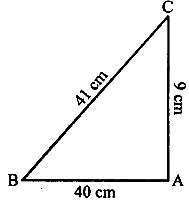
Show that the triangle ABC is a right-angled triangle; if: AB = 9 cm, BC = 40 cm and AC = 41 cm
Answer

$\begin{aligned} & A B=9 cm \\ & C B=40 cm \\ & A C=41 cm \end{aligned}$

The given triangle will be a right-angled triangle if square of its largest side is equal to the sum of the squares on the other two sides.
According to Pythagoras Theorem,
$
\begin{aligned}
& (A C)^2=(B C)^2+(A B)^2 \\
& (41)^2=(40)^2+(9)^2 \\
& 1681=1600+81 \\
& 1681=1681
\end{aligned}
$
Hence, it is a right-angled triangle $A B C$.
View full question & answer
Question 64 Marks
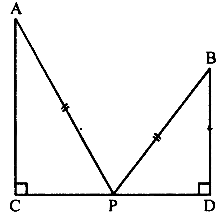
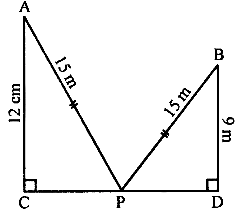
In the given figure, angle $A C P=\angle B D P=90^{\circ}, A C=12\ m , B D=9\ m$ and $P A=P B=15\ m$. Find:
(i) $CP$
(ii) $PD$
(iii) $C D$
Answer
Given :  $A C=12\ m$
$ B D=9 \ m$
$ P A=P B=15 \ m $

$(i)$ In right angle triangle $\text{ACP}$
$(A P)^2=(A C)^2+(C P)^2$
$ 15^2=12^2+C P^2$
$ 225=144+C P^2$
$ 225-144=C P^2$
$ 81=C P$
$ \sqrt{81}=C P$
$ \therefore C P=9\ m$
$(ii)$ In right angle triangle $\text{BPD}$
$(P B)^2=(B D)^2+(P D)^2$
$ (15)^2=(9)^2+P D^2$
$ 225=81+P D^2$
$ 225-81=P^2$
$ 144=P D^2$
$ \sqrt{144}=P D^2$
$ \therefore P D=12\ m$
$\text { (iii) } C P=9\ m$
$P D=12 \ m$
$\therefore C D=C P+P D$
$=9+12$
$=21\ m $
View full question & answer
Question 74 Marks
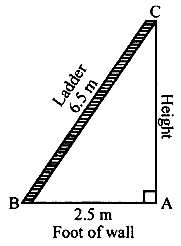
A ladder, 6.5 m long, rests against a vertical wall. If the foot of the ladder is 2.5 m from the foot of the wall, find up to how much height does the ladder reach?
Answer
Given :
Length of ladder $=6.5 m$
Length of the foot of the wall $=2.5 m$
To find: Height AC According to Pythagoras Theorem,
$
(B C)^2=(A B)^2+(A C)^2
$

$\begin{aligned} & (6.5)^2=(2.5)^2+(A C)^2 \\ & 42.25=6.25+A C^2 \\ & A C^2=42.25-6.25=36 m \\ & A C=\sqrt{6 \times 6}=6 m \\ & \therefore \text { Height of wall }=6 m \end{aligned}$
View full question & answer
Question 84 Marks
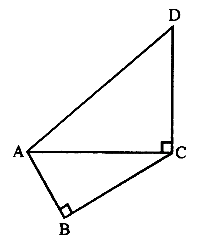
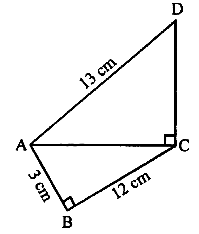
In the given figure, $A D=13 cm , B C=12 cm , A B=3 cm$ and angle $A C D=$ angle $A B C=90^{\circ}$. Find the length of $D C$.
Answer
Given:
$
\begin{aligned}
& \triangle A C D=\angle A B C=90^{\circ} \\
& \text { and } A D=13 cm , B C=12 cm , A B=3 cm
\end{aligned}
$
To find : Length of DC.

(i) In right angled $\triangle A B C$
$
A B=3 cm , B C=12 cm
$
According to Pythagoras Theorem,
$
\begin{aligned}
& (A C)^2=(A B)^2+(B C)^2 \\
& (A C)^2=(3)^2+(12)^2 \\
& (A C)=\sqrt{9+144}=\sqrt{153} cm
\end{aligned}
$
(ii) In right angled $\triangle A C D$
$
A D=13 cm , A C=\sqrt{153}
$
According to Pythagoras Theorem,
$
\begin{aligned}
& D C^2=A B^2-A C^2 \\
& D C^2=169-153 \\
& D C=\sqrt{16}=4 cm
\end{aligned}
$
$\therefore$ Length of $D C$ is $4 cm$
View full question & answer
Question 94 Marks
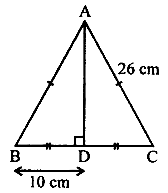
In the given figure, angle $A D B=90^{\circ}, A C=A B=26 cm$ and $B D=$ $D C$. If the length of $A D=24 cm$; find the length of $B C$.
Answer
Given:
$\triangle \mathrm{ABC}$
$\angle A D B=90^{\circ}$ and $A C=A B=26 \mathrm{~cm}$
$A D=24 \mathrm{~cm}$
To find : Length of $B C$ In right angled $\triangle A D C$
$ A B=26 \mathrm{~cm}, A D=24 \mathrm{~cm} $
According to Pythagoras Theorem,
$ \begin{aligned} & (A C)^2=(A D)^2+(D C)^2 \\ & (26)^2=(24)^2+(D C)^2 \\ & 676=576+(D C)^2 \\ & \Rightarrow(D C)^2=100 \\ & \Rightarrow D C=\sqrt{100}=10 \mathrm{~cm} \\ & \therefore \text { Length of } B C=B D+D C \\ & =10+10=20 \mathrm{~cm} \end{aligned} $
View full question & answer
[4 marks sum] - MATHS STD 7 Questions - Vidyadip