Questions

[4 marks sum]

🎯

Test yourself on this topic

4 questions · timed · auto-graded

Question 14 Marks
Construct a triangle ABC in which AB = AC = 5 cm and BC = 5.6 cm. If possible, draw its lines of symmetry.
Answer
Steps of Construction:
(i) Draw a line segment $BC =5.6 cm$
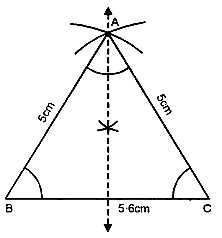
(ii) With centres $B$ and $C$ and radius $5 cm$, draw two arcs intersecting each other at $A$.
(iii) Join $A B$ and $A C$.
$\triangle ABC$ is an isosceles triangle.
(iv) Draw the bisector of $\angle A$. This is the only one line of symmetry as the triangle is an isosceles.
View full question & answer
Question 24 Marks
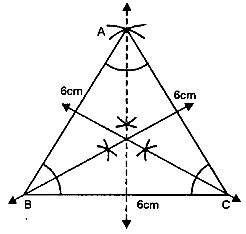
Construct an equilateral triangle with each side 6 cm. In the triangle drawn, draw all the possible lines of symmetry.
Answer
Steps of Construction:
(i) Draw a line segment $BC =6 cm$

(ii) With centres $B$ and $C$ and radius $6 cm$, draw two arcs intersecting each other at $A$.
(iii) Join $A B$ and $A C$
$\triangle A B C$ is the required equilateral triangle,
(iv) Draw the angle bisectors of $\angle A, \angle B$, and $\angle C$.
These are the lines of symmetry which are three in numbers as the triangle is equilateral.
View full question & answer
Question 34 Marks
Complete the following table:
PointReflection in
x-axisy-axisorigin
(i) (8, 2)
(ii) (5, 6)
(iii) (4, −5)
(iv) (6, −2)
(v) (−3, 7)
(vi) (−4, 5)
(vii) (−2, −7)
(viii) (−6, −3)
(ix) (4, 0)
(x) (−7, 0)
(xi) (0, −6)
(xii) (0, 7)
(xiii) (0, 0)
Answer
PointReflection in
x-axisy-axisorigin
(i) (8, 2)(8, − 2)(− 8, 2)(− 8, − 2)
(ii) (5, 6)(5, − 6)(− 5, 6)(− 5, − 6)
(iii) (4, − 5)(4, 5)(− 4, − 5)(− 4, 5)
(iv) (6, − 2)(6, 2)(− 6, − 2)(− 6, 2)
(v) (− 3, 7)(− 3, − 7)(3, 7)(3, − 7)
(vi) (− 4, 5)(− 4, − 5)(4, 5)(4, − 5)
(vii) (− 2, −7 )(− 2, 7)(2, − 7)(2, 7)
(viii) (− 6, − 3)(− 6, 3)(6, − 3)(6, 3)
(ix) (4, 0)(4, 0)(− 4, 0)(− 4, 0)
(x) (− 7, 0)(− 7, 0)(7, 0)(7, 0)
(xi) (0, − 6)(0, 6)(0, − 6)(0, 6)
(xii) (0, 7)(0, − 8)(0, − 8)(0, − 8)
(xiii) (0, 0)(0, 0)(0, 0)(0, 0)
View full question & answer
Question 44 Marks
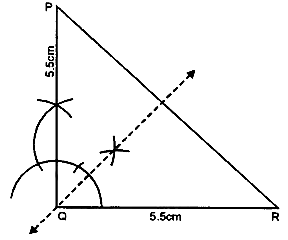
Construct a triangle PQR such that PQ = QR = 5 .5 cm and angle PQR = 90°. If possible, draw its lines of symmetry.
Answer
$\therefore \angle P Q R=90^{\circ}$, and $\angle P=\angle R$ ...........(opposite sides are equal)
$
\therefore \angle P +\angle R =90^{\circ}
$
Hence $Z P=Z R==45^{\circ}$
Steps of Construction:
(i) Draw a line segment $Q R=5.5 cm$

(ii) At $Q$, draw a ray making an angle of $90^{\circ}$ and cut off $Q P=5.5 cm$.
(iii) Join PR.
$\triangle PQR$ is an isosceles triangle.
(iv) Draw the angle bisector of $\angle P Q R$. It is the line of symmetry.
Since the triangle is an isosceles.
$\therefore$ It has only one line of symmetry.
View full question & answer
[4 marks sum] - MATHS STD 7 Questions - Vidyadip