Questions

[1 Mark Question Answer]

🎯

Test yourself on this topic

19 questions · timed · auto-graded

Question 11 Mark
Differentiate between inflammable and nonflammable substances.
Answer
Substances that catch fire easily are called inflammable substances. On the other hand, substances that do no catch fire easily are called nonflammable substances.
View full question & answer
Question 21 Mark
Under what condition does heat energy flow from one object to the other ?
Answer
Heat energy always flows from a body at higher temperature to a body at lower temperature, when brought in contact.
View full question & answer
Question 31 Mark
Convection
Answer
Convection is the process of transfer of heat in fluids (liquids and gases) wherein the molecules actually move from one part of the fluid to the other.
View full question & answer
Question 41 Mark
Conduction
Answer
Conduction is the process of transfer of heat energy in solids, from one particle to another, without the actual movement of the particles.
View full question & answer
Question 51 Mark
Evaporation
Answer
The change of a substance from its liquid state to its gaseous state at any temperature below its boiling point is called evaporation.
View full question & answer
Question 61 Mark
Sublimation
Answer
The process by which certain substances which are solid directly changes into vapours, without changing into liquid state.
View full question & answer
Question 71 Mark
Solidification
Answer
The process during which a liquid changes to solid state at a constant temperature by release of heat energy.
View full question & answer
Question 81 Mark
Condensation
Answer
The process during which a substance in its vapour or gaseous state changes into its liquid state at a constant temperature by release of heat.
View full question & answer
Question 91 Mark
Boiling
Answer
The process during which a liquid changes to vapour state at a constant temperature by absorption of heat.
View full question & answer
Question 101 Mark
Melting
Answer
The process during which a solid changes to a liquid state at a constant temperature by absorption of heat.
View full question & answer
Question 141 Mark
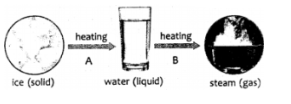
Name the temperatures at which processes A and B take place.
Answer
Process A takes place at 0 °C while process B takes place at 100 °C.
View full question & answer
Question 161 Mark
Why are wood, kerosene oil and petrol used as common fuels?
Answer
Wood, kerosene oil and petrol are used as fuels because they are inflammable substances that bum easily and release a lot of heat and energy.
View full question & answer
Question 171 Mark
Why is water used as one of the main substances for extinguishing fire?
Answer
Water is easily available everywhere and helps in extinguishing fire as it cuts off oxygen supply to the fire and stops combustion.
View full question & answer
Question 181 Mark
Why is asbestos used in fire-proof buildings?
Answer
Asbestos is used in fire-proofing buildings because it is a non-flammable material and does not catch fire.
View full question & answer
Question 191 Mark
Is convection possible in solids? Give reason.
Answer
As molecules in solids are tightly packed, actual movement of molecules is not possible in solids. Hence, convection does not take place in solids. So, heat transfer by convection takes place only in fluids, that is, in liquids and gases.
View full question & answer
[1 Mark Question Answer] - PHYSICS STD 7 Questions - Vidyadip