Questions

[3 marks Question Answer]

🎯

Test yourself on this topic

6 questions · timed · auto-graded

Question 13 Marks
Give any three differences between an artery and a vein.
Answer
Following are the differences between the artery and a vein:
Artery Vein
$1.$ Arteries carry blood from the heart to various body parts. $1.$ Veins carry blood from different body parts to the heart.
$2.$ These carry oxygenated blood $($except the pulmonary artery$)$. $2.$ These carry deoxygenated blood $($except the pulmonary vein$)$.
$3.$ Blood flows with high speed and under high pressure. $3.$ Blood flows with low speed and under low pressure.
View full question & answer
Question 23 Marks
During surgical operations or during accidents, the patient may be given blood from outside to save his life. What is the technical name of this process ? Briefly explain the precautions to be observed and taken in this process.
Answer
During surgical operation or an accident when excess of bleeding takes place, the patient may be given blood from outside to save his life.
The transfer of blood from the donor to the recipient is called blood transfusion.
The following precautions are taken before the blood is given to the needy person:
$1.$ Matching of the donor’s blood with that of the recipient should be done.
$2.$ It should be made sure clinically that blood of donor is free from any infection.
$3.$ Sterilization of all the instruments to be used during the operation is must.
View full question & answer
Question 33 Marks
Name any two heart conditions that occur commonly. Briefly explain each of them.
Answer
$1.$ Palpitations: Sometimes, one may experience the heart beating too hard or too fast or sometimes even skipping a beat. This can be frightening, but not serious or harmful and often this condition goes away on its own. Most of the time it is caused by stress or anxiety. Sometimes certain types of food may also cause palpitations.
In rare cases, palpitations may be an indication of a more serious heart condition, specially if it is accompanied by shortness of breath, dizziness or chest pain.
$2.$​​​​​​​ Hypertension: This is a condition that occurs in a person when blood flows through the blood vessels with a force greater than normal. This is also called High Blood Pressure. Hypertension can strain the heart, damage blood vessels and increase the risk of a heart attack or stroke.
View full question & answer
Question 43 Marks
Differentiate between Blood and the lymph.
Answer
Difference between Blood and Lymph
Lymph Blood
$1.$ It contains blood plasma without blood proteins and some $\text{RBC}$. $1.$ It contains blood plasms with proteins and all three types of blood cells namely $\text{RBC., WBC}$ and blood platelets.
$2.$ They are light yellow in colour and does not contain $\text{RBC}$. and haemoglobin. $2.$ They are red in colour due to presence of haemoglobin in RBC,
$3.$ It doesnot carry Oxygen. $3.$ It carries oxygen in the body.
$4.$ It is the part of open circulatory system. $4.$ It is the part of closed circulatory system.
View full question & answer
Question 53 Marks
Give the functions of lymph.
Answer
Functions of lymph are:
$1.$ Nutritive : It supplies nutrition and oxygen to those parts where blood cannot reach.
$2.$ Drainage : It drains away excess tissue fluid and metabolites and returns proteins to the blood from tissue spaces.
$3.$ Absorption : It absorbs the fats from the intestine through lymphatics.
$4.$ Defence : Lymphocytes and monocytes of the lymph function to protect the body. The lymphatics also remove bacteria from the tissues.
View full question & answer
Question 63 Marks
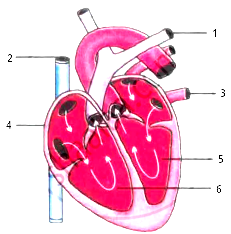
Given alongside is a diagram of human heart showing its internal structures. Label the parts marked $1$ to $6$, and answer the following questions.

$1.$ Which type of blood is carried by the blood vessel marked $2$?
$2.$ Name the main artery which takes the blood from heart to different parts of the body?
$3.$ Which chamber of the heart receives deoxygenated blood from the body?
Answer
$1.$ Left pulmonary artery
$2.$ Superior vena cava
$3.$ Left pulmonary vein
$4.$ Pericardium
$5.$ Left Ventricle
$6.$ Right Ventricle
$(a).$The superior vena cava carries deoxygenated blood from the upper part of the body $($head, neck, and arms$)$ back to the right atrium of the heart.
$(b).$The main artery that takes oxygenated blood from the heart to different parts of the body is the aorta
$(c).$The right atrium of the heart receives deoxygenated blood from the body.
View full question & answer
[3 marks Question Answer] - BIOLOGY STD 8 Questions - Vidyadip