Questions

[2 Mark Question Answer]

🎯

Test yourself on this topic

8 questions · timed · auto-graded

Question 12 Marks
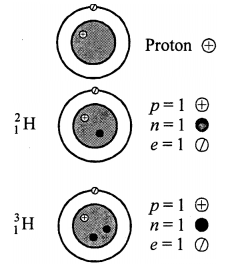
Draw the structure of the following atoms showing the nucleus containing $-$ protons, neutrons and the orbits with the respective electrons: Isotopes of hydrogen $\ce{[^1_1H, ^2_1H, ^3_1H]}$
Answer
$z = 1 = p = e$
$e = 1$
$A = p + n$
$1 = 1 + n$
$n = 1 – 1 = 0$
Image
View full question & answer
Question 22 Marks
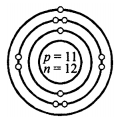
Draw the structure of the following atoms showing the nucleus containing $–$ protons, neutrons and the orbits with the respective electrons : Sodium $[$At. no. $= 11$, Mass no. $= 23]$
Answer
$Z = 11 = p = e\  \ce{K.L.M}$
$e = 11 = 2, 8, 1$
$A – p + n$
$23 = 11 + n$
$n = 23 – 11 = 12$
Image
View full question & answer
Question 32 Marks
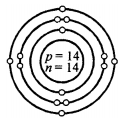
Draw the structure of the following atoms showing the nucleus containing $–$ protons, neutrons and the orbits with the respective electrons : Silicon $[$At. no. $= 14$, Mass no. $= 28]$
Answer
$Z = 14 = p = e \  \ce{K. L. M}$
$e = 14 = 2, 8, 4$
$A – p + n$
$28 = 14 + n$
$n = 28 – 14 = 14$
Image
View full question & answer
Question 42 Marks
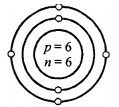
Draw the structure of the following atoms showing the nucleus containing $–$ protons, neutrons and the orbits with the respective electrons : Carbon $[$At. no. $= 6$, Mass no. $= 12]$
Answer
$Z = 6 = p = e\  K .L$
$e = 6 = 2, 4$
$A = p + n$
$12 = 6 + n$
$n = 12 – 6 = 6$
Image
View full question & answer
Question 52 Marks
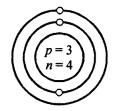
Draw the structure of the following atoms showing the nucleus containing $–$ protons, neutrons and the orbits with the respective electrons : Lithium $[$At. no. $= 3,$ Mass no. $= 7]$
Answer
$Z = 3 = p = e\  K .L$
$e = 3 = 2, 1$
$A = p + n$
$7 = 3 + 3$
$n = 7 – 3 = 4$
Image
View full question & answer
Question 62 Marks
Valency is the number of hydrogen atoms which can combine with $[$or displace$]$ one atom of the element $[$or radical$]$ forming a compound'. With reference to the above definition of valency, state the valency of chlorine in hydrogen chloride, giving reasons.
Answer
Hydrogen chloride $[\ce{ HCl} ]$, one atom of chlorine has combined with one atom of hydrogen and also $1$ atom of hydrogen can be replaced by metals like potassium, sodium. Hence valency of chlorine in one.
View full question & answer
Question 72 Marks
State why the atomic weight of an element is also termed $–$ relative atomic mass.
Answer
Atomic weight is mass of an atom, the number times it is heavier than an atom of hydrogen. Since carbon atom is $12$ times heavier than an atom of hydrogen. Relative mass is equal to the number of times an atom of an element is heavier than $1/12^{th}$ mass of an atom of carbon. Hence atomic weight of an element is also termed relative atomic mass as it is in comparison with mass of $1/12^{th}$ mass of a carbon atom.
View full question & answer
Question 82 Marks
Define the term $–$ ‘atomic number’ of an atom. If an atom $‘A’$ has an atomic number of $–$ eleven, state the number of protons $\& $ electrons it contains.
Answer
Atomic number is the number of protons in the atom of an element. Since atom is electrically neutral i.e. is charge less, therefore’ number of electrons $=$ number of protons.
It has $11\  P$ and $11$ electrons.
Atomic number $Z = p = e$
View full question & answer
[2 Mark Question Answer] - CHEMISTRY STD 8 Questions - Vidyadip