Questions

[5 Mark Question Answer]

🎯

Test yourself on this topic

6 questions · timed · auto-graded

Question 14 Marks
The diagram represents an isotope of hydrogen $[H],$ Answer the following:
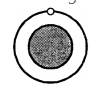
Image
At. no.$ = 1$
Mass no. $= 1$
$1.$ Are isotopes atoms of the same element or different elements.
$2.$ Do isotopes have the same atomic number or the same mass number.
$3.$ If an isotope of $‘H’$ has mass no.$ = 2$, how many electrons does it have.
$4.$ If an isotope of ‘$H’$ has mass no. $= 3$, how many neutrons does it have.
$5.$ Which sub$-$atomic particles in the $3$ isotopes of $‘H’ $ are the same.
Answer
$1.$ Isotopes atoms are of the same element.
$2.$ Same atomic number.
$3.$ One electron.
$4.$ Two neutrons. $[v A = P + n]$
$5.$ Protons and electrons in each isotope are same.
View full question & answer
Question 24 Marks
Valency is also the number of electrons $-$ donated or accepted by an atom so as to achieve stable electronic configuration of the nearest noble gas'. With reference to this definition $-$
$a.$ State what is meant by 'stable electronic configuration'.
$b.$ State why the valency of $-$
$i.$ sodium, magnesium $\& $ aluminium is : $+1,+2 \&+3$ respectively.
$ii.$ chlorine, oxygen $\&$ nitrogen is : $-1,-2 \&-3$ respectively.
Answer
$a$. Stable electronic configuration means to have $2$ electrons in the $1^{st} [$or $K ]$ outer most shell like $He [$Duplet$].$
OR
$8$ electrons in outer most orbit like other nearst noble gas $- [$Octet$].$
$b\ . i.$ Valency is the number of electrons donated or lost from the valence shell. Since sodium donates $1$ valence electron its valency is $+1$ . Magnesium loses $2$ electrons and aluminium loses $3 $, electrons from their valence shell their valency is $+2 -$ magnesium $+3 - $Aluminium
$ii.$ Valency of an element is the number of electrons accepted to achieve stable configuration of nearest noble gas.
Chlorine accepts $1$ electron and has valency $-1$ where as oxygen accepts $2$ electrons the valency of oxygen is $-2$ and nitrogen accepts $3$ electrons, valency of nitrogen is $-3$ .
View full question & answer
Question 34 Marks
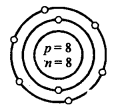
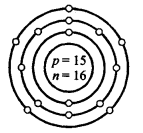
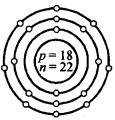
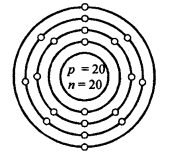
Draw the atomic diagrams of the following elements showing the distribution of $-$ protons, neutrons  the electrons in the various shells of the atoms.
$a$. Carbon $-{ }^{12} C$
$b$. Oxygen $-{ }_8^{16} O$
$c$. Phosphorus $-{ }^{31}{ }_{15} P$
$d$. Argon $-{ }^{40}{ }_{18} Ar$
$e$. Calcium $-{ }_{20}^{40} Ca$
$[$The upper number represents the $-$ mass number $\ $ the lower number the $ -$ atomic number e.g. calcium $-$ mass number $=40$, atomic number $=20]$
Answer
$a$. Carbon $-{ }^{12} 6 C$ Mass number $A = p + n =12$
$6+n=12$
$\therefore n=12-6=6$
$e=p=$ Atomic number
$=6(C) \ 6=2,4(K, L)$
Image
$b$. Oxygen $-{ }^{16}{ }_8 O$ Atomic number $Z=p=e=8$
Mass number $A = p + n$
$16=8+n$
$\therefore n=16-8=8$
$O\ 8=2,6$
$(K, L)$
$c$. Phosphorus $-{ }^{31}{ }_{15} P$ Atomic number $Z=p=e=15$
Mass number $A = p + n$
$31=15+n$
$\therefore n=31-15=16$
Image
$P \ 15=2,8,5\ce{(K, L, M)}$

$d$. Argon $-{ }^{40}{ }_{18} Ar$ Atomic number $Z=p=p=18$
Mass number $A = p + n\  9 $
$ 40=18+n$
$\therefore n=40-18=22$
$Ar\ 15=2,8,8,2\ce{(K , L , M , N)}$
Image
$e$. Calcium $-{ }^{40}{ }_{20} Ca$ Atomic number $Z=p=e=20$
Mass number $A=p+n$
$40=20+H$
$\therefore n=40-20=20$
$Ca$
$15=2,8,8,2\ce{(K, L, M, N)}$
Image
View full question & answer
Question 44 Marks
Explain in brief $–$ Goldstein’s experiment which led to the discovery of the proton and $–$ Lod Rutherford’s experiment which led to the discovery of the atomic nucleus.
Answer
Discovery of $–$ Protons
Discovery $–$ Constituent of positive rays i.e. particles that contain $–$ protons.
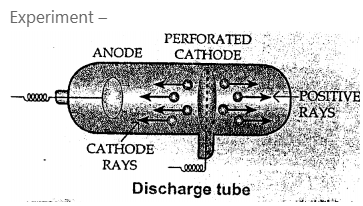
Image
Goldstein used a modified cathode ray tube with a perforated cathode.
He observed a new type of rays produced from the anode passing through the holes of the perforated cathode. These rays were called anode rays.
Conclusion $–$
Anode rays or positive rays consist of positively charged particles now called $–$ protons.
  • The positive rays were affected by electric $\&$ magnetic fields but $–$ in a direction opposite to that of cathode rays.
  • Thus with the discovery of the positive particles $–$ proton was initiated.
Discovery of $–$ Atomic nucleus
Discovery $–$ Study of the atomic model leading to the discovery of $–$ atomic nucleus.
Experiment $–$
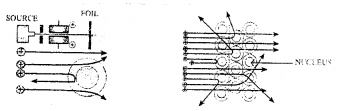
Image
Rutherford projected alpha particles towards a thin gold foil, $–$ in the path of the rays.
He saw that most of the alpha particles went straight through the foil, $–$ but some were deflected slightly $\&$ some by large angles. Conclusion $–$
  • An atom on the whole is relatively empty but consists of a $–$ concentrated positive mass in the centre, which lead to the deflection of the alpha particles.
  • Thus the discovery of a central positive region $–$ atomic nucleus was initiated.
View full question & answer
Question 54 Marks
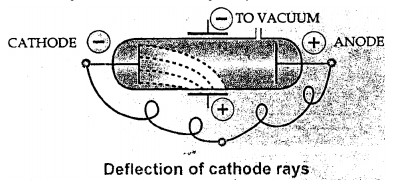
With reference to the discovery of the structure of an atom, explain in brief $-$ William Crookes experiment for the discovery of cathode rays, followed by $-$ J.J. Thomsons experiment pertaining to the constituents of the cathode rays. State which sub$-$atomic particle was discovered from his experiment.
Answer
Discovery of the three subatomic particles $–$ electrons, protons and neutrons Atom are built up of three sub$-$atomic particles $–$ electrons, protons and neutrons.
Image
Discovery of cathode rays leading to the discover of ‘electrons’
Scientist $–$ William Crookes $[1878]$
Discovery $–$ The cathode rays Experiment
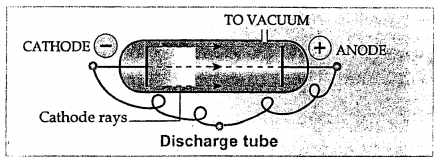
Image
$(i)$ An electric discharge was passed through a tube containing a gas at low pressure.
$(ii)$ Blue rays were emitted from the cathode $[$negative plate$] –$ which were called cathode rays.
View full question & answer
Question 64 Marks
State the main postulates of $-$ Dalton’s atomic theory. Explain how the modern atomic theory contradicted Dalton’s atomic theory.
Answer
$a.$ Dalton’s Atomic Theory :
The main postulates of theory are :
$1.$ Matter consists of small indivisible particles called $-$ atoms i.e. Atom is the basic unit of matter.
$2.$ Atoms of the same element are $-$ alike in all respects i.e. atoms of hydrogen have same properties like mass, density and atoms of oxygen are alike in all respects.
$3.$ Atoms of different elements are different from each other. i.e. atoms of hydrogen are different from atoms of oxygen.
$4.$ Atom can neither be created nor destroyed.
$5.$ Atoms combine with other atoms in simple whole number ratio forming compounds or molecules.
$b.$ Modern atomic theory contradicted Dalton Atomic Theory as :
$1.$ Atom is no longer indivisible as atom has been divided and has sub$-$atomic particles
$a.$ Protons
$b.$ Neutrons
$c.$ Electrons
$2.$ Atoms of same element may have different properties i.e.
i. e. Isotopes $\ce{^1_1H, ^2_1H, ^3_1H}$
$3.$ Atoms of different elements may have same properties i.e. isobars
$4.$ Atoms combine with other atoms may not be in simple whole number ratio i.e. $($Sugar$)$.
$5.$ Atom can be destroyed and converted into energy.
View full question & answer
[5 Mark Question Answer] - CHEMISTRY STD 8 Questions - Vidyadip