Questions

[5 Mark Question Answer]

🎯

Test yourself on this topic

6 questions · timed · auto-graded

Question 15 Marks
Mention briefly the salient features of Dalton’s atomic theory $($five points$)$
Answer
Salient features of Dalton’s atomic theory:
  1. Matter consists of very small and indivisible particles called atoms, which can neither be created nor can be destroyed.
  2. The atoms of an element are alike in all respects i.e. size, mass, density, chemical properties but they differ from the atoms of other elements.
  3. Atoms of an element combine in small numbers to form molecules of the element.
  4. Atoms of one element combine with atoms of another element in simple whole number ratio to form molecules of compounds.
  5. Atoms are the smallest units of matter that can take part in a chemical reaction during which only rearrangement of atoms takes place
View full question & answer
Question 25 Marks
Name three fundamental particles of the atom. Give the symbol with charge, on each particle.
Answer
The fundamental particles of the atom are: electrons, protons and neutrons.
Particle Symbol Charge
electron $e^–$ $-1$ or $1.602 \times 10^{-19}C.$ Where $-1$ represent its one unit negative electrical charge
proton $p^+$ $+ 1$ or $1.602 \times 10^{-19} C$. Where $+1$ represents one unit $+ve$ electrical charge.
neutron $n^o$ $0$
View full question & answer
Question 35 Marks
Complete the table below by identifying $\text{A, B, C, D, E}$ and $\text{F}.$
Answer
Element Symbol Number of protons Numbers of neutrons Number if electrons
Fluorine ${ }_9 F^{19}$ $9$ $A$ $B$
Aluminium $C$ $D$ $14$ $13$
Postassium ${ }_{19} K^{39}$ $E$ $F$ $19$

ans
Element Symbol Number of protons Number of neutrons Numbers if electrons
Fluorine ${ }_9 F^{19}$ $9$ $10$ $9$
Aluminium ${ }_{13} A l^{27}$ $13$ $14$ $13$
Potassium ${ }_{19} K^{39}$ $19$ $20$ $19$
View full question & answer
Question 45 Marks
What are isotopes? How does the existence of isotopes contradict Dalton’s atomic theory?
Answer
Atoms of an element must have the same atomic number, but their mass number can be different due to the presence of a different number of neutrons. These atoms of an element having a different number of neutrons are called groups.
According to Dalton’s theory, all atoms of an element are similar in all respects, for example, they have the same shape, size, etc., and have similar physical and chemical properties like mass, density, and reactivity. Whereas isotopes of an element have atoms that are similar as they have the same number of protons and electrons but differ in the number of neutrons. So, the isotopes have atoms that are not similar in all aspects
View full question & answer
Question 55 Marks
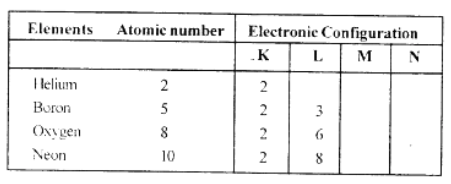
Explain the rule with example according to which electrons are filled in various energy levels
Answer
The ma$\times$imum number of electrons that can be present in any shell or orbit of an atom is given by the formula $2n2$, where n is the serial number of the shell.
Therefore:
$K$ shell, $n = 1$, no. of electrons $= 2 \times 12 = 2$
$L$ shell, $n = 2$, no. of electrons $= 2 \times 22 = 8$
$M$ shell, $n = 3$, no. of electrons $= 2 \times 32 = 18$
$N$ shell, $n = 4$, no. of electrons $= 2 \times 42= 32$
Electrons are not accommodated in a given shell, unless the inner shells are filled.
That is, the shells are filled in a stepwise manner
Image
View full question & answer
Question 64 Marks
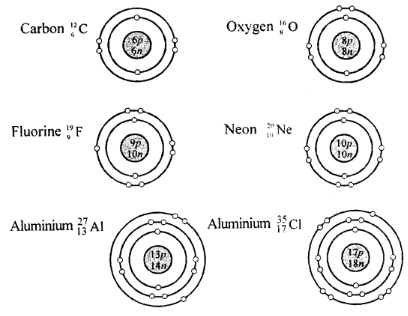
State the mass number, the atomic number, number of neutrons and electronic configuration of the following atoms.
${ }_6^{12} \mathrm{C},{ }_8^{16} \mathrm{O},{ }_9^{19} \mathrm{~F},{ }_{10}^{20} \mathrm{Ne},{ }_{13} \mathrm{Al}^{27},{ }_{17} \mathrm{Cl}^{35}$
Also, draw atomic diagrams for them.
Answer
Match the contents of Column A Column B
Coumn $A$ Column $B$
$1.$ mployement of children below $14$ years is banned in India $(c)$ Right against Exploitation
$2.$ In India one can practise any religion $(d)$ Right to FReedom of Religion
$3.$ Every Community can safegaurd its language $(e)$ Cultural and Educational Rights
$4.$ Everybody can approach the court for the enforcement of his Fundamental Rights, if they are encroached upon by anyone. $(f)$ Right to Constitutional Remedies
$5.$ Everybody has the right to from an association $(b)$ Right to Freedom
$6.$ Everybody has the right to use public well. $(a)$ Right to Equality
Image
View full question & answer
[5 Mark Question Answer] - CHEMISTRY STD 8 Questions - Vidyadip