Questions

[3 Mark Question Answer]

🎯

Test yourself on this topic

8 questions · timed · auto-graded

Question 13 Marks
With reference to the equation: $\ce{Cl_2 + H_2S \rightarrow 2HCl + S}$ pertaining to a redox reaction $-$ select the correct answer
in each case $-$
$(a)$ Chlorine is oxidised/redcued to $\ce{HCl}$.
$(b)$ Hydrogen sulphide is oxidised$/$redcued to sulphur since the reaction involves addition$/$removal of hydrogen.
$(c)$ Chlorine acts as an oxidising$/$reducing agent.
View full question & answer
Question 23 Marks
With reference to the uses of hydrogen, give reasons for the following :
$(a)$ Hydrogen is not used in air balloons
$(b)$ A mixture of hydrogen $\&$ oxygen on burning, find application in welding $\&$ cutting metals
$(c)$ Reaction of hydrogen with nitrogen under specific conditions finds industrial utility.
Answer
$(a)$ Hydrogen gas in ‘highly inflamable’ i.e. catches fire. Hence generally it is not used in air balloons. $(b)$ Hydrogen and oxygen mixture on burning produces a high temperature upto $2800^\circ C$ which is used for welding and cutting of metals. $(c)$ One vol. of $N2$ and $3$ vol. of $H2$ in presence of a catalyst $($finely divided iron$)$ at $450 – 500^\circ C$ and at $200 – 900$ mm pressure forms basic compound ammonia $\ce{[NH3]}$ which finds applications in fertilizers and nitric acid $\ce{[HNCf]}$ and explosives.
View full question & answer
Question 33 Marks
Using a burning candle and a jar of hydrogen $–$ how would you prove experimentally that
$(a)$ Hydrogen is a combustible gas
$(b)$ Hydrogen does not support combustion.
Answer
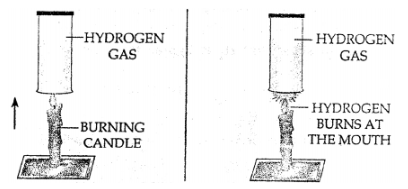
$(a)$ Hydrogen gas is combustible and bums at the mouth of the gas jar. When a burning candle is brought near the mouth of hydrogen in gas jar.
Image

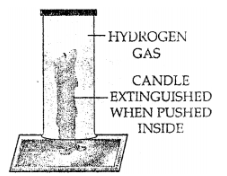
$(b)$ Hydrogen extinguishes the burning candle when pushed inside the jar. This shows that hydrogen does not support combustion.
Image
View full question & answer
Question 43 Marks
Starting from hydrogen gas how would you obtain
$(a)$ A neutral liquid
$(b)$ A basic gas
$(c)$ A metal by reduction of its heated oxide. $[$The metal formed is above iron in the activity series$]$
Answer
$(a)$ Hydrogen bums quietly in oxygen to produce water $($a neutral liquid$)$
$2H_2+ O_2 \rightarrow 2H_2O$
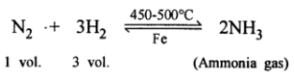
$(b) 3$ volumes of $H_2$ react with $1$ vol. of $N _2$ gas in presence of catalyst $($finely divided $Fe$ at $450-500^{\circ} C)$ and a basic gas ammonia is produced.
Image
$(c)$ Reduction of $\ce{Fe_2O_3} ($iron oxide$)$ on heating to metal iron.
Image
View full question & answer
Question 53 Marks
State the following pertaining to the physical properties of hydrogen :
$(a)$ Colour $\&$ odour
$(b)$ Solubility in water
$(c)$ Effect on moist blue litmus paper.
Answer
$(a)$ Colour and odour of hydrogen gas colourless. Odourless.
$(b)$ Slightly soluble in water.
$(c)$ No$-$effect i.e. colour does not change.
View full question & answer
Question 63 Marks
In the industrial method of preparation of hydrogen by the Bosch process $–$ give
$(a)$ Balanced equations for the first two main steps in the production of hydrogen
$(b)$ The reason for use of addition of a promoter to the catalyst in the final step
$(c)$ The name of the solution which absorbs the unreacted carbon monoxide.
Answer
$(a)$ Bosch process for industrial production of hydrogen :
$\ce{Step [I]}$ : Preparation of water gas $\left[CO + H_2\right]$ by passing steam over white hot coke.
$\underset{\text { Steam }}{ \ce{H_2O}} \xrightarrow{1000^{\circ} C } \underset{\text { [Water gas] }}{\left[CO + H _2\right]-\Delta}$
$\ce{Step [II]}$ : Reduction of steam to hydrogen by carbon monoxide.
$CO + \ce{H_2 + H_2O \xrightarrow[ Fe_2O_3]{45{ }^{\circ} C } CO_2 + 2H _2+\Delta}$
$(b)$ Promotor $\ce{Cr_2O_3}$ is used to increase the efficiency of catalyst $[\ce{Fe_2O_3]}$.
$(c)$ Ammoniacal cuprous Chloride $[\ce{CuCl]}$ solution absorbs unreacted $CO$.
View full question & answer
Question 73 Marks
In the laboratory preparation of hydrogen from zinc $\&$ dilute hydrocholoric acid $–$ state a reason for
$(a)$ Addition of traces of copper $\ce{[II]}$ sulphate to the reaction medium
$(b)$ Collecting the hydrogen by downward displacement of water and not air $\&$ collecting it after all the air in the apparatus is allowed to escape
$(c)$ Having the end of the thistle funnel dip below the level of the acid in the flask.
Answer
$(a)$ Addition of traces of copper $\ce{[II]}$ sulphate acts as catalyst and speeds up the reaction.
$(b)$ Hydrogen is collected by downward displacement of water as it is slightly soluble in water and in air it form explosive mixture with air and also hydrogen is lighter than air.
$(c)$ Otherwise the gas formed will escape through thistle funnel.
View full question & answer
Question 83 Marks
‘Hydrogen is obtained by electrolysis of acidified water’. Answer the following pertaining to the preparation of hydrogen by electrolysis, $(a)$ The meaning of the term ‘electrolysis’ and ‘electrolyte’, $(b)$ Name the electrode
$(i)$ through which the current enters the electrolyte.
$(ii)$ at which hydrogen is liberated.
Answer
$(a)$ Electrolysis: "Dissociation of water into hydrogen gas and oxygen gas by the passage of electric current is called electrolysis."
$\ce{2H_2O \stackrel{\text { Currenct }}{\stackrel{\text { Electricity }}{\rightleftharpoons}} 2H_2 + O_2}$
Electrolyte: "A chemical compound $($water$)$ in solution state which conducts electric current and decomposes is called electrolyte."
$(b)\  (i)$ Electrode through which current enters the electrolyte is anode.
$(ii)$ Electrode at which hydrogen is liberated is cathode.
View full question & answer
[3 Mark Question Answer] - CHEMISTRY STD 8 Questions - Vidyadip