Question 13 Marks
Give balanced equations to show how $–$
$(a)$ Temporary hardness enters into water
$(b)$ Temporary hardness in water can be removed by boiling
$(c)$ Permanent hardness in water can be removed by addition of washing soda.
$(a)$ Temporary hardness enters into water
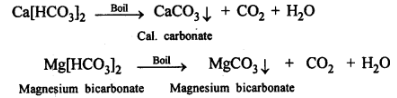
$(b)$ Temporary hardness in water can be removed by boiling
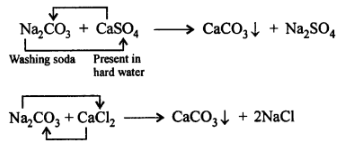
$(c)$ Permanent hardness in water can be removed by addition of washing soda.
Answer
View full question & answer→$(a)$ Temporary hardness : Enters in water when rain water containing $\ce{CO_2}$ falls on earth and combines with limestone $[\ce{CaCO_3]}\ \&$ magnesite $[ \ce{MgCO _3]}$ layers forming respective soluble bicarbonates.
$\ce{CaCO_3 + H_2 + CO_2 \rightarrow Ca \left[HCO_3\right]_2} ($Cal. bicarbonate$)$
$\ce{MgCO _3 + H _2 O + CO _2 \rightarrow Mg \left[HCO_3\right]_2} ($Magnesium bicarbonate$)$
$(b)$ To remove temporary hardness by boiling : Bicarbonate changes to insoluble carbonate and water becomes soft.
$(c)$ Removal of permanent hardness in water by adding washing soda: $\ce{CaCl _2}$ or $\ce{CaSO _4}$ present in permanent hard water exchanges the ions and forms $\ce{CaCO_4}$ which being in soluble can be filtered.
$\ce{CaCO_3 + H_2 + CO_2 \rightarrow Ca \left[HCO_3\right]_2} ($Cal. bicarbonate$)$
$\ce{MgCO _3 + H _2 O + CO _2 \rightarrow Mg \left[HCO_3\right]_2} ($Magnesium bicarbonate$)$
$(b)$ To remove temporary hardness by boiling : Bicarbonate changes to insoluble carbonate and water becomes soft.
$(c)$ Removal of permanent hardness in water by adding washing soda: $\ce{CaCl _2}$ or $\ce{CaSO _4}$ present in permanent hard water exchanges the ions and forms $\ce{CaCO_4}$ which being in soluble can be filtered.