Questions

[4 Mark Question Answer]

🎯

Test yourself on this topic

8 questions · timed · auto-graded

Question 14 Marks
List few countries with low population density $($under population$)$
Answer
Country Population Density $($per sq.$ km.)$
Mongolia $32,38,479$ $2.07$
Namibia $24,13,643$ $2.93$
Australia $2,57,39,394$ $3$
Suriname $5,68,301$ $3.47$
Iceland $3,66,130$ $3.56$
View full question & answer
Question 24 Marks
List few countries with high population density $($over population$)$.
Answer
Country Population Density $($per sq. $km.)$
Singapore $57,00,600$ $7,894$
Bahrain $15,43,300$ $1,982$
Malta $4,93,559$ $1,566$
Maldives $374,775$ $1,257$
Bangladesh $16,87,76,992$ $1,172$
View full question & answer
Question 34 Marks
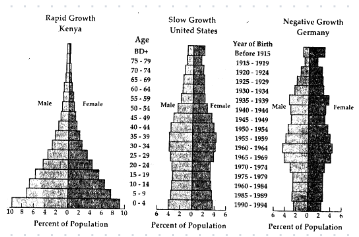
Explain the diagram of a population pyramid. Also show the three types of pyramids.
Answer
The diagram of a population pyramid consists of bars arranged in the form of a pyramid. The bars show different age groups, with the males on the left and females on the right. The base represents the youngest age group and the top represents the oldest. The shape of the population pyramid shows the characteristics of the population.
The three types of pyramid are :
  1. Expanding population : In this case, the age$-$sex pyramid is more or less triangular with a broad base and a narrow top. The broad base shows large population of young people which indicates high birth rate. The narrow top shows high death rate in the older age group. Such a pyramid indicates rapid population growth. For example, countries like Bangladesh, India, Mexico, Nigeria have such a population pyramid.
  2. Constant Population : The shape of the pyramid is like a bell, with the narrow top and a broad middle for several bars. This shows that the birth rate is almost equal to the death rate, leading to a constant population with the percentage of males and females remaining almost the same. Usually, developed countries such as the $\text{USA}$ have this kind of a pyramid.
  3. Declining Population : Such a pyramid has a narrow base, a bulging middle that indicates low birth rate and death rates and a slightly narrow apex. Countries like Japan, Germany and Italy have this kind of a pyramid.
 
Image
View full question & answer
Question 44 Marks
Write the main differences between rural and urban populations.
Answer
Rural Population Urban Population
It refers to people living in villages. It refers to people living in towns and cities.
The population density in rural areas is low. The population density in urban areas is generally high.
The people do primary activities like farming, fishing, mining etc. People living in these areas are usually engaged in secondary and tertiary activities such as trade, transport, services, etc.
The educational and medical facilities are not very highly developed. The educational and medical facilities are highly developed.
Poor standards of transport and communication there. Better standards of transport and communication.
Village communities are usually closely$-$knit with strong emphasis on culture and traditions. The socio$-$cultural ties between people in cities are not as strong as in villages.
View full question & answer
Question 54 Marks
Write the positive as well as negative effects of under population.
Answer
Under population has several positive effects :
  1. There are sufficient employment opportunities for everyone.
  2. There are fewer instances of overcrowding.
  3. There are lower levels of poverty.
  4. There are adequate educational, medical and other facilities to meet everyone’s needs.
  5. There are sufficient natural resources to meet the requirements of the population.
  6. There is lesser pressure on the environment, and hence, lower rates of environmental degradation.
However, there are also some negative effects of under population :
  1. The lack of adequate labour leads to low productivity.
  2. In some instances, a higher proportion of the population is either too young or too old to work.
  3. There are lesser taxpayers, leading to low income for the government.
  4. There are not enough people to develop the natural resources of the country.
View full question & answer
Question 64 Marks
What is the impact of overpopulation?
Answer
  1. Adverse effect on the environment : Higher population consumes more natural resources like fresh water, arable land and mineral resources. This leads to deforestation, scarcity of water, extinction of plants and animals, depletion of fossil fuels, pollution, global warming.
  2. Adverse effect on economy : Higher population leads to unemployment, overcrowding, shortage of food, fuel, minerals and other resources. This leads to poor quality of education, low per capita income, inflation, less productivity and slow economic growth of the country.
  3. Poor quality of life : There is not enough affordable food, shelter and education. People live in congested areas with poor sanitary conditions leading to spread of diseases, poverty and rise in crime rate.
View full question & answer
Question 74 Marks
Write a note on the distribution of population in the world.
Answer
At present, the population of the world stands at $7.35$ billion. China has the largest population in the world with over $1.3$ billion people, followed by India, with over $1.2$ billion people, the $\text{USA}$ with over $321$ million people and Indonesia with over $257$ million people. Island nations of the Pacific Ocean have populations of just a few thousand.
Continent$-$wise, Asia has the largest population with over $4.4$ billion people, followed by Africa with $1.18$ billion people. Europe has over $738$ million people, North America has over $573$ million people, South America has over $418$ million people and Oceania $($Australia, New Zealand, Pacific Islands of Fiji, Papua New Guinea, Vanuatu, Samoa, etc$)$ has over $3’9$ million people$)$
View full question & answer
Question 84 Marks
Write any two causes of overpopulation?
Answer
Causes of overpopulation are :
  1. Immigration $–$ When people come from another country.
  2. Increased birth rate $–$ due to better medical facilities
  3. Decreased death rate $–$ due to better medical facilities.
  4. Better medical facilities
  5. Lack of family planning.
View full question & answer
[4 Mark Question Answer] - Geography STD 8 Questions - Vidyadip