Sample QuestionsSets questions
One sample from each question group in this chapter. Select any group above to see the full set with answer keys.
State the sets representing by the shaded portion of following venn$-$diagram :
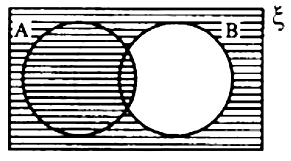
View full solution →State the sets representing by the shaded portion of following venn$-$diagram :
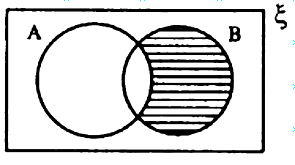
View full solution →State the sets representing by the shaded portion of following venn$-$diagram :
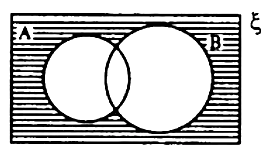
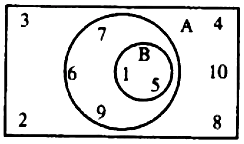
View full solution →Use the given Venn$-$diagram to find $:A ∪ B$
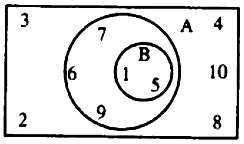
View full solution →Use the given Venn$-$diagram to find$ \ :A ∩ B$
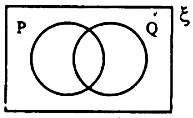
View full solution →In the given diagram, shade the region which represents the set given underneath the diagrams$: (P ∩ Q)'$
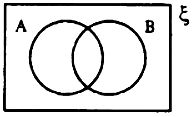
View full solution →In the given diagram, shade the region which represents the set given underneath the diagrams $: (A ∩ B)'$
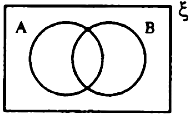
View full solution →In the given diagram, shade the region which represents the set given underneath the diagrams $: (B - A)'$
View full solution →Two sets $A$ and $B$ are such that $A ∩ B = \Phi $. Draw a venn$-$diagram to show the relationship between $A$ and $ B$ . Shade the region representing : $B ∩ A'$
View full solution →Two sets $A $ and $B$ are such that $A ∩ B = \Phi $. Draw a venn$-$diagram to show the relationship between $A$ and $B$. Shade the region representing : $B - A$
View full solution →If $A = \{6, 7, 8, 9\}, B = \{4, 6, 8,10\}$ and $C = \{x : x \in N : 2 < x \leq 7\}$; Find: $B - (A ∩ C)$.
View full solution →If $A = \{6, 7, 8, 9\}, B = \{4, 6, 8,10\}$ and $C = \{x : x ∈ N : 2 < x ≤ 7\} $; Find: $B - (A - C)$.
View full solution →Given $A = \{0, 1, 2, 4, 5\}, B = \{0, 2, 4, 6, 8\}$ and $C = \{0, 3, 6, 9\}$. Show that $A ∩ (B ∩ C) = (A ∩ B) ∩ C$ i.e. the intersection of sets is associative.
View full solution →If $A = \{5, 6, 7, 8, 9\}, B = \{x : 3 < x < 8$ and $x \in W\}$ and $C = \{x : x \leq 5$ and $x \in N\}$. Find: $A ∩ B$ and $(A ∩ B) ∩ C$
View full solution →If $A = \{5, 6, 7, 8, 9\}, B = \{x : 3 < x < 8$ and $x \in W\}$ and $C = \{x : x \leq 5$ and $x \in N\}$. Find: $B ∪ C$ and $A ∪ (B ∪ C)$
View full solution →If $A = \{1, 2, 3, 4, 5\}B = \{2, 4, 6, 8\}$ and $C = \{3, 4, 5, 6\}$ Verify : $A - (B ∩ C) = (A - B) ∪ (A - C)$
View full solution →If$ A = \{1, 2, 3, 4, 5\}B = \{2, 4, 6, 8\}$ and $C = \{3, 4, 5, 6\}$ Verify :$ A - (B ∪ C) = (A - B) ∩ (A - C)$
View full solution →If $A = \{5, 6, 7, 8, 9\}, B = \{x : 3 < x < 8$ and $x \in W\}$ and $C = \{x : x \leq 5$ and $x \in N\}$. Find: $B ∩ C$ and $A ∩ (B ∩ C)$ Is $(A ∪ B) ∪ C = A ∪ (B ∪ C)$? Is $(A ∩ B) ∩ C = A ∩ (B ∩ C)$?
View full solution →Given the universal set $=\{x : x \in N$ and $x < 20\}$, find: $B = \{y : y = 2n + 3, n \in N\}$
View full solution →State, if the following pair of a set is equal or not : $A =\{x : x \in N, x < 3\}$ and $B =\{y : y^2 - 3y + 2 = 0\}$
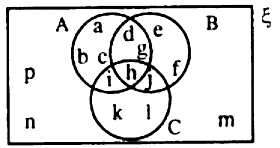
View full solution →Use the given diagram to find : $(i)\ A ∪ (B ∩ C)\ (ii)\ B - (A - C)\ (iii)\ A - B(iv) A ∩ B'$ Is $A ∩ B' = A - B$?
View full solution →From the given diagram, find : $(i)\ A’\ (ii)\ B’\ (iii)\ A' ∪ B'\ (iv)\ (A ∩ B)'$
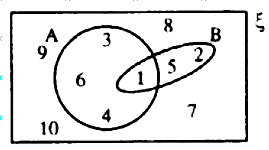
Is $A' ∪ B' = (A ∩ B)'$ ?
Also, verify if $A' ∪ B' = (A ∩ B)'.$ View full solution →From the given diagram, find : $(i) (A ∪ B) - C(ii) B - (A ∩ C)\ (iii) (B ∩ C) ∪ A$ Verify : $A - (B ∩ C) = (A - B) ∪ (A - C)$
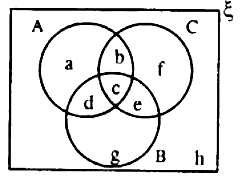
View full solution →Given $A = \{x : \in N :< 6\}, B = \{3, 6, 9\}$ and $C \{x \in N : 2x - 5 \leq 8\}.$ show that : $A ∩ (B ∪ C) = (A ∩ B) ∪ (A ∩ C)$
View full solution →Given $A = \{x : \in N :< 6\}, B = \{3, 6, 9\}$ and $C = \{x \in N : 2x - 5 \leq 8\}$. show that : $A ∪ (B ∩ C) = (A ∪ B) ∩ (A ∪ C)$
View full solution →Given, $A = \{$Quadrilaterals$\}, B = \{$Rectangles$\}, C = \{$Squares$\}, D= \{$Rhombuses$\}.$ State the following statement is true or false. Give reasons. $ A ⊇ B ⊇ D$
View full solution →Given, $A = \{$Quadrilaterals$\}, B = \{$Rectangles$\}, C = \{$Squares$\}, D= \{$Rhombuses$\}$. State the following statement is true or false. Give reasons. $B ⊇ C$
View full solution →Given, $A = \{$Quadrilaterals$\}, B = \{$Rectangles$\}, C = \{$Squares$\}, D= \{$Rhombuses$\}$. State the following statement is true or false. Give reasons. $D ⊂ A$
View full solution →Given, $A = \{$Quadrilaterals$\}, B = \{$Rectangles$\}, C = \{$Squares$\}, D= \{$Rhombuses$\}$. State the following statement is true or false. Give reasons. $C ⊆ B ⊆ A$
View full solution →Given, $A = \{$Quadrilaterals$\}, B = \{$Rectangles$\}, C = \{$Squares$\}, D= \{$Rhombuses$\}$. State the following statement is true or false. Give reasons. $D ⊂ B$
View full solution →