Questions

[3 Mark Question Answer]

🎯

Test yourself on this topic

19 questions · timed · auto-graded

Question 13 Marks
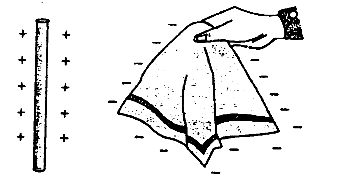
A glass rod is rubbed with silk. State the kind of charge acquired by each.
Answer
When a glass rod is rubbed with silk, the glass rod which has free electrons get transferred to the silk cloth. The glass rod has a deficiency of electrons acquired a positive charge while the silk cloth acquires electrons, therefore acquires a negative charge.
View full question & answer
Question 23 Marks
State three safety measures that you will observe in thunder storm.
Answer
THREE SAFETY MEASURES DURING THUNDERSTORM:
$i.$ Do not lie on the ground, but squat low on the ground with your hands on your knees and head in between.
$ii.$ Take out the plugs of the $T.V.$ sets, computers, etc. Do not use the wired phone.
$iii.$ Do not take bath during the thunderstorms and avoid contact with running water or metallic tap.
$iv.$ Do not carry an umbrella over your head particularly if walking in an open ground. If there are tree around, take shelter under a shorter tree.
View full question & answer
Question 33 Marks
How is a tall building protected from damage due to lightning?
Answer
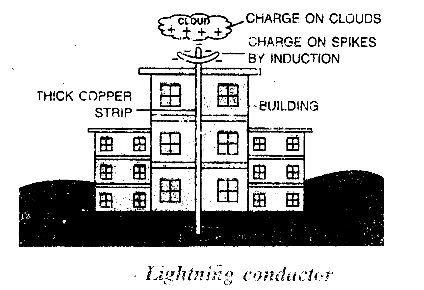
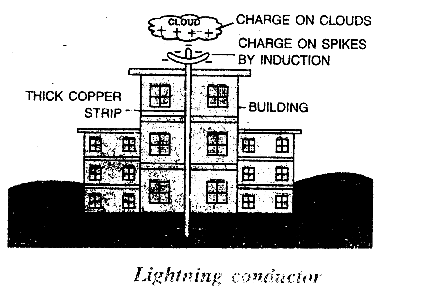
We can protect a tall building from lightning by the use of LIGHTNING CONDUCTOR.

WORKING : When a charged cloud passes over the building induction takes place and opposite charge $($negative$)$ is induced on spikes of the conductor. Spikes being pointed $($having very small area$)$ cannot hold the charge and charge leaks into air and opposite charge in air and cloud cancel each other. Even if some charge remains on spikes it passes to earth from copper rod and the building is saved.
View full question & answer
Question 43 Marks
What is a lightning conductor? How does it work?
Answer
The conductor which is fixed on the top of the building to protect the buildings from the damage by lightning. The conductor consists of several sharp metal spikes connected to a thick copper strip. The other end of the copper strip is fixed to a metal plate buried inside the ground. The process is called earthing. The conductor works on the principle of induction. Whenever a charged cloud passes by the building, the conductor gets charge x opposite to that of the cloud
through the process of induction. Now, this acquired charge moves to the earth through the earthing system.
View full question & answer
Question 53 Marks
What causes lightning?
Answer
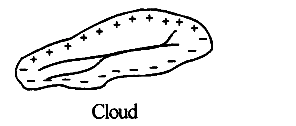
Due to friction from winds, clouds collide with each other and get electrically charged during a thunderstorm $($bundles of small water droplets and ice particles form a thunderstorm$)$.
The upper part of the cloud is usually positive while the lower part of the cloud gets usually negatively charged.
A sudden movement in the cloud causes this electrical charge to discharge in the form of lightning.
View full question & answer
Question 63 Marks
Describe Franklin’s experiment. What did he conclude from his experiment?
Answer
FRANKLIN’S EXPERIMENT : Flying a kite in a storm was perhaps Benjamin Franklin's most famous experiment that led to the invention of the lightning rod and the understanding of positive and negative charges. The connection between electricity and lightning was known but not fully understood. By conducting the kite experiment Franklin proved that lightning was an electrical discharge and realized that it can be charged over a conductor into the ground providing a safe alternative path and eliminating the risk of deadly fires.
View full question & answer
Question 73 Marks
How will you use a gold leaf electroscope to find out whether a body is charged or uncharged ?
Answer
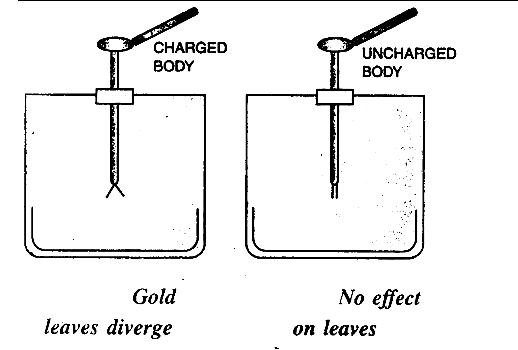
TO TEST IF THE BODY is CHARGED OR UNCHARGED with GOLD LEAF ELECTROSCOPE:

The body to be tested for charged or not is brought near the disc of $\text{G.L.E.}$ and touched with the disc. If the leaves diverge, the body is charged and if leaves have not diverged, it is uncharged.
View full question & answer
Question 83 Marks
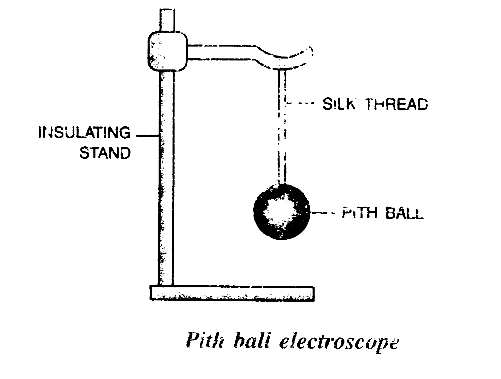
Describe a pith ball electroscope. how can you use it to test whether a body is charged or uncharged?
Answer
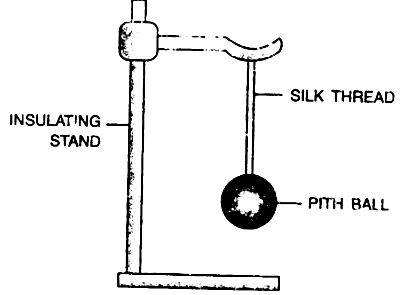
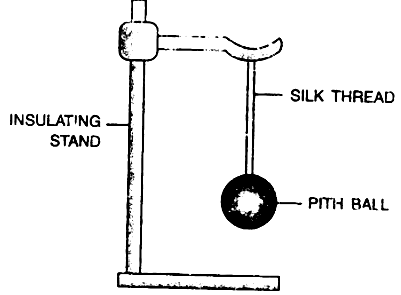
PITH BALL ELECTROSCOPE
It consists of a small pith ball suspended by a dry silk thread from an insulating stand.

TO TEST A BODY IS CHARGED OR NOT :
Bring the body to be tested near the pith ball $($without touching it$)$. If the pith ball moves towards the body, the body is charged. But if the body does not move, the body is uncharged.
View full question & answer
Question 93 Marks
Name the two types of electroscopes.
Answer
The electroscope are of two types.
$(i)$ Pith ball electroscope.
$(ii)$ Gold leaf electroscope.
View full question & answer
Question 103 Marks
What is an electroscope?
Answer
An electroscope is a device with the help of which we detect whether the body is charged or uncharged and in the charged body detects the type of charge it carries. ie whether positive or negative.
View full question & answer
Question 113 Marks
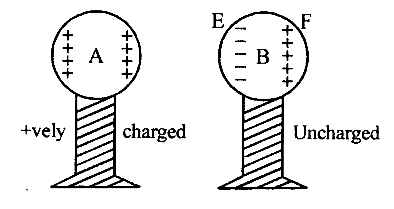
Explain the charging by induction in terms of movement of electrons.
Answer
Let uncharged conductor $B$ mounted on an insulated stand is placed near positively charged conductor Amounted on an insulated stand without touching.

Electrons which are equal in number of protons in uncharged $B$ are attracted towards positively charged $A$. Hence end $E$ is charged negatively called $\text{BOUND CHARGE}$ and protons remain at end $F$ of $B$ is positively charged called $\text{FREE}$ charge:
This induced charge remains on $B$ so long as body $A$ remains near $B$.
View full question & answer
Question 123 Marks
An ebonite rod is rubbed with fur. Explain the charging of the ebonite rod and the fur on the basis of electron movement.
Answer
An Ebonite rod is rubbed with fur.
Ebonite rod gains electrons and acquires negative charge while fur loses electrons and acquires positive charge.
Explanation
Suppose an ebonite rod has $7$ protons and $7$ electrons and fur has $10$ electrons and $10$ protons.
On rubbing together, fur loses $2$ electrons and ebonite rod gains $2$ electrons. Now fur has $8$ electrons and $10$ protons which makes it positively charged. The ebonite rod has $9$ electrons and $7$ protons making it negatively charged.
View full question & answer
Question 133 Marks
Briefly describe the structure of an atom.
Answer
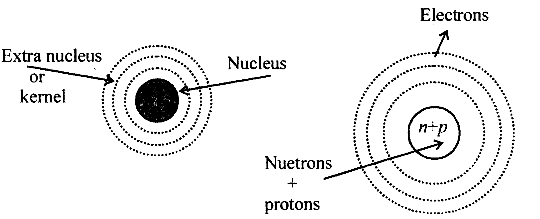
STRUCTURE OF ATOM:

Atom : has an equal number of $+ve$ charge $($protons$)$ and $-ve$ charge electrons and hence atom has no charge.
Neutrons $($having no charge$)$ and protons are present in the nucleus. Electrons keep revolving around the nucleus in different shells.
View full question & answer
Question 143 Marks
What do you mean by conservation of charges?
Answer
According to the Law of conservation of charge
“When two different bodies are rubbed together, both bodies get charged equally but with charges of the opposite kind.” Thus, the total charge of two bodies before and after rubbing remains the same.
Example: When an ebonite rod is rubbed with fur, the electrons from the fur are transferred to the ebonite rod and therefore the ebonite rod becomes negatively charged $($due to gain of electrons$)$, while the fur becomes equally positively charged $($due to deficit of a same number of electrons$)$. As the same no. of electrons are, exchanged by the ebonite rod and fur, the magnitude of charges main same but with opposite sign.
View full question & answer
Question 153 Marks
A source of potential difference $V$ volt sends current $I$ ampere in a circuit for time $t$ second. Write expressions for
$(1).$ electrical energy supplied by the source and
$(2).$ electrical power spent by the source.
Answer
Potential difference $V$ is the work done in moving a unit charge
\therefore Work was done in moving a charge Q through the pot. diff. $V = QV$
i.e. $W = QV$
but $=\frac{Q}{t}= I$ or $Q= It$
Work done $=$ Electrical energy
$(a) \therefore$ Electrical energy $= VIt$ is the expression
$(b)$ Power is the rate of doing $W$
$P=\frac{W}{t}=\frac{V I t}{t}=V I$
$P = VI$ is the expression.
View full question & answer
Question 173 Marks
How are the electrical appliances connected in a house circuit: in series or in parallel ? Give reason.
Answer
$\text{ELECTRICAL}$ appliances in a house are connected in $\text{PARALLEL}$ as :
$1.$ Each appliance gets full voltage as resistance in parallel becomes low.
$2.$ If the fuse of one appliance fails it does not affect the working of other appliances.
$3.$ We can light one bulb without lighting the other bulbs.
View full question & answer
Question 183 Marks
Assuming the electric consumption per day to be $12\  kWh$ and the rate of electricity to be ? $6.25$ per unit, find how much money is to be paid in a month of $30$ days?
Answer
Electric energy consumed per day $= 12\  kWh = 12$ units
Electric energy consumed in $30$ days $= 12 \times 30 = 360$
Units Cost to be paid in $1$ month $= 360 \times 6.25 = ₹. 2250$
View full question & answer
Question 193 Marks
An electric iron of power $1.5\  kW$ is used for $30$ minutes to press the clothes. Calculate the electrical energy consumed in
$a.$ kilowatt$-$hour
$b.$ joule.


Answer
$(a)$ Given : $P = 1.5\  kW; t = 30$ minutes $=\frac{30}{60} = \frac{1}{2}hr$
$\therefore P = \frac{w}{t}$
$\therefore W = P \times t$
$\therefore 1.5 \times \frac{1}{2}$
$= 0.75\  kwh$
$(b)1 \ kWh = 3.6 \times 10^6 J$
$\therefore 75 kWh = 0.75 \times 3.6 \times 10^6$
$= 2.700 \times 10^6$
$= 2.7 \times 10^6 J$
View full question & answer
[3 Mark Question Answer] - PHYSICS STD 8 Questions - Vidyadip