Questions

[3 Mark Question Answer]

🎯

Test yourself on this topic

16 questions · timed · auto-graded

Question 13 Marks
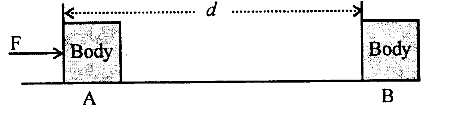
Write the expression for work done by a force.
Answer
Work done by applying force $F$ is the product of the force applied on the body and distance moved by the body in the direction of force, work done $=$ Force $\times$ distance moved in the direction of the force.
$W = F \times d$
​​​
View full question & answer
Question 23 Marks
State two conditions when no work is done by a force.
Answer
Two conditions are :
$1.$ No work is said to be done if there is no change in position or no motion even after the application of force. There should be no displacement i.e. $S = 0$
$2.$ When the angle between the displacement and force applied is 90 degrees i.e the force applied is perpendicular to the displacement. The displacement is $\text{NORMAL}$ to the direction of $\text{FORCE}$  i.e. – $\theta = 90^\circ$
View full question & answer
Question 33 Marks
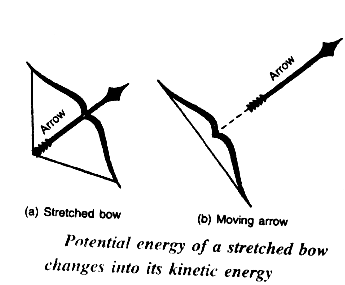
Give an example to show the conversion of potential energy to kinetic energy when put in use.
Answer
A stretched bow has the potential energy because of its stretched position. When the stretched bow is released the potential energy of the bow changes into its kinetic energy.
View full question & answer
Question 43 Marks
A cyclist doubles his speed. How will his kinetic energy change : increase, decrease or remain same?
Answer
As Kinetic energy $ K.E. =1 / 2\  Mv _2$
Since speed is doubled, its square will become $4$
times $\therefore K.E$. increases i.e. become $4$ times.
Or
$ K.E\  j =M v_2 $
When speed is doubled New speed $v_1=(2 v)$
New$ K.E_2=\frac{1}{2} M V_1^2$
$ \therefore \text { New } K \cdot E_2=\frac{1}{2} M (2 v )^2$
$\text { K. } E_2=\frac{1}{2} M 4 V^2=4\left[\frac{1}{2} M V^2\right]$
$\text { (ii) } \div( i )$
$=\frac{K E_2}{K E_1}=\frac{4\left[\frac{1}{2} M V^2\right]}{\left[\frac{1}{2} M V^2\right]}=\frac{4}{1}$
$=\frac{K E_2}{K E_1}$
New $K. E_{\cdot 2}=4$ Times $K. E_1$
View full question & answer
Question 53 Marks
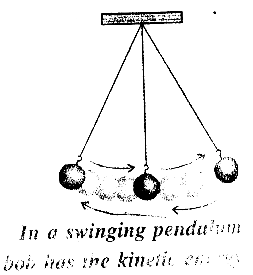
Define the term kinetic energy. Give one example of a body which possesses kinetic energy.
Answer
The energy of a body in motion is called its kinetic energy.
It is defined as follows:
Kinetic energy of a body is the energy possessed by it due to its state of motion. Actually, it is the work done on the body bringing it to the state of motion.
In short form, it is written as $K.E.$ or $K.$
Example: In a swinging pendulum moving to and fro, the bob has the kinetic energy.
View full question & answer
Question 63 Marks
Write the expression for the gravitational potential energy explaining the meaning of the symbols used.
Answer
EXPRESSION FOR GRAVITATIONAL POTENTIAL ENERGY : $P.E. = U = mgh$
Where $U$ is gravitational potential energy $m$ is the mass of the body.
$g$ is force of gravity on the mass of $1 kg$
$mg$ is the force acting on body
$h$ is the distance or height moved above the ground level.
View full question & answer
Question 73 Marks
Two bodies $A$ and $B$ of masses $10 \ kg$ and $20 \ kg$ respectively are at the same height above the ground. Which of the two has greater potential energy?
Answer
Body A
$P.E_1=m_1 g h$
$P. E_1=10 \times gh$
Body B
$\text { P. } E_2=m_2 gh$
$\text { P. } E_2=20 \times gh$
As $g$ is constant and h is the same in both the cases
$Pe_2$ is greater than $\text{PE}$.
Hence, Potential energy of body $B\  ($more mass$)$ is greater than the $\text{PE}$. of body $A.$
Or
As the height of body $A$ and is same and $'g'$ is constant, the body with greater mass i.e. body $B$ has greater potential energy.
View full question & answer
Question 83 Marks
A truck of mass $1000 \ kg$, increases its speed from $36 \ km/ h^{-1} to 72 \ km/ h^{-1}.$ Find the increase is its kinetic energy.
Answer
Mass $( m )=1000\ kg$
$1 \ km /h ^{-1}=\frac{5}{18} ms ^{-1}$
Initial speed $u =36 \ km/h ^{-1}=36 \times \frac{5}{18}=10 ms ^{-1}$
Final speed $v =72 \ km/h ^{-1}=72 \times \frac{5}{18}=20 ms ^{-1}$
Increase in kinetic energy $= ?$
Increase in kinetic energy $=\frac{1}{2} m v^2-\frac{1}{2} m u^2$
$=\frac{1}{2} m[(v+u)(v-u)]$
$=\frac{1}{2} \times 1000(20+10)(20-10) $
$ =\frac{1}{2} \times 1000 \times 30 \times 10$
Increase in kinetic energy $=150000\ J =1.5 \times 10^5\ J$
View full question & answer
Question 93 Marks
A body of mass $60 \ kg$ is moving with a speed $50\  m s_1$. Find its kinetic energy.
Answer
mass $m = 60 \ kg$
Speed $v = 50\  mS^1$
$K.E = 1/2\  MV^2$
$1/2 \times 60 \times 50 \times 50 = 75000 \ kg/ms $ or Joule
$K.E = 75/10 \times 1000 \times 10 = 7.5 \times 10^4 J$
View full question & answer
Question 103 Marks
The potential energy of a body of mass $0.5 \ kg$ increases by $100 J$ when it is taken to the top of a tower from ground. If force of gravity on $1 \ kg$ is $10 N$, what is the height of the tower?
Answer
$P.E. =$ Force$ \times$ height
Potential energy $= (m g) h$
$100 J = (0.5 \times 10) N \times h$
$h =\frac{100}{0.5 / 10}=\frac{100}{\frac{5}{10} / 10}=20\  m$
View full question & answer
Question 113 Marks
The gravitational potential energy stored in a box of weight $150\  kgf$ is $1.5 \times 10^4 J$. Find the height of the box. Take $1 kgf =10 N$.
Answer
Gravitational potential energy $(U)=1.5 \times 10^4\ J$
Force $=$ weight $=150\ kgf =1500\ N . .[1\ kgf =10\ N ]$
Height $(h)= ?$
$U = mg \times h $
$ \therefore 1.5 \times 10^4 J =1500 \times h $
$ \therefore \frac{1.5 \times 10^4 J }{1500}= h$
$ \therefore h =10\ m$
View full question & answer
Question 123 Marks
Find the gravitational potential energy of $2.5 \ kg$ mass kept at a height of $15 m$ above the ground. The force of gravity on mass $1 \ kg$ is $10 n.$
Answer
Mass $m = 2.5 \ kg$
Gravitational potential energy is the work done against the force of gravity ¡s stored in the body at a height h.
$P.E = U = mgh$
$U = 2.5 \times 10 \times 15$
$U = 25/10 \times 10 \times 15 = 375 j$
View full question & answer
Question 133 Marks
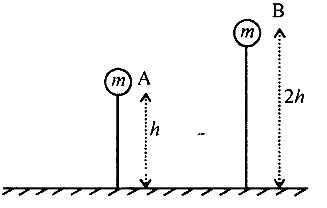
Two bodies of same masses are placed at heights $h$ and $2h.$ Compare their gravitational potential energy.
Answer
Gravitational pot. energy of $A $ Gravitational pot. energy of $B$
$mgh / mg2h = 1/2 = 1 : 2$
View full question & answer
Question 143 Marks
A man lifts a mass of $20 \ kg$ to a height of $2.5 m$. Assuming that the force of gravity on $1 \ kg$ mass is $10 N$, find the work done by the man.
Answer
Mass $= 20 \ kg h = 2.5m$
Force of gravity on a mass of $1 \ kg = 10 N$
Force of gravity on a mass of $20\ kg$
$F = mg = 20 \times 10 = 200\  N$
Work done in lifting the mass to height $h = 20m$ is
$W = F \times h$
$= 200 N \times 2.5 m$
$= 200 \times 25/10 =500 J$
View full question & answer
Question 153 Marks
It takes $20s$ for a girl $A$ to climb up the stairs while girl $B$ takes $15 s$ for the same job. Compare the power spent by then.
Answer
Power $=\frac{\text { Work done }}{\text { Time taken }}=\frac{\text { Energy }}{\text { Time }} $
$ =\frac{\text { Power of } A }{\text { Power of } B }=\frac{\frac{\text { Energy }}{t_1}}{\frac{\text { Energy }}{t_2}} $
$ =\frac{1}{t_1} \cdot \frac{t_2}{1}=\frac{15}{20} $
$ =\frac{3}{4}=3: 4$
View full question & answer
Question 163 Marks
A car is moving with a speed of $15 \ km /h ^{-1}$ and another identical car is moving with a speed of $30 \ km/ h ^{-1}$. Compare their kinetic energy.
Answer
Two identical cars mean, they have equal mass
$K.E = 1/2\  mv^2$
Let m be the mass of each car Kinetic energy of car $ A =\frac{1}{2} m \times (15)^2 = \frac{225}{2} m =$ $112.5\  m J$
Kinetic energy of car $B = 1/2 M (30)^2$​​​​​​​
$=450\  M J$
$\frac{K \cdot E \cdot o f A}{K \cdot E \cdot o f B}=\frac{225 m}{2 \times 450 m}=\frac{1}{4}=1: 4$
$K.E$. of car $B$ is $4$ times $K.E$. of car $A$.
View full question & answer
[3 Mark Question Answer] - PHYSICS STD 8 Questions - Vidyadip