Questions

[5 Mark Question Answer]

🎯

Test yourself on this topic

6 questions · timed · auto-graded

Question 15 Marks
What is evaporation? Explain it on the basis of molecular motion.
Answer
$\text{EVAPORATION}$: “The change of liquid into its vapours at all temperature from its surface is called evaporation.”
$\text{EXPLANATION OF EVAPORATION}$ on the bases of molecular motion:
Molecules of liquid have more spaces, the less molecular force of attraction and more $\text{K.E}$. than molecules of solids and can move throughout the liquid.
While moving they can not escape the surface as they are being pulled inside by other molecules as there are no molecules above the surface. But when some molecules acquire sufficient $\text{K.E}. ($Threshold velocity$)$, they overcome the $\text{ATTRACTIVE FORCES}$ of other molecules and escape into the open space above the liquid. These escaping molecules form the vapour of the liquid and the process called Evaporation continues till all the liquid evaporates.
View full question & answer
Question 25 Marks
Describe an experiment to show that liquids expand on heating.
Answer
Experiment $1$.
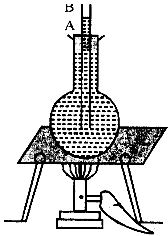
Take round$-$bottomed flask filled with water. Close its mouth with air$-$tight cork having delivery tube through it. Mark the level of water. Let it be at $A$. Now heat the flask. As the water gets heated in a flask, the level of water in the tube rises from $A$ to $B$. This proves that liquids expand on heating.

OR Experiment $2$ :
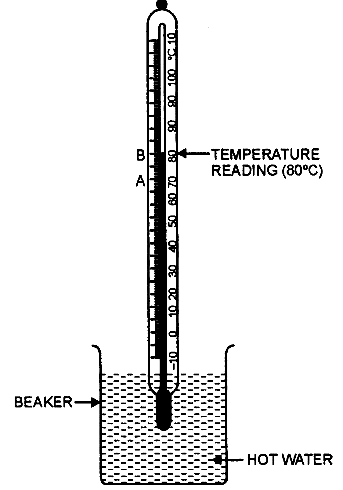
Take a laboratory Celsius thermometer Suspend it with the help of a stand. Note the level of mercury thread in it. Let it be at $A$. Now take hot water in a beaker and as shown, set up the arrangement. The mercury thread rises to $B$ by gaining temperature.
This shows that liquids expand on heating.
View full question & answer
Question 35 Marks
State three factors on which depend the linear expansion of a metal rod on heating.
Answer
Factors on which an increase in the length of a rod depend when heated are:
$1.$ Length of rod $L$. Increase in length is directly proportional to the original length.
$2.$ Temperature of the rod. It is directly proportional to the increase in temperature.
$3.$ Nature of material of rod.
If $L _1$ is original length of rod at $t_1{ }^{\circ} C$ and on heating to $t_2{ }^{\circ} C$ its length becomes $L _2$.
$\therefore $ Increase in length of rod $= ( L_2– L_1)$
and the increase in temperature $( t_2 – t_1)$
$\therefore [L_2– L_1] ∝ L_1(t_2 – t_1)$
But the increase in the length of rod does not depend on whether the rod is solid or hollow.
View full question & answer
Question 45 Marks
Describe an experiment to demonstrate the thermal expansion in solids.
Answer
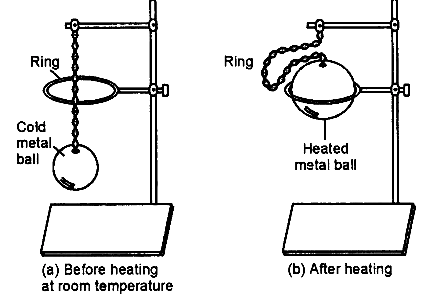
Experiment : $[$Gravesand’s ball and ring experiment$]$

Take metallic ball and ring so that ball can pass through the ring easily. Now heat the ball. We see that the heated ball cannot pass through the same ring. This is because on heating the ball increases in size. Now on cooling the ball again, it can pass through the ring. This experiment shows that solids expand on heating and contract on cooling.
View full question & answer
Question 55 Marks
Name two ways of change of liquid state to the vapour state and distinguish them.
Answer
Two ways of change of liquid state to vapour state are:
$1.$ Evaporation
$2.$ Boiling.
DIFFERENCE BETWEEN EVAPORATION AND BOILING:
BOILING EVAPORATION
$(1)$ Heat is supplied. Heat is absorbed.
$(2)$ Fast process. Slow process.
$(3)$ Starts from the bottom. Starts form surface i.e.
$(4)$ Sound is produced. surface phenomenon Silent process.
$(5)$ Heating effect Cooling effect
$(6)$ Takes place at a fixed temperature called the boiling point. Takes place at all temperatures.
View full question & answer
Question 65 Marks
Match the column
Column $A$ Column $B$
$(a)$ Blowing air increases $(1)$ Increase in intermolecular separation
$(b)$ Increase in pressure increases $(2)$ Pendulum of a clock
$(c)$ Thermal expansion $(3)$ Cooking utensils
$(d)$ Invar $(4)$ Boiling point
$(e)$ Pyrex glass $(5)$ Evaporation
Answer
Column $A$ Column $B$
$(a)$ Blowing air increases $(5)$ Evaporation
$(b)$ Increase in pressure increases $(4)$ Boiling point
$(c)$ Thermal expansion $(1)$ Increase in intermolecular separation
$(d)$ Invar $(2)$ Pendulum of a clock
$(e)$ Pyrex glass $(3)$ Cooking utensils
View full question & answer
[5 Mark Question Answer] - PHYSICS STD 8 Questions - Vidyadip