Questions

[3 Mark Question Answer]

🎯

Test yourself on this topic

25 questions · timed · auto-graded

Question 13 Marks
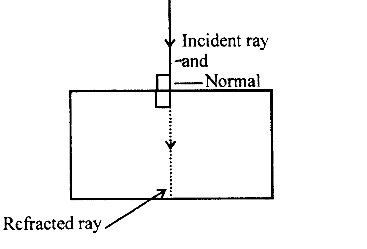
A ray of light falls normally on a glass slab. What is the angle of incidence?
Answer
When a ray of light falls on a glass slab normally, the angle between normal and incident ray is zero.
$\therefore$ Angle of incidence is zero.
View full question & answer
Question 23 Marks
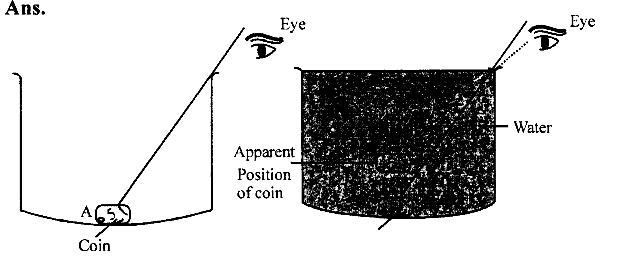
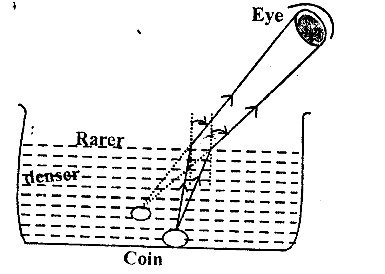
Draw a ray diagram to show that the depth of a vessel containing water when seen from above, appears to be less than its real depth.
Answer

When there is no water in the vessel $(a)$ when water is added in the vessel coin appear to be at $B$ than actually, the coin is at $A$. Hence, the coin appears to be raised up in water.
i.e. its height appears to be less than actual.
View full question & answer
Question 33 Marks
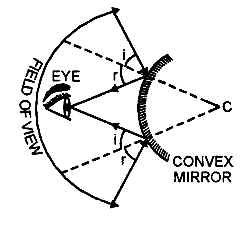
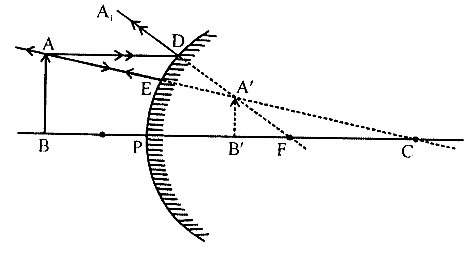
A driver uses a convex mirror as a rearview mirror. Explain the reason with the help of a ray diagram.
Answer
A convex mirror always forms a small and upright image between pole and focus. That means in a small area of mirror driver can see all the traffic coming from behind.
View full question & answer
Question 43 Marks
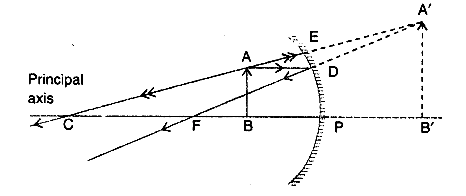
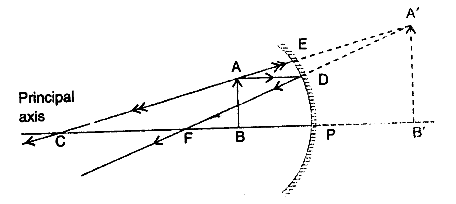
How can a concave mirror be used to obtain a virtual image of an object ? Draw a diagram to illustrate your answer.
Answer
A concave mirror forms a virtual image of an object when the object is placed between focus and mirror $($pole$)$

A virtual, erect and bigger image is formed behind the mirror
View full question & answer
Question 53 Marks
Name the mirror which forms an erect, virtual and enlarged image of an object. What is the position of object relative to the mirror?
Answer
Concave mirror forms an erect, virtual and enlarged image of an object. Since convex mirror always forms a virtual, diminished, erect image.
The position of the object is between focus and pole of the mirror as shown in figure
View full question & answer
Question 63 Marks
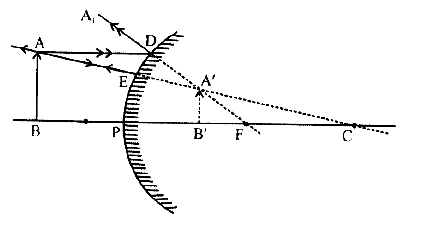
Draw a ray diagram to show the formation of image of an object placed on the principal axis of a convex mirror. State the position, size and nature of the image. What happens to the image as the object is moved away from the mirror?
Answer
OBJECT PLACED IN FRONT OF CONVEX MIRROR :

Place the object anywhere in front of convex mirror image formed is
$1.$ Between pole and focus $\leftarrow$ position.
$2.$ Diminished $\leftarrow$ size.
$3.$ Upright $($erect$)$ and virtual $\leftarrow$ nature.
As the object is moved away from the mirror, the image shifts towards the focus and decreases in size but is $($diminished$)$
View full question & answer
Question 73 Marks
Which is optically denser : water or air ? Give reason
Answer
Denser medium are those in which speed of light gets reduced when light travels through that medium.
when light travels through water or glass it's speed get reduced hence they are optically denser medium.
$\text{WATER}$ is optically $\text{DENSER}$ as the speed of light is less in water than in air.
$2.25 \times 10^8 ms^{-1} < 3 \times 10^8 ms^{-1}$
speed of light in Water $<$ speed of light in Air.
View full question & answer
Question 83 Marks
Draw a ray diagram to show the formation of image of an object placed between the pole and focus of a concave mirror. State the position, size and nature of the image.
Answer
OBJECT LIES BETWEEN FOCUS AND POLE :

A virtual erect and bigger image is formed behind the mirror
Image formed $A\ ’B\ ’$ is on the other side of the mirror on producing $\leftarrow$ position
Enlarged $($magnified$) \leftarrow$ size
Virtual and erect $\leftarrow$ nature
View full question & answer
Question 93 Marks
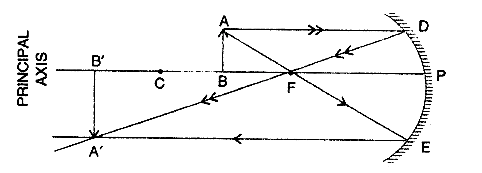
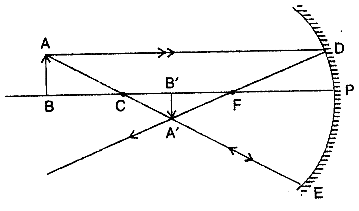
Draw a ray diagram to show the formation of image of an object placed between the focus and centre of curvature of a concave mirror. State the position, size and nature of the image.
Answer
OBJECT PLACED BETWEEN $C$ and $F $ :

A real, inverted and magnified image is formed beyond the centre of curvature
The image formed $A\ ’B\ ’$ is beyond $C \leftarrow$ position
Enlarged $\leftarrow$ size
inverted and real $\leftarrow$ nature
View full question & answer
Question 103 Marks
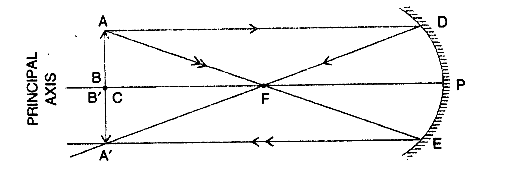
Draw a ray diagram to show the formation of image of an object placed at the centre of curvature of a concave mirror. State the position, size and nature of the image.
Answer
Object placed at $C :$

A real, inverted image of the same size is formed at the centre of curvature
Image formed
$A\ ‘B\ ’$ is at $C$ the centre of curvature.
Size is equal to the size of object $AB.$
It is inverted and real.
View full question & answer
Question 113 Marks
Draw a ray diagram to show the formation of the image of an object placed beyond the centre of curvature of a concave mirror. State the position, size and nature of the image.
Answer
OBJECT PLACED BEYOND $C$ : Image is formed :

A real, inverted and smaller image is formed between the centre of curvature and focus
Position : between $C$ and $F.$
Size smaller than an object.
View full question & answer
Question 123 Marks
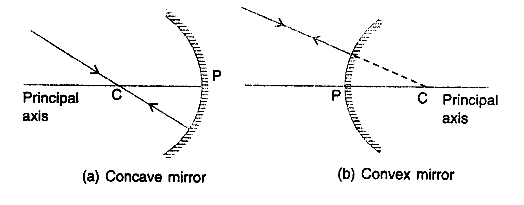
State the direction of incident ray which after reflection from a spherical mirror gets reflected along its own path. Give a reason.
Answer

A ray passing through THE CENTRE OF CURVATURE is incident normally on the spherical mirror, gets reflected back along its own path.
A ray passing through the centre of curvature.
It is because the ray is normal to the spherical mirror,
Hence $\angle i=0$, i.e., the angle of incidence is $0$
Therefore, the angle of reflection $\angle r=0.$
View full question & answer
Question 133 Marks
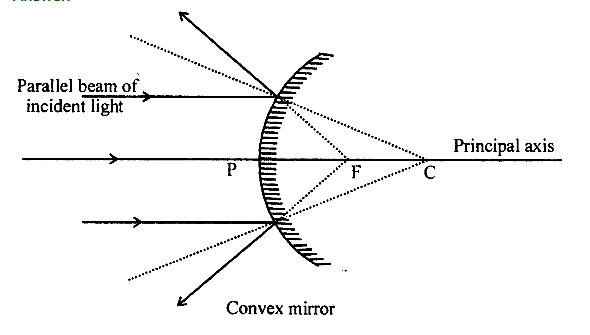
How is a spherical mirror used to diverge a beam of light from a point ? Name the type of mirror used.
Answer

In the case of a convex mirror, the reflected rays diverge and do not meet at a point after reflection. They appear to come from a point $’ F$ on the principal axis.
The type of mirror used is a $\text{CONVEX}$ mirror.
View full question & answer
Question 143 Marks
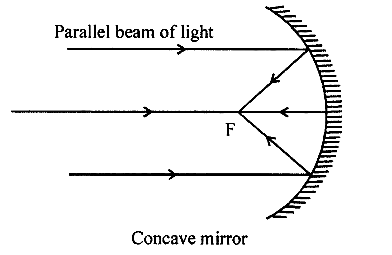
How is a spherical mirror used to converge a beam of light at a point ? Name the type of mirror used.
Answer
If a parallel beam of light is incident on a concave mirror, it converges the beam to a point called focus

Type of mirror used is $\text{CONCAVE}.$
View full question & answer
Question 153 Marks
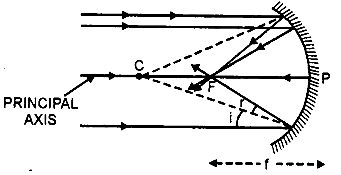
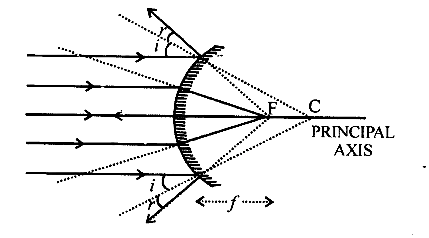
Draw suitable diagrams to illustrate how a beam of light incident parallel to the principal axis is reflected by:
$(a)$ a concave mirror, and $(b)$ a convex mirror
Answer
$(a)$ Concave mirror

$(b)$ Convex mirror
View full question & answer
Question 163 Marks
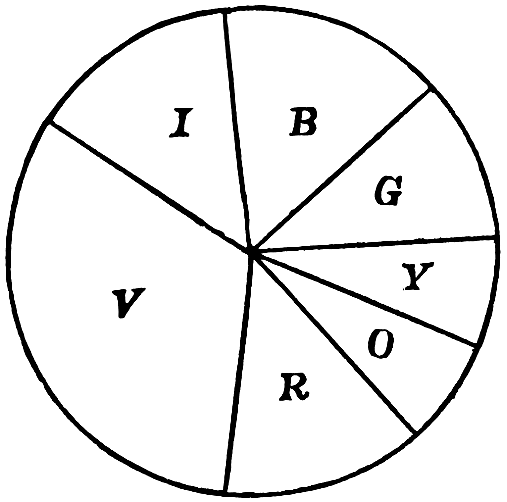
You are given a disc divided into seven sectors with colours violet, indigo, blue, green, yellow, orange and red in them. What would be its colour when it is rotated rapidly ?
Answer

Newton’s colour disc $—$ It is a circular disc taken by Newton to demonstrate that the recombination of seven colours produces white light. A circular cardboard disc which is divided into seven sectors and they were painted with the seven colours of $\text{VIBGYOR}$. The disc when rotated at a very high speed appears $\text{WHITE}.$
View full question & answer
Question 173 Marks
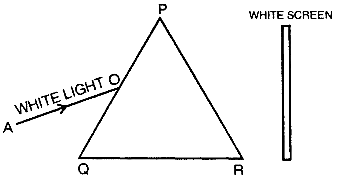
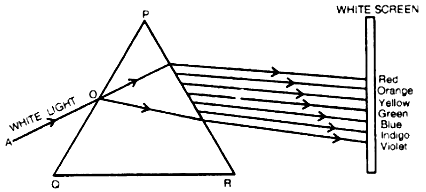
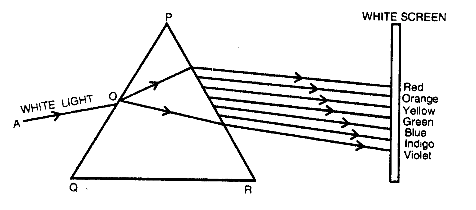
In figure $AO$ is the ray of white light falling on a prism $\text{PQR}$. Complete the diagram till the light emerges out from the prism and falls on the screen.
Answer

Diagram is completed:
‘The white light splits up into seven colours which are seen on the screen and arrangement of colours from bottom to top is given by the word $\text{‘VIBGYOR’}.$
View full question & answer
Question 183 Marks
What do you mean by the term dispersion?
Answer
The splitting or breaking up of the white light into its constituent colours as it passes through a refracting medium such as prism is known as dispersion
View full question & answer
Question 193 Marks
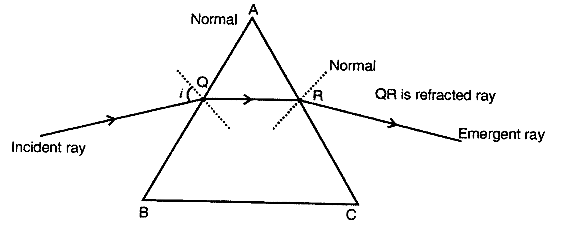
What is a prism ? Draw a ray diagram to show the refraction of a light ray through a prism.
Answer
$\text{PRISM}$ “is a transparent refracting medium bounded by two plane surfaces inclined at some angle.”
REFRACTING EDGE and $\text{BASE}$ are shown in figure.
View full question & answer
Question 203 Marks
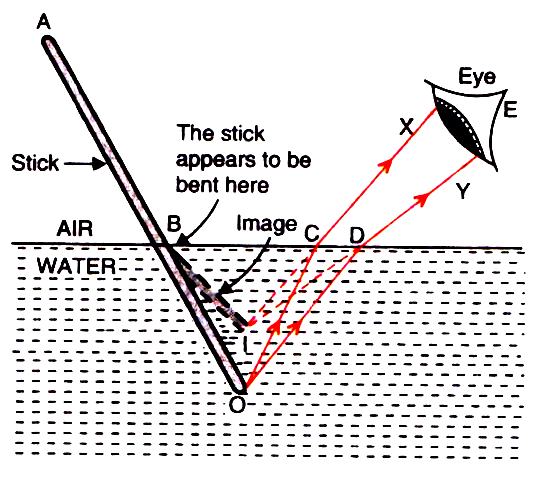
A straight stick partly dipped in water obliquely, appears to be bent at the surface of water.
Answer
The phenomenon is due to refraction of light.
A ray of light $OC$ coming from $O$ passes from water into air and gets refracted away from normal $($along $CX)$. Another ray $OD$ gets refracted along $DY.$ The two refracted rays $CX$ and $DY$, when produced backwards, appear to meet at the point I. Thus, I is the virtual image of the end $O$ of the stick. So, the stick appears to be bent as shown below.
View full question & answer
Question 213 Marks
A coin placed at the bottom of a vessel appears to be raised when water is poured in the vessel.
Answer
The coin at a appears to be at $B$ i. e. depth of coin observed is less than the actual depth at $A.$
The ray of light starting from $A ($denser$)$ medium bends away from the normal. Due to the Refraction of light, the coin appears at $B$ at a lower depth. Hence, in the same way, the depth of water appears to be less deep.
View full question & answer
Question 223 Marks
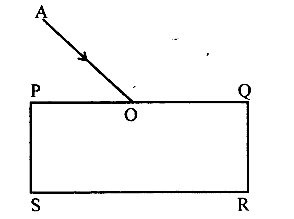
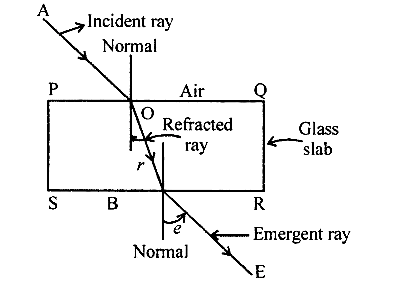
The diagram in figure shows a ray of light $AO$ falling on a rectangular glass slab $\text{PQRS}$. Complete the diagram till the ray of light emerges out of the slab. Label on the diagram the incident ray, the refracted ray and the emergent ray.
Answer

Incident ray $AO$
Refracted ray $OB$
Emergent ray $BE$ are shown.
View full question & answer
Question 233 Marks
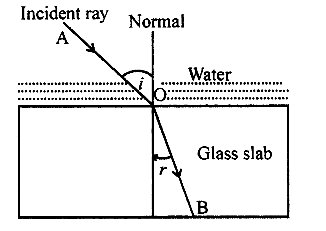
Draw a diagram showing the refraction of a light ray from water to glass. Label on it the incident ray, the angle of incidence $(i)$, and the angle of refraction $(r)$
Answer
Water is rarer than glass.
Light travels from water to glass mean light travels from a rarer to a denser medium.

The incident ray is $AO.$
Angle of incidence is $\angle i$
Angle of refraction is $\angle r$
View full question & answer
Question 243 Marks
A ray of light travels from a denser medium to a rarer medium. How will it bend?
Answer
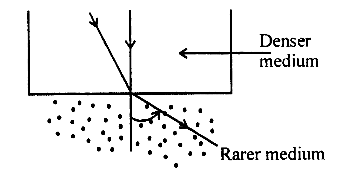
When a ray of light travels from a $\text{DENSER}$ medium to a $\text{RARER}$ medium it will bend $\text{AWAY}$ from normal
.
View full question & answer
Question 253 Marks
A ray of light travels from a rarer medium to a denser medium. How will it bend?
Answer
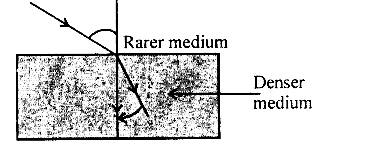
When a ray of light travels from a Rarer medium to a denser medium, it bends towards the normal.
View full question & answer
[3 Mark Question Answer] - PHYSICS STD 8 Questions - Vidyadip