Questions

[5 Mark Question Answer]

🎯

Test yourself on this topic

12 questions · timed · auto-graded

Question 15 Marks
Define the following terms : Incident ray, Refracted ray, Angle of incidence, Angle of refraction.
Answer
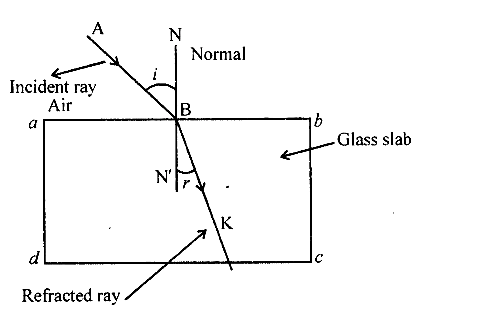
INCIDENT RAY AB : The ray light $AB$ which is in air strikes the glass slab at $B$.
Or
“A ray of light falling on the surface separating the two media.”
REFRACTED RAY BK : A ray of light which after passing the first medium is in second medium i.e. ray $BK$.
“A ray of light travelling in other medium in the changed direction.”
ANGLE OF INCIDENCE : “The angle which the incident ray makes with the normal is called angle of incidence.”
i.e. $\angle i$
ANGLE OF REFRACTION: “The angle which the refracted ray makes with the normal is called angle of refraction.”
i.e. $\angle r$
​​​​​​​
View full question & answer
Question 25 Marks
Describe an experiment to show that a light ray bends when it passes from one transparent medium into another transparent medium.
Answer
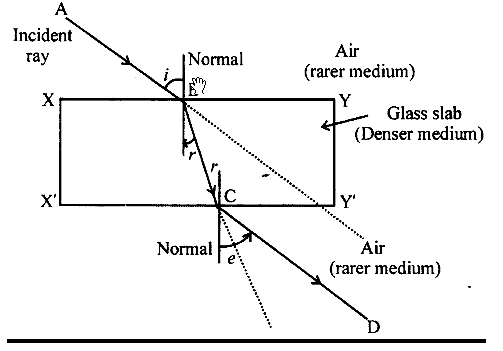
EXPERIMENT : Spread and fix a sheet of white paper on the drawing board.
At the centre of the paper, place a glass slab $XYX ‘ Y’$ and draw its boundary.
A ray of light $AB$ travelling from air $($rarer medium$)$ to glass slab $($denser medium$)$. Part of path $BC$ in denser medium bends towards the normal.
$\angle r \angle i.$ This shows that when light travels from $\text{RARER}$ to $\text{DENSER}$ medium bends towards the normal. Ray $BC$ travels from $\text{DENSER}$ medium to $\text{RARER}$ medium in air $\text{(RAY CD)}$ bend away from normal.$ \angle e >\angle r.$
This shows that when a ray of light travels from $\text{DENSER}$ to $\text{RARER}$ medium bends $\text{AWAY}$ from normal.
View full question & answer
Question 35 Marks
Draw separate diagrams for the formation of virtual image of an object by convex mirror. State the difference between concave and convex image.
Answer
Image Formation By Convex Mirror
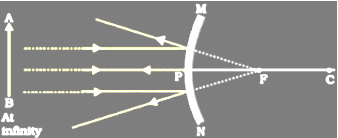
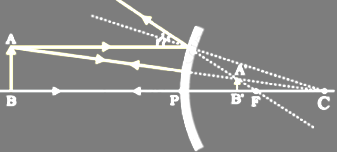
The image formed in a convex mirror is always virtual and erect, whatever be the position of the object. In this section, let us look at the types of images formed by a convex mirror.
When an object is placed at infinity, a virtual image is formed at the focus. The size of the image is much smaller as compared to that of the object.

When an object is placed at a finite distance from the mirror, a virtual image is formed between pole and focus of the convex mirror. The size of the image is smaller as compared to that of the object.

Difference between convex and concave mirrors:
  Concave mirror Convex mirror
What are convex and concave mirrors? If the inner side of the spherical mirror is reflecting, it is called a concave mirror. If the outer side of the spherical mirror is reflecting, it is called a convex mirror.
Image Concave mirrors can form inverted and real images and also virtual and erect images. Convex mirrors form virtual and erect images
Size Size can be smaller, larger or of the same size depending on the position of the object. Smaller than the size of the object, always.
Position Depends on the position of the object. Always within the focus, irrespective of the position of the object.
View full question & answer
Question 45 Marks
Which are the two convenient rays that are chosen to construct the image by a spherical mirror for a given object? Explain with the help of suitable ray diagrams.
Answer
Two convenient rays that are chosen to construct the image by a spherical mirror for a given object :
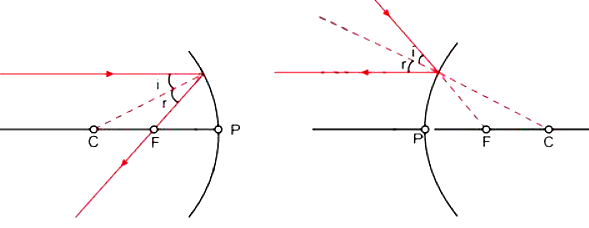
$1.$ A ray passing through the centre of curvature: A ray of light passing through the centre of curvature of a concave mirror or a ray directed in the direction of the centre of curvature of a convex mirror is reflected back along the same path after reflection.

$2.$ A ray parallel to the principal axis: A ray of light parallel the principal axis, after reflection pass through the principal focus in case of a concave mirror or appears to diverge from it in case of a convex mirror.
View full question & answer
Question 55 Marks
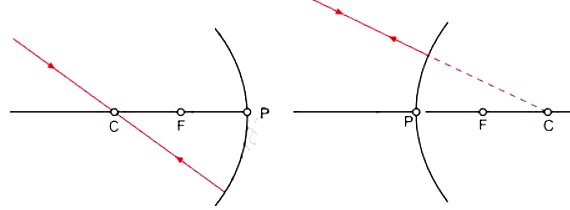
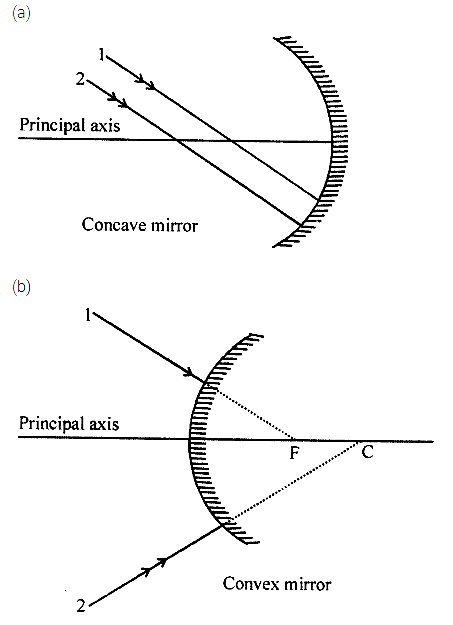
Complete the following diagrams in figure by drawing the reflected rays for the incident rays $1$ and $2$ if $F$ is the focus and $C$ is the centre of curvature.
Answer

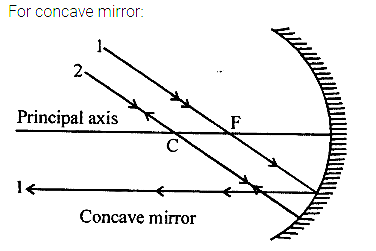
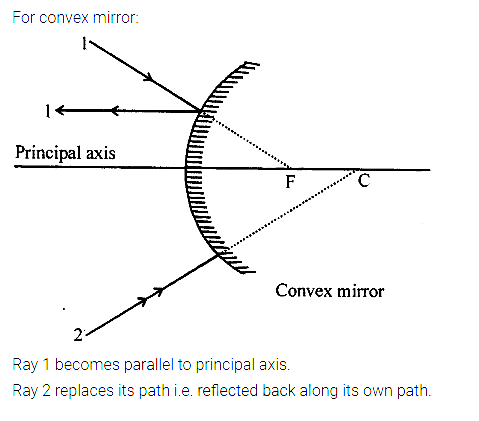
$(1)$ Ray passing through $F$ after reflection becomes parallel to the principal axis.
Ray $(2)$ passing through the centre of curvature travels back $($retraces its path$)$ i.e. reflected back along its own path.
View full question & answer
Question 65 Marks
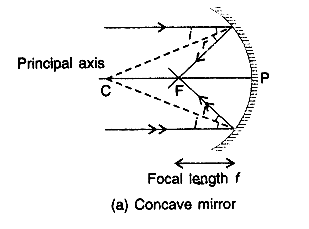
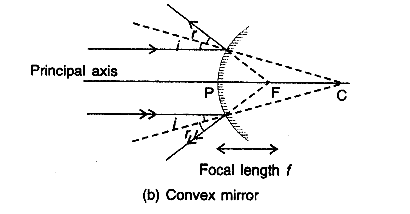
What do you understand by the focus and focal length of a spherical mirror? Show them on the separate diagrams for each of a concave mirror and a convex mirror.
Answer
$\text{FOCUS : For}$ concave mirror
“A point on the principal axis at which the light rays incident parallel to the principal axis meet after reflection from the mirror.
$\text{FOCAL LENGTH}$ : “The distance between focus and pole”. $\text{FP}$ is focal length for a concave mirror.

$\text{FOCUS: For}$ Convex mirror
“A point on its principal axis at which the light rays incident parallel to the principal axis appear to meet after reflection from the mirror”.
$\text{FOCAL LENGTH}$ : “The distance between $P$ and $F$ is $F.L.”$
View full question & answer
Question 75 Marks
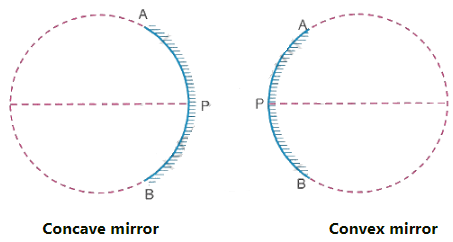
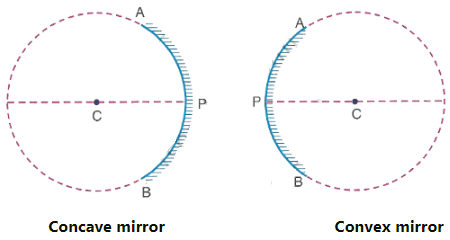
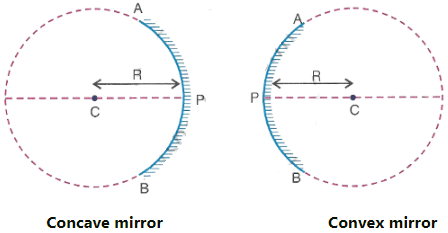
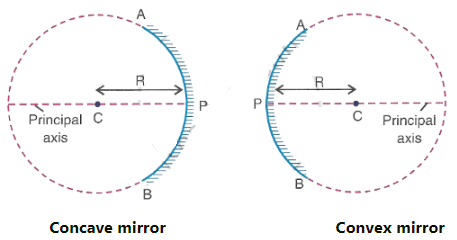
Explain the following terms : Pole, Centre of curvature, Radius of curvature, Principal axis. Show them on separate diagrams for each of the concave and convex mirrors
Answer
Pole : "The geometric centre of a spherical mirror is called $\text{POLE}.$"
Image
"The midpoint of aperture $AB$ of the mirror is called pole." $P$ is pole of mirror.Centre of curvature: "The centre of a hollow sphere of which the mirror forms a part." It is represented by the symbol ' $C$ '
Image
Radius of curvature : "The radius of a hollow sphere of which the mirror is a part". It is represented by ' $R$ '
Image
Principal axis : "Is a straight line joining the pole of the mirror to its centre of curvature and extended further."
Image
View full question & answer
Question 85 Marks
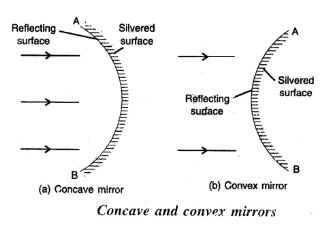
State the two kinds of spherical mirror and distinguish them with the aid of proper diagrams.
Answer
The kinds of $\text{SPHERICAL MIRRORS}$ are:
$\text{i. CONCAVE MIRROR}$
$\text{ii. CONVEX MIRROR}$
Image
$\text{CONCAVE MIRROR}$: Silvered surface is away from the centre of curvature and focal length is negative, i.e. reflecting surface is towards the centre of curvature.
$\text{CONVEX MIRROR}$: Silvered surface is towards the centre of curvature and focal length is positive i.e. reflecting surface is away from the centre of curvature. It always forms diminished $($small$)$ image which is $\text{VIRTUAL}$..
View full question & answer
Question 95 Marks
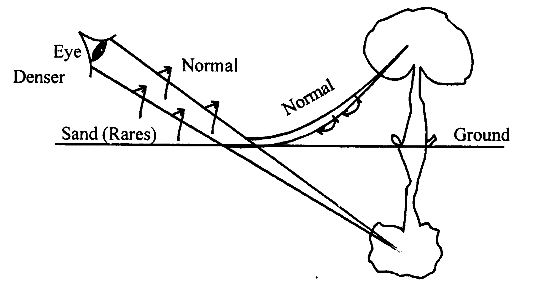
What is mirage? Give a reason for its formation?
Answer
Hot sand $($Rarer medium$)$
$\text{MIRAGE}$ : When it is very hot, an inverted image of a tree is seen which is ‘illusion of eye’ $($gives a false impression$)$ of water under the tree. This is called a $\text{MIRAGE}$.”

$\text{REASON}$ : Sand becomes very hot during hot noon, the layers of air in contact become rarer $($expand$)$ while upper layers of air are still at comparatively low temperature and are denser medium.
When rays of light from $\text{DENSER}$ to $\text{RARER}$ medium $($starting from tree$)$ are bent away from normal when refracted from Rarer to Denser medium $($going towards the eye$)$ bend towards normal and a tree appears $\text{INVERTED}$.
View full question & answer
Question 105 Marks
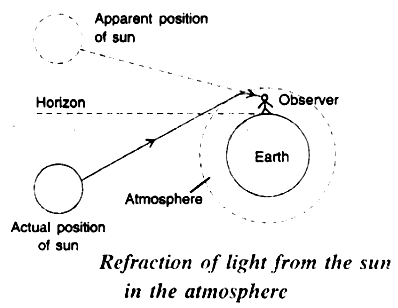
The sun is seen before the sunrise and after the sunset.
Answer

$\text{EARLY SUNRISE}$ and $\text{SUNSET}$ : At sun Rise: When the Sun is just below the horizon, the light from the Sun suffers refraction from $\text{RARE}$ to $\text{DENSER}$ medium $($As the atmosphere is warmer than layers near the earth at that time$)$ bends towards the normal at each refraction. Due to continuous bending of light rays, the Sun can be seen even when its actual position is just below the Horizon. As a result, the Sun is seen in advance, two minutes before it rises above the horizon in the morning.
Similarly, in the evening Sun is seen delayed by $2$ minutes longer above the horizon after the Sunset.
View full question & answer
Question 115 Marks
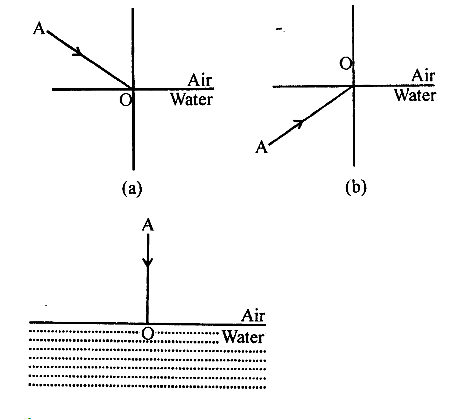
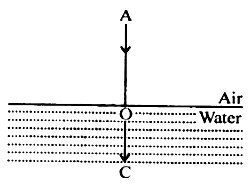
The diagram given below in fig shows a ray of light $AO$ falling on a surface separating two media. Draw the refracted ray in each, case.
Answer
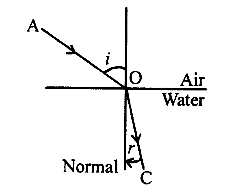
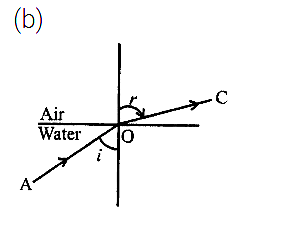
Refracted ray $0\  C$ is shown in each case.

Towards the normal or $\angle r < \angle i$

Away from the normal or $\angle r > \angle i$​​​​​​​

Refracted ray goes undeviated
or
$\angle i = 0$
$\angle r = 0$
View full question & answer
Question 125 Marks
Match the Following$>$
Column $A$ Column $B$
$(a)$ white Light $(1)$ Convex mirror
$(b)$ Refraction $(2)$ Concave mirror
$(c)$ Virtual images $(3)$ refraction
$(d)$ Real images $(4)$ spectrum
$(e)$ Prism $(5)$ ray of light from glass to air
Answer
Column $A$ Column $B$
$(a)$ White light $(1)$ Spectrum
$(b)$ Refraction $(2)$ Ray of light from glass to air
$(c)$ Virtual images $(3)$ Convex mirror
$(d)$ Real images $(4)$ Concave mirror
$(e)$ Prism $(5)$ refraction
View full question & answer
[5 Mark Question Answer] - PHYSICS STD 8 Questions - Vidyadip