Questions

[5 Mark Question Answer]

🎯

Test yourself on this topic

5 questions · timed · auto-graded

Question 15 Marks
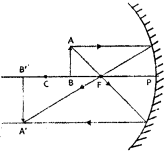
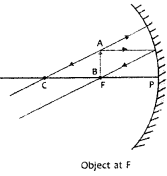
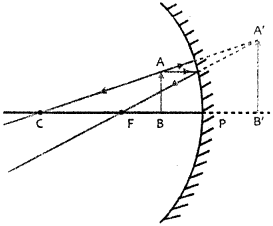
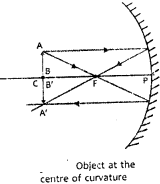
Image formed by a concave mirror if the object is placed :
$a.$ at infinity
$b.$ between $C$ and $F$
$c.$ at $F$
$d.$ between $F$ and $P$
$e.$ at $C$
Answer

$a.$ at infinity
Image
$b.$ between $C$ and $F$
Image
$c.$ at $F$
Image
$d.$ between $F$ and $P$
Image
$e.$ at $C$
Image​​​​​​​
View full question & answer
Question 25 Marks
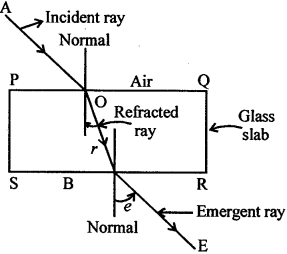
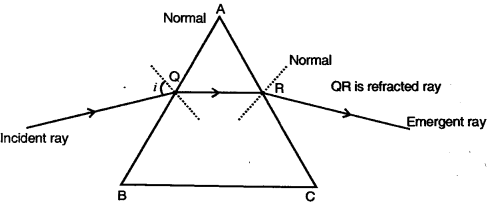
Refraction of light through:
$a.$ a parallel$-$sided glass slab
$b.$ a prism
Answer

$(a)$Image
$(b) $​​​​​​​Image
View full question & answer
Question 35 Marks
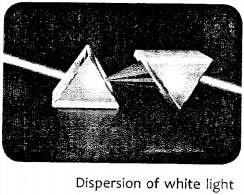
Explain why two prisms placed next to each other such that their adjacent faces are parallel, behave like a glass slab.
Answer
If two prisms are placed next to each other such that their adjacent faces are parallel to each other and a ray of white light is allowed to fall on the refracting surface of one of them, then the first prism on which the ray of light falls will disperse the light into its seven colours. When this dispersed light enters the second prism, all the seven components of light re-unite and a ray of white light emerges out from the prism. Therefore, two prisms kept opposite to each other behave like a glass slab.
Image
View full question & answer
Question 45 Marks
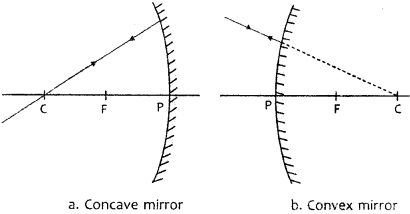
State the rules for drawing ray diagrams for spherical mirrors. Support them with ray diagrams.
Answer
In order to obtain the image of an object by drawing ray diagrams for spherical mirrors, any two of the following rays can be taken as the incident rays for locating the image.
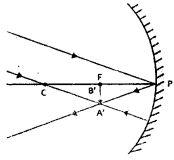
$a.$ An incident ray passing through the centre of curvature :
An incident ray passing through the centre of curvature of a concave mirror reflects back along the same path, without any deviation. In case of a convex mirror, an incident ray which appears to move towards the direction of centre of curvature is reflected back along the same path without any deviation.
Image
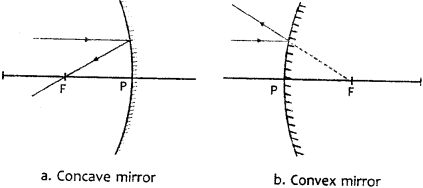
$b.$ An incident ray parallel to the principal axis :
In case of a concave mirror, an incident ray parallel to the principal axis passes through its focus after reflection. In case of a convex mirror, the incident ray after reflection appears to come from the focus of the mirror.
Image
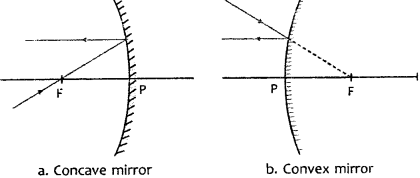
$c. $ An incident ray passing through the focus :
In a concave mirror, an incident ray passing through the focus is reflected parallel to the principal axis. In case of a convex mirror, the incident ray, which appears to move in the direction of the focus of the mirror, is reflected parallel to the prinipal axis.
Image
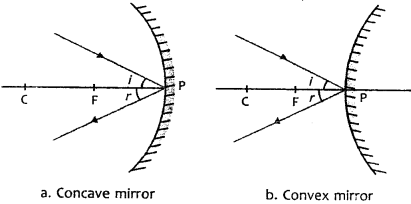
$d.$ A ray of light incident at the pole of the mirror :
In a concave mirror, a ray of light incident at the pole gets reflected along a path such that the angle of incidence is equal to the angle of reflection. This is also true for a convex mirror.
Image
View full question & answer
Question 55 Marks
What do you mean by a spherical mirror? Distinguish between a concave mirror and a convex mirror. .
Answer
A spherical mirror is a part of a hollow glass sphere with one of its curved surfaces polished in silver while the
Concave mirror :
It is a spherical mirror whose inner surface $($curving inwards$)$ is the reflecting surface and the outer surface $($bulging outwards$)$ is polished.
When a parallel beam of light falls on this mirror, it converges at a point after reflection.
It is also known as converging mirror.
It can form real or virtual image depending on the position of the object with respect to the mirror.
Convex mirror :
It is a spherical mirror whose outer surface is the reflecting surface and the inner surface is polished.
When a parallel beam of light falls on this mirror,
it appears diverge from a point after reflection.
It is also known as diverging mirror.
It always form a virtual, erect and diminished image of the object irrespective of the position of the object with respect to the mirror.
View full question & answer
[5 Mark Question Answer] - PHYSICS STD 8 Questions - Vidyadip