Questions

[2 Mark Question Answer]

🎯

Test yourself on this topic

7 questions · timed · auto-graded

Question 12 Marks
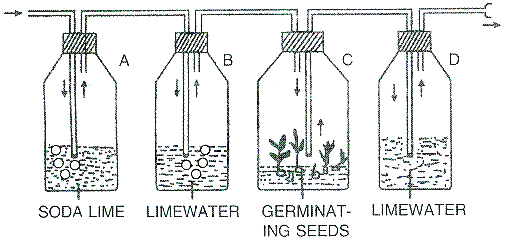
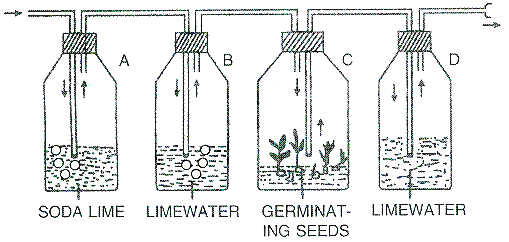
In order to study and prove a particular physiological process in plants, the following experiment was set up. Study the same and then answer the question that follow:
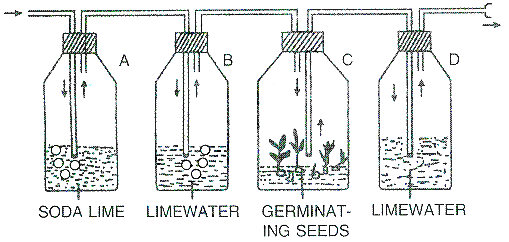
If bottle 'C' was fitted with a 3-holed rubber stopper and a thermometer was introduced in such a way that its bulb reaches close to the germinating seeds, what would you observe? Why?
Answer
By introducing a thermometer in bottle 'C', the change in temperature is checked or observed. If respiration takes place, there will be a rise in temperature and if there is no rise in temperature, no respiration occurs. Therefore, a three-holed rubber stopper and a thermometer were introduced.
View full question & answer
Question 22 Marks
In order to study and prove a particular physiological process in plants, the following experiment was set up. Study the same and then answer the question that follow:

What change would you expect to observe in bottle $'D\ '$?
Answer
The bottle $'D\ '$ having limewater will show that $CO _2$ is produced due to respiration taking place in bottle $'C\ '$ having germinating seeds in it. Due to the $CO _2$ produced in bottle C, the limewater turns milky, which passes through bottle $'D\ '.$
View full question & answer
Question 32 Marks
In order to study and prove a particular physiological process in plants, the following experiment was set up. Study the same and then answer the question that follows:

What is the function of soda lime in the bottle $'A\ '$ and why is limewater placed in bottle $'B\ '$?
Answer
Soda-lime is kept in bottle $'A\ '$ so as to check the (presence of) passage of$CO _2$ present in bottle $'B\ '$. This is because soda lime has a tendency to absorb $CO _2$ present in the air.
The limewater present in bottle $'B\ '$ shows that no $CO _2$​​​​​​​is entering bottle $C$ with the air passing through bottle $C$.
View full question & answer
Question 42 Marks
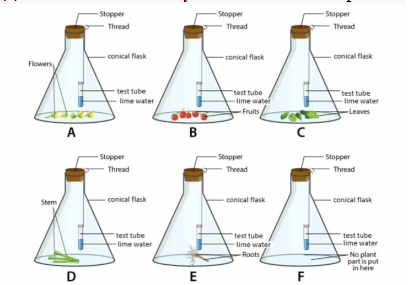
Given below is a set of six experimental set-ups $(A-F)$, kept in this state for about $24$ hours.
Image
In which tube/tubes the limewater will turn milky?
Answer
All the five flasks $(A-E)$ containing plant parts will show respiration and thus, the tubes containing limewater will turn milky. The flask $F$ does not contain any plant part. So, there is no respiration and hence, there is no change.
View full question & answer
Question 52 Marks
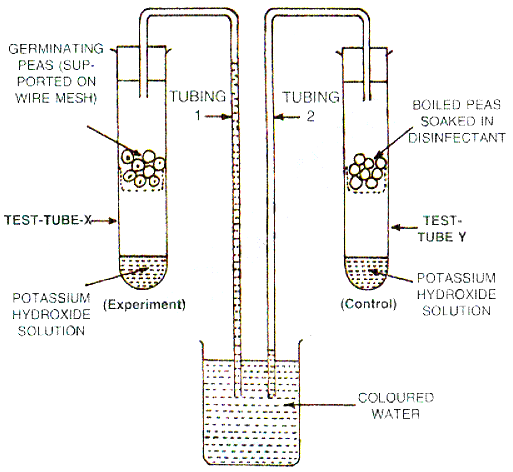
The following diagram refers to an apparatus which is used to demonstrate a physiological process:

Why has the coloured water risen in tubing $1$?
Answer
When the process of respiration takes place in test tube X, the $O_2$ present in the test tube is consumed. The $CO_2$ produced due to respiration is absorbed by the $KOH$ present in the test tube. Hence, space is developed due to the consumption of oxygen and hence, the coloured water rises in tubing $1$.
View full question & answer
Question 62 Marks
Why is it usually difficult to demonstrate respiration in green plants?
Answer
During day time, both photosynthesis and respiration takes place in green plants. Evolution of $CO_2$  is an indicator to demonstrate respiration in living organisms. $CO_2$ produced during respiration in plants gets utilized during photosynthesis and thus, there is no evolution of $CO_2$  Therefore, it is difficult to demonstrate respiration in green plants as there is no evolution of $CO_2$  during day time.
View full question & answer
Question 72 Marks
What happens to the energy liberated during respiration?
Answer
The energy liberated during respiration is utilised for carrying out various life processes.
Some of the energy liberated during the breakdown of 03the glucose molecule, is in the form of heat, but a large part of it is converted into chemical energy called Adenosine Triphosphate $\text{(ATP)}$. Any activity inside the cell is carried out by the energy released by these $\text{ATP}$ molecules.
View full question & answer
[2 Mark Question Answer] - BIOLOGY STD 9 Questions - Vidyadip