Questions

[3 Mark Question Answer]

🎯

Test yourself on this topic

13 questions · timed · auto-graded

Question 13 Marks
Distinguish between the following pair of terms associated with vulcanicity:
Geysers and Hot Springs
Answer
Geysers Hot Springs
In a geyser, hot water and steam are thrown out at intervals in the form of a fountain. There is an old faithful geyser which erupts out exactly in a one-hour interval, these are about 100 geysers. In a hot spring, the heated water flows out continuously without any eruptive activity such hot springs are common in Yellow stone park U.S.A. Badrinath and Mani Karan in India. These hot springs are very healthy for a bath.
View full question & answer
Question 23 Marks
Spine or plug
Answer
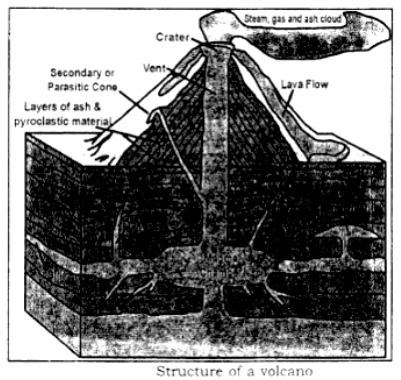
Spine or plug: Acid lava dome is formed when viscous lava solidifies quickly and gives rise to steep sloping cones. This is known as a spine or plug. Sometimes these spines and plugs are exposed by denudation.

https://pg-data.sgp1.digitaloceanspaces.com/chapter_wise/21520/S151.png" alt="Image" width="400" height="">
View full question & answer
Question 33 Marks
Fissure type of volcanoes
Answer
Fissure type of volcanoes: A volcano is a vent in the earth’s crust out of which hot molten rocks (lava) flow. The hot rocks may also eject violently in the form of solid pieces. If the vent is in the form of a long crack then it is known as a Fissure Type Volcano. In this type volcanic activity occurs quietly the lava upwells silently and spreads over a large area giving rise to volcanic plateaux and extensive lava sheets.
View full question & answer
Question 43 Marks
How the theory of plate tectonics has explained the formation of mountains like Himalaya or Alps and of the volcanic islands.
Answer
The formation of the highest mountains of Himalayas and Alps have been created by the bucking up of the geosynclines of Tethys sea between Angaraland and Gondwanaland which pushed towards each other and forced the geosynclines to be lifted up forming the mountains. The Mid-Atlantic Ridge is the proof of the edge raised at the joint of continental plates which gives birth to several volcanic islands.
View full question & answer
Question 53 Marks
Distinguish between the following pair of terms associated with vulcanicity:
Geysers and Hot Springs
Answer
GeysersHot Springs
In a geyser, hot water and steam are thrown out at intervals in the form of a fountain. There is an old faithful geyser which erupts out exactly in a one-hour interval, these are about 100 geysers.In a hot spring, the heated water flows out continuously without any eruptive activity such hot springs are common in Yellow stone park U.S.A. Badrinath and Mani Karan in India. These hot springs are very healthy for a bath.
View full question & answer
Question 63 Marks
Mention some of the main effects of earthquakes.
Answer
 The destructive effects of earthquakes are very dangerous e.g. disruption of the rocks bed landslides changing the river courses floods tides collapsing of buildings destruction of transport lines and fires in electric wiring etc.
The constructive effects are the creation of additional coastal plains inlets bays for good harbours creation of fissure- openings to form sulphur or hot springs, etc.
View full question & answer
Question 73 Marks
Describe the distribution of volcanoes in the world.
Answer
Volcanoes are found along the weak zones of the earth’s crust where due to continuous tussle by tectonic forces maximum active volcanoes have created. These are
  1. Cirum-Pacific Belt : It is also known as ‘ring of fire due to consisting 75 % active volcanoes of the world.
  2. Mid-World Mountain Belt or Mid Continental Belt : It extends along the fold mountain zone of Alpine-Himalayan Region. Although this belt is noted for drastic earthquakes but these are some of the very destructive volcanoes e.g. Stromboli Vesuvius Mt. Etna Mt. Pelee (West Indies). Out of these belts, there are also various volcanoes scattered here and there.
View full question & answer
Question 83 Marks
Give two of its main characteristics of Geysers
Answer
Main Characteristics of Geysers
  1. Water in a geyser gets heated up beyond its boiling point.
  2. They may spout to a height of over 150 feet.
View full question & answer
Question 93 Marks
Describe the effect of volcanic eruption of Karakatoa in 1883.
Answer
Karakatoa island is situated between the islands of Java and Sumatra in the Sunda Strait. It suddenly erupted in 1883. The top of the mountain was blown away by the explosion 16 metres high tidal waves were caused killing 36,000 persons in west Java. Volcanic dust rose to a height of about 27 kilometres. This dust encircled the globe for 3 years. Its effect caused strange sunrise and sunset conditions.
View full question & answer
Question 103 Marks
Describe the materials thrown out during volcanic eruption.
Answer
The materials thrown out of a volcano due to eruptions are of three types :
  1. Solid materials:- The solid materials include large fragments of rocks known as volcanic Bombs. The finest particles include cinder volcanic ash dust.
  2. Liquid materials:- The liquid materials include basic lava and Acid lava. Acid lava has more silica while Basic lava has a low content of Silica.
  3. Gaseous materials:- The gaseous material is mainly composed of steam. The other gases include Oxygen Hydrogen Sulphuric acid Carbon dioxide etc.
View full question & answer
Question 113 Marks
Describe the distribution of volcanoes in the world.
Answer
Volcanoes are found along the weak zones of the earth’s crust where due to continuous tussle by tectonic forces maximum active volcanoes have created. These are
  1. Cirum-Pacific Belt : It is also known as ‘ring of fire due to consisting 75 % active volcanoes of the world.
  2. Mid-World Mountain Belt or Mid Continental Belt : It extends along the fold mountain zone of Alpine-Himalayan Region. Although this belt is noted for drastic earthquakes but these are some of the very destructive volcanoes e.g. Stromboli Vesuvius Mt. Etna Mt. Pelee (West Indies). Out of these belts, there are also various volcanoes scattered here and there.
View full question & answer
Question 123 Marks
Describe the causes of volcanic eruptions.
Answer
The main causes of volcanic eruptions are the following :
  1. Heat and Pressure inside the Earth: Temperature and pressure both increase from the surface towards the centre of the earth. Rocks are bad conductors of heat. So the earth’s heat does not escape on its own. Instead, it melts the rocks and builds up great pressure. The pressure forces the heat to find an escape route through fissures and cracks in the rocks.
  2. Plate Tectonics: Most volcanic eruptions take place near plate margins. The same forces that cause earthquakes also cause volcanic eruptions.
  3. Magma Chamber: The molten material while still under the earth’s crust melts weak rocks and creates a huge chamber for itself. Fresh magma continues to pour inside the chamber. Since magma contains silicate materials gases and water vapours the pressure always acts vertically upwards. Once a route is found it rises to the surface
View full question & answer
[3 Mark Question Answer] - Geography STD 9 Questions - Vidyadip