Questions

[3 Mark Question Answer]

🎯

Test yourself on this topic

12 questions · timed · auto-graded

Question 13 Marks
What is known as exfoliation? Name the processes involved in it?
Answer
Sudden change in temperature causes fissures in the rocks through which water penetrates to motivate chemical weathering along with sudden contraction and expansion due to change in temperature peels out the upper layer of rock known as exfoliation. The processes involved in exfoliation are mechanical or physical weathering, chemical weathering, contraction and expansion of rocks.
View full question & answer
Question 23 Marks
State the effects of weathering.
Answer
Effects of weathering :
  1. It causes landslides.
  2. It causes mudflow, that is, the flow of weathered material, soggy with water, deacon a hillside, or a slope.
  3. Weathering breaks down the particles of rocks gradually and makes it easy for rivers and other agents of denudation to transport them down the slope. It exposes the rock to further weathering. Thus weather assists the agents of denudation.
  4. Weathering assists the formation of soils.
View full question & answer
Question 33 Marks
Which human activities lead to weathering of rocks?
Answer
Following human activities lead to weathering of rocks :
  1. Mining
  2. Quarrying
  3. Deforestation
When trees are cut the binding action of the roots of the trees is no longer present. Rocks get exposed to sun and rain and weathering takes place rapidly. Mining and quarrying exposes bare rocks on the surface and these get weathered quickly.
View full question & answer
Question 43 Marks
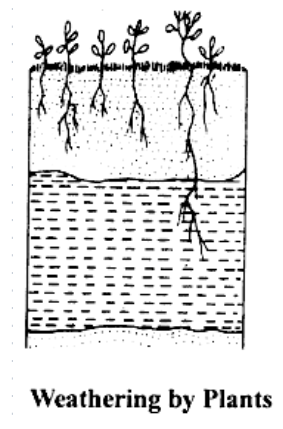
Describe the work of plants as agents of weathering.
View full question & answer
Question 53 Marks
Name the different processes of chemical weathering.
Answer
Different processes of chemical weathering are as follows :
  1. Solution
  2. Hydration
  3. Oxidation
  4. Carbonation
View full question & answer
Question 63 Marks
Describe how changes of temperature lead to weathering. ### How do changing temperature lead to weathering?
Answer
The alternate action of heat and cold helps in the weathering of rocks. For example, during the day, the rocks expand by heat and they contract due to cold during the night. It tends to loosen the particles of rock and it begins to disintegrate because every rock is composed of different minerals, which are affected differently due to changes in temperature, and therefore the component parts of the rock begin to lose cohesion.
View full question & answer
Question 73 Marks
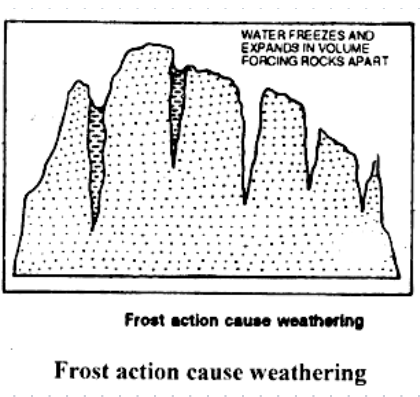
How does frost action cause weathering?
View full question & answer
Question 83 Marks
Explain the processes of physical weathering giving examples.
Answer
The disintegration of the bedrock due to changes in temperature and freezing action of water by mechanical process is called physical weathering e.g. frost or snow lying between the cracks forces to expand the rocks cracks which helps in disintegration. Besides this, the change in temperature does the expansion and contraction of rocks resulting in breaking the rocks into smaller pieces.
View full question & answer
Question 93 Marks
Explain the processes of physical weathering giving examples.
Answer
The disintegration of the bedrock due to changes in temperature and freezing action of water by mechanical process is called physical weathering e.g. frost or snow lying between the cracks forces to expand the rocks cracks which helps in disintegration. Besides this, the change in temperature does the expansion and contraction of rocks resulting in breaking the rocks into smaller pieces.
View full question & answer
Question 103 Marks
On what factors does the weathering depend?
Answer
Weathering depends upon :
  • structure of rocks
  • climate
  • vegetation
  • topography and slope of land.
View full question & answer
Question 113 Marks
State the main agents of biological weathering.
Answer
Main agents of biological weathering:
  1. Animals and Insects: Animals like rabbits, worms, moles, and insects bring large quantities of fine material to the surface. Burrowing animals help to loosen the surface materials around the rocks facilitating their physical disintegration. Upon death, the decaying physical also provide many chemicals and acids for rock disintegration.
  2. Vegetation: Roots of large trees reach deep into rocks and cause physical disintegration due to pressure. Most of: vegetation, however, prevents disintegration of rocks because it binds the surface layer and does not allow exposure of rocks
View full question & answer
Question 123 Marks
What is the biological weathering?
Answer
Biological weathering is weathering caused by plants and animals. Plants and animals release acid-forming chemicals that cause weathering and also contribute to the breaking down of rocks and landforms. It is also known as Organic weathering. Its main agents are animals, insects, plants, and man. In all the cases, however, both physical disintegration and/or chemical decomposition are involved
View full question & answer
[3 Mark Question Answer] - Geography STD 9 Questions - Vidyadip