Questions

[4 marks sum]

🎯

Test yourself on this topic

12 questions · timed · auto-graded

Question 14 Marks
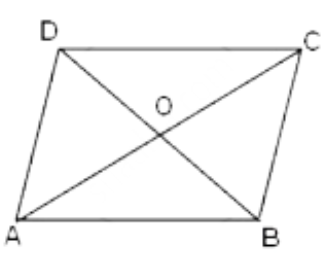
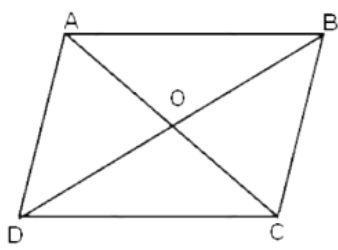
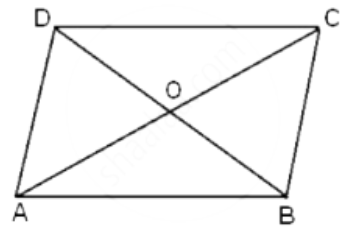
$\text{ABCD}$ is a quadrilateral in which diagonals $AC$ and $BD$ intersect at a point $O$. Prove that: area $\triangle AOD +$ area $\triangle BOC +$ area $\triangle ABO +$ area $\triangle CDO.$
Answer
Image
Since the diagonals of a parallelogram bisect each other at the point of intersection.
Therefore, $O B=O D$ and $O A=O C$
In $\triangle A B C, O B$ is the median and median divides triangle into two triangles of equal areas
Therefore, area$(\triangle B O C)=$area$(\triangle A B O)$
In $\triangle ADC , OD$ is the median and median divides triangle into the triangles of equal areas
Therefore, area$(\triangle A O D)=$area$(\triangle C D O)\dots..........(ii)$
Adding (i) and (ii)
area$(\triangle A O D)+$area$(\triangle B O C)=$area$(\triangle A B O)+$area$(\triangle C D O)$
View full question & answer
Question 24 Marks
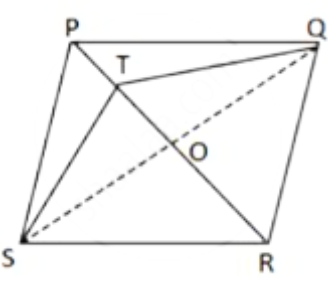
In a parallelogram $\text{PQRS}, T$ is any point on the diagonal $PR$. If the area of $\triangle PTQ$ is $18$ square units find the area of $\triangle PTS.$
Answer
Construction: Join $QR$. Let the diagonals $PR$ and $QS$ intersect each other at point $O.$
Image
Since diagonals of a parallelogram bisect each other,
therefore $O$ is the mid$-$point of both $PR$ and $QS$.
Now, median of a triangle divides it into two triangles of equal area.
In $\triangle P S Q, O P$ is the median.
$\therefore$ Area$(\triangle POS )=$Area$(\triangle POQ ) \ldots (i)$
Similarly, $OT$ is the median of $\triangle T S Q$.
$\therefore$ Area$(\Delta T O S)=$Area$(\Delta T O Q)\dots...(ii)$
Subtracting equation $(ii)$ from $(i)$, we have
Area$(\triangle POS )-$Area$(\Delta T O S)=$Area$(\triangle POQ )-$Area$(\Delta T O Q)$
$\Rightarrow$ Area$(\Delta PTQ )=Area(\Delta PTS )$
$\Rightarrow$ Area $(\Delta P T S)=18$ square units.
View full question & answer
Question 34 Marks
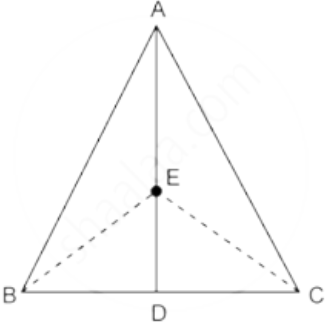
In the given figure, $\text{ABC}$ is a triangle and $AD$ is the median.
Image
If $E$ is the midpoint of the median $A D$, prove that: Area of $\triangle A B C=4 \times$ Area of $\triangle A B E$
Answer
$AD$ is the median of $\triangle ABC.$
Therefore it will divide $\triangle ABC$ into two triangles of equal areas.
$\therefore $Area$(\triangle ABD) =$ Area$(\triangle ACD) \dots….(i)$
Similarly, $ED$ is the median of $\triangle EBC.$
$\therefore $ Area$(\triangle EBD) =$ Area$(\triangle ECD) \dots….(ii)$
Subtracting equation $(ii)$ from $(i)$, we have
Area$(\triangle ABD) -$ Area$(\triangle EBD) =$ Area$(\triangle ACD) -$ Area$(\triangle ECD)$
$\Rightarrow $ Area$(\triangle ABE) =$ Area$(\triangle ACE) \dots….(iii)$
Since $E$ is the mid$-$point of median $AD,$
$AE = ED$
Now,
$\triangle ABE$ and $\triangle BED$ have equal bases and a common vertex $B.$
$\therefore $ Area$(\triangle ABE) =$ Area$(\triangle BED) \dots….(iv)$
From $(i), (ii), (iii)$ and $(iv)$, we get
Area$(\triangle ABE) = A(\triangle BED) = $Area$(\triangle ACE) =$ Area$(\triangle EDC) ….(v)$
Now,
Area$(\triangle ABC) = $Area$(\triangle ABE) + A(\triangle BED) +$ Area$(\triangle ACE) +$ Area$(\triangle EDC)$
$= 4 \times $ Area$(\triangle ABE). [$From $(v)]$
View full question & answer
Question 44 Marks
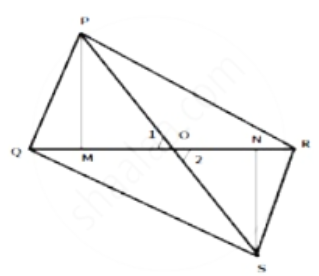
$\triangle PQR$ and $\triangle SQR$ are on the same base $QR$ with $P$ and $S$ on opposite sides of line $QR,$ such that area of $\triangle PQR$ is equal to the area of $\triangle SQR$. Show that $QR$ bisects $PS.$
Answer
Image
Join $PS.$
Suppose $PS$ and $QR$ intersect at $O.$
Draw $PM$ and $SN$ perpendicular to $QR. $
$\operatorname{ar}(\triangle P Q R)=\operatorname{ar}(\triangle S Q R)$
Thus $\triangle P Q R$ and $\triangle S Q R$ are on the same base $Q R$ and have equal area.
Therefore, their corresponding altitudes are equal i.e. $PM = SN$.
Now,
In $\triangle PMO$ and $\triangle SNO$.
$\angle 1=\angle 2...($vertically opposite angles$)$
$\angle PMO =\angle SNO \ldots($right angles$)$
$PM=SN$
Therefore, $\triangle PMO \cong \triangle SNO.(\text{AAS}$ axiom$)$
$\Rightarrow PO = OS$
$\Rightarrow QR$ bisects $PS$.
View full question & answer
Question 54 Marks
In the given figure, $BC\| DE.(a)$ If area of $\triangle ADC$ is $20\ sq$. units, find the area of $\triangle AEB.(b)$ If the area of $\triangle BFD$ is $8$ square units, find the area of $\triangle CEF$
Answer
$(a)$ Triangles on the same base and between the same parallels are equal in area.
$\therefore A(\triangle DBC) = A9\triangle ECB) ....(i)$
Now,
$A(\triangle ABC) = A(\triangle ADC) + A(\triangle DBC) = A(\triangle AEB) + A(\triangle ECB)$
$\Rightarrow A(\triangle AC) + A(DBC) = A(\triangle AEB) + A(\triangle ECB)$
$\Rightarrow A(\triangle ADC) = A(\triangle AEB) ....(ii) [$from $(i)]$
Given, $A(\triangle ADC) = 20 sq.$ units
$\Rightarrow A(\triangle AEB) = 20 sq.$ units
$(b) A(\triangle ADC) = A(\triangle AEB) ...[$From $(ii)]$
$\Rightarrow A(\triangle ADC) - A(\triangle DEF) = A(\triangle AEB) - A(\triangle DFE)$
$\Rightarrow A(\triangle CEF) = A(\triangle BFD)$
Given, $A(\triangle BFD) = 8 sq.$ units
$\Rightarrow A(\triangle CEF) = 8 sq.$ units.
View full question & answer
Question 64 Marks
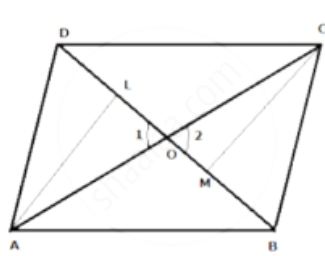
A quadrilateral $\text{ABCD}$ is such that diagonals $BD$ divides its area into two equal parts. Prove that $BD$ bisects $AC.$
Answer
Image
Join $A C$.
Suppose $A C$ and BD intersect at $O$.
Draw $A L$ and $C M$ perpendicular to $B D$.
$\operatorname{ar}(\triangle ABD )=\operatorname{ar}(\triangle B D C)$
Thus $\triangle A B D$ and $\triangle A B C$ are on the same base $A B$ and have equal area.
Therefore, their corresponding altitudes are equal i.e. $AL = CM$.
Now,
In  $ \triangle ALO$ and $\triangle CMO,$
$\angle 1=\angle 2\dots...($vertically opposite angles$)$
$\angle ALO =\angle CMO \ldots ($right angles$)$
$AL = CM$
Therefore,
$ \triangle A L O \cong \triangle C M O \quad \ldots(\text { AAS }$ axiom$)$
$\Rightarrow A O=O C$
$\Rightarrow B D$ bisects $A C . $
View full question & answer
Question 74 Marks
The diagonals $AC$ and $BC$ of a quadrilateral $\text{ABCD}$ intersect at $O$. Prove that if $BO = OD$, then areas of $\triangle ABC$ an $\triangle ADC$ area equal.
Answer
Image
In $\triangle ABD$
$B O=O D$
$\Rightarrow O$ is the mid$-$point of $BD$
$\Rightarrow AO$ is a median.
$\Rightarrow \operatorname{ar}(\triangle AOB )=\operatorname{ar}(\triangle AOD )$
In $\triangle C B D, O$ is the mid$-$point of $B D$
$\Rightarrow CO$ is a median.
$\Rightarrow \operatorname{ar}(\triangle COB )=\operatorname{ar}(\triangle COD )$
Adding $(i)$ and $(ii)$
$\operatorname{ar}(\triangle AOB ) 6 \operatorname{ar}(\triangle C O B)=\operatorname{ar}(\triangle AOD )+\operatorname{ar}(\triangle COD )$
Therefore, $\operatorname{ar}(\triangle A B C)=\operatorname{ar}(\triangle A D C)$.
View full question & answer
Question 84 Marks
Prove that the diagonals of a parallelogram divide it into four triangles of equal area.
Answer
Image
The diagonals of a parallelogram bisect each other.
Therefore, $O$ is the mid$-$point of $A C$ and $B D$.
$B o$ is the median in $\triangle A B C$.
Therefore, it will divide it into two triangles of equal areas
$\therefore \operatorname{ar}(\triangle AOB )=\operatorname{ar}(\triangle BOC ) \ldots . . . \text { (i) }$
In $\triangle B C D, C O$ is the median.
$\therefore \operatorname{ar}(\triangle B O C)=\operatorname{ar}(\triangle C O D) \ldots . . . \text { (ii) }$
Similarly, $\operatorname{ar}(\triangle C O D)=\operatorname{ar}(\triangle AOD )$
From $(i), (ii)$ and $(iii)$
$\operatorname{ar}(\triangle AOB )=\operatorname{ar}(\triangle BOC )=\operatorname{ar}(\triangle COD )=\operatorname{ar}(\triangle AOD )$
Hence, diagonals of a parallelogram divide it into foor triangles of equal areas.
View full question & answer
Question 94 Marks
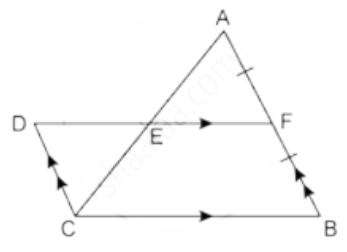
In the given figure $AF=B F$ and $\text{DCBF}$ is a parallelogram. If the area of $\triangle A B C$ is $30$ square units, find the area of the parallelogram $\text{DCBF}.$
Image
Answer
In $\triangle ABC,$
$AF = FB$ and $EF \| BC \dots...($given$)$
$\therefore AE = EC \dots...($Converse of Midpoint theorem$) \dots...(i)$
In $\triangle AEF$ and $\triangle CED,$
$\angle FEA = \angle DEC \dots...($Vertically opposite angles$)$
$CE = AE \dots...[$From $(i)]$
$\angle FAE = \angle DCE \dots...($Alternate angles$)$
$\therefore \triangle FAE \cong \triangle CED \dots...( \text{ASA}$ test of congruency$)$
$\Rightarrow A(\triangle AEF) = A(\triangle CED) \dots....(ii)$
$A(\triangle ABC)$
$= A(\triangle AEF) + A(EFBC)$
$= A(\triangle CED) + A(EFBC) ....[$From $(ii)]$
$\therefore A(\triangle ABC) = A(||^{gm} \text{DCBF})$
$\Rightarrow A(||^{gm} \text{DCBF}) = 30 sq$. units.
View full question & answer
Question 104 Marks
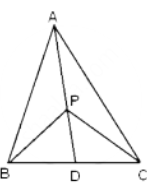
$AD$ is a median of a $\triangle ABC.P$ is any point on $AD$. Show that the area of $\triangle ABP$ is equal to the area of $\triangle ACP.$
Answer
Image
$A D$ is the median of $\triangle A B C$,
so, it will divide $\triangle A B C$ into two triangles of equal areas.
Therefore, Area$(\triangle ABD )=$Area$(\triangle ACD ) \dots. .(1)$
Now $PD$ is the median of $\triangle P B C$.
Therefore,Area$(\triangle P B D)=$Area$(\triangle P C D) \ldots(2)$
Subtract equation $(2)$ from equation $(1),$ we have
Area$(\triangle ABD )-$Area$(\triangle PBD )=$Area$(\triangle ACD )-$Area$(\triangle PCD )$
Area$(\triangle ABP )=$Area$(\triangle ACP )$.
View full question & answer
Question 114 Marks
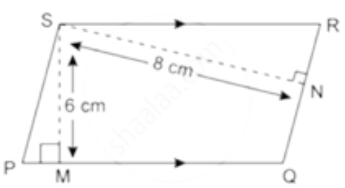
In the given figure, the perimeter of parallelogram $\text{PQRS}$ is $42\ cm.$ Find the lengths of $PQ$ and $PS.$
Image
Answer
Area of $\| gm \text{PQRS}=P Q \times 6$
Also,
Area of $\| gm \text{PQRS} =P S \times 8$
$ \therefore P Q \times 6=P S \times 8$
$\Rightarrow P Q=\frac{8 P S}{6}$
$\Rightarrow P Q=\frac{4 P S}{3} \ldots \text {(i)}$
Perimeter of $\| gm \text{PQRS}=P Q+O R+R S+P S$
$\Rightarrow 42=2 PQ +2 PS\dots...($opposite sides of a parallelogram are equal$)$
$\Rightarrow 21=P Q+P S$
$\Rightarrow \frac{4 PS }{3}+ PS =21 \ldots [$From $(i)]$
$\Rightarrow \frac{4 PS +3 PS }{3}$
$\Rightarrow 7 PS =63$
$\Rightarrow PS =9 \ cm$
Now,
$ P Q=\frac{4 P S}{3}$
$=\frac{4 \times 9}{3}$
$=12 \ cm$
$\therefore P Q=12 \ cm$ and $P S=9 \ cm . $
View full question & answer
Question 124 Marks
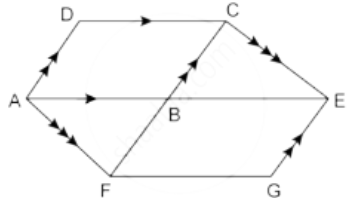
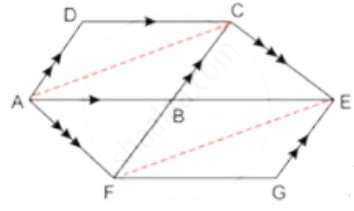
In the given figure, if $AB \| DC \| FG$ and $AE$ is a straight line. Also, $AD \| FC$. Prove that: area of $∥ gm\text{ABCD} =$ area of $\| gm \text{BFGE}.$
Image
Answer
Joining $AC$ and $FE$, we get
Image
$\triangle AFC$ and $\triangle AFE$ are on the same base $AF$ and between the same parallels $AF$ and $CE$.
$\Rightarrow A (\triangle AFC )= A (\triangle AFE )$
$\Rightarrow A (\triangle ABF )+ A (\triangle ABC )= A (\triangle ABF )+ A (\triangle BFE )$
$\Rightarrow A (\triangle ABC )= A (\triangle BFE )$
$\Rightarrow \frac{1}{2} A ($parallelogram$\text { ABCD})$
$=\frac{1}{2} A ($parallelogram $\text{ BFGE})$
$\Rightarrow A ($parallelogram $\text{ ABCD })$
$= A ($parallelogram$\text{ BFGE })$
View full question & answer
[4 marks sum] - MATHEMATICS STD 9 Questions - Vidyadip