Questions

[2 Mark Question Answer]

🎯

Test yourself on this topic

17 questions · timed · auto-graded

Question 12 Marks
Find a point on the $y-$axis which is equidistant from the points $(5, 2)$ and $(-4, 3).$
Answer
Let the co$-$ordinates of the required point on $y-$axis be $P (0, y).$
The given points are $A (5, 2)$ and $B (-4, 3).$
Given$, \text{PA} =\text{PB}$
$PA^2 = PB^2$
$(0 -5)^2 + (y -2)^2 = (0 + 4)^2 + (y - 3)^2$
$25 + y^2 + 4 - 4y = 16 + y^2 + 9 - 6y$
$2y = -4$
$y = -2$
Thus, the required point is $(0, -2).$
View full question & answer
Question 22 Marks
What point on the $x-$axis is equidistant from the points $(7, 6)$ and $(-3, 4)$?
Answer
Let the co$-$ordinates of the required point on $x-$axis be $P (x, 0).$
The given points are $A (7, 6)$ and $B (-3, 4).$
Given,$\text{PA} =\text{PB}$
$PA^2 = PB^2$
$(x - 7)^2 + (0 - 6)^2 = (x + 3)^2 + (0 - 4)^2$
$x^2+ 49 - 14x + 36 = x^2 + 9 + 6x + 16$
$60 = 20x$
$x = 3$
Thus, the required point is $(3, 0).$
View full question & answer
Question 32 Marks
The distance between the points $(3, 1)$ and $(0, x)$ is $5.$ Find $x.$
Answer
It is given that the distance between the points $A (3, 1)$ and B $(0, x)$ is $5.$
$\therefore \text{AB} = 5$
$AB^2 = 25$
$(0 - 3)^2 + (x - 1)^2 = 25$
$9 + x^2 + 1 - 2x = 25$
$x^2 - 2x - 15 = 0$
$x^2 - 5x + 3x - 15 = 0$
$x(x - 5) + 3(x - 5) = 0$
$(x - 5)(x + 3) = 0$
$x = 5, -3$
View full question & answer
Question 42 Marks
Calculate the distance between $A (5, -3)$ and $B$ on the $y-$axis whose ordinate is $9.$
Answer
We know that any point on $y-$axis has co$-$ordinates of the form $(0, y).$
Ordinate of point $B = 9$
Since, $B$ lies of $y-$axis, so its co$-$ordinates are $(0, 9).$
$\text{AB}=\sqrt{(0-5)^2+(9+3)^2} $
$ =\sqrt{25+144} $
$=\sqrt{169}$
$=13 \text{ units }$
View full question & answer
Question 52 Marks
Calculate the distance between $A (7, 3)$ and $B$ on the $x-$axis whose abscissa is $11.$
Answer
We know that any point on $x-$axis has co$-$ordinates of the form $(x, 0).$
Abscissa of point $B = 11$
Since,$B$ lies of $x-$axis, so its co-ordinates are $(11, 0).$
$\text{AB} =\sqrt{(11-7)^2+(0-3)^2} $
$=\sqrt{16+9}$
$ =\sqrt{25} $
$ =5 \text { units }$
View full question & answer
Question 62 Marks
Calculate the distance between the points $P (2, 2)$ and $Q (5, 4)$ correct to three significant figures.
Answer
$\text{PQ}=\sqrt{(5-2)^2+(4-2)^2}$
$ =\sqrt{9+4} $
$ =\sqrt{13}$
$= 3.6055$
$= 3.61\text{units}$
View full question & answer
Question 72 Marks
Find the distance between the origin and the point$:(8, -15)$
Answer
Coordinates of origin are $O\ (0, 0).$
$C\ (8, -15)$
$\text{CO} =\sqrt{(0-8)^2+(0+15)^2}$
$=\sqrt{64+225}$
$=\sqrt{289} $
$=17$
View full question & answer
Question 82 Marks
Find the distance between the origin and the point$:(-5, -12)$
Answer
Co$-$ordinates of origin are $O\ (0, 0).$
$B\ (-5, -12)$
$\text{BO} =\sqrt{(0+5)^2+(0+12)^2} $
$ =\sqrt{25+144} $
$=\sqrt{169} $
$=13$
View full question & answer
Question 92 Marks
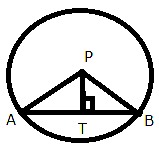
Point $P (2, -7)$ is the centre of a circle with radius $13\ unit, \text{PT}$ is perpendicular to chord $\text{AB}$ and $T = (-2, -4);$ calculate the length of $\text{AB}.$
Answer
We know that the perpendicular from the center of a circle to a chord bisects the chord.
$\therefore \text{AB} = 2\text{AT}$
$= 2 \times 12 \text{units}$
$= 24 \text{units}.$
View full question & answer
Question 102 Marks
Find the distance between the origin and the point$:(-8, 6)$
Answer
Co$-$ordinates of origin are $O\ (0, 0).$
$A\ (-8, 6)$
$\text{AO} =\sqrt{(0+8)^2+(0-6)^2}$
$=\sqrt{64+36} $
$ =\sqrt{100}$
$ =10$
View full question & answer
Question 112 Marks
Given $A = (x + 2, -2)$ and $B (11, 6)$. Find $x$ if $\text{AB} = 17.$
Answer
$\text{AB} = 17$
$\text{AB}^2= 289$
$(11 - x - 2)^2+ (6 + 2)^2= 289$
$x^2+ 81 - 18x + 64 = 289$
$x^2- 18x - 144 = 0$
$x^2- 24x + 6x - 144 = 0$
$x(x - 24) + 6(x - 24) = 0$
$(x - 24) (x + 6) = 0$
$x = 24, -6$
View full question & answer
Question 122 Marks
Given $A = (3, 1)$ and $B = (0, y - 1).$ Find $y$ if $\text{AB} = 5.$
Answer
$\text{AB} = 5$
$\text{AB}^2= 25$
$(0 - 3)^2+ (y - 1 - 1)^2= 25$
$9 + y^2+ 4 - 4y = 25$
$y^2- 4y - 12 = 0$
$y^2- 6y + 2y - 12 = 0$
$y(y - 6) + 2(y - 6) = 0$
$(y - 6) (y + 2) = 0$
$y = 6, -2$
View full question & answer
Question 132 Marks
Find the distance between the following pairs of points$:(\sqrt{3}+1,1)$ and $(0, \sqrt{3})$
Answer
$(\sqrt{3}+1,1)$ and $(0, \sqrt{3})$
Distance between the given points
$=\sqrt{(0-\sqrt{3}-1)^2+(\sqrt{3}-1)^2} $
$=\sqrt{3+1+2 \sqrt{3}+3+1-2 \sqrt{3}}$
$=\sqrt{8} $
$ =2 \sqrt{2}$
View full question & answer
Question 142 Marks
Find the distance between the following pairs of points$:\left(\frac{3}{5}, 2\right)$ and $\left(-\frac{1}{5}, 1 \frac{2}{5}\right)$
Answer
$\left(\frac{3}{5}, 2\right)$ and $\left(-\frac{1}{5}, 1 \frac{2}{5}\right)$
Distance between the given points
$=\sqrt{\left(-\frac{1}{5}-\frac{3}{5}\right)^2+\left(1 \frac{2}{5}-2\right)^2}$
$=\sqrt{\left(-\frac{4}{5}\right)^2+\left(\frac{7-10}{5}\right)^2} $
$=\sqrt{\frac{16}{25}+\frac{9}{25}} $
$=\sqrt{\frac{25}{25}}$
$= 1$
View full question & answer
Question 152 Marks
Find the distance between the following pairs of points$:(-a, -b)$ and $(a, b)$
Answer
$(-a, -b)$ and $(a, b)$
Distance between the given points
$=\sqrt{(a+a)^2+(b+b)^2}$
$=\sqrt{(2 a)^2+(2 b)^2}$
$=\sqrt{4 a^2+4 b^2}$
$=2 \sqrt{a^2+b^2}$
View full question & answer
Question 162 Marks
Find the distance between the following pairs of points$:(-3, 6)$ and $(2, -6)$
Answer
$(-3, 6)$ and $(2, -6)$
Distance between the given points
$=\sqrt{(2+3)^2+(-6-6)^2}$
$ =\sqrt{(5)^2+(-12)^2}$
$ =\sqrt{25+144} $
$=\sqrt{169}$
$=13$
View full question & answer
Question 172 Marks
A point $P$ lies on the $x-$axis and another point $Q$ lies on the $y-$axis.
If the abscissa of point $P$ is $-12$ and the ordinate of point $Q$ is $-16;$ calculate the length of line segment $\text{PQ}.$
Answer
The co$-$ordinates of $P$ and $Q$ are $(-12, 0)$ and $(0, -16)$ respectively.
$\text{PQ}=\sqrt{(-12-0)^2+(0+16)^2} $
$ =\sqrt{144+256} $
$=\sqrt{400} $
$=20$
View full question & answer