Questions

[3 marks sum]

🎯

Test yourself on this topic

11 questions · timed · auto-graded

Question 13 Marks
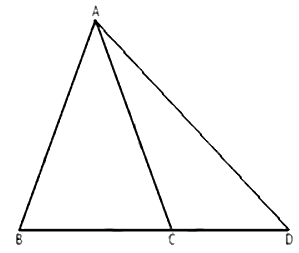
$\triangle ABC$ is isosceles with $AB = AC.$ If $BC$ is extended to $D,$ then prove that $AD > AB.$
Answer
Using the exterior angle and property in $\triangle ACD,$
we have
$\angle ACB = \angle CDA + \angle CAD$
$\Rightarrow \angle ACB > \angle CDA ------(1)$
Now, $AB = AC$
Now, $\angle ACB = \angle ABC ------(2)$
From $(1)$ and $(2)$
$\angle ABC > \angle CDA$
It is known that, in a triangle, the greater angle has the longer side opposite to it.
Now, In $\triangle ABD$, er have $\angle ABC > \angle CDA$
$\therefore AD > AB.$
View full question & answer
Question 23 Marks
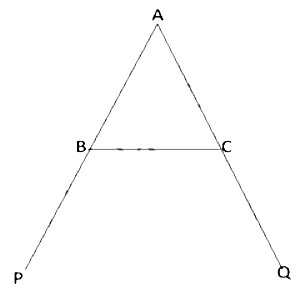
In $\triangle ABC,$ the exterior $\angle PBC >$ exterior $\angle QCB.$ Prove that $AB > AC.$
Answer
It is given that $\angle PBC > \angle QCB -------(1)$
$\angle PBC + \angle ABC = 180 ...[$Linear pair angles$]$
$\Rightarrow \angle PBC = 180 - \angle ABC$
Similarly, $\angle QCB = 180 - \angle ACB$
From $(1)$ and $(2)$
$180 - \angle ABC > 180 - \angle ACB$
$\Rightarrow -\angle ABC > - \angle ACB$
$\Rightarrow ABC < \angle ACB$ or $\angle ACB > \angle ABC$
It is known that in a triangle, the greater angle has the longer side opposite to it.
$\therefore AB > AC.$
View full question & answer
Question 33 Marks
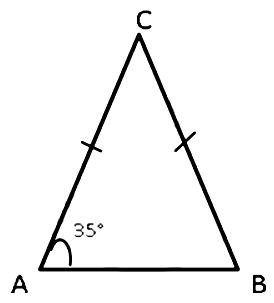
In a triangle $ABC, BC = AC$ and $\angle A = 35^\circ .$ Which is the smallest side of the triangle?
Answer
In $\triangle ABC,$
$BC = AC ...($given$)$
$\Rightarrow \angle A = \angle B = 35^\circ $
Let $\angle C = x^\circ $
In $\triangle ABC,$
$\angle A + \angle B + \angle C = 180^\circ $
$35^\circ + 35^\circ + x = 180^\circ $
$70^\circ + x^\circ = 180^\circ $
$x^\circ = 180^\circ - 70^\circ $
$x^\circ = 110^\circ $
$\angle C = x^\circ = 110^\circ $
Hence, $\angle A = \angle B = 35^\circ $ and $\angle C = 110^\circ $
In $\triangle ABC,$ the greatest angle is $\angle C.$
As the smallest angles are $\angle A$ and $\angle B,$
smallest sides are $BC$ and $AC.$
View full question & answer
Question 43 Marks
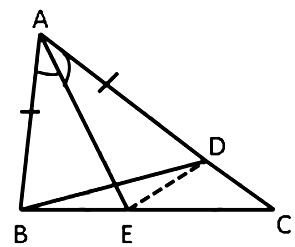
In $\triangle ABC, AE$ is the bisector of $\angle BAC. D$ is a point on $AC$ such that $AB = AD.$ Prove that $BE = DE$ and $\angle ABD > \angle C.$
Answer
In the $\triangle ABE$ and $\triangle ADE,$
$AB = AD ....($Given$)$
$\angle BAE = \angle DAE ....(AE$ is the bisector of $\angle BAC)$
$AE = AE ....($Common side$)$
$\therefore \triangle ABE ≅ \triangle ADE ....(\text{SAS}$ test$)$
$\Rightarrow BE = DE ....($c.p.c.t.c$)$
In $\triangle ABD,$
$AB = AD$
$\Rightarrow \angle ABD = \angle ADB$
$\angle ADB > \angle C ...($Exterior angle property$)$
$\Rightarrow \angle ABD > \angle C.$
View full question & answer
Question 53 Marks
Arrange the sides of the following triangles in an ascending orde$r:\triangle DEF, \angle D = 38^\circ , \angle E = 58^\circ .$
Answer
In $\triangle DEF,$
$\angle D + \angle E + \angle F = 180^\circ $
$38^\circ + 58^\circ + \angle F = 180^\circ $
$96^\circ + \angle F = 180^\circ $
$\angle F = 180^\circ - 96^\circ $
$\angle F = 84^\circ $
Hence, $\angle D = 38^\circ , \angle E = 58^\circ , \angle F = 84^\circ $
$38^\circ < 58^\circ < 84^\circ $
Hence, ascending order of the angles in the
given triangle is $\angle D < \angle E < \angle F$.
Hence, ascending order of sides in triangle
$EF, DF, DE.$
View full question & answer
Question 63 Marks
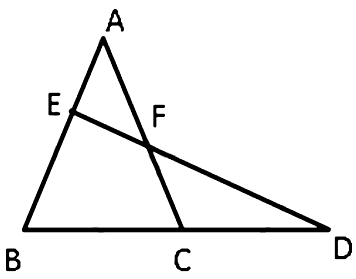
$\triangle ABC$ in a isosceles triangle with $AB = AC. D$ is a point on $BC$ produced. $ED$ intersects $AB$ at $E$ and $AC$ at $F.$ Prove that $AF > AE.$
Answer
$\angle AEF > \angle ABC ...($Exterior angle property$)$
$\angle AEF = \angle DFC$
$\angle ACB > \angle DFC ...($Exterior angle property$)$
$\Rightarrow \angle ACB > \angle AFE$
Since $AB = AC$
$\Rightarrow \angle ACB = \angle ABC$
So, $\angle ABC > \angle AFE$
$\Rightarrow \angle AEF > \angle ABC > \angle AFE$
that is $\angle AEF > \angle AFE$
$\Rightarrow AF > AE.$
View full question & answer
Question 73 Marks
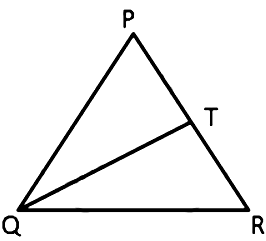
In the given figure,$T$ is a point on the side $PR$ of an equilateral $\triangle PQR.$ Show that $PT < QT$

 
Answer
In $\triangle PQR,$
$PQ = QR = PR$
$\Rightarrow \angle P = Q = \angle = 60^\circ $
In $\triangle PQT,$
$\angle PQT < 60^\circ $
$\therefore \angle PQT < \angle P$
$\therefore PT < QT.$
View full question & answer
Question 83 Marks
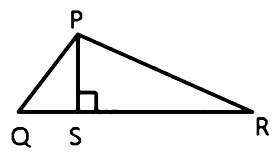
In $\triangle PQR, PS \perp QR ;$ prove that$: PQ > QS$ and $PQ > PS$
​​​​​​​
Answer
In $\triangle PQS,$
$PS < PQ ....($Of all the straight lines that can be drawn to a given straight line from a point outside it, the perpendicular is the shortest$.)$
I.e.$ PQ > PS$
Also, $QS < QP ....($Of all the straight lines that can be drawn to a given straight line from a point outside it, the perpendicular is the shortest$.)$
i.e. $PQ > QS.$
View full question & answer
Question 93 Marks
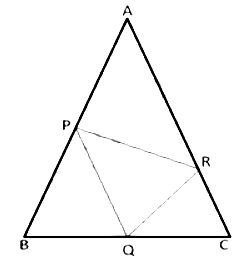
In $ABC, P, Q$ and $R$ are points on $AB, BC$ and $AC$ respectively. Prove that :$AB + BC + AC > PQ + QR + PR.$
Answer
In $\triangle APR,$
$AP + AR > PR ......(i)$
In $\triangle BPQ,$
$BQ + PB > PQ .......(ii)$
In $\triangle QCR,$
$QC + CR > QR .......(iii)$
Adding $(i), (ii)$ and $(iii)$
$AP + AR + BQ + PB + QC + CR > PR + PQ + QR$
$(AP + PB) + (BQ + QC) + (CR + AR) > PR + QR + PQ)$
$\Rightarrow AB + BC + AC > PQ + QR + PR.$
View full question & answer
Question 103 Marks
Name the greatest and the smallest sides in the following triangles:$\triangle DEF, \angle D = 32^\circ , \angle E = 56^\circ$ and $\angle F = 92^\circ .$
Answer
In the given $\triangle DEF$ the greatest angle is $\angle F$ and
the opposite side to the $\angle F$ is $DE$
Hence, the greatest side is $DE$.
The smallest angle in the $\triangle DEF$ is $D$ and
the opposite side to the $\angle D$ is $EF .$
Hence, the smallest side is $EF.$
View full question & answer
Question 113 Marks
Name the greatest and the smallest sides in the following triangles$:\triangle ABC, \angle = 56^\circ , \angle B = 64^\circ$ and $\angle C = 60^\circ .$
Answer
In the given $ \triangle ABC$ the greatest angle is $\angle B$ and
the opposite side to the $\angle B$ is $AC$.
Hence, the greatest side is $AC.$
The smallest angle in the $\triangle ABC$ is $\angle A$ and
the opposite side to the $\angle A$ is $BC.$
Hence, the smallest side is $BC.$
View full question & answer
[3 marks sum] - MATHEMATICS STD 9 Questions - Vidyadip