Questions

[5 marks sum]

🎯

Test yourself on this topic

6 questions · timed · auto-graded

Question 15 Marks
Prove that the hypotenuse is the longest side in a right$-$angled triangle.
Answer
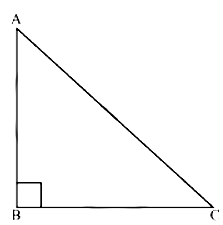
Let us consider a right angled $\triangle ABC$, right angle at $B.$
In $\triangle ABC$
$\angle A + \angle B +\angle C = 180^\circ ...($angle sum property of a triangle$)$
$\angle A + 90^\circ + \angle C = 180^\circ $
$\angle A +\angle C = 90^\circ $
Hence, the other two angles have to be acute $($i.e. less than $90^\circ).$
$\therefore \angle B$ is the largest angle in $\triangle ABC.$
$\Rightarrow \angle B > \angle A$ and $\angle B > \angle C$
$\Rightarrow AC > BC$ and $AC > AB$
$[$In ant triangle, the side opposite to the larger $($greater$)$ angle is longer$]$
So, $Ac$ is the largest side in $\triangle ABC.$
But $AC$ is the hypotenuse of $\triangle ABC$.
Therefore, hypotenuse is the longest side in a right angled triangle.
View full question & answer
Question 25 Marks
Prove that the perimeter of a triangle is greater than the sum of its three medians.
Answer
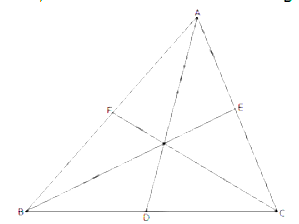
Given: $\triangle ABC$ ion which $AD, BE$ and $CF$ are its medians.
To Prove: we know that the sum of any two dies of a triangle is greater than twice the median bisecting the third side.
Therefore,
$AD$ is the median bisecting $BC$
$\Rightarrow AB + AC > 2AD ...(i)$
$BE$ is the median bisecting $AC ...(ii)$
And, $C$F is the median bisecting $AB$

$\Rightarrow BC + AC > 2EF ...(iii)$
Adding $(i), (i$i) and $(iii)$, we get
$(AB + AC) + (AB + BC) + (BC + AC) > 2. AD + 2. BE + 2. BE + 2. CF$
$\Rightarrow 2 (AB + BC + AC) > 2 (AD + BE + CF)$
$\Rightarrow AB + BC + AC > AD + BE + CF.$
View full question & answer
Question 35 Marks
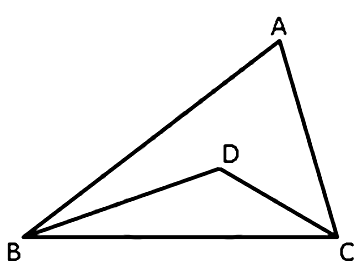
In $\triangle ABC, D$ is a point in the interior of the triangle. Prove that $DB + DC < AB + AC.$
Answer

In the $\triangle A B C$,
$A B+A C>B C . . . .(\because$ Sum of the two sides of triangle is always greater than third side.$)$
Also, in the $\triangle B D C$,
$B D+D C>B C \ldots \text { (ii) }$
Dividing $(i)$ by $(ii),$
$ \frac{A B+A C}{B D+D C}>\frac{B C}{B C}$
$\frac{A B+A C}{B D+D C}>1$
$A B+A C>B D+D C$
i.e. $B D+D C$
View full question & answer
Question 45 Marks
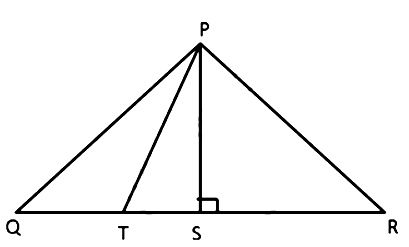
Prove that in an isosceles triangle any of its equal sides is greater than the straight line joining the vertex to any point on the base of the triangle.
Answer

Let the triangle be $\text{PQR}.$
$PS QR$, the straight line joining verte\times $P$
to the line $QR.$
To prove : $PQ > PT$ and$ PR > PT$
In $\triangle PSQ,$
$PS2 + SQ^2 = PQ^2 ....($Pythagoras theroem$)$
$PS^2 = PQ^2 - SQ^2 ....(i)$
In $\triangle PST,$
$PS^2 + ST^2= PT^2 ....($Pythagoras theroem$)$
$PQ^2- SQ^2 = PT^2 - ST^2 ....(ii)$
$PQ - (ST + TQ)^2= PT^2 - ST^2 ....[$from $(i)$ and $(ii)]$
$PQ^2 - (ST^2 - 2ST \times TQ + TQ^2) = PT^2 - ST^2$
$PQ^2 - (ST^2 - 2ST \times TQ - TQ2 = PT^2 - ST$
$PQ^2 - PT^2 = TQ^2 + 2ST \times TQ$
$PQ^2 - PT^2 = TQ \times (2ST + TQ)$
As, $TQ \times (2ST + TQ) > 0$ always.
$PQ^2 - PT^2> 0$
$PQ^2 > PT^2$
$PQ > PT$
Also, $PQ = PR$
$PR > PT.$
View full question & answer
Question 55 Marks
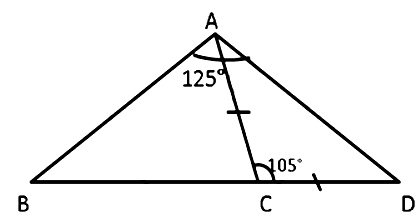
In $\triangle ABC, BC$ produced to $D,$ such that, $AC = CD; \angle BAD = 125^\circ$ and $\angle ACD = 105^\circ.$ Show that $BC > CD.$
Answer
 In $\triangle ACD ,$
$AC = CD$
$\angle CDA =\angle DAC \ldots . .(\triangle ACD$ is isosceles triangle.$)$
 Let $\angle CDA =\angle DAC = x ^{\circ}$
$\angle CDA +\angle DAC +\angle ACD =180^{\circ}$
$x ^{\circ}+ x ^{\circ}+105^{\circ}=180^{\circ}$
$2 x ^{\circ}+180^{\circ}-105^{\circ}$
$2 x ^{\circ}=75^{\circ}$
$x=\frac{75^{\circ}}{2}$
$x =37.5^{\circ}$
$\angle C =\angle DAC = x ^{\circ}=37.5^{\circ} \ldots . . . \text { (i) }$
$\angle DAC =\angle AC +\angle BAC$
$125^{\circ}-37.5^{\circ}=\angle BAC \ldots . .$ from $\text { (i) }$
$125^{\circ}-37.5^{\circ}=\angle BAC$
$87.5^{\circ}=\angle BAC$
Also, $\angle BCA +\angle ACD =180^{\circ}$
$\Rightarrow \angle B C A+105^{\circ}=180^{\circ}$
$\Rightarrow \angle B C A=75^{\circ} $
So, in $\triangle B A C$,
$ \angle ACB +\angle BAC +\angle C =180^{\circ}$
$\Rightarrow 75^{\circ}+87.5^{\circ}+\angle ABC =180^{\circ}$
$\Rightarrow \angle ABC =17.5^{\circ} $
As $87.5^{\circ}>17.5^{\circ}$
$\angle B A C>\angle A B C$
$\Rightarrow B C>A C$
$\Rightarrow B C>C D . \ldots .($Since $A C=C D)$
View full question & answer
Question 65 Marks
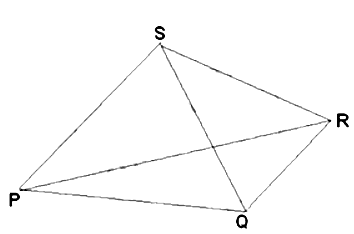
For any quadrilateral, prove that its perimeter is greater than the sum of its diagonals.
Answer

Given: $\text{PQRS}$ is a quadrilateral.
$PR$ and $QS$ are its diagonals.
To Prove: $PQ + QR + SR + PS > PR + QS$
Proof: In $\triangle PQR$
$PQ + QR > PR ...($Sum of two sides of triangle is greater than the third side$)$
Similarly, In $\triangle PSR, PS + SR > PR$
In $\triangle PQS, PS + PQ > QS$ and in $\text{QRS}$
we have $QR + SR > QS$
Now we have
$PQ +QR > PR$
$PS + SR > PR$
$PS + PQ > QS$
$QR + SR > QS$
After adding above inequalities we get
$2(PQ + QR + PS + SR) > 2(PR + QS)$
$\Rightarrow PQ + QR + PS + SR > PR +QS.$
View full question & answer
[5 marks sum] - MATHEMATICS STD 9 Questions - Vidyadip