Questions

[5 marks sum]

🎯

Test yourself on this topic

12 questions · timed · auto-graded

Question 15 Marks
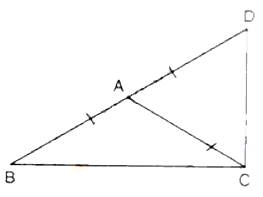
Side $BA$ of an isosceles $\triangle ABC$ is produced so that $AB = AD$. If $AB$ and $AC $are the equal sides of the isosceles triangle, prove that $\angle BCD$ is a right angle.
Answer
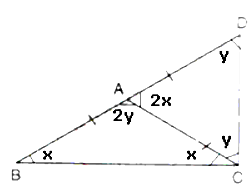
Let $\angle ABC = x$,
$\therefore \angle BCA = x$
since $AB = AC$
In $\triangle ABC,$
$\angle ABC + \angle BCA + \angle BAC = 180^\circ ......(i)$
But $\angle BAC + \angle DAC = 180^\circ ......(ii)$
From $(i)$ and $(ii)$
$\angle ABC + \angle BCA + \angle BAC = \angle BAC + \angle DAC$
$\angle DAC = \angle ABC + \angle BCA = x + x = 2x$
Let $\angle ADC = y$,
$\therefore \angle DCA = y$
since $AD = AC$
In $\triangle ADC,$
$\angle ADC + \angle DCA + \angle DAC = 180^\circ ......(iii)$
But $\angle BAc + \angle DAC = 180^\circ ......(iv)$
From $(iii)$ and $(iv)$
$\angle ADC + \angle DCA + \angle DAC = \angle BAC + \angle DAC$
$\angle BAC = \angle ADC + \angle DCA = y + y = 2y$
Substituting the value of $\angle BAC$ and $\angle DCA$ in $(ii)$
$2x + 2y = 180^\circ $
$x + y = 90^\circ $
$\Rightarrow \angle BCA + \angle DCA = 90^\circ $
$\Rightarrow \angle BCD$ is a right angle.
View full question & answer
Question 25 Marks
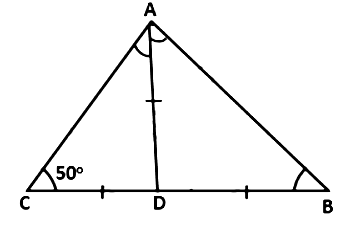
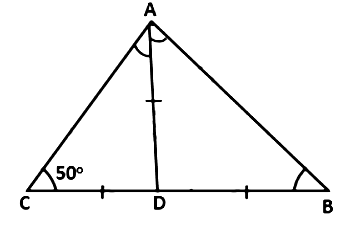
Find the interior angles of the following triangles:
Answer

In $\triangle ACD,$
$AD = CD ....($given$)$
$\Rightarrow \angle ACD = \angle CAD ....($angles opposite to two equal sides are equal$)$
Now, $\angle ACD = 50^\circ ....($given$)$
$\Rightarrow \angle CAD = 50^\circ $
By exterior angle property,
$\angle ADB = \angle ACD + \angle CAD = 50^\circ + 50^\circ = 100^\circ $
In $\text{ADB},$
$AD = BD ....($given$)$
$\Rightarrow \angle DBA =\angle DAB ....($angles opposite to two equal sides are equal$)$
Also, $\angle ADB + \angle DBA + \angle DAB = 180^\circ $
$\Rightarrow 100 + 2\angle DBA = 180^\circ $
$\Rightarrow 2\angle DBA = 80^\circ $
$\Rightarrow \angle DBA = 40 ^\circ $
$\Rightarrow \angle DBA = 40^\circ $
$\angle BAC = \angle DAB + \angle CAD = 40^\circ + 50^\circ = 90^\circ $
Hence, the interior angles of $\triangle ABC$ are $50^\circ , 90^\circ $ and $40^\circ .$
View full question & answer
Question 35 Marks
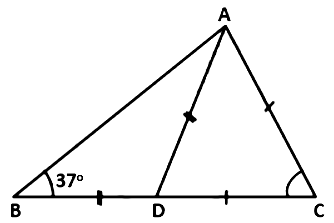
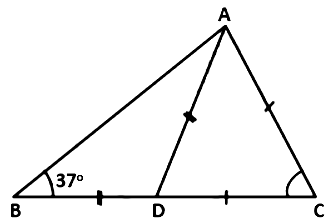
Find the interior angles of the following triangles:
Answer

In $\triangle ABD,$
$AD = BD ....($given$)$
$\Rightarrow \angle ABD = \angle BAD ....($angles opposite to two equal sides are equal$)$
Now, $\angle ABD = 37^\circ ....($given$)$
$\Rightarrow \angle BAD = 37^\circ $
By exterior angle property,
$\angle ADC =\angle ABD + \angle BAD$
$\Rightarrow \angle ADC = 37^\circ + 37^\circ = 74^\circ $
In $\triangle ADC,$
$AC = DC ....($given$)$
$\Rightarrow \angle ADC = \angle DAC ....($angles opposite to two equal sides are equal$)$
$\Rightarrow \angle DAC = 74^\circ $
Now, $\angle BAC = \angle BAD + \angle DAC$
$\Rightarrow \angle BAC = 37^\circ + 74^\circ = 111^\circ $
In $\triangle ABC,$
$\angle BAC + \angle ABC + \angle ACB = 180^\circ $
$\Rightarrow 111^\circ + 37^\circ + \angle ACB = 180^\circ $
$\Rightarrow \angle ACB = 180^\circ - 111^\circ - 37^\circ = 32^\circ $
Hence, the interior angles of $\triangle ABC$ are $37^\circ , 111^\circ $ and $32^\circ .$
View full question & answer
Question 45 Marks
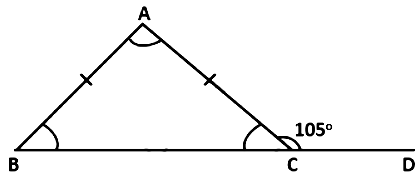
Find the interior angles of the following triangles:
Answer

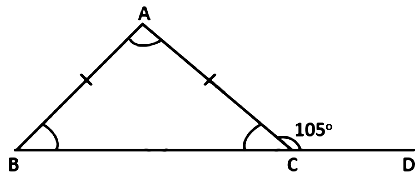
In $ABC,$
$AB = AC$
$\Rightarrow \angle ACB = \angle ABC ....(1)($angles opposite two equal sides are equal$)$
Now, $\angle ACB + \angle ACD = 180^\circ ...($linear pair$)$
$\Rightarrow \angle ACB = 180^\circ - \angle ACD$
$\Rightarrow \angle ACB = 180^\circ - 105^\circ $
$\Rightarrow \angle ABC = 75^\circ $
$\Rightarrow \angle ABC = 75^\circ ....[$From $(1)]$
By angle sum property, in $\triangle ABC$
$\angle ABC + \angle ACB - \angle BAC = 180^\circ $
$\Rightarrow 75^\circ + 75^\circ + \angle BAC = 180^\circ $
$\Rightarrow 150^\circ + \angle BAC = 180^\circ $
$\Rightarrow \angle BAC = 180^\circ - 150^\circ $
$\Rightarrow \angle BAC = 30^\circ $
Hence, in $\triangle ABC, \angle A = 30^\circ , \angle B = 75^\circ $ and $\angle C = 75^\circ .$
View full question & answer
Question 55 Marks
Find the interior angles of the following triangles:
Answer
Image
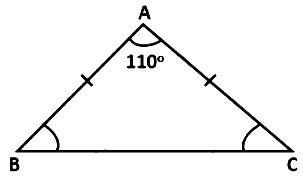
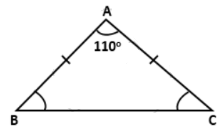
In $\text {ABC}$
$\angle A=110^{\circ}$
$A B=A C$
$\Rightarrow \angle C=\angle B \ldots .($angles opposite to two equal sides are equal$)$
$\Rightarrow \angle C=\angle B....($angles opposite to two equal sides are equal$)$
Now, by angle sum property,
$\angle A+\angle B+\angle C=180^{\circ}$
$\Rightarrow \angle A+\angle B+\angle B=180^{\circ}$
$\Rightarrow 110^{\circ}+2 \angle B=180^{\circ}$
$\Rightarrow 2 \angle B=180-110^{\circ}$
$\Rightarrow 2 \angle B=70^{\circ}$
$\Rightarrow \angle B=35^{\circ}$
$\Rightarrow \angle C=35^{\circ} $
Hence, $\angle B=35^{\circ}$ and $\angle C=35^{\circ}$.
View full question & answer
Question 65 Marks
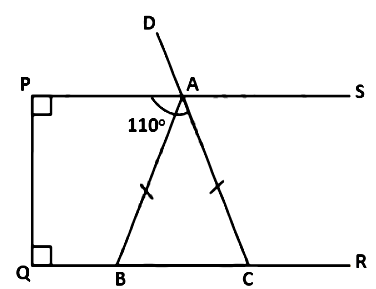
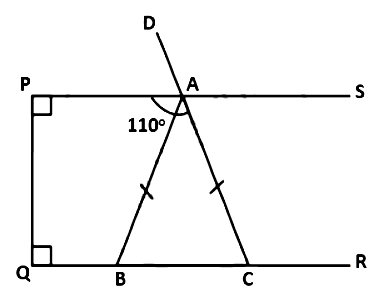
In the given figure, if $\text{DABC}$ is an isosceles triangle and $\angle PAC = 110^o,$ find the base angle and vertex angle of the $\text{DABC}.$
Answer

Given : $\angle PAC = 110^\circ$
To find :
Base angles : $\angle ABC$ and $\angle ACB$
Vertex angle : $\angle BAC$
In quadrilateral $APQC,$
$\angle APQ + \angle PQC + \angle ACQ + \angle PAC = 360^\circ$
$\Rightarrow 90^\circ + 90^\circ + \angle QCA + 110^\circ = 360^\circ$
$\Rightarrow \angle ACQ = 360^\circ - 290^\circ$
$\Rightarrow \angle ACQ = 70^\circ$
$\Rightarrow \angle ACB = 70^\circ ....(i)$
In $\triangle ABC,$
$AB = AC ....($given$)$
$\Rightarrow \angle ACB = \angle ABC ....($angles opposite to two equal sides are equal$)$
$\Rightarrow \angle ABC = 70^\circ ....[$From $(i)]$
In $\triangle ABC$
$\angle ABC + \angle ACB + \angle BAC = 180^\circ ....($angle sum property$)$
$\Rightarrow 70^\circ + 70^\circ + \angle BAC = 180^\circ$
$\Rightarrow \angle BAC = 180^\circ - 140^\circ$
$\Rightarrow \angle BAC = 40^\circ .$
View full question & answer
Question 75 Marks
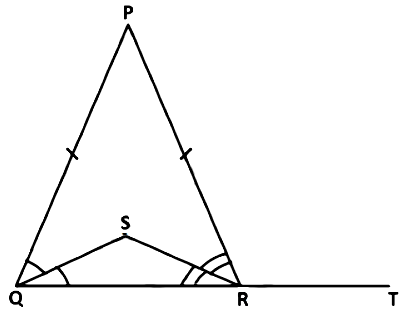
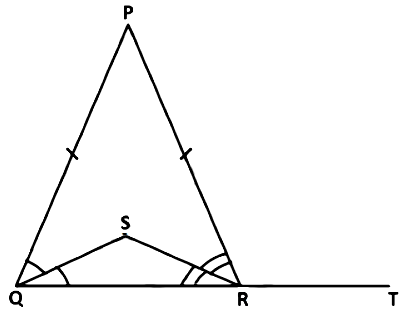
In the give figure, if $\text{DPQR}$ is an isosceles triangle, prove that: $\angle QSR =$ exterior $\angle PRT.$
Answer

Let $\angle PQS = \angle SQR = x$ and $\angle PRS = \angle SRQ = y$
In $\triangle PQR,$
$\angle QPR + \angle PQR + \angle PRQ = 180^\circ $
$\Rightarrow \angle QPR + 2x + 2y = 180^\circ $
$\Rightarrow \angle QPR = 180^\circ - 2x - 2y ....(i)$
Since $PQ = PR,$
$\angle PRQ = \angle PQR ....($angles opposite to two equal sides are equal$)$
$\Rightarrow 2x = 2y$
$\Rightarrow x = y$
Now, $\angle PRT = \angle PQR + \angle QPR ....($by exterior angle property$)$
$\Rightarrow \angle PRT = 2x + 180^\circ - 2x - 2y ....($From $(i)]$
$\Rightarrow \angle PRT = 180^\circ - 2y ....(ii)$
In $\triangle SQR,$
$\angle QSR + \angle SQR + \angle SRQ = 180^\circ $
$\Rightarrow \angle QSR + x + y = 180^\circ $
$\Rightarrow \angle QSR = 180^\circ - x - y$
$\Rightarrow \angle QSR = 180^\circ - y - y ....[\because x = y ($proved$)]$
$\Rightarrow \angle QSR = 180^\circ - 2y ....(iii)$
From $(ii)$ and $(iii),$
$\angle QSR = \angle PRT.$
View full question & answer
Question 85 Marks
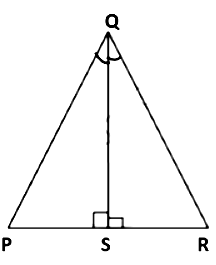
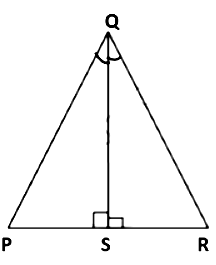
In $\text{DPQR}$ as shown, $\angle PQS = \angle RQ$S and $QS \perp PR$. Find the value of $x$ and $y$, if $PQ = 3x + 1; QR = 5y - 2; PS = x + 1$ and $SR = y + 2.$
Answer

In $\triangle PQS$ and $\triangle SQR,$
$QS = QS ....[$Common$]$
$\angle QSP = \angle QSR ....[$each $= 90^\circ ]$
$\angle PQS = \angle RQS ....[$given$]$
$\therefore \triangle PQS \cong \triangle SQR ....[$By $\text{ASA}$ criterion$]$
$\Rightarrow PS = RS$
$\Rightarrow x + 1 = y + 2$
$\Rightarrow x = y + 1 ....(i)$
And $PQ = SQ$
$\Rightarrow 3x + 1 = 5y - 2$
$\Rightarrow 3(y + 1) + 1 = 5y - 2 ....$[From $(i)]$
$\Rightarrow 3y + 3 + 1 = 5y - 2$
$\Rightarrow 3y + 4 = 5y - 2$
$\Rightarrow 2y = 6$
$\Rightarrow y = 3$
Putting $y = 3$ in $(i),$
$x = y + 1$
$= 3 + 1$
$= 4.$
View full question & answer
Question 95 Marks
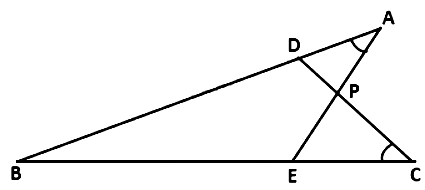
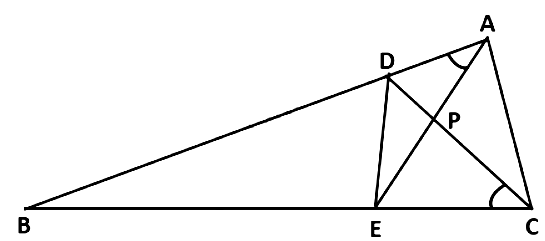
In the given figure, $D$ and $E$ are points on $AB$ and $AC$ respectively. $AE$ and $CD$ intersect at $P$ such that $AP = CP$. If $\angle BAE = \angle BCD$, prove that $\text{DBDE}$ is isosceles.
Answer

Join $DE$ and $AC$
In $\triangle APD = \triangle EPC,$
$\angle DAP = \angle ECP ....(\because \angle BAE = \angle BCD)$
$AP = CP ....($given$)$
$\angle APD = \angle EPC ....($vertically opposite angles$)$
$\therefore \triangle APD ≅ \triangle EPC ....($By $\text{ASA}$ Congruence critetion$)$
$\Rightarrow AD = EC ....(c.p.c.t)$
In $\triangle APC,$
$AP = CP ....($given$)$
$\Rightarrow \angle PAC = \angle PCA ....($angles opposite to two equal sides are equal$)$
Now, $\angle BAC = \angle BCD$ and .$\angle PAC = \angle PCA$
$\Rightarrow \angle BAC =\angle BCA$
$\Rightarrow BC = BA ...($sides opposites to two equal sides are equal$)$
$\Rightarrow BE + EC = BD + DA$
$\Rightarrow BE = BD ....(\because EC = DA)$
$\Rightarrow \angle BDE = \angle BED ....($angles opposite to two equal sides are equal$)$
$\Rightarrow \triangle BDE$ is an isosceles triangle.
View full question & answer
Question 105 Marks
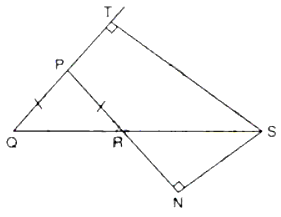
$\triangle PQR$ is an isosceles triangle with $PQ = PR. QR$ is extended to $S$ and $ST$ is drawn perpendicular to $QP$ produced, and $SN$ is perpendicular to $PR$ produced. Prove that $QS$ bisects $\angle TSN.$
​​​​​​​
Answer
In $\triangle PQR$, let $\angle PQR = x$
$PQ = PR$
$\Rightarrow \angle PQR = \angle PRQ = x ........(i)$
In $\triangle RNS,$
$\angle NRS = \angle PRQ = x .........($vertically opposite angles$)$
$\angle RNS = 90^\circ ...($given$)$
$\angle NSR + \angle RNS + \angle NRS = 180^\circ $
$\angle NSR + 90^\circ + x = 180$
$\angle NSR = 90^\circ - x .........(ii)$
Now in Quadrilateral $\text{PTRS}$
$\angle PTS = 90^\circ ...($given$)$
$\angle TPR = \angle PQR + \angle PRQ = 2x ....($exterior angle to $\triangle PQR)$
$\angle PRS = 180^\circ - \angle PRQ = 180^\circ - x ...(\text{QRS}$ is a $st.$ Line$)$
$\angle PTS + \angle TRP + \angle PRS + \angle TSR = 360^\circ ...($angles of a quad. $= 360^\circ )$
$90^\circ + 2x + 180^\circ - x + \angle TSR = 360^\circ $
$\angle TSR = 90^\circ - x ..........(iii)$
From $(ii)$ and $(iii)$
$\angle TSR = \angle NSR$
Therefore, $QS$ bisects $\angle TSN.$
View full question & answer
Question 115 Marks
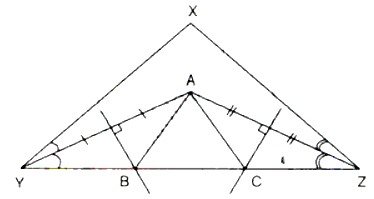
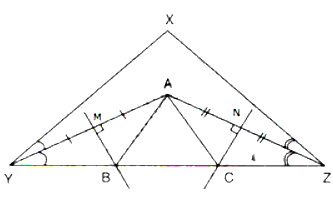
In $\triangle XYZ, AY$ and $AZ$ are the bisector of $\angle Y$ and $\angle Z$ respectively. The perpendicular bisectors of $AY$ and $AZ$ cut $YZ$ at $B$ and $C$ respectively. Prove that line segment $YZ$ is equal to the perimeter of $\triangle ABC.$
​​​​​​​
Answer

Let $M$ and $N$ be the points where $AY$ and $AZ$ are bisected.
In $\triangle ABM$ and $\triangle BMY$
$MY = MA ...(BM$ bisects $AY)$
$BM = BM ...($common$)$
$\angle BMY = \angle BMA$
Therefore, $\triangle ABM \cong \triangle BMY$
Hence, $YB = AB ..........(i)$
In $\triangle ACN$ and $\triangle CNZ$
$NZ = NA ...(CN$ bisects $AZ)$
$CN = CN ...($common)
$\angle CAN = \angle CNZ$
Therefore, $\triangle ACN \cong \triangle CNZ$
Hence, $CZ = AC ............(ii)$
$YZ = YB + BC + CZ$
Substituting from $(i)$ and $(ii)$
$YZ = AB + BC + AC$
Hence, $YZ$ is equal to the perimeter of $\triangle ABC.$
View full question & answer
Question 125 Marks
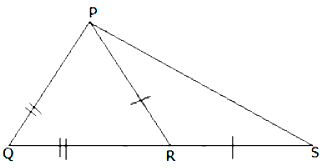
$\triangle PQR$ is isosceles with $PQ = QR. QR$ is extended to $S$ so that $\triangle PRS$ becomes isosceles with $PR = PS.$ Show that $\angle PSR .SP : \angle QPS = 1 : 3$
Answer

In $\triangle P Q R$
$P Q=Q R \ldots($given$)$
$\angle P R Q=\angle Q P R . . . . (i)$
In $\triangle P R S$
$P R=R S \ldots ($given$)$
$\angle P S R=\angle R P S . . . . . (ii)$
Adding $(i)$ and $(ii)$
$\angle QPR +\angle RPS =\angle PRQ +\angle PSR$
$\angle QPS =\angle PRQ +\angle PSR \ldots . . . (iii)$
Now in $\text{PRS},$
$ \angle PRQ =\angle RPS +\angle PSR$
$\angle PRQ =\angle PSR +\angle PSR \ldots ($from $(ii))$
$\angle PRQ =2 \angle PSR \ldots . . . . . . . (iv)$
Now, $\angle QPS =2 \angle PSR +\angle PSR \ldots...($from $(iii)$ and $(iv))$
$ \angle QPS =3 \angle PSR$
$\frac{\angle PSR }{\angle QPS }=\frac{1}{3}$
$\Rightarrow \angle PSR =\angle QPS =1: 3 . $
View full question & answer
[5 marks sum] - MATHEMATICS STD 9 Questions - Vidyadip