Question 14 Marks
In the given figure, $T$ is the midpoint of $QR$. Side $PR$ of $\triangle PQR$ is extended to $S$ such that $R$ divides $PS$ in the ratio $2:1$. $TV$ and $WR$ are drawn parallel to $PQ$. Prove that $T$ divides $SU$ in the ratio $2:1$ and $WR = \frac{1}{4} PQ$.
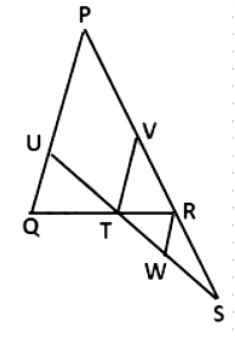
AnswerIn $\triangle PQR$,
$T$ is the mid$-$point of $Q R$ and $V T \| P Q$
So, $V$ is the mid$-$point of $PR.$
Since $R$ divides $P R$ in the ratio $2: 1$ and $P V=V R$,
so,$P V=P R=R S $
Since $R$ is the mid$-$point of $S V$ and $RW \| V T$,
$W$ is the mid$-$point of $S T$.
Since $V$ is the mid$-$point of $P R$ and $V T \| P Q$,
$T$ is the mid$-$point of $UW.$
So, $UT = TW = SW$
$\Rightarrow T$ divides $SU$ in the ratio $2: 1$
Also,
$R$ and $W$ are the midpoints $SV$ and $TS$ respectively.
$\Rightarrow WR =\frac{1}{2} VT$
$V$ and $T$ are the mid$-$points of $PR$ and $UW$ respectively.
$ \Rightarrow VT =\frac{1}{2} PQ $
So, $WR =\frac{1}{2}\left(\frac{1}{2} PQ \right)$
$ \Rightarrow WR =\frac{1}{4} PQ \text {. } $
View full question & answer→Question 24 Marks
In the given figure $, PS = 3RS. M$ is the midpoint of $QR$. If $TR \| MN \| QP,$ then prove that:
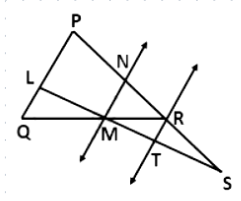
$ST =\frac{1}{3} LS$ AnswerProof:
In $\triangle PQR$,
Since $M$ is the mid $-$ point of $Q R$, and $M N \| Q P, N$ is the mid $-$ point of $PR.$
$ \Rightarrow PN = PR $
Given $P S=3 R S$
$ \Rightarrow PS = RS = PN + NR + RS $
But, $P S=P N+N R+RS$
$ \Rightarrow PN = PR = RS $
$\Rightarrow R$ is the mid $-$ point of $S N$
$RT \| MN$
$\Rightarrow T$ is the mid $-$ point of $SM\dots ....(i)$
Also $, N$ is the mid $-$ point of $PR$ and $MN \| LP$
$\Rightarrow M$ is the mid $-$ point of $L T\dots ....(ii)$
So, from $(i)$ and $(ii),$
$ LM = MT = ST$
$\Rightarrow ST =\frac{1}{3} LS . $
View full question & answer→Question 34 Marks
In the given figure, the lines $l, m$ and $n$ are parallel to each other. $D$ is the midpoint of $CE$. Find: $a. BC, b. EF, c. CG$ and $d. BD.$
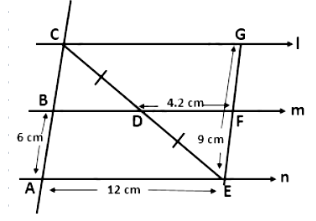
AnswerAccording to equal intercept theorem, since $C D=D E$
$ A B=B C \ldots \dots... (i)$
$E F=G F \ldots \text { (ii) } $
$ \text { a. } B C=A B=6 \ cm\dots ....[$From $(i)]$
$\text { b. } E G=E F+F G$
$\Rightarrow E G=2 E F \dots....[$from $(ii)]$
$\Rightarrow 9=2 E F$
$\Rightarrow E F=\frac{9}{2}=4.5 \ cm $
$ \text { c. } C G=2 D F=2 \times 4.2=8.4 \ cm$
$\text { d. } A E=2 B D$
$\Rightarrow B D=\frac{1}{2} A E$
$=\frac{1}{2} \times 12$
$=6 \ cm . $.
View full question & answer→Question 44 Marks
In $\triangle ABC, D$ and $E$ are two points on the side $AB$ such that $AD = DE = EB$. Through $D$ and $E,$ lines are drawn parallel to $BC$ which meet the side $AC$ at points $F$ and $G$ respectively. Through $F$ and $G$, lines are drawn parallel to $AB$ which meet the side $BC$ at points $M$ and $N$ respectively.Prove that $BM = MN = NC.$
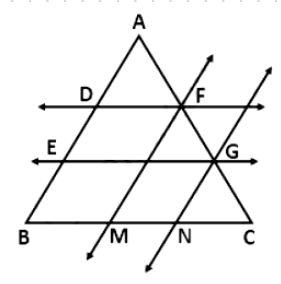
Answer
In $\triangle AEG,$
$D$ is the mid$-$point of $AE$ and $DF \| EG \| BC$
Therefore, $F$ is the mid$-$point of $AG.$
$\Rightarrow AF = FG\dots ....(1)$
Again, $DF \| EG \| BC.$
Therefore,$ FG = GC \dots....(2)$
Similarly, since $GN \| FM \| AB,$
therefore $MB = MN = NC.\dots ...($proved$)$ View full question & answer→Question 54 Marks
In $\triangle ABC,$ the medians $BE$ and $CD$ are produced to the points $P$ and $Q$ respectively such that $BE = EP$ and $CD = DQ$. Prove that: $A$ is the mid$-$point of $PQ.$
Answer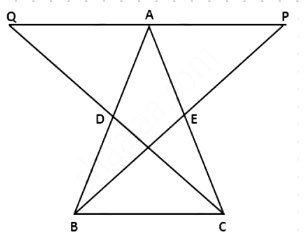
In $\triangle BDC$ and $\triangle ADQ,$
$CD = DQ \dots....($given$)$
$\angle BDC = \angle ADQ \dots....($vertically opposite angles$)$
$BD = AD\dots ....(D$ is the mid$-$point of $AB)$
$\therefore \triangle BDC \cong \triangle ADQ $
$\Rightarrow \angle DBC = \angle DAQ (\text{c.p.c.t})\dots....(i)$
And, $BC = AQ (\text{c.p.c.t})\dots....(ii)$
Similarly, we can prove $\triangle CEB \cong \triangle AEP$
$\Rightarrow \angle ECB = \angle EAP (\text{c.p.c.t})\dots....(iii)$
And, $BC = AP (\text{c.p.c.}t)\dots....(iv)$
From$ (ii)$ and $(iv),$
$AQ = AP$
$\Rightarrow A$ is the mid$-$point of $PQ.$ View full question & answer→Question 64 Marks
In a parallelogram $\text{ABCD, E}$ and $F$ are the midpoints of the sides $AB$ and $CD$ respectively. The line segments $AF$ and $BF$ meet the line segments $DE$ and $CE$ at points $G$ and $H$ respectively Prove that:$\text{EGFH}$ is a parallelogram.
Answer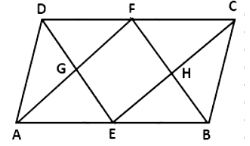
In quadrilateral $\text{AECF},$
$AE = CF \dots....[$from $(i)]$
$AE \| CF \dots ....[$as $AB \| DC]$
$\Rightarrow \text{AECF}$ is a parallelogram.
$\Rightarrow EC \| AF$ or $EH \| GF \dots....(i)$
In quadrilateral $\text{BFDE},$
$BE = DF \dots....[$from $(i)]$
$BE \| DF . \dots...[$as $AB \| DC]$
$\Rightarrow \text{BEDF}$ is a parallelogram
$\Rightarrow BF \| ED$ or $HF \| EG \dots ....(ii)$
From $(i)$ and $(ii),$ we get that
$\text{EGFH}$ is parallelogram. View full question & answer→Question 74 Marks
In a parallelogram $\text{ABCD, E}$ and $F$ are the midpoints of the sides $AB$ and $CD$ respectively. The line segments$ AF$ and $BF$ meet the line segments $DE$ and $CE$ at points $G$ and $H$ respectively Prove that: $\triangle HEB \cong \triangle HFC$
Answer
Since $\text{ABCD}$ is a parallelogram,
$AB = CD$ and $AD = BC$
Now, $E$ and $F$ are the mid$-$points of $AB$ and $CD$ respectively,
$\Rightarrow AE = EB = DF = FC \dots....(i)$
In $\triangle HEB$ and $\triangle HFC,$
$BE = FC ....[$From $(i)]$
$\angle EHB = \angle FHC\dots ....($vertically opposite angles$)$
$\angle HBE = \angle HFC\dots ....($Alternate interior angles$)$
$\therefore \triangle HEB \cong \triangle HFC.$ View full question & answer→Question 84 Marks
The diagonals of a quadrilateral intersect each other at right angle. Prove that the figure obtained by joining the mid$-$points of the adjacent sides of the quadrilateral is a rectangle.
Answer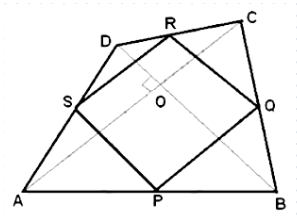
$P$ and $Q$ are mid$-$points of $A B$ and $B C$.
$ \therefore PQ \| AC$ and $PQ =\frac{1}{2} AC \dots .......(i)$
$S$ and $R$ are mid$-$points of $A D$ and $D C$.
$ \therefore S R \| A C$ and $S R=\frac{1}{2} A C \dots. . . . . \text { (ii) } $
From $(i)$ and $(ii)$
$P Q \| S R$ and $P Q=S R$
Therefore, $\text{PQRS}$ is a parallelogram.
Further $A C$ and $B D$ intersect at right angles
$ \therefore SP \| BD$ and $BD \perp AC$
$\therefore SP \perp AC$
$\Rightarrow SP \perp SR$
$\Rightarrow \ce{\angle RSP =90^{\circ}}$
$\therefore \ce{\angle RSP =\angle SRQ =\angle RQS =\angle SPQ =90^{\circ}}$
Therefore, $\text{PQRS}$ is a rectangle. View full question & answer→Question 94 Marks
Prove that the straight lines joining the mid$-$points of the opposite sides of a quadrilateral bisect each other.
Answer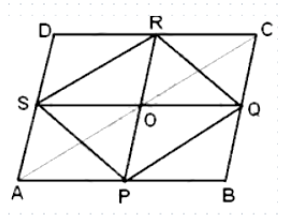
Join $AC.$
$P$ and $Q$ are mid$-$points of $A B$ and $B C$ respectively.
$ \therefore P Q \| A C, P Q=\frac{1}{2} A C \dots...(i)$
$S$ and $R$ are mid-points of $A D$ and $D C$ respectively.
$ \therefore SR \| AC , SR =\frac{1}{2} AC \dots....(ii)$
From $(i)$ and $(ii)$
$ PQ = SR $
Therefore, $\text{PQRS}$ is a parallelogram.
Since, diagonals of a parallelogram bisect each other
Therefore, $PQ$ and $QS$ bisect each other. View full question & answer→Question 104 Marks
$D, E$ and $F$ are the mid$-$points of the sides $AB, BC$ and $CA$ of an isosceles $\triangle ABC$ in which $AB = BC$. Prove that $\triangle DEF$ is also isosceles.
Answer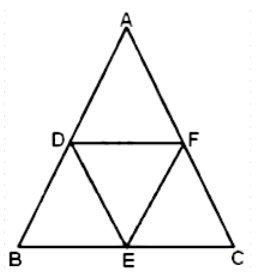
$E$ and $F$ are mid$-$points of $BC$ and $AC$
Therefore, $EF =\frac{1}{2} AB \ldots . .. (i)$
$D$ and $F$ are mid$-$points of $A B$ and $A C$
Therefore, $D F=\frac{1}{2} B C\dots......$
But $A B=B C$
From $(i)$ and $(ii)$
$EF = DF$
Therefore, $\triangle DEF$ is an isosceles triangle. View full question & answer→Question 114 Marks
In $\triangle ABC, BE$ and $CF$ are medians. $P$ is a point on $BE$ produced such that $BE = EP$ and $Q$ is a point on $CF$ produced such that $CF = FQ$. Prove that: $\text{QAP}$ is a straight line.
Answer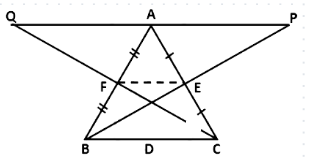
Since $BE$ and $CF$ are medians,
$F$ is the mid$-$point of $A B$ and $E$ is the mid$-$point of $A C$.
Now, the line joining the mid-point of any two sides is parallel and half of the third side, we have In $\triangle ACQ$,
$EF \| AQ$ and $EF =\frac{1}{2} AQ \dots....(i)$
In $\triangle A B P$,
$EF \| AP$ and $EF =\frac{1}{2} AP \dots....(ii)$
From $(i)$ and $(ii)$, we get $AP \| AQ ($both are parallel to $EF)$
As $AP$ and $AQ$ are parallel and have a common point $A$,
this is possible only if $\text{QAP}$ is a straight line.
Hence proved. View full question & answer→Question 124 Marks
In $\triangle ABC, D, E$ and $F$ are the midpoints of $AB, BC$ and $AC$.If $AE$ and $DF$ intersect at $G$, and $M$ and $N$ are the midpoints of $GB$ and $GC$ respectively, prove that $\text{DMNF}$ is a parallelogram.
Answer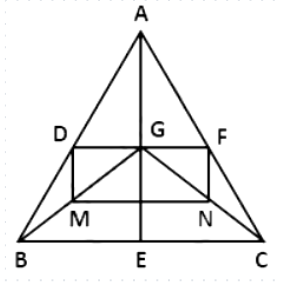
Consider$ \triangle ABC$ and $\triangle GBC$, by mid$-$point theorem,
$2DF = BC$ and $2MN = BC$
$\Rightarrow DF = MN\dots ....(i)$
Consider $\triangle ABG$ and $\triangle ACG$, by mid$-$point theorem,
$2DM = AG$ and $2FN = AG$
$\Rightarrow DM = FN \dots....(ii)$
From $(i)$ and $(ii),$ it is clear that $\text{DMNF}$ is a parallelogram. View full question & answer→Question 134 Marks
In $\triangle ABC, D, E$ and $F$ are the midpoints of $AB, BC$ and $AC$.Show that $AE$ and $DF$ bisect each other.
Answer
Since $D$ and $F$ are mid$-$points of $AB$ and $AC$, by Mid$-$point theorem,
$BC = 2DF$
Now,
$BC = BE + EC$
$DF = DG + GF$
But $E$ is the mid$-$point of $BC,$
$\Rightarrow BE = EC \dots....(i)$
Also, $AG = GE \dots....(G$ is the mid$-$point of $AE)$
Consider $\triangle ABE$ and $\triangle ACE$, by mid$-$point theorem,
$BE = 2DG$ and $EC = 2GF$
$\Rightarrow 2DG = 2GF \dots....[$From $(i)]$
$\Rightarrow DG = GF$
Hence, $AE$ and $DF$ bisect each other. View full question & answer→Question 144 Marks
In $\triangle ABC, X$ is the mid $-$ point of $AB,$ and $Y$ is the mid $-$ point of $AC. BY$ and $CX$ are produced and meet the straight line through $A$ parallel to $BC$ at $P$ and $Q$ respectively. Prove $AP = AQ.$
Answer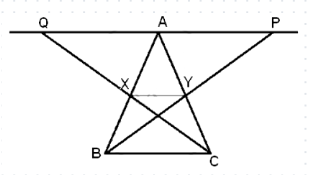
Join $X$ and $Y$
In $\triangle A B P$,
$X$ and $Y$ are the mid $-$ points of $A B$ and $A C$ respectively
Therefore $, XY \| BC$
Since $BC \|AP$
$\Rightarrow X Y \| A P$ and $X Y \| A Q$
$\therefore X Y=\frac{1}{2} A P ...(i)$
$ X Y=\frac{1}{2} AQ\dots . . . . . . . . \text { (ii) }$
From $(i)$ and $(ii)$
$\Rightarrow \frac{1}{2} AP =\frac{1}{2} AQ$
$\Rightarrow AP = AQ . $ View full question & answer→Question 154 Marks
$\text{ABCD}$ is a kite in which $BC = CD, AB = AD. E, F$ and $G$ are the mid$-$points of $CD, BC$ and $AB$ respectively. Prove that: The line drawn through $G$ and parallel to $FE$ and bisects $DA.$
Answer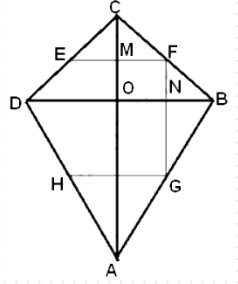
In $\triangle ABD,$
$G$ is the mid$-$point of $AB$ and $HG \| BD\dots ...($from $(ii) EF \| DB$ and $EF \| HG)$
Therefore, $HG \| DB$
Therefore, $H$ is the mid$-$point of $DA.$
Hence, the line drawn through $G$ and parallel to $FE$ bisects $DA.$ View full question & answer→Question 164 Marks
$\text{ABCD}$ is a kite in which $BC = CD, AB = AD. E, F$ and $G$ are the mid$-$points of $CD, BC$ and $AB$ respectively. Prove that: $\angle EFG = 90^\circ$
Answer
Diagonals of a kite intersect at right angles
$ \therefore \angle MON =90^{\circ}$
In $\triangle BCD \text {, } $
$E$ and $F$ are mid$-$points of $C D$ and $B C$ respectively.
Therefore, $EF \| DB$ and $EF =\frac{1}{2} DB \dots...(ii)$
$ EF \| DB$
$\Rightarrow MF \| ON$
$\therefore \angle MON +\angle MFN =180^{\circ}$
$\Rightarrow 90^{\circ}+\angle MFN =180^{\circ}$
$\Rightarrow \angle MFN =90^{\circ}$
$\Rightarrow \angle EFG =90^{\circ} . $ View full question & answer→Question 174 Marks
$\text{ABCD}$ is a parallelogram. $E$ is the mid$-$point of $C D$ and $P$ is a point on $A C$ such that $P C=\frac{1}{4} A C$. $E P$ produced meets $B C$ at $F$. Prove that: $F$ is the mid$-$point of $B C$.
Answer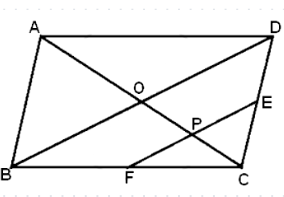
Join $B$ and $D$.
Suppose $AC$ and $BD$ cut at $O$. Then,
$OC =\frac{1}{2} AC$
Now,
$PC =\frac{1}{4} AC$
$ \Rightarrow PC =\frac{1}{2} OC$
In $\triangle DCO, E$ and $P$ are the mid$-$points of $DC$ and $OC$ respectively.
$\therefore EP \| DO$
Also, in $\triangle COB, P$ is the midpoint of $OC$ and $PF \| DO \| BD$
Therefore, $F$ is the mid$-$point of $BC, F$ being $EP$ produced. View full question & answer→Question 184 Marks
$M$ and $N$ divide the side $AB$ of $\triangle ABC$ into three equal parts. Line segments $MP$ and $NQ$ are both parallel to $BC$, and meet $AC$ in $P$ and $Q$ respectively. Prove that $P$ and $Q$ divide $AC$ into three equal parts.
Answer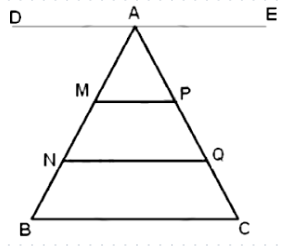
Draw $DE \| BC$ through $A$
$AM = MN = NB\dots ...($given$)$
$MP \| BC ; NQ \| BC \dots...($given$)$
$DE \| BC$
i.e. $AM, MN$ and $NB$ are equal intercepts made on transversal $AB.$
$AC$ is also a transversal; intercepts made on $AC$ are $AP, PQ$ and $QC.$
Hence, $AP = PQ = QC$
Therefore,$P$ and $Q$ divide $AC$ in three equal parts. View full question & answer→Question 194 Marks
Side $A C$ of a $\text{ABC}$ is produced to point $E$ so that $C E= \frac{1}{2} A C. D$ is the mid $-$ point of $BC$ and $ED$ produced meets $A B$ at $F$. Lines through $D$ and $C$ are drawn parallel to $AB$ which meets $AC$ at point $P$ and $EF$ at point $R$ respectively. Prove that: $3\ DF = EF$
Answer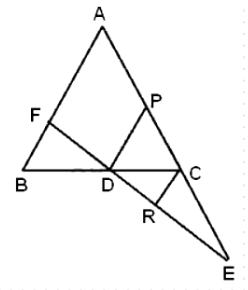
In $\triangle B D F$ and $\triangle D R C$,
$B D=D C \ldots(D$ is the mid $-$ point of $B C)$
$C R\|P D\| A B$
$\angle B F D=D R C \ldots... \ ($alternate angles$)$
$\angle B D F=R D C\dots...($vertivally opposite angles$)$
Therefore,
$\triangle BDF \cong \triangle DRC$
$\Rightarrow DF = DR\dots ...(i)$
In $\triangle A B C$,
$D$ is the mid $-$ point of $B C$ and $D P \| A B$
Therefore, $P$ is the mid $-$ point of $A C$.
In $\triangle D E P$,
$C$ is the mid $-$ point of $PE$ and $DP \|RC \| A B \ldots \ (C E=\frac{1}{2} A C.$ and $P$ is the mid $-$ point of $A C )$
Therefore, $R$ is the mid $-$ point of $D E$.
$ \Rightarrow D R=R E \ldots . . \text { (ii) }$
But
$E F=D F+D R+R E$
$E F=D F+D F+D F$
$E F=3 D F . $ View full question & answer→Question 204 Marks
In $\triangle ABC, P$ is the mid$-$point of $BC.$ A line through $P$ and parallel to $CA$ meets $AB$ at point $Q,$ and a line through $Q$ and parallel to $BC$ meets median $AP$ at point $R.$ Prove that: $BC = 4QR$
Answer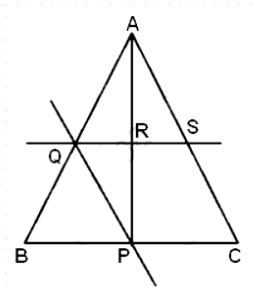
In $\triangle A B C$,
$Q$ and $S$ are the mid $-$ points of $A B$ and $A C$ respectively.
Also $QS$ is parallel to $B C$
Therefore $, QS =\frac{1}{2} BC\dots....(i)$
Now $, AP$ is the median, hence it bisects $BC$ and $QS$
Therefore
$ \frac{1}{2} QS = QR$
$\Rightarrow QS =2 QR $
Substituting in $(i)$
$ \Rightarrow 2 Q R=\frac{1}{2} B C$
$\Rightarrow B C=4 Q R . $ View full question & answer→Question 214 Marks
In the given figure $,\text{ ABCD}$ is a trapezium. $P$ and $Q$ are the midpoints of non $-$ parallel side $AD$ and $BC$ respectively. Find : $PQ,$ if $AB = 12 \ cm$ and $DC = 10 \ cm$.
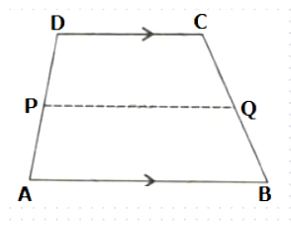
AnswerLet us draw a diagonal $AC$ which meets $PQ$ at $O$ as shown below:
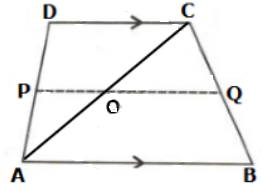
Given $A B=12 \ cm$ and $D C=10 \ cm$
In $\triangle A B C \text {, } $
$ OQ =\frac{1}{2} AB\dots ....\ ($Mid $-$ point Theorem$)$
$ \Rightarrow OQ =\frac{1}{2} \times 12=6 \ cm $
In $\triangle ADC,$
$ OP =\frac{1}{2} DC \dots....\ ($Mid $-$ point Theorem$)$
$ \Rightarrow OP =\frac{1}{2} \times 10=5 \ cm $
Now,
$ P Q=O P+O Q$
$=6+5$
$=11 \ cm . $ View full question & answer→Question 224 Marks
In a parallelogram $\text{ABCD, M}$ is the mid$-$point $AC. X$ and $Y$ are the points on $AB$ and $DC$ respectively such that $AX = CY$. Prove that:$(i)$ Triangle $\text{AXM}$ is congruent to $\triangle CYM$, and;$(ii) \text{XMY}$ is a straight line.
Answer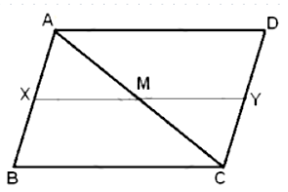
$(i)$ Join $XM$ and $MY.$
In $\triangle AXM$ and $\triangle CY\ m$
$AM = MC \dots...($given$)$
$AX = CY \dots...($given$)$
$\angle XAM = \angle YCM \dots ...($alternate angles$)$
Therefore, $\triangle AXM \cong \triangle CYM.$
$(ii) \angle AMX + \angle AMY = 180^\circ \dots...($linear pair of angle $= 180^\circ )$
THerefore, $\text{XMY}$ is a straight line. View full question & answer→