Question 15 Marks
If the quadrilateral formed by joining the mid-points of the adjacent sides of quadrilateral $\text{ABCD}$ is a rectangle,show that the diagonals $AC$ and $BD$ intersect at the right angle.
Answer
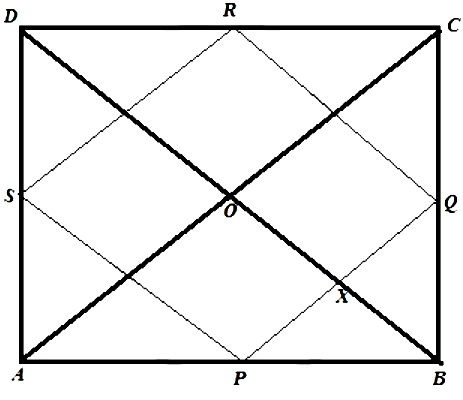
View full question & answer→The figure is shown below
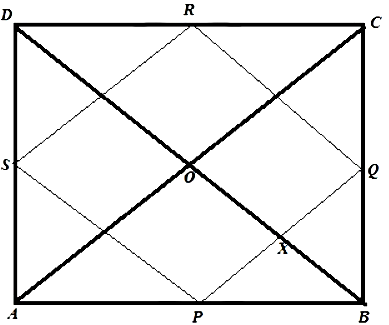
Let $\text{ABCD}$ be a quadrilateral where $P, Q, R, S$ are the midpoint of $A B, B C, C D, D A .$
$\text{PQRS}$ is a rectangle. Diagonal $A C$ and $B D$ intersect at point $O$.
We need to show that $AC$ and $BD$ intersect at a right angle.
Proof:
$PQ \| AC$, therefore $\angle AOD =\angle PXO\dots ...[$ Corresponding angle $]\dots...(1)$
Again $BD \| RQ$, therefore $\angle PXO =\angle RQX =90^{\circ} \ldots .[$ Corresponding
angle and angle of a rectangle $]\dots...(2)$
From $(1)$ and $(2)$ we get,
$\angle AOD =90^{\circ}$
Similarly,$\angle A O B=\angle B O C=\angle D O C=90^{\circ}$
Therefore diagonals $AC$ and $BD$ intersect at right angle.
Hence proved.
Let $\text{ABCD}$ be a quadrilateral where $P, Q, R, S$ are the midpoint of $A B, B C, C D, D A .$
$\text{PQRS}$ is a rectangle. Diagonal $A C$ and $B D$ intersect at point $O$.
We need to show that $AC$ and $BD$ intersect at a right angle.
Proof:
$PQ \| AC$, therefore $\angle AOD =\angle PXO\dots ...[$ Corresponding angle $]\dots...(1)$
Again $BD \| RQ$, therefore $\angle PXO =\angle RQX =90^{\circ} \ldots .[$ Corresponding
angle and angle of a rectangle $]\dots...(2)$
From $(1)$ and $(2)$ we get,
$\angle AOD =90^{\circ}$
Similarly,$\angle A O B=\angle B O C=\angle D O C=90^{\circ}$
Therefore diagonals $AC$ and $BD$ intersect at right angle.
Hence proved.