Question 13 Marks
Find the radius and area of the circle which has circumference equal to the sum of circumferences of the two circles of radii $3 \ cm$ and $4 \ cm$ respectively.
AnswerLet $R$ be the radius of the big circle.
The radii of two circles are $r_1=3 \ cm$ and $r_2=4 \ cm$
Now,
Circumference of big circle
$=$ Sum of circumference of circles of radii $r_1$ and $r_2$
$\Rightarrow 2 \pi R=2 \pi r_1+2 \pi r_2$
$\Rightarrow R=r_1+r_2$
$\Rightarrow R$
$=3+4$
$=7 \ cm$
$\therefore$ Area of big circle
$=\pi R^2=\frac{22}{7} \times 7 \times 7$
$=154 \ cm ^2$.
View full question & answer→Question 23 Marks
The sum of the circumference and diameter of a circle is $176\ cm.$ Find the area of the circle.
AnswerLet the radius of a circle $= r\ cm$
Circumference of a circle $=2 \pi\ cm$
Diameter of a circle $=2 r\ cm$
Now,
Circumference of a circle $+$ Diameter of a circle $=176\ cm$
$\Rightarrow 2 \pi r+2 r=176 $
$\Rightarrow 2 \pi r(\pi+1)=176 $
$\Rightarrow 2 r(3.14+1)=176 $
$\Rightarrow 2 r \times 4.14=176 $
$\Rightarrow r=\frac{176}{2 \times 4.14} $
$=21.26 \ cm $
Area of a circle
$=\pi r^2 $
$=3.14 \times 21.26 \times 21.26 $
$=1419.24 \ cm ^2 .$
View full question & answer→Question 33 Marks
The circumference of a circle is numerically equal to its area. Find the area and circumference of the circle.
AnswerLet the radius of a circle $=r \ cm$
$\Rightarrow$ Circumference of a circle $=2 \pi r\ cm$
Area of a circle $=\pi r^2$
Now,
Circumference of a circle
$=$ Area of a circle
$\Rightarrow 2 \pi r=\pi r^2$
$\Rightarrow 2=r$
Thus, we have
Area of a circle
$= \pi r^2$
$= 3.14 \times 2 \times 2$
$= 12.56\ cm^2$
Circumference of a circle
$=$ Area of a circle
$= 12.56\ cm^2.$
View full question & answer→Question 43 Marks
The circumference of a circle exceeds its diameter by $450\ cm.$ Find the area of the circle.
AnswerLet the radius of a circle $= r\ cm$
$\Rightarrow$ Circumference of a circle $=2 \pi r\ m$
Diameter of a circle $=2 rcm$
Now, Circumference of a circle $-$ Diameter of a circle $=450\ m$
$\Rightarrow 2 \pi r-2 r=450$
$\Rightarrow 2 r(\pi-1)=450$
$\Rightarrow 2 r\left(\frac{22}{7}-1\right)=450$
$\Rightarrow 2 r \times \frac{15}{7}=450$
$\Rightarrow r=\frac{450 \times 7}{2 \times 15}$
$=105\ cm$
$\therefore$ Area of a circle
$=\frac{22}{7} \times 105 \times 105$
$=34650\ cm^2 . $
View full question & answer→Question 53 Marks
The diameter of a wheel is $1.4\ m.$ How many revolutions does make in moving a distance of $2.2\ km$?
AnswerThe Circumference of a Circle with diameter $d$ is $\pi d$
The Circumference of a Circle with diameter $1.4\ m$ is $\pi \times 1.4$
$ =\frac{22}{7} \times 1.4$
$=22 \times 0.2$
$=4.\ m$
Total distance moved
$=2.2\ km$
$=2.2 \times 1000\ m$
$=2200\ m $
Number of revolutions
$ =\frac{\text { Total distance moved }}{\text { Circumference of Circle }}$
$=\frac{2200}{4.4}$
$=500 .$
View full question & answer→Question 63 Marks
Find the circumference of a circle whose area is $81\pi\ cm^2.$
AnswerThe Area of a Circle with radius $r=\pi r^2$
Here, Area of a Circle $=81 \pi\ cm^2$
$\Rightarrow 81\pi = \pi r^2$
$\Rightarrow 81 = r^2$
$\Rightarrow r = 9\ cm$
The Circumference of a Circle with radius $r=2 \pi r$
The Circumference of a Circle with radius $9$
$= 2\pi \times 9$
$= 18\pi \ cm.$
View full question & answer→Question 73 Marks
Find the area enclosed between two concentric circles of radii $6.3\ cm$ and $ 8.4\ cm$. A third concentric circle is drawn outside the $8.4\ cm$ circle. So that the area enclosed between it and the $8.4\ cm$ circle is the same as that between the two inner circles. Find the radii of the third circle correct to two decimal places.
AnswerArea of the ring between two concentric circles $= \pi (R^2 - r^2)$
Where $R$ and $r$ are the radii of the outer and the inner circle respectively
Here there are three concentric circles,
the innermost of radius $6.3\ cm,$ the second of radius $8.4\ cm$ and the outermost of radius $x \ cm ($say$)$
$\Rightarrow \pi (8.4^2 - 6.3^2) = \pi (x^2 - 8.4^2)$
$\Rightarrow \pi (2 \times 8.4^2 - 6.3^2) = \pi x^2$
$\Rightarrow (2 \times 8.4^2 - 6.3^2) = \pi x^2$
$\Rightarrow (2 \times 8.4^2 - 6.3^2) = x^2$
$\Rightarrow (141.12\ cm^2 - 39.69\ cm^2) = x^2$
$\Rightarrow x^2 = 101.43\ cm^2$
$\Rightarrow x = 10.07\ cm.$
View full question & answer→Question 83 Marks
A square is inscribed in a circle of radius $6 \ cm$. Find the area of the square. Give your answer correct to two decimal places if $\sqrt{2}=1.414$.
AnswerLet the radius of the circle $=r=6 \ cm$
Now $_4$
diagonal of a square $=$ diameter of a circle
$=2 r$
$=2 \times 6$
$=12 \ cm$
Also,
$\sqrt{2} \times$ side of a square $=$ diagonal of a square
$\Rightarrow \sqrt{2} \times$ side $=12$
$\Rightarrow$ side $=\frac{12}{\sqrt{12}}$
$=6 \sqrt{2} \ cm $
$\therefore$ Area of a square
$ =($ Side $)^2$
$=(6 \sqrt{2})^2$
$=72 \ cm ^2 .$
View full question & answer→Question 93 Marks
The sum of the radii of two circles is $10.5\ cm$ and the difference of their circumferences is $13.2\ cm.$ Find the radii of the two circles.
AnswerLet $r_1$ and $r_2$ be the radii of two circles.
$\Rightarrow r_1+r_2=10.5$
And,
$ 2 \pi r _{6.3-4.21}-2 \pi r _2=13.2$
$\Rightarrow 2 \times \frac{22}{7} \times\left( r _1- r _2\right)=13.2$
$\Rightarrow r _1- r _2=\frac{13.2 \times 7}{2 \times 22}$
$\Rightarrow r _1- r _2=2.1 \text {....(ii) } $
Adding $(i)$ and $(ii),$
we get
$2 r_1=12.6$
$\Rightarrow r_1=6.3 \ cm$
Now,
$ r_1-r_2=2.1$
$\Rightarrow 6.3-r_2=2.1$
$\Rightarrow r_2=4.2 \ cm .$
View full question & answer→Question 103 Marks
Find the area of a circular field that has a circumference of $396\ m.$
AnswerThe Circumference of a Circle with radius $r=2 \pi r$
Here, Circumference of a Circle $=369$
$ \Rightarrow 2 \pi r=396$
$\Rightarrow r=\frac{396}{2 \pi}$
$=\frac{396 \times 7}{2 \times 22}$
$=63\ m$
The Area of a Circle with radius $r=\pi r^2$
$\Rightarrow$ The Area of a Circle with radius $63\ m$
$=\pi(63)^2$
$=\frac{22}{7} \times(63)^2$
$=\frac{22}{7} \times 3969$
$=12,474\ m^2 . $
View full question & answer→Question 113 Marks
The circumference of a circle is equal to the perimeter of a square. The area of the square is $484\ sq.m.$ Find the area of the circle.
AnswerLet the side of the square $=s$ and the radius of the circle $=r$
$\therefore 2 \pi r=4 s$
But, the area of the square $484\ m ^2$
$\therefore$ the side of the square
$ =\sqrt{484}$
$=22\ m$
$=2 \pi r$
$=4 \times 22 er$
$=14\ m $
The Area of a Circle with radius $r=\pi r^2$
The Area of a Circle with radius 14
$=\pi(14)^2$
$=\frac{22}{7} \times(14)^2$
$=616\ m ^2 $
View full question & answer→Question 123 Marks
Find the circumference of the circle whose area is $25$times the area of the circle with radius $7\ cm.$
AnswerThe Area of a Circle with radius $r = \pi r^2$
The Area of a Circle with radius $7 = \pi (7)^2$
The Area of the bigger Circle
$= 25 \times \pi (7)^2$
$= \pi (7^2 \times 5^2)$
$= \pi (35^2)$
Let radius of the bigger Circle $= R$
$R^2 = \pi (35^2)$
$\Rightarrow$ radius of the bigger Circle $= 35$
The Circumference of a Circle with radius $r = 2\pi r$
The Circumference of a Circle with radiu $35r$
$= 2\pi \times 35$
$= 220\ cm.$
View full question & answer→Question 133 Marks
The area of the circular ring enclosed between two concentric circles is $88 \ cm^2$. Find the radii of the two circles, if their difference is $1\ cm.$
AnswerLet the radius of outer circle $=R \ cm$
And, the radius of inner circle $=r \ cm$
Then, we have
$R-r=1$
And, $\pi\left(R^2-r^2\right)=88$
$\Rightarrow( R - r )( R + r )$
$ =88 \times \frac{7}{22}$
$\Rightarrow 1 \times(R+r)=28$
$\Rightarrow R+r=28 \ldots \text { (ii) }$
Adding $(i)$ and $(ii),$ we get
$2 R=29 $
$\Rightarrow R=14.5 \ cm$
Now, $R + r =28$
$\Rightarrow 14.5+r=28 $
$\Rightarrow r=13.5 \ cm .$
View full question & answer→Question 143 Marks
The diameter of a cycle wheel is $4 \frac{5}{11} \ cm$. How many revolutions will it make in moving $6.3 \ km$ ?
AnswerThe Circumference of a wheel with diameter $d$ is $\pi d$
The Circumference of a wheel with diameter $4 \frac{5}{11} \ cm$
$ =\frac{49}{11} \text { is } \pi \times \frac{49}{11}$
$=\frac{22}{7} \times \frac{49}{11}$
$=14 \ cm$
Total distance moved
$ =6.3 \ km$
$=6.3 \times 100000 \ cm$
$=630000 \ cm $
Number of revolutions
$=\frac{\text { Total distance moved }}{\text { Circumference of wheel }}$
$=\frac{6.3 \times 100000}{14}$
$=45000 .$
View full question & answer→Question 153 Marks
The circumference $o$ a garden roller is $280\ cm.$ How many revolutions does it make in moving $490\ m$?
AnswerThe Circumference of a Circle
$=280 \ cm $
$=2.8\ m $
Number of revolutions
$=\frac{\text { Total distance moved }}{\text { CIrcumference of Circle }} $
$=\frac{490}{2.8} $
$=175 .$
View full question & answer→Question 163 Marks
A bucket is raised from a well by means of a rope wound round a wheel of diameter $35 \ cm.$ If the bucket ascends in $2$ minutes with a uniform speed of $1.1\ m$ per $sec$, calculate the number of complete revolutions the wheel makes in raising the bucket.
AnswerThe Circumference of a Circle with diameter $d$ is $\pi d$
The Circumference of a Circle with diameter $35 \ cm$ is $\pi \times 35$
$=\frac{22}{7} \times 35$
$=22 \times 5$
$=110 \ cm$
$\Rightarrow$ distance moved in $1$ revolution $=110 \ cm$
$=\frac{110}{100}\ m$
$=1.1\ m$
Total distance moved in 1 second $=1.1\ m$
$\Rightarrow$ Total distance moved in $1$ revolution $=$ Total distance movedd in $1$ second
$\Rightarrow$ Total distance moved in $2\ min =2 \times 60 ($Total distance moved in $1$ revolution$)$
$=2 \times 60 \times .1\ m$
View full question & answer→Question 173 Marks
A cart wheel makes $9$ revolutions per second. If the diameter of the wheel is $42\ cm,$ find its speed in \ km per hour. $($Answer correct to the nearest $km)$
AnswerThe Circumference of a Circle with diameter $d$ is $\pi d$
The Circumference of a Circle with diameter $42 \ cm$ is $\pi \times 42$
$ =\frac{22}{7} \times 42$
$=22 \times 6$
$=132 \ cm$
$\Rightarrow$ distance moved in $1$ revolution $=132 \ cm$
Total distance moved in $9$ revolutions
$=9 \times 132 \ cm$
$=1188 \ cm$
Total distance moved in $1$ second $=1188 \ cm$
$\Rightarrow$ Total distance moved in hour
$=1188 \ cm \times 60 \times 60$
$=4276800 \ cm$
$=\frac{4276800}{100 \times 1000} \ km$
$\Rightarrow$ Speed $=42.7 \ km / hr .$
$\therefore$ Speed $=42.7 \ km / hr .$
View full question & answer→Question 183 Marks
The speed of a car is $66\ km$ per hour. If each wheel of the car is $140\ cm$ in diameter, find the number if revolution made by each wheel per minute.
AnswerThe Circumference of Circle with diameter $d$ is $\pi d$
The Circumference of a Circle with diameter $140 \ cm$ is $\pi \times 140$
$=\frac{22}{7} \times 140 $
$=440 \ cm$
distance moved in $1$ hour
$=66 \ km$
$=6600000 \ cm$
distance moved in $1$ minute
$=\frac{6600000 \ cm }{60}$
$=110000 \ cm$
Number of revolutions
$=\frac{\text { Total distance moved }}{\text { Circumference of Circle }}$
$=\frac{110000}{440}$
$=250 .$
View full question & answer→Question 193 Marks
Find the area and perimeter of the circles with following: Diameter $= 35\ cm$
AnswerThe radius of a Circle with diameter $d$ is $r =\frac{ d }{2}$
The Area of a Circle with radius $r=\pi r^2$
The radius of a Circle with diameter $35$ is $r$
$=\frac{35}{2}$
$=17.5 \ cm$
The Area of a Circle with radius $r$
$ =\pi(17.5)^2$
$=\frac{22}{7} \times(17.5)^2$
$=962.5 \ cm ^2 $
The Circumference of a Circle with diameter $d$ is $\pi d$
The Circumference of a Circle with diameter $35$ is $\pi \times 35$
$ =\frac{22}{7} \times 35$
$=110 \ cm . $
View full question & answer→Question 203 Marks
Find the area and perimeter of the circles with following: Diameter $= 77\ cm$
AnswerThe radius of a Circle with diameter $d$ is $r=\frac{d}{2}$
The Area of a Circle with radius $r=\pi r^2$
The radius of a Circle with diameter $77$ is $r$
$=\frac{77}{2}$
$=38.5 \ cm$
The Area of a Circle with radius $r$
$=\pi(38.5)^2$
$=\frac{22}{7} \times(38.5)^2$
$=4658.5 \ cm^2$
The Circumference of a Circle with diameter $d$ is $\pi d$
The Circumference of a Circle with diameter $77$ is $\pi \times 77$
$=\frac{22}{7} \times 77$
$=242 \ cm$
View full question & answer→Question 213 Marks
Find the area and perimeter of the circles with following: Radius $= 10.5\ cm$
AnswerThe Area of a Circle with radius $r=\pi r^2$
$\therefore$ The Area of a Circle with radius $10.5 \ cm$
$ =\pi(10.5)^2$
$=\frac{22}{7}(10.5)^2$
$=346.5 \ cm ^2 $
The Circumference of a Circle with radius $r=2 \pi r$
The Circumference of a Circle with radius $10.5$
$=2 \pi(10.5)$
$=2 \times \frac{22}{7}(10.5)$
$=66 \ cm . $
View full question & answer→Question 223 Marks
Find the area and perimeter of the circles with following: Radius $= 2.8\ cm$
AnswerThe Area of a Circle with radius $r=\pi r^2$
$\therefore$ The Area of a Circle with radius $2.8 \ cm$
$=\pi(2.8)^2$
$=\frac{22}{7}(2.8)^2$
$=24.64 \ cm^2$
The Circumference of a Circle with radius $r=2 \pi r$
The Circumference of a Circle with radius $2.8$
$=2 \pi(2.8)$
$=2 \times \frac{22}{7}(2.8)$
$=17.6 \ cm .$
View full question & answer→Question 233 Marks
The diameter of two circles are $28\ cm$ and $24\ cm.$ Find the circumference of the circle having its area equal to sum of the areas of the two circles.
AnswerLet $R$ be the radius of the big circle.
The radii of two circles are
$ r _1=\frac{ d _1}{2}=\frac{28}{2}=14 \ cm$
and
$r _2=\frac{ d _2}{2}=\frac{24}{2}=12 \ cm $
and
$r _2=\frac{ d _2}{2}=\frac{24}{2}=12 \ cm$
Now,
Area of big circle
$=$ Sum of areas of circles of radii $r_1$ and $r_2$
$\Rightarrow \pi R^2=\pi r_1^2+\pi r_2^2$
$\Rightarrow R^2=r_1^2+r_2^2$
$\Rightarrow R^2=14^2+12^2$
$\Rightarrow R^2=196+144$
$\Rightarrow R^2=340$
$\Rightarrow R =18.4$
$\therefore$ Circumference of big circle
$=2 \pi R$
$=2 \times \frac{22}{7} \times 18.4$
$=115.65 \ cm ^2$.
View full question & answer→Question 243 Marks
Find the area of quadrilateral, whose diagonals of lengths $18\ cm$ and $13\ cm$ intersect each other at right angle.
AnswerWhen two diagonals of a quadrilateral intersect each other at right angles,
Area of quadrilateral $=\frac{1}{2} \times$ Product of the diagonals
$\therefore$ Area of required quadrilateral
$=\frac{1}{2} \times 18 \times 13$
$=117 \ cm ^2 $
View full question & answer→Question 253 Marks
Find the area of each of the following figure:
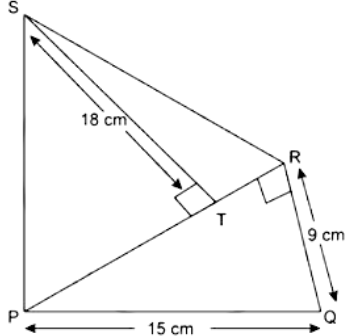
AnswerIn right $\triangle Q R P_t$
$R P^2=P Q^2-Q R^2$
$=15^2-9^2$
$=225-81$
$=144$
$\Rightarrow R P=12 \ cm $
Area of $\triangle Q R P$
$ =\frac{1}{2} \times QR \times RP$
$=\frac{1}{2} \times 9 \times 12$
$=54 \ cm ^2 $
$\therefore$ Area of given figure
$=$ Area of $\triangle Q R P+$ Area of $\triangle R P S$
$ =54 \ cm ^2+108 \ cm ^2$
$=162 \ cm ^2 $
View full question & answer→Question 263 Marks
The cross$-$section of a canal is a trapezium in shape. If the canal is $10\ m$ wide at the top, $6\ m$ wide at the bottom and the area of cross$-$section is $72\ sq.m,$ determine its depth.
AnswerThe cross$-$section of the canal is a trapezium Area of a Trapezium $=\frac{1}{2}( a + b ) \times h$,
Where $a$ and $b$ are the lengths of its parallel sides
Let $h$ the perpendicular distance between them
here, $a=10, b=6$ and perpendicular distance $=h$
$\therefore$ Area of Trapezium
$=\frac{1}{2}(10+6) \times h$
$=72\ m ^2$
$\Rightarrow 8 h =72$
$\Rightarrow h =9\ m$.
View full question & answer→Question 273 Marks
A chessboard contains $64$ equal square and the area of each square is $6.25 \ cm^2. A 2 \ cm$ wide border is left inside of the board. Find the length of the side of the chessboard.
AnswerArea of each of the 64 squares of the chessboard $=6.25 \ cm^2$
So, Side of each of the 64 squares of the chess board $=2.5 \ cm$
The sum of Sides of each of the 8 squares on one side of the chess board
$= 8 \times 2.5$
$= 20\ cm$
The border on each side is $2\ cm.$
So, the length of the board
$= 20 + 4$
$= 24\ cm.$
View full question & answer→Question 283 Marks
The sides of a rectangle are $5 \ cm$ and $3 \ cm$ respectively. Find its area in $mm^2.$
AnswerLength of a rectangle $= 5\ cm$
Breadth of a rectangle $= 3\ cm$
$\therefore $ Area of a rectangle
$=$ Length $\times$ Breadth
$= 5\ cm \times 3\ cm$
$= 15 \times 100\ mm^2$
$= 1500\ mm^2.$
View full question & answer→Question 293 Marks
Find the perimeter and area of a square whose diagonal is $5 \sqrt{2} \ cm$. Give your answer correct to two decimal places if $\sqrt{2}=1.414$.
AnswerDiagonal of a square $=5 \sqrt{2} \ cm$
$\Rightarrow$ Side of a square $ \times \sqrt{2}=5 \sqrt{2}$
$\Rightarrow$ Side pf a square$=5 \ cm$
Thus, we have
Perimeter of a square
$=4 \times$ Side
$=4 \times 5$
$=20 \ cm$
Area of a square
$=($ Side $)^2$
$=(5)^2$
$=25 \ cm ^2 .$
View full question & answer→Question 303 Marks
Find the area of a square whose diagonal is $12 \sqrt{12} \ cm$
AnswerThe sides and diagonal of a square form a right triangle as each angle of a square is a right angle.
Diagonal is the side opposite to the right angle,
$\therefore$ it is the hypotenuse
Here, Diagonal of the square $=12 \sqrt{2} \ cm$
Let the side of the square $=s$
$ \therefore \sqrt{ s ^2+ s ^2}=12 \sqrt{2}$
$\Rightarrow \sqrt{2 s ^2}=12 \sqrt{2}$
$\Rightarrow s \sqrt{2}=12 \sqrt{2}$
$\Rightarrow s =12 $
We know,
The area of a square with side $s=s^2$
$ \therefore s ^2$
$=(12)^2$
$=144 \ cm ^2 . $
View full question & answer→Question 313 Marks
The area of a square garden is equal to the area of a rectangular plot of length $160\ m$ and width $40\ m.$ Calculate the cost of fencing the square garden at $Rs.12$ per m.
AnswerThe area of a rectangle with length $I$ and breadth $b=A=I \times b$
$\therefore$ The area of the rectangular plot with length $160\ m$ and breadth $40\ m$
$ = A$
$=160 \times 40 $
$=$ area of the square garden
We know,
The area of a square with side $s=s^2$
$ \therefore s^2=160 \times 40$
$\Rightarrow s=\sqrt{160 \times 40}$
$=\sqrt{16 \times 4 \times 100}$
$=4 \times 2 \times 10$
$=80\ m $
The perimeter of a square with side
$ =P$
$=4 s $
$\therefore$ The perimeter of a square with side $80$
$=4 \times 80$
$=320\ m$
The cost of fencing at the rate of $Rs. 12$ per $m$
$ =320 \times 12$
$=\text { Rs. } 3840 . $
View full question & answer→Question 323 Marks
A rectangular floor $45$ in long and $12\ m$ broad is to be paved exactly with square tiles, of side $60 \ cm.$ Find the total number of tiles required to pave it.If a carpet is laid on the floor such as a space of $50 \ cm$ exists between its edges and the edges of the floor, find what fraction of the floor is uncovered.
AnswerLength of a rectangular floor $=45\ m$
Breadth of a rectangular floor $=12\ m$
$\therefore$ Area of a rectangular floor
$=45\ m \times 12\ m$
$=540\ m ^2$
Side of a square title
$=60\ cm$
$=0.6\ m$
$\therefore$ Area of $o$
$=(0.6\ m )^2$
$=0.36\ m ^2$
$\therefore$ Area of one square title
$=(0.6\ m )^2$
Thus, total number of titles required
.$=\frac{\text { Area of a rectangular floor }}{\text { Area of one square title }}$
$=\frac{540}{0.36}$
$=1500$
Space
$=50 \ cm$
$=0.5\ m$
$\Rightarrow$ On both sides, space
$=0.5 \times 2$
$=1\ m$
$\therefore$ Area of carpet
$=(45-1) \times(12-1)$
$=44 \times 11$
$=484\ m ^2$
$\Rightarrow$ Uncovered area
$=$ Area of a rectangular floor $-$ Area of carpet
$=(540-484)\ m ^2$
$=56\ m ^2$
$\therefore$ Fraction of floor uncovered
$=\frac{\text { Uncovered area }}{\text { Area of a rectangular floor }}$
$=\frac{56}{540}$
$=\frac{14}{135} .$
View full question & answer→Question 333 Marks
In a trapezium the parallel sides are $12\ cm$ and $8\ cm.$ If the distance between them is $6\ cm,$ find the area of the trapezium.
AnswerArea of a Trapezium $=\frac{1}{2}( a + b ) \times h$,
Where $a$ and $b$ are the lengths of its parallel sides and $h$ the perpendicular distance between them here, $a =12 \ cm , b =8 \ cm$ and $h =6 \ cm$
$\therefore$ Area of Trapezium
$=\frac{1}{2}(12+8) \times 6$
$=\frac{1}{2}(20) \times 6$
$=10 \times 6$
$=60 \ cm ^2$.
View full question & answer→Question 343 Marks
A rectangular field $240 \ m$ long has an area $36000 m^2$. Find the cost of fencing the field at $Rs. 2.50$ per $m .$
AnswerLet the breadth of the rectangle $= x\ m$
The area of a rectangle with length $I$ and breadth $b=A=1 \times b$
$\therefore$ The area of a rectangle with length $240\ m$ and breadth $x\ m = A =240 x$
$ \Rightarrow 240 x =36000$
$\Rightarrow x =\frac{36000}{240}$
$=150\ m $
Now, the perimeter of a rectangle with length and breadth $b=P=2(l+b)$
$\therefore$ The perimeter of a rectangle with length $240$ and breadth $150$ is
$ P=2(240+150)$
$=2(390)$
$=780 $
The cost of fencing $1\ m = Rs. 2.50$
$\Rightarrow$ The cost of fencing $780\ m$
$ =Rs .2 .50 \times 780$
$=Rs .1950 $
View full question & answer→Question 353 Marks
The area of a floor of a rectangular room is $360\ m^2$. If its length is $24 \ cm ,$ find its perimeter.
AnswerThe area of a rectangle with length $I$ and breadth $b=A=I \times b$
Let the breadth of the rectangle $=bc\ m$
$\therefore$ For a rectangle with length $24\ cm$ and breadth $b\ cm , A=24 \times b$
$ \Rightarrow 360=24 b$
$\Rightarrow b=\frac{360}{24}$
$=15\ cm $
The perimeter of a rectangle with length $I$ and breadth $b=P=2(l+b)$
$\therefore$ For a rectangle with length $24\ cm$ and breadth $15\ cm , P=2(24+15)=78\ cm$.
View full question & answer→Question 363 Marks
Find the perimeter and area of a rectangle whose length and breadth are $12\ cm$ and $9\ cm$ respectively.
AnswerThe area of a rectangle with length $l$ and breadth $b = l \times b$
The perimeter of a rectangle with length $l$ and breadth $b = P = 2(l + b)$
$\therefore $ For a rectangle with length $12\ cm$ and breadth $9\ cm$
$P = 2(12 + 9)$
$= 2(21)$
$= 42\ cm;$
$= 12 \times 9$
$= 108\ cm^2.$
View full question & answer→Question 373 Marks
Two adjacent sides of a parallelogram are $20\ cm$ and $18\ cm.$ If the distance between the larger sides is $9\ cm,$ find the area of the parallelogram. Also, find the distance between the shorter sides.
AnswerArea of a parallelogram with base $b$ and height $h$ is $A=b \times h$
$\therefore$ Area of a parallelogram with base $20 \ cm$ and height $9 \ cm$ is $A=20 \times 9=180 \ cm ^2$
The height corresponding to the side $18 \ cm =x \ cm$
Area of a parallelogram with base $18 \ cm$ and height $x \ cm$ is $A=18 \times x$
$ \Rightarrow 20 \times 9=18 \times x$
$\Rightarrow x=\frac{20 \times 9}{18}$
$=10\ cm . $
View full question & answer→Question 383 Marks
One side of a parallelogram is $12\ cm$ and the altitude corresponding to i is $8\ cm.$ If the length of the altitude corresponding to its adjacent side is $16\ cm,$ find the length of the adjacent side.
AnswerArea of a parallelogram with base $b$ and height $h$ is $A=b \times h$
$\therefore$ Area of a parallelogram with base $12\ cm$ and height $8\ cm$ is $A=12 \times 8=96\ cm ^2$
Let the length of the adjacent side of the parallelogram $=x\ cm$
The height corresponding to it $=16$
$\therefore$ Area of a parallelogram with base $x\ cm$ and height $16\ cm$ is $A=16 x=96$
$\Rightarrow x=\frac{96}{16}$
$=6\ cm .$
View full question & answer→Question 393 Marks
In a rectangle $\text{ABCD}, AB = 7 \ cm$ and $AD = 25 \ cm.$ Find the height of a triangle whose base is $AB$ and whose area is two times the area of the rectangle $\text{ABCD}.$
AnswerArea of rectangle $\text{ABCD}=A B \times A D=7 \times 25=175 \ cm ^2$
Area of triangle whose base is $A B=\frac{1}{2} \times AB \times$ Height $=\frac{1}{2} \times 7 \times$ Height
Now,
Area of triangle whose base is $A B=2 \times$ Area of rectangle $\text{ABCD}$
$=\frac{1}{2} \times 7 \times$ Height $=175$
$\Rightarrow$ Height
$=\frac{175 \times 2}{7}$
$=50 \ cm .$
View full question & answer→Question 403 Marks
Find the area of an equilateral triangle having perimeter of $18\ cm.$
AnswerWe know that, Perimeter of an equilateral triangle $(P)$ of side $a=3 a$
Here, $P=18 \ cm$
$\Rightarrow$ side of the equilateral triangle is $=6 \ cm$
Area of an equilateral triangle $(A)$ of side is $A=\frac{\sqrt{3}}{4} a^2$
$\Rightarrow A =\frac{\sqrt{3}}{4}(6)^2$
$\Rightarrow \frac{\sqrt{3}}{4}(36)$
$\Rightarrow 9 \sqrt{3}$
Area of an equilateral triangle$(A)$ of side $6 \ cm$ is $9 \sqrt{3} \ cm ^2$.
View full question & answer→Question 413 Marks
Find the area of a triangle with a base $12 \ cm$ and a height equal to the width of a rectangle having area of $96 \ cm^2$ and a length of $12 \ cm.$
AnswerWe know that the Area of a Rectangle, with length $I$ and breadth $b$ is $A=I \times b$
The Area of the given Rectangle is $96 \ cm ^2$ and length of the given Rectangle is $12 \ cm$
Let its breadth $= b\ cm$
$\therefore 12 \times b=96$
$\Rightarrow b=\frac{96}{12}$
$=8 \ cm$
The height of the triangle $=8 \ cm$. We are given that the base of the triangle $=12 \ cm$
Area of a Triangle $=\frac{1}{2} b \cdot h$
$=\frac{1}{2}(12) \cdot(8)$
$=48 \ cm ^2 .$
View full question & answer→Question 423 Marks
The area of an equilateral triangle is numerically equal to its perimeter. Find the length of its sides, correct two decimal places.
AnswerLet each side of an equilateral triangle measures $acm$.
Then, we have
$ \frac{\sqrt{3}}{4} \times a^2=a+a+a$
$\Rightarrow \frac{\sqrt{3}}{4} \times a^2=3 a$
$\Rightarrow \frac{a^2}{a}=\frac{4}{\sqrt{3}} \times 3$
$\Rightarrow a=4 \sqrt{3}$
$\Rightarrow a=4 \times 1.732$
$\Rightarrow a=6.928$
$\Rightarrow a=6.93$ units.
View full question & answer→Question 433 Marks
Find the area of a triangle whose base is $3.8\ cm$ and height is $2.8\ cm.$
AnswerBase of a triangle $=3.8 \ cm$
Height of a triangle $=2.8 \ cm$
Area of a triangle
$=\frac{1}{2} \times$ Base $\times$ Height
$=\frac{1}{2} \times 3.8 \times 2.8$
$=5.32 \ cm ^2 .$
View full question & answer→