Questions

[5 marks sum]

🎯

Test yourself on this topic

14 questions · timed · auto-graded

Question 15 Marks
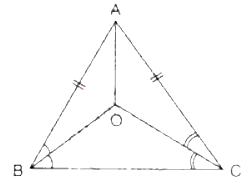
In $\triangle ABC, AB = AC$ and the bisectors of angles $B$ and $C$ intersect at point $O$.Prove that $BO = CO$ and the ray $AO$ is the bisector of $\angle BAC.$
​​​​​​​
Answer
In $\triangle ABC,$
Since $AB = AC$
$\angle C = \angle B ...($angles opposite to the equal sides are equal$)$
$BO$ and $CO$ are angle bisectors of $\angle B$ and $\angle C$ respectively
Hence, $\angle ABO = \angle OBC = \angle BCO = \angle ACO$
Join $AO$ to meet $BC$ at $D$
In $\triangle ABO$ and $\triangle ACO$ and
$AO = AO$
$AB = AC$
$\angle C = \angle B $
Therefore, $\triangle BAO \cong \triangle ACO ...(\text{SAS}$ criteria$)$
Hence, $\angle BAO = \angle CAO$
$\Rightarrow AO$ bisects $\angle BAC$
In $\triangle ABO$ and $\triangle ACO$
and $AB = AC$
$AO = AO$
$\angle BAD = \angle CAD ...($proved$)$
$\triangle BAO \cong \triangle ACO ...(\text{SAS}$ criteria$)$
Therefore,
$BO = CO.$
View full question & answer
Question 25 Marks
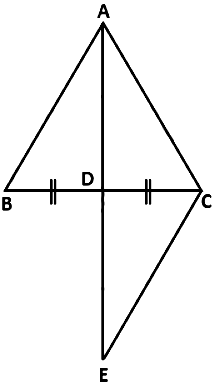
In a $\triangle ABC$, if $D$ is midpoint of $BC; AD$ is produced upto $E$ such as $DE = AD$, then prove that:$a. \text{DABD}$ and $\text{DECD}$ are congruent.$b. AB = EC,c. AB$ is parallel to $EC$
Answer
Given:
$D$ on mid$-$point of $BC$
$\Rightarrow BD = DC$
$DE = AD$
To prove:
$a. \triangle ABD \cong \triangle ECD$
$b. AB = EC$
$c. AB \| EC$

$a.$ In $\triangle ABD$ and $\triangle ECD$
$BD = DC ....($given$)$
$\angle ADB = \angle CDE ....($vertically opposite angles$)$
$AD = DE ....($given$)$
$\therefore $ By Side$-$Angle$-$Side criterion of congruence,
$\triangle ABD \cong \triangle ECD$
$b.$ The corresponding parts of the congruent triangle are congruent.
$\therefore AB = EC$
$c.$ Also, $\angle DAB = \angle DEC ....(\text{c.p.c.t})$
$\therefore AB \| EC ....(\angle DAB$ and $\angle DEC$ are alternate angles$).$
View full question & answer
Question 35 Marks
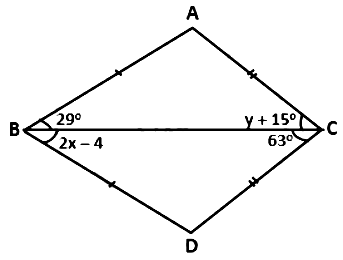
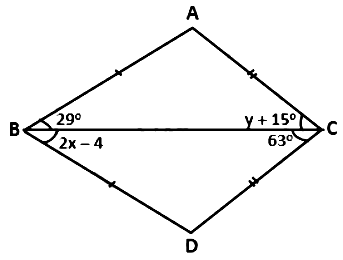
In the given figure, $AB = DB$ and $AC = DC.$ Find the values of $x$ and $y.$
Answer

In $\triangle A B C$ and $\triangle D B C$
$AB = DB ....[$given$]$
$AC = DC ....[$given$]$
$BC = BC ....[$common$]$
By Side$-$Side$-$Side criterion of congruence,
$\triangle ABC \cong \triangle DBC$
$\therefore \angle ACB =\angle DBC \ldots .[\text{c.p.c.t}]$
$\Rightarrow y+15^{\circ}=63^{\circ}$
$\Rightarrow y=63^{\circ}-15^{\circ}$
$\Rightarrow y=48^{\circ}$
Now, $\angle A B C=\angle D B C....[\text{c.p.c.t}]$
$\Rightarrow 29^{\circ}=2 x-4^{\circ} $
$\Rightarrow 2 x=29^{\circ}+4^{\circ} $
$ \Rightarrow 2 x=33^{\circ}$
$\Rightarrow x=\frac{33^{\circ}}{2}$
$ \Rightarrow x=16.5^{\circ}$
Hence, $x=16.5^{\circ}$ and $y=48^{\circ}$.
View full question & answer
Question 45 Marks
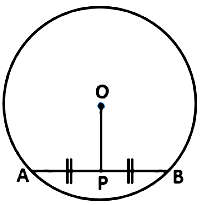
In the given figure $P$ is a midpoint of chord $AB$ of the circle $O$. prove that $OP \perp AB.$
​​​​​​​
Answer
Given:
In the figure, $O$ is centre of the circle and $ab$ is chord.
$P$ is the mid$-$point of $AB$
$\Rightarrow AP = PB$
To prove: $OP \perp AB$

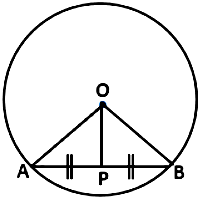
Construction: Join $OA$ and $OB$
Proof:
In $\triangle OAP$ and $\triangle OBP$
$OA = OB ....[$radii of the same circle$]$
$OP = OP ....[$common$]$
$AP = PB ....[$given$]$
$\therefore$ By Side$-$Side$-$Side criterion of congruency,
$\triangle OAP \cong \triangle OBP$
The corresponding parts of the congruent triangles are congruent.
$\therefore \angle OPA = \angle OPB$
But $\angle OPA + \angle OPB = 180^\circ ....[$linear pair$]$
$\therefore \angle OPA = \angle OPB = 90^\circ$
Hence $OP \perp AB.$
View full question & answer
Question 55 Marks
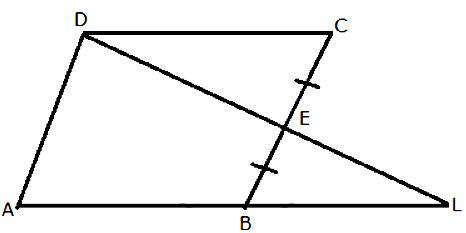
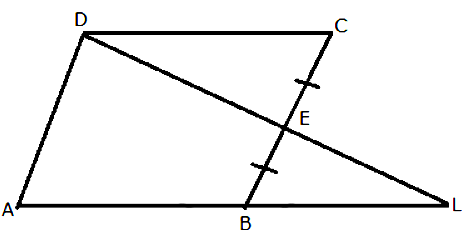
In the given figure $\text{ABCD}$ is a parallelogram, $AB$ is Produced to $L$ and $E$ is a midpoint of $BC$. Show that:

$a. \text{DDCE} \cong \text{DLDE};b. A B=B L;c. DC =\frac{ AL }{2}$
Answer
Given:
$\text{ABCD}$ is a parallelogram, where $B E=C E$
To prove:
$a.\text{DDCE} \cong \text{DLDE}$
$b.A B=B L$
$c.DC =\frac{ AL }{2}$


$a.$ In $\triangle DCE$ and $\triangle LBE$
$\angle DCE =\angle EBL \ldots .[DC \| AB,$ alternate angles$]$
$CE = BE \ldots . [$given$]$
$\angle DEC =\angle LEB \ldots . .[$vertically opposite angles$]$
$\therefore$ By Angle$-$Side$-$Angle criterion of congruence,
$\triangle DCE \cong \triangle LBE$
The corresponding parts of the congruent triangles are congruent.
$\therefore DC = LB$
$b. DC = AB....(2)[$opposite sides of a parallelogram$]$
From $(1)$ and $(2),$
$A B=B L$
$C. Al = AB + BL$
$\Rightarrow AL = Ab + AB \ldots.[$From $(3)]$
$\Rightarrow A L=2 A B$
$\Rightarrow Al =2 DC.....[$From $(2)]$
View full question & answer
Question 65 Marks
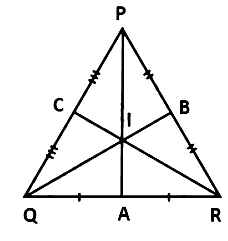
If the perpendicular bisector of the sides of a $\triangle PQR$ meet at $I,$ then prove that the line joining from $P, Q, R$ to $I$ are equal.
Answer
Given:
In $\triangle PQR,$
$PA$ is the perpendicular bisector of $QR$
$\Rightarrow QA = RA$
$RC$ is the perpendicular bisector of $PQ$
$\Rightarrow PC = QC$
$QB$ is the perpendicular bisector of $PR$
$ \Rightarrow PR = RB$
$PA, RC$ and $QB$ meet at $I$.

To prove:$ IP = IQ = IR$
Proof:
In $\triangle QIA$ and $\triangle RIA$
$QA = RA ....[$Given$]$
$\angle QAI = \angle RAI ....[$Each $= 90]$
$IA = IA ....[$Common$]$
$\therefore $ By Side$-$Angle$-$Side criterion of congruence,
$\triangle IQ = IR ....(i)$
Similarly, in $\triangle RIB$ and $\triangle PIB$
$RB = PB ...[$Given$]$
$\angle RBI = \angle PBI ...[$Each $= 90^\circ ]$
$IB = IB ...[$Common$]$
$\therefore $ By Side$-$Angle$-$Side criterion of congruence,
$\triangle RIB \cong \triangle PIB$
The corresponding parts of the congruent triangles are congruent.
$\therefore IR = IP ....(ii)$
From $(i)$ and $(ii)$, we have
$IP = IQ = IR.$
View full question & answer
Question 75 Marks
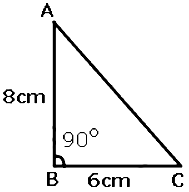
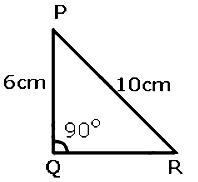
Which of the following pairs of triangles are congruent?Give reasons;$\triangle ABC;(\angle B = 90^\circ,BC = 6\ cm,AB = 8\ cm);\triangle PQR;(\angle Q = 90^\circ,PQ = 6\ cm,PR = 10\ cm).$
Answer

In $\triangle A B C$ and $\triangle P Q R$
$\angle B=\angle Q $
$B C=P Q$
By Pythagoras theorem,
$PR ^2= PQ ^2+ QR ^2$
$10^2=6^2+ QR ^2$
$100=36+ QR ^2$
$QR =\sqrt{100-36}$
$QR =\sqrt{64}=8 \ cm$
$AB = QR $
Therefore,
$\triangle A B C \cong \triangle P Q R ..(\text{SAS}$ criteria$)$
View full question & answer
Question 85 Marks
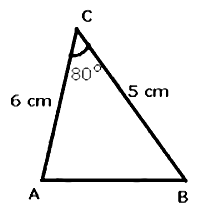
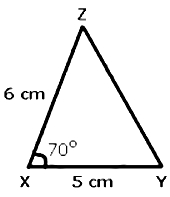
Which of the following pairs of triangles are congruent? Give reasons;$\triangle ABC;(BC = 5\ cm,AC = 6\ cm,\angle C = 80^\circ );\triangle XYZ;(XZ = 6\ cm,XY = 5\ cm,\angle X = 70^\circ).$
Answer

In $\triangle ABC$ and $\triangle XYZ$
$AC = XZ$
$BC = XY$
The included angle $\angle C = 80^\circ $ is not equal to $\angle X$ i.e. $70^\circ .$
Now, for $\triangle ABC$ to be congruent to $\triangle XYZ,$
$AB$ should be equal to $XY$ and $YZ$ should be equal to $BC.$
Then, $\angle A = \angle C$ and $\angle X = \angle Z$.
So, the measure of $\angle B$ will not be equal to $\angle Y.$
Therefore,$ \triangle ABC$ cannot be congruent to $\triangle XYZ.$
View full question & answer
Question 95 Marks
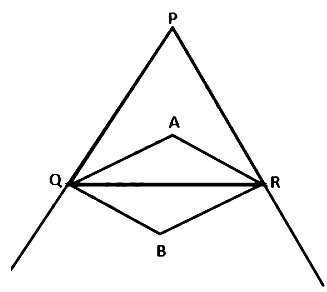
In a $\triangle PQR,$ the internal bisectors of angles $Q$ and $R$ meet at $A$ and the external bisectors of the angles $Q$ and $R$ meet at $B.$ Prove that: $\angle QAR + \angle QBR = 180^\circ.$
Answer

By exterior angle property,
$\angle R Q S=\angle P+\angle R$ and $\angle Q R T=\angle P+\angle Q$
Since $QB$ bisects $\angle RQS$,
$\angle BQR =\frac{1}{2} \angle RQS =\frac{1}{2}(\angle P +\angle R )$
Also $RB$ bisects $\angle Q R T$,
$\angle BRQ =\frac{1}{2} \angle QRT =\frac{1}{2}(\angle P +\angle Q )$
In $\triangle Q B R_r$
$\angle QBR +\angle BRQ +\angle BQR =180^{\circ}$
$\Rightarrow \angle QBR +\frac{1}{2}(\angle P +\angle Q )+\frac{1}{2}(\angle P +\angle R )=180^{\circ}$
$\Rightarrow \angle QBR +\frac{1}{2}(\angle P +\angle Q +\angle P +\angle R )=180^{\circ}$
$\Rightarrow \angle QBR +\frac{1}{2}\left(\angle P +180^{\circ}\right)=180^{\circ} . . .\left[\angle P +\angle Q +\angle R =180^{\circ}\right]$
$\Rightarrow 2 \angle QBR +\angle P +180^{\circ}=360^{\circ}$
$\Rightarrow 2 \angle QBR =180^{\circ}-\angle P$
Since $Q B$ bisects $\angle P Q R$,
$\angle AQR =\frac{1}{2} \angle PQR$
Also $RA$ bisects $\angle PRQ$
$\angle QRA =\frac{1}{2} \angle PRQ$
In $\triangle A Q R$,
$ \angle AQR +\angle QRA +\angle QAR =180^{\circ}$
$\Rightarrow \frac{1}{2} \angle PQR +\frac{1}{2} \angle PRQ +\angle QAR =180^{\circ}$
$\Rightarrow \frac{1}{2}(\angle PQR +\angle PRQ )+\angle QAR =180^{\circ}$
$\Rightarrow \angle PQR +\angle PRQ +2 \angle QAR =360^{\circ}$
$\Rightarrow 2 \angle QAR =360^{\circ}-\angle PQR -\angle PRQ$
$\Rightarrow 2 \angle QAR =180^{\circ}+(180-\angle PQR -\angle PRQ )$
$\Rightarrow 2 \angle QAR =180^{\circ}+\angle P $
Adding $(i)$ and $(ii)$
$ \Rightarrow 2 \angle QAR +2 \angle QBR =180^{\circ}+\angle P +180^{\circ}-\angle P$
$\Rightarrow 2 \angle QAR +2 \angle QBR =360^{\circ}$
$\Rightarrow \angle QAR +\angle QBR =180^{\circ} . $
View full question & answer
Question 105 Marks
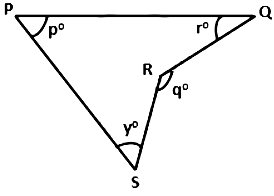
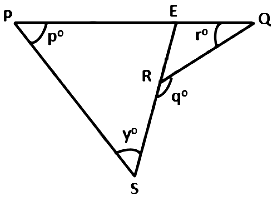
Use the given figure to find the value of $y$ in terms of $p, q$ and $r.$
​​​​​​​
Answer
$SR$ is produced to meet $PQ$ at $E.$

In $\triangle PSE,$
$\angle P + \angle S + \angle PES = 180^\circ ....($Angle sum property of a triangle$)$
$\Rightarrow p^\circ + y^\circ + \angle PES = 180^\circ $
$\Rightarrow \angle PES = 180^\circ - p^\circ - y^\circ ....(i)$
In $\triangle RQE,$
$\angle R + \angle Q + \angle REQ = 180^\circ ....($Angle sum property of a triangle$)$
$\Rightarrow (180^\circ - q^\circ ) + r^\circ + \angle REQ = 180^\circ $
$\Rightarrow \angle REQ = 180^\circ - (180^\circ - q^\circ ) - r^\circ $
$\Rightarrow \angle REQ = q^\circ - r^\circ ....(ii)$
Now, $\angle PES + \angle REQ - 180^\circ ....($Linear pair$)$
$\Rightarrow (180^\circ - p^\circ - y^\circ ) + (q^\circ - r^\circ ) = 180^\circ ....[$From $(i)$ and $(ii)]$
$\Rightarrow -p^\circ - y^\circ + q^\circ - r^\circ = 0$
$\Rightarrow -y^\circ = -q^\circ + p^\circ + r^\circ $
$\Rightarrow y^\circ = q^\circ - p^\circ - r^\circ .$
View full question & answer
Question 115 Marks
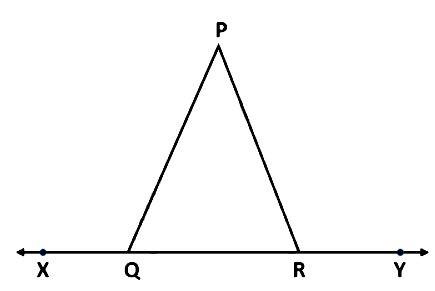
In a $\triangle PQR, \angle P + \angle Q = 130^\circ $ and $\angle P + \angle R = 120^\circ $. Calculate each angle of the triangle.
Answer

In $\triangle PQR,$
$\angle P + \angle Q = 130^\circ ....($given$)$
Now, $\angle P + \angle Q = \angle PRY ....($Exterior angle property$)$
$\Rightarrow \angle PRY = 130^\circ $
$\angle PRY + \angle R = 180^\circ ....($Linear pair$)$
$\Rightarrow 130^\circ + \angle R = 180^\circ $
$\Rightarrow \angle R = 180^\circ - 130^\circ = 50^\circ $
Also, $\angle P + \angle R = 120^\circ ....($given$)$
Now, $\angle P + \angle R = \angle PQX ....($Exeterior angle property$)$
$\Rightarrow \angle PQx = 120^\circ $
$\angle PQX +\angle Q = 180^\circ ....($Linear pair$)$
$\Rightarrow 120^\circ + \angle Q = 180^\circ $
$\Rightarrow \angle Q = 180^\circ - 120^\circ = 60^\circ $
In $\triangle PQR,$
$\angle P + \angle Q + \angle R = 180^\circ ....($Angle sum property of a triangle$)$
$\Rightarrow \angle P + 60^\circ + 50^\circ = 180^\circ $
$\Rightarrow \angle P = 180^\circ - 110^\circ = 70^\circ $
Thus, the angles of $\triangle PQR$ are as follows:
$\angle P = 70^\circ , \angle Q = 60^\circ $ and $\angle R = 50^\circ .$
View full question & answer
Question 125 Marks
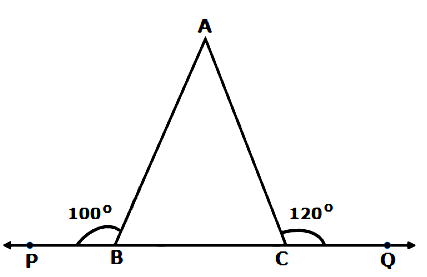
The exterior angles, obtained on producing the side of a triangle both ways, are $100^\circ $ and $120^\circ $. Find all the angles of the triangle.
Answer

$\angle ABP + \angle ABC = 180^\circ ....($Linear pair$)$
$\Rightarrow 100^\circ + \angle ABC = 180^\circ $
$\Rightarrow \angle ABC = 180^\circ - 100^\circ = 80^\circ $
$\angle ACQ + \angle ACB = 180^\circ ....($Linear pair$)$
$\Rightarrow 120^\circ + \angle ACB = 180^\circ $
$\Rightarrow \angle ACB = 180^\circ - 120^\circ = 60^\circ $
Now, in $\triangle ABC,$
$\angle A + \angle B + \angle C = 180^\circ ....($Angle sum property of a triangle$)$
$\Rightarrow \angle A + 80^\circ + 60^\circ = 180^\circ $
$\Rightarrow \angle A = 180^\circ - 80^\circ - 60^\circ = 40^\circ $
Hence, the angles of a triangle are $40^\circ , 60^\circ $ and $80^\circ .$
View full question & answer
Question 135 Marks
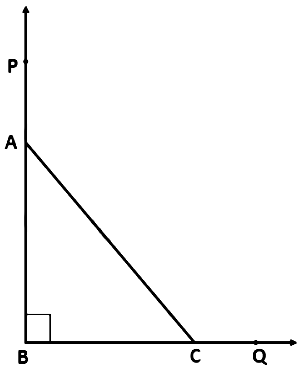
In a right$-$angled $\triangle ABC, \angle B = 90^\circ $. If $BA$ and $BC$ produced to the points $P$ and $Q$ respectively, find the value of $\angle PAC + \angle QCA.$
Answer

In $\triangle ABC, \angle B = 90^\circ $
And, $\angle ABC + \angle BAC + \angle ACB = 180^\circ $
$\Rightarrow \angle BAC + \angle ACB = 180^\circ - \angle ABC$
$\Rightarrow \angle BAC + \angle ACB = 180^\circ - 90^\circ $
$\Rightarrow \angle BAC + \angle ACB = 90^\circ ....(i)$
By exterior angle property,
$\angle PAC = \angle ABC + \angle ACB ....(ii)$
$\angle QCA = \angle ABC + \angle BAC ....(iii)$
Adding $(ii)$ and $(iii)$, we get
$\angle PAC + \angle QCA = \angle ABC + \angle ACB + \angle ABC + \angle BAC$
$\Rightarrow \angle PAC + \angle QCA = (\angle ABC + \angle BAC) + 2\angle ABC$
$\Rightarrow \angle PAC + \angle QCA = 90^\circ + 2 x 90^\circ ....[$From $(i)]$
$\Rightarrow \angle PAC + \angle QCA = 90^\circ + 180^\circ $
$\Rightarrow \angle PAC + \angle QCA = 270^\circ .$
View full question & answer
Question 145 Marks
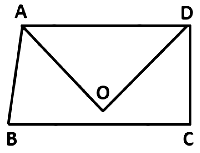
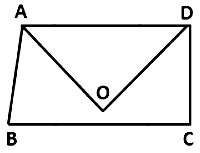
If bisectors of angles $A$ and $D$ of a quadrilateral $\text{ABCD}$ meet at $0$, then show that $\angle B + \angle C = 2 \angle AOD$
​​​​​​​
Answer

Since $AO$ and $DO$ are bisectors of $\angle A$ and $\angle D$ of quadrilateral $\text{ABCD},$
$\angle A = 2\angle OAD$ and $\angle D = 2\angle ODA ....(i)$
In $\triangle AOD,$
$\angle OAD + \angle ODA + \angle ACD = 180^\circ $
$\Rightarrow 2\angle OAD + 2\angle ODA + 2\angle AOD = 360^\circ ....[$Multiplying both sides by $2]$
$\Rightarrow 2\angle OAD + 2\angle ODA = 360^\circ - 2\angle AOD ....(ii)$
In quadrlateral $\text{ABCD},$
$\angle A + \angle B + \angle C + \angle D = 360^\circ $
$\Rightarrow 2\angle OAD + \angle B + \angle C + 2\angle ODA = 360^\circ ....[$From $(i)]$
$\Rightarrow \angle B + \angle C = 360^\circ - 2\angle OAD - 2\angle ODA$
$\Rightarrow \angle B + \angle C = 360^\circ (2\angle OAD + 2\angle ODA)$
$\Rightarrow \angle B + \angle C = 360^\circ - (360^\circ - 2\angle AOD) ....[$From $(ii)]$
$\Rightarrow \angle B + \angle C = 360^\circ - 360^\circ - 2\angle AOD$
$\Rightarrow \angle B + \angle C = 2\angle AOD.$
View full question & answer
[5 marks sum] - MATHEMATICS STD 9 Questions - Vidyadip