Question 13 Marks
The following figure shows a metal rod PQ mounted on an insulated stand. The cap of an uncharged electroscope touches one end Q of the metal rod. A negatively charged ebonite rod is brought near the other end P of the metal rod.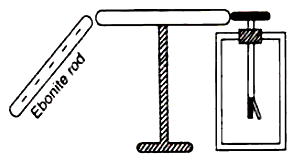
(a) What charge does the end P have?
(b) What charge does the end Q have?
(c) What charge does the cap of the electroscope have?
(d) What charge does the gold leaf have?
(e) Will the leaf diverge or collapse? Give reason.
(f) If the electroscope is now earthed, what charge does the metal rod have?
(a) What charge does the end P have?
(b) What charge does the end Q have?
(c) What charge does the cap of the electroscope have?
(d) What charge does the gold leaf have?
(e) Will the leaf diverge or collapse? Give reason.
(f) If the electroscope is now earthed, what charge does the metal rod have?
Answer
View full question & answer→(a) P will have a positive charge
(b) Q will have no charge.
(c) The Cap of the electroscope will have no charge.
(d) The gold leaf will have a negative charge.
(e) The leaf will diverse because like charges repel each other
(f) If electroscope is earthed then the metal rod will have a positive charge.
(b) Q will have no charge.
(c) The Cap of the electroscope will have no charge.
(d) The gold leaf will have a negative charge.
(e) The leaf will diverse because like charges repel each other
(f) If electroscope is earthed then the metal rod will have a positive charge.