Questions

[3 Mark Question Answer]

🎯

Test yourself on this topic

14 questions · timed · auto-graded

Question 13 Marks
The following figure shows a rectangular box with two tubes P and Q at the top. A burning candle R is placed under the tube P. The candle burns brightly.
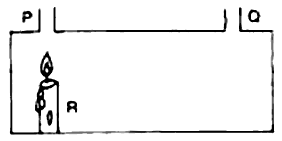
Explain: (i) How is the air in the box circulating?
(ii) What will happen if the opening Q is closed?
Answer
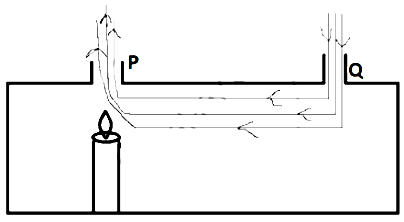
(i) Air is entering into the box from tube Q and as air reaches near the candle its temperature increase and air become lighter and leaves out from tube P.
(ii) If opening Q is closed then circulation of air stops and there is no way for air to enter. Air inside the box will leave out from tube P and after some time candle stops because for burning it requires air which is not circulating in the box now.
View full question & answer
Question 23 Marks
Give reasons for the following:
Even when the water in the lakes is frozen, fish can survive.
Answer
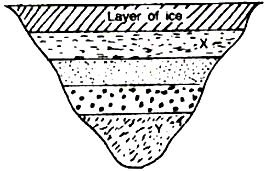
Even when the water in the lakes is frozen, fishes can survive due to anomalous expansion of water, water has maximum density at 4°C and this dense water remains at the bottom of the lake and the upper layer of water is less dense and freezes but the temperature of each layer of water below increases by 1°C. Thus it is warmer in the lakes below the ice layer. This helps the fishes to survive.C and this dense water remains at the bottom of the lake and the upper layer of water is less dense and freezes but the temperature of each layer of water below increases by 1°C. Thus it is warmer in the lakes below the ice layer. This helps the fishes to survive.
View full question & answer
Question 33 Marks
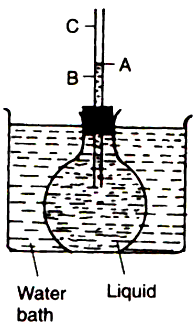
Show by an experiment that the real expansion of a liquid is equal to the sum of its apparent expansion of a liquid is equal to the sum of its apparent expansion and the volume expansion of the vessel containing the liquid.
Answer
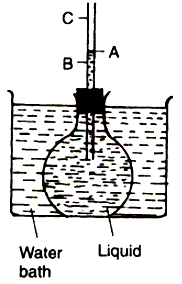
Fill a round bottom flask with a coloured liquid up to the brim. Fit it with a one holed cork and pass a narrow glass tube through it. Mark the level of the liquid in the glass tube as A. Place the flask in a water bath and heat the bath. You will see that the level of liquid of water starts falling to level Band then it rises to level C. In this, AC is the apparent expansion and is due to expansion of the flask due to heating which provides more space for the liquid. Hence the level of liquid drops. As soon as the liquid also starts getting heated up, it expands and the level of liquid rises. BC is the real expansion. So the actual expansion of the water is the sum of AC and AB.
View full question & answer
Question 43 Marks
Describe an experiment to demonstrate the thermal expansion of solids.
Answer
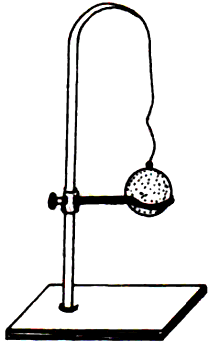
Take a ball and ring apparatus as shown in figure. At room temperature, the ball can just pass through the ring. Now heat the ball over a flame and try to pass it through the ring. You will find that the ball when heated is not able to pass through the ring. The diameter of the ball increases when the ball is heated. This shows the expansion of solid on heating.
View full question & answer
Question 53 Marks
Describe an experiment to demonstrate thermal expansion in gases.
Answer
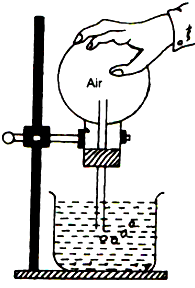
Take a round bottom flask which is filled with air and closed with a one holed rubber cork. A narrow capillary tube is passed through the cork and the flask is supported on a tripod in an inverted position as shown in the figure, so that the end of the capillary tube is underwater. Now, heat the flask gently with a spirit lamp. You will observe bubbles coming out from the capillary tube. This shows that gases expand on heating.
View full question & answer
Question 63 Marks
How will you demonstrate thermal expansion in liquids? Describe an experiment.
Answer
Fill a round bottom flask with a coloured liquid up to the brim. Fit it with a one holed cork and pass a narrow glass tube through it. Mark the level of the liquid in the glass tube. Place the flask in a water bath and heat the bath.
You will see that the level of liquid water rises in the glass tube. This is due to the expansion of the liquid on heating.
View full question & answer
Question 73 Marks
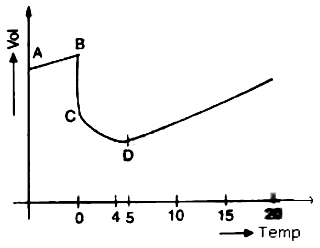
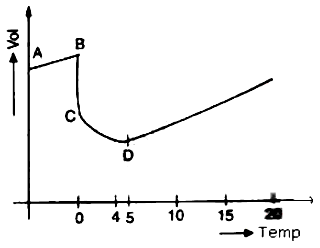
The diagram shows a sketch graph showing a change in volume of a given mass of ice at -5°C to water at 15°C.
(i) Why does the temperature along BC remain constant?
(ii) When is the volume of water minimum?
(iii) At what temperature does water have maximum density? Explain.
Answer

(i) At BC temperature is constant because at 0°C all of the heat given is used in the process of formation of water from ice and no part of the heat is used in changing the temperature of ice.
(ii) At point D i.e. at 4°C the volume of water is minimum
(iii) At point D i.e. at 4°C, the density of water is maximum due to anomalous expansion of water in the temperature range of 0°C and 4°C as volume decreases, the density of water increases
View full question & answer
Question 83 Marks
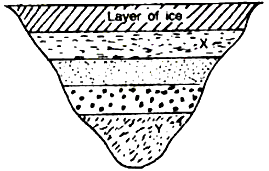
What will be the approximate temperature of water in the lake shown in the following diagram?

(i) At X, and
(ii) At Y?
Answer

The layer at the top level is ice so its temperature is therefore 0°C and temperature at every layer of water below ice increases by 1°C
(i) At X = 1°C since it is the first layer below the ice
(ii) At Y = 4°C since it is the fourth layer below ice
View full question & answer
Question 93 Marks
Differentiate between clinical thermometer and laboratory thermometer.
Answer
Differentiate between clinical thermometer and laboratory thermometer. >
Clinical thermometer Laboratory thermometer
1. The range of temperature is low The range of temperature is high
2. It has a kink(constriction) in it It has no kink in it
3. It is used to measure human body temperature It is used to measure the temperature of chemical reactions
View full question & answer
Question 103 Marks
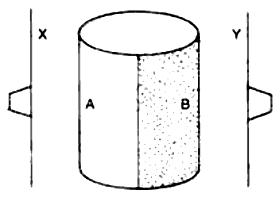
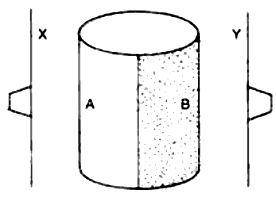
The following figure shows a metal cylinder, containing boiling water. One half side A is polished and another half, B is painted black. Two thin metal sheets X and Y are painted black and have one rubber stopper fixed with wax on each sheet. These sheets are equidistant from the boiling water (container A, B) as shown in the diagram. What would you expect to happen after a few minutes? Give a reason for your answer.
Answer

After a few minutes, the rubber stopper fixed to plate y will drop down because the plate y is on the black side of the cylinder. The black side of the cylinder radiates more heat than the polished side so it heats up the plate Y faster than heating up of plate X by polished surface of the cylinder which melts down the wax holding the stopper and the stopper will drop down
View full question & answer
Question 113 Marks
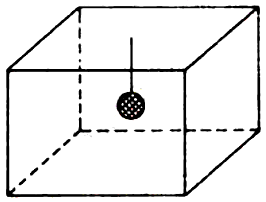
The hot metal ball is suspended from a string in a metal box as shown in the following figure
(i) What are the ways in which the ball loses heat
(ii) Which side of the box will be the hottest and which the least hot after some time? Explain.
Answer

(i) As the ball is suspended in the air there is no material medium present around the ball, it will not lose heat by the process of conduction of convection. The ball will lose heat by the process of Radiation only.
(ii) The speed of heat radiation is equal to the speed of light and intensity of heat radiation does not depend upon direction so all sides of the box would be equally hot as the box is cubical.
View full question & answer
Question 123 Marks
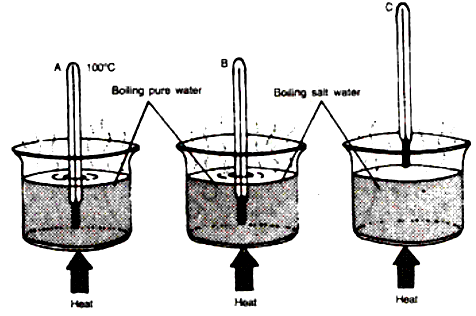
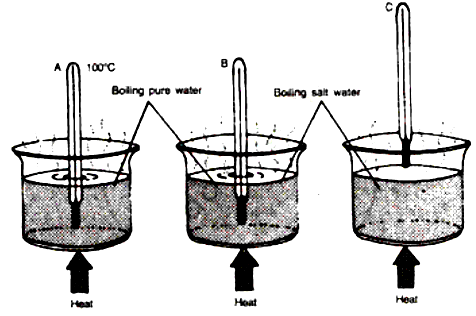
The following diagrams illustrate three situations involving thermometers which are labeled A, Band C. In each situation the thermometers indicate different readings.
(i) What do you expect the approximate reading of the thermometer B and C would be? Give a reason for your answer.
(ii) How would the readings of A and B help you in calibrating a thermometer?
Answer

(i) The temperature of steam and boiling water Is equal so the reading of thermometer is the same. But due to the addition of salt boiling point of water elevates so the reading of thermometer would be slightly higher than the boiling point of water i.e 100° C.
(ii) The addition of salt boiling point of water increases so thermometer has to measure temperature for a wider range and thus it helps in the calibration of the thermometer.
View full question & answer
Question 133 Marks
Distinguish between a clinical and a laboratory thermometer.
Answer
Difference between laboratory and clinical thermometer.
Laboratory thermometer Clinical thermometer
The range of temperature is high The range of temperature is low
It has no kink in it It has a kink (constriction) in it
It is used to measure the temperature of chemical reactions It is used to measure the human body temperature
View full question & answer
Question 143 Marks
State the advantages and disadvantages of mercury and alcohol as thermometric liquids.
Answer
Advantages of mercury and alcohol as thermometric liquid are
(a). They both are good conductors of heat.
(b). They have a high coefficient of expansion thus are sensitive to the smallest change in temperature
(c). Their freezing points are very low and boiling point is high in case of mercury
Disadvantages
(d). Alcohol is transparent and this makes hard to read the thermometer.
(e). It does not have uniform expansion.
(f). Mercury is less sensitive than alcohol as its coefficient of expansion is less than alcohol.
(g). Alcohol is a volatile liquid.
View full question & answer
[3 Mark Question Answer] - PHYSICS STD 9 Questions - Vidyadip